 Take Home Pay
Take Home Pay
Take Home Pay
Use this NHS Additional Pension calculator to find out exactly how much it costs to buy extra guaranteed annual pension inside the 2015 NHS Pension Scheme. Enter your age, the amount of additional pension you want, and your preferred payment method. The tool returns your lump sum cost or monthly instalment figure instantly.
All estimates are based on cost factors set by the Government Actuary's Department (GAD). Your confirmed cost is provided by the NHS Business Services Authority (NHSBSA) when you submit form AP1. Sources: NHSBSA Additional Pension Factsheet V14A, April 2025 | NHSBSA Knowledge Base KA-04929 | NHS Pension Scheme Regulations 2015 SI 2015/94 | NHS Employers Member Contributions 2026/27
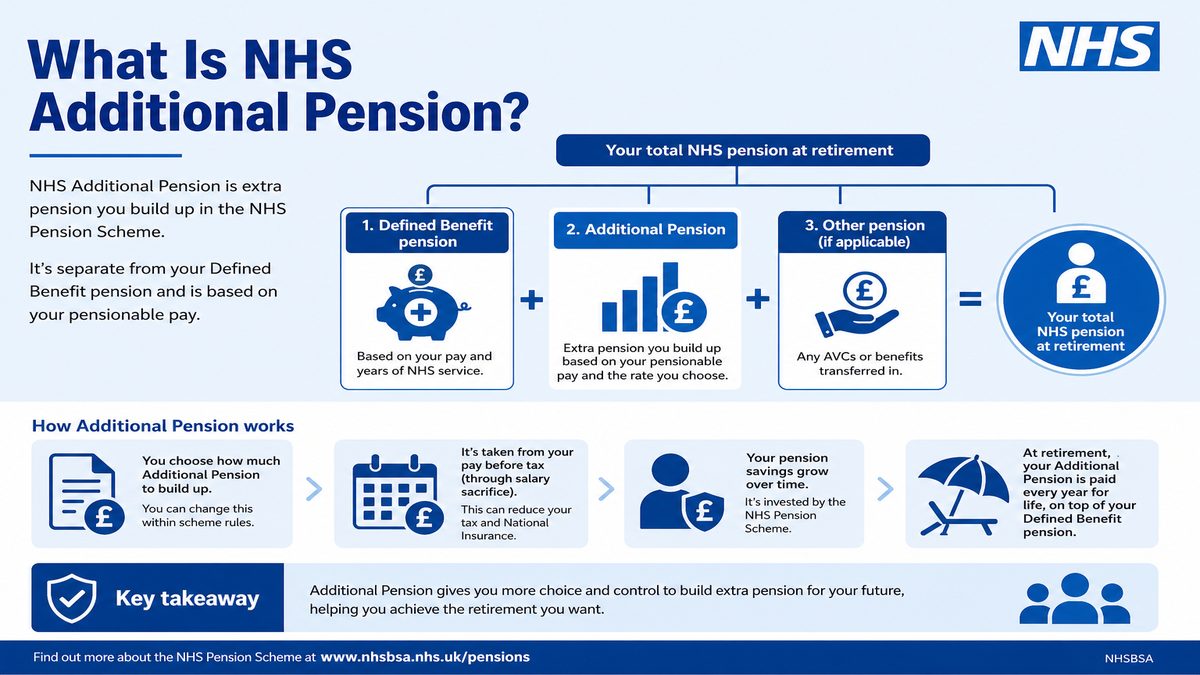
Additional Pension (AP) is a defined-benefit top-up available to active members of the 2015 NHS Pension Scheme. It allows you to buy extra guaranteed annual pension income on top of the pension you are already building through your normal 1/54th annual accrual.
13 All active members accrue in the 2015 Scheme from 1 April 2022 following the public service pensions remedy. This means that AP is now the only way for active NHS staff to buy extra defined-benefit pension within the NHS Pension Scheme. The legacy options — Added Years (1995 Section) and Preston contributions (2008 Section) — are both permanently closed to new applicants. 5 AP is a flexible way of increasing your pension if you are an active member of the NHS Pension Scheme. It allows you to buy extra annual pension.
The pension you buy through AP is paid for life from the date you claim your main NHS pension. It is:
Key scheme facts:
Attribute | Value |
Scheme | 2015 NHS Pension Scheme (CARE) |
Accrual basis | Career Average Revalued Earnings — 1/54th per year |
AP type | Defined-benefit top-up |
Governing regulation | Regulation 55–61, NHS Pension Scheme Regulations 2015 (SI 2015/94) |
Administrator (England & Wales) | NHS Business Services Authority (NHSBSA) |
Administrator (Scotland) | Scottish Public Pensions Agency (SPPA) |
Administrator (Northern Ireland) | HSC Pension Service |
Cost-setting body | Government Actuary's Department (GAD) |
Inflation measure | Consumer Prices Index (CPI) |
Application form (England & Wales) | AP1 — Election to Purchase Additional Pension |
Application form (Scotland) | APQUOT |
Application form (Northern Ireland) | AP2 2015 |
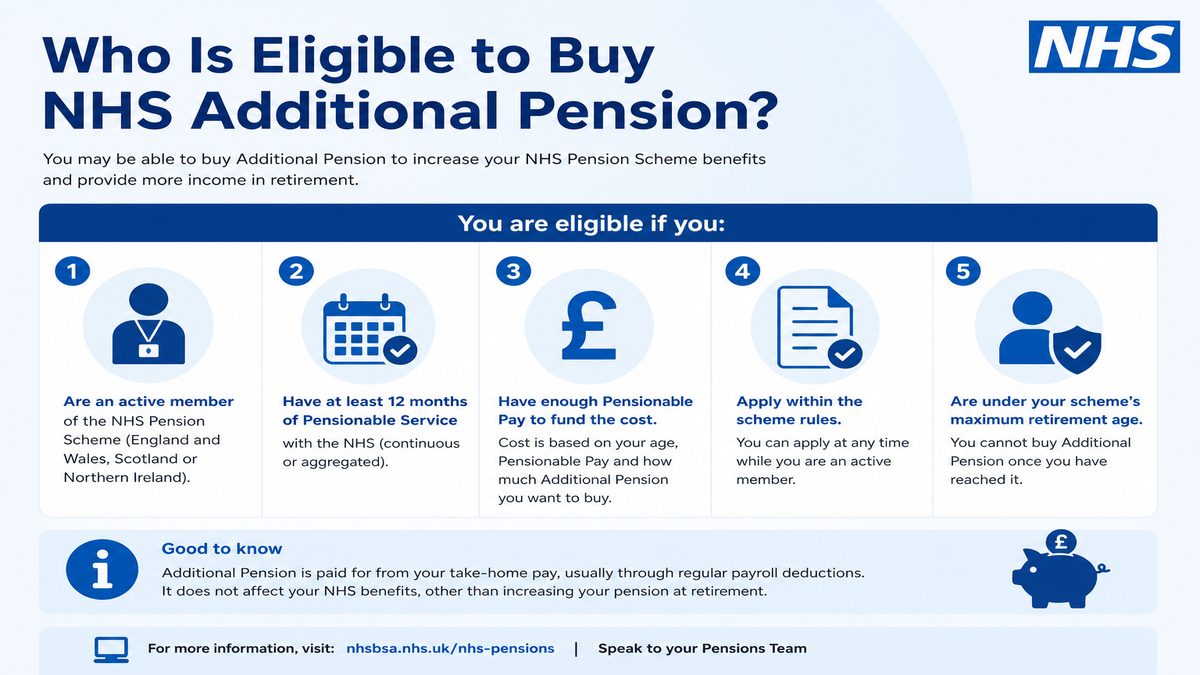
You qualify to purchase Additional Pension if you satisfy all four conditions simultaneously:
1. You are an active, contributing member of the 2015 NHS Pension Scheme. Deferred members, pensioner members, and opted-out members do not qualify. You must be actively paying contributions at the time of application.
2. You are below your Normal Pension Age (NPA).
5 You must make the application and complete all payments before your Normal Pension Age (NPA). The NPA for the 2015 Scheme is your State Pension age, or age 65, if later.
3. You are not currently absent from work due to ill health. You cannot apply while you are on sick leave. You must be below your NPA and you cannot be absent from work due to ill health at the time you submit your AP1 form.
4. Your total AP contracts do not exceed the overall annual maximum.
5 The maximum amount you can apply for from 1 April 2026 is £9,053 per year of extra annual pension in the 2015 Scheme.
Part-time workers: The cost of purchasing Additional Pension is identical whether you work full-time or part-time. The only variable that affects your cost is your age at the date of calculation.
AP is purchased in multiples of £250 of annual pension. The minimum purchase is £250 per year of extra annual pension. There is no restriction on making multiple separate AP contracts, provided the combined total of all open contracts does not exceed the maximum limit at any one time.
5 The cost to purchase AP is subject to annual change by the Government Actuary's Department (GAD).
The maximum AP limit increases every April in line with CPI:
Scheme Year | Maximum Additional Pension (Per Year) | Source |
2025/26 | £8,946.24 | NHSBSA Factsheet V14A |
2026/27 | £9,053 |
Multiple contracts: If you choose to buy £1,000 of annual pension over 4 years and complete that contract, you can apply for more Additional Pension. The rule is that all open contracts must not exceed the total maximum at any point in time. The scheme manager must not accept an election from a member in so far as the effect of accepting the election would be to provide the member with one or more additional pensions which in aggregate exceed the overall limit.
The cost of buying Additional Pension depends on three things:
Your age is the single most important cost variable. Younger members pay significantly less per £1 of annual pension purchased because the pension fund has a longer investment horizon before payments begin. Older members pay more because the payout period starts sooner.
The calculation is only valid until your next birthday. Your age affects the cost of additional pension — this means when you calculate how much it will cost, the amount is only valid until your next birthday.
Practical tip: 5You must send your AP1 form to your employer within 6 weeks of the calculation date otherwise another calculation will be needed. If you have a birthday between performing the calculation and submitting your application, a new calculation is needed.
If your birthday falls within the next 6 weeks, wait until after your birthday to perform the calculation. The cost will be higher post-birthday, but your AP1 will not expire before you can submit it.
Costs scale exactly in proportion. Buying £1,000 of annual pension costs 4× the price of buying £250. Buying £5,000 of annual pension costs 20× the price of buying £250.
5 You can choose if your AP is for you or also provides benefits for your dependants in the event of your death. If you purchase AP with cover for dependants, every £250 of AP increases your partner's survivor's pension by £93.75 a year.
For dependant children's pensions, every £250 of AP purchased with dependant cover increases the children's pension by £187.50 per year, paid in line with the rules of that benefit.
AP without dependant cover costs less. AP with dependant cover costs more but provides financial protection for your spouse, civil partner, or qualifying partner if you die before or after retirement.
You have three payment methods:
You make one single payment through your employer's payroll. 5If your application is accepted and you're paying by a one-off lump sum, an AP3 acceptance letter will be sent to you and your employer. You have one calendar month from the date of the AP3 letter to pay the lump sum to your employer. If you miss this deadline, your application is rejected and you must start again.
If paying by regular instalment, you choose a payment period of between 1 and 20 years, ending no later than your State Pension Age. Instalments are deducted from your salary through PAYE in the same way as your main scheme pension contributions. Your employer deducts the instalment amount from your gross pay before tax is calculated, so you receive automatic income tax relief.
Four-year cost review: Instalment purchase costs are reviewed by the scheme actuary every four years. If a review results in an increase to the cost, you will have the opportunity to terminate your contract without losing the AP you have already purchased.
You can pay a proportion of the total cost as an upfront lump sum and then pay the remaining balance through monthly instalments. This reduces the instalment amount and shortens the payment period.
All Additional Pension contributions — whether paid as a lump sum or via monthly instalments — qualify for income tax relief because they are deducted from your gross salary through PAYE before income tax is calculated. This is the same mechanism as your standard NHS Pension Scheme contributions.
The net cost to you after tax relief:
Income Tax Rate | Gross AP Cost (Example: £100/month) | Your Actual Net Cost |
Basic rate (20%) | £100 | £80 |
Higher rate (40%) | £100 | £60 |
Additional rate (45%) | £100 | £55 |
Higher-rate and additional-rate taxpayers receive the greatest benefit from purchasing Additional Pension because tax relief reduces the effective cost significantly.
Annual Allowance caution: Purchasing Additional Pension increases your Pension Input Amount (PIA) for the tax year. The standard Annual Allowance is £60,000 per tax year. For high earners, the Tapered Annual Allowance can reduce this to as low as £10,000. Each £1,000 of AP purchased in a tax year adds approximately £16,000 to your PIA (based on HMRC's pension input valuation: Annual Pension × 16). Consultants, senior managers, and other high earners must calculate their total PIA before committing to an AP purchase to avoid an Annual Allowance tax charge.
Your Additional Pension is paid in full from the date your main NHS pension is put into payment. It is paid for life and increases in line with CPI every April after retirement.
5 If you take your pension before your NPA, the AP will be paid with a reduction for early payment alongside your pension. The reduction factors are set by GAD and are the same actuarial reduction factors that apply to the rest of your 2015 Scheme pension. 5 A reduction for early payment also applies to members who hold Special Class status (SCS) and claim their unreduced NHS Pension benefits.
If you retire early and were paying AP by monthly instalments, your benefits may be reduced further because you will not have completed your instalment contract in full.
No. 5AP does not automatically increase your standard lump sum on retirement. You can exchange some of your pension to provide a lump sum on retirement. The commutation rate is 8£12 of lump sum for every £1 of pension given up. This exchange is subject to the Lump Sum Allowance (LSA) of £268,275 per individual.
If you leave NHS employment before completing an AP instalment contract, breaks in employment will reduce the amount of additional pension purchased. You cannot make up for missed instalments retrospectively — any gap in NHS pensionable employment means fewer instalments are collected and therefore less AP is purchased than you originally planned.
The AP you have already purchased before leaving is preserved as a deferred benefit. It remains CPI-indexed throughout the deferment period and is paid when you claim your NHS pension, regardless of your age at the time of leaving.
If you leave NHS employment on ill-health grounds, your Additional Pension is payable without actuarial reduction provided two conditions are met:
If both conditions are satisfied, the full Additional Pension purchased to date is paid in full as part of your ill-health retirement benefits.
Some NHS employers offer Shared Cost Additional Pension Contributions (SCAPCs). Under this arrangement, the employer pays two-thirds of the total AP cost and the employee pays one-third. SCAPCs represent exceptional value when available because your net cost is reduced to one-third of the standard purchase price before tax relief.
SCAPCs are most commonly offered to compensate for approved breaks in service such as:
Not all NHS Trusts and employers offer SCAPCs. Contact your employer's HR or payroll department to confirm whether SCAPCs are available to you.
Before purchasing Additional Pension, understand how it compares to the other two NHS Pension Scheme top-up options:
Feature | Additional Pension (AP) | ERRBO | AVCs |
Scheme type | Defined benefit — guaranteed income | Defined benefit — removes early retirement penalty | Defined contribution — investment-based |
Available to | Active 2015 Scheme members | Active 2015 Scheme members | All active NHS Pension Scheme members |
Purpose | Adds extra annual pension income for life | Removes actuarial reduction for retiring before NPA | Builds a separate investment pot |
Inflation protection | Yes — CPI-linked before and after retirement | Yes — built into the main pension CPI revaluation | No — depends entirely on investment performance |
Dependant cover | Optional — £93.75 per £250 purchased | Built into the main pension benefit | Depends on annuity or drawdown choice at retirement |
Tax relief | Automatic via PAYE | Automatic via PAYE | Automatic via PAYE |
Payment options | Lump sum or 1–20 year instalments | Monthly payroll deductions only | Monthly payroll deductions |
Investment risk | Zero — GAD-guaranteed cost | Zero | Yes — fund value can fall |
Access before retirement | No — locked until pension is drawn | No — locked into main pension | Limited — scheme rules apply |
Best for | Members wanting more guaranteed lifetime income | Members planning to retire before their State Pension Age | Members wanting investment flexibility |
Decision guide:
Step 1 — Calculate your cost Use the calculator at the top of this page to work out the exact cost of your chosen amount of AP. The official NHSBSA calculator at additional-pension-calculator.nhsbsa.nhs.uk generates a partially completed AP1 form when you complete the calculation.
Step 2 — Complete form AP1 (Part A) You complete Part A of the AP1 form. The form captures your name, NI number, date of birth, the amount of AP you wish to purchase, your payment method, and whether you want dependant cover.
Step 3 — Submit to your employer within 6 weeks
5 You must send your AP1 form to your employer within 6 weeks of the calculation date otherwise another calculation will be needed. Your employer completes Part B of the form. 11 All employers must ensure that the member's section has been filled in correctly before submitting the application to NHS Pensions.
Step 4 — Wait for NHSBSA to process your application
5 NHSBSA aims to respond within 4 weeks.
Step 5 — Pay (lump sum route only)
5 If your application is accepted and you're paying by a one-off lump sum, an AP3 acceptance letter will be sent to you and your employer. You have one calendar month from the AP3 issue date to pay the lump sum to your employer. Missing this deadline results in automatic rejection.
Step 6 — Instalment deductions begin (instalment route) If paying by monthly instalments, your employer begins deducting the agreed amount from your gross salary through PAYE from the following pay period after acceptance.
Regional form reference:
Country | Form Name |
England & Wales | AP1 — Election to Purchase Additional Pension |
Scotland | APQUOT |
Northern Ireland | AP2 2015 |
Your AP cost is paid on top of your standard NHS Pension Scheme member contributions. 6Because the 2026/27 Agenda for Change pay award (3.3%) is lower than the CPI from September 2025 (3.8%), there will be no further amendment to the member contribution pensionable pay thresholds in 2026/27. The 2026/27 thresholds increased by 3.8% CPI from the 2025/26 bands.
Pensionable Earnings Band (2026/27) | Member Contribution Rate |
Up to £13,762 | 5.2% |
£13,763 – £28,857 | 6.5% |
£28,858 – £43,572 | 8.3% |
£43,573 – £52,978 | 9.8% |
£52,979 – £75,632 | 10.7% |
£75,633 and above | 12.5% |
Source: NHS Employers — NHS Pension Scheme Member Contributions 2026/27
Before committing to AP instalments, confirm your take-home pay is sufficient to cover both your standard tiered contributions and your new AP instalment deductions every month.
Administered by NHSBSA. Maximum AP from 1 April 2026 = £9,053 per year. Application form = AP1. All rules described on this page apply.
Administered by the Scottish Public Pensions Agency (SPPA). The Scotland-specific maximum AP amount is lower than England and Wales. Additional Pension in Scotland can be bought in multiples of £250 of annual pension, up to a current maximum of £6,750 per year. Application form = APQUOT. Submit to SPPA, not NHSBSA.
Administered by HSC Pension Service. 13Separate NHS pension arrangements operate in Scotland and Northern Ireland. If you are working in Northern Ireland, the correct application form is AP2 2015. Rules broadly mirror England and Wales but are governed by separate Northern Ireland-specific regulations.
Additional Pension provides a guaranteed, inflation-protected income for life. Whether it represents good value for your specific circumstances depends on several personal factors.
AP is most likely to be good value when:
AP may be less suitable when:
Breakeven analysis: The breakeven point for an AP purchase (the age by which you must live to recover the purchase cost) depends on your age at purchase, tax rate, and whether dependant cover is included. The younger you are and the higher your tax rate, the shorter the breakeven period. A 35-year-old higher-rate taxpayer typically reaches breakeven within 7–10 years of retiring. An older, basic-rate taxpayer may need 12–15 years of retirement income to recover the purchase cost.
This is general information, not personal financial advice. For a recommendation specific to your circumstances, consult an FCA-regulated independent financial adviser who specialises in NHS pensions.
No. This service is exclusively for active contributing members of the 2015 NHS Pension Scheme. The 1995 and 2008 Sections closed to active accrual on 31 March 2022. You cannot buy Additional Pension to increase benefits in those legacy sections.
Yes. The cost of purchasing Additional Pension is identical whether you work full-time or part-time. The only variable that changes your cost is your age at the date of the calculation.
Yes. An existing Added Years contract does not restrict any Additional Pension purchase you may wish to make. The two arrangements are independent of each other.
Your calculation is valid until your next birthday. After your birthday, your age changes and the cost increases. You must generate a new calculation if your existing one expires.
Yes. If you wish to stop making regular contributions to an AP instalment contract, you complete the Additional Pension — Cessation/Cancellation of Contract application form and submit it to your employer. The Additional Pension you have already purchased up to the cancellation date is preserved in full as a deferred benefit.
Yes. Every £1,000 of AP purchased adds approximately £16,000 to your Pension Input Amount (PIA) for that tax year, based on the HMRC defined-benefit input amount formula (Annual Pension Increase × 16). Members close to the £60,000 standard Annual Allowance, or subject to the Tapered Annual Allowance, must calculate their total PIA before purchasing AP. Exceeding the Annual Allowance results in an Annual Allowance charge payable through your self-assessment tax return.
Yes. In some circumstances an employer may purchase Additional Pension for a member by making a lump sum payment on the member's behalf. This is most commonly done through SCAPC arrangements following approved absences.
If you die in NHS service, the AP you have purchased forms part of the survivor's benefit calculation. If you selected dependant cover when purchasing your AP, your partner's survivor's pension is increased by £93.75 for every £250 of AP you purchased. Your children's pension is increased by £187.50 for every £250 of AP purchased with dependant cover.
No. Additional Pension does not lower your Normal Pension Age. AP is payable from the same date as your main 2015 Scheme pension. If you claim your main pension before your NPA, your AP is subject to the same early retirement actuarial reduction. If your goal is to retire before your State Pension Age without a reduction, consider an ERRBO contract instead of AP.
Yes. 5AP is protected against inflation by being index-linked both before and after retirement. The index used is the Consumer Prices Index (CPI). This means if CPI rises by 3% in a given year, your AP income rises by 3% that April, both during the deferment period and throughout retirement.
5 The cost to purchase AP is subject to annual change by the Government Actuary's Department (GAD). Instalment contracts are subject to a full review by the scheme actuary every four years. If the review results in an increase to the cost, you will be notified and offered the opportunity to terminate your contract at the original purchase price without penalty.
5 NHSBSA aims to respond within 4 weeks. Incomplete forms cause delays. 11 NHSBSA has noted it is receiving a high volume of incomplete and outdated forms for Additional Pension and asks all employers to direct members to the Additional Pension calculator on the Additional Pension webpage of the Member Hub.