 Take Home Pay
Take Home Pay
Take Home Pay
This NHS bank shift pay calculator answers the question staff actually ask before booking: “How much will this bank shift pay me?” It models one Trust bank or NHS Professionals assignment using your 2026/27 Agenda for Change hourly rate (or a local rate-card override), unpaid break, Section 2 unsocial-hours enhancement, optional 12.07% WTD holiday pay, and an estimated take-home figure when the shift is taxed as a second job.
Official sources: NHS Employers pay scales 2026/27 · Unsocial hours payments (Section 2).
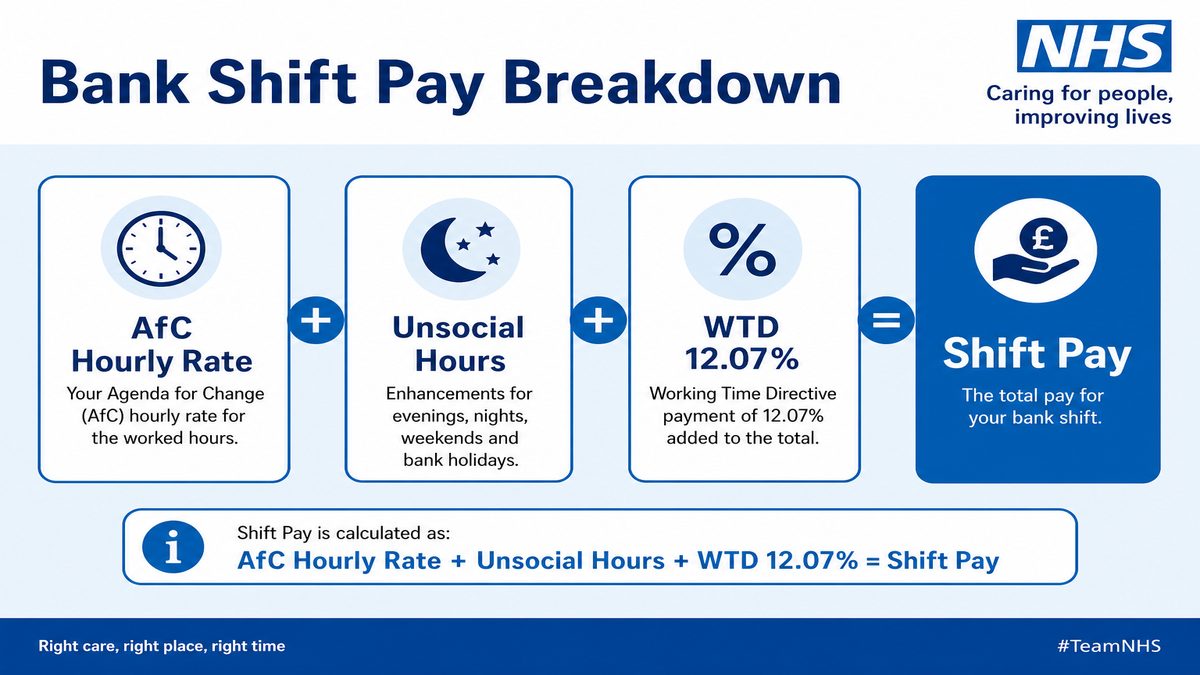
NHS bank shift pay is hourly, not monthly salary. Gross pay for one shift is:
Gross bank shift pay = (paid hours × basic hourly rate) + unsocial enhancement + WTD holiday pay (if added separately).
Paid hours are shift length minus unpaid break. A common long day is 12.5 hours with a 30- or 60-minute unpaid break, leaving 12.0 or 11.5 paid hours. The basic hourly rate is usually the AfC rate for the bank assignment band — which is not always the same as your substantive band.
Worked example (England 2026/27, Band 5 entry £16.40/hr, Saturday, 12 paid hours, WTD added):
| Step | Calculation | Amount |
| Basic pay | 12 × £16.40 | £196.80 |
| Saturday enhancement (Bands 4–9 = +30%) | £196.80 × 30% | £59.04 |
| Gross before WTD | £196.80 + £59.04 | £255.84 |
| WTD 12.07% | £255.84 × 12.07% | £30.88 |
| Gross including WTD | £255.84 + £30.88 | £286.72 |
That £286.72 is gross. If the assignment is a second job on a BR tax code, tax and NI still come off before money hits your account. Use the take-home panel in the calculator above for a BR estimate, then confirm against your payslip.
Where a Trust bank mirrors Agenda for Change, NHS Employers lists these England hourly rates from 1 April 2026:
| Band | Typical bank roles | 2026/27 hourly range |
| Band 2 | HCA, support worker, domestic, porter | £12.92 |
| Band 3 | Senior HCA, clinical support, admin | £13.17–£14.05 |
| Band 4 | Assistant practitioner, senior admin | £14.52–£15.93 |
| Band 5 | Registered nurse, midwife, AHP | £16.40–£19.97 |
| Band 6 | Senior nurse / specialist practitioner | £20.44–£24.61 |
| Band 7 | Team leader / advanced practitioner | £25.26–£28.90 |
NHS Professionals and some Trust banks publish a local rate card. Adverts often say “£X an hour (excluding 12.07% holiday uplift)”. In that case leave the AfC dropdown as a guide and type the advertised hourly rate into the override field, with WTD set to “Add 12.07% on top”.
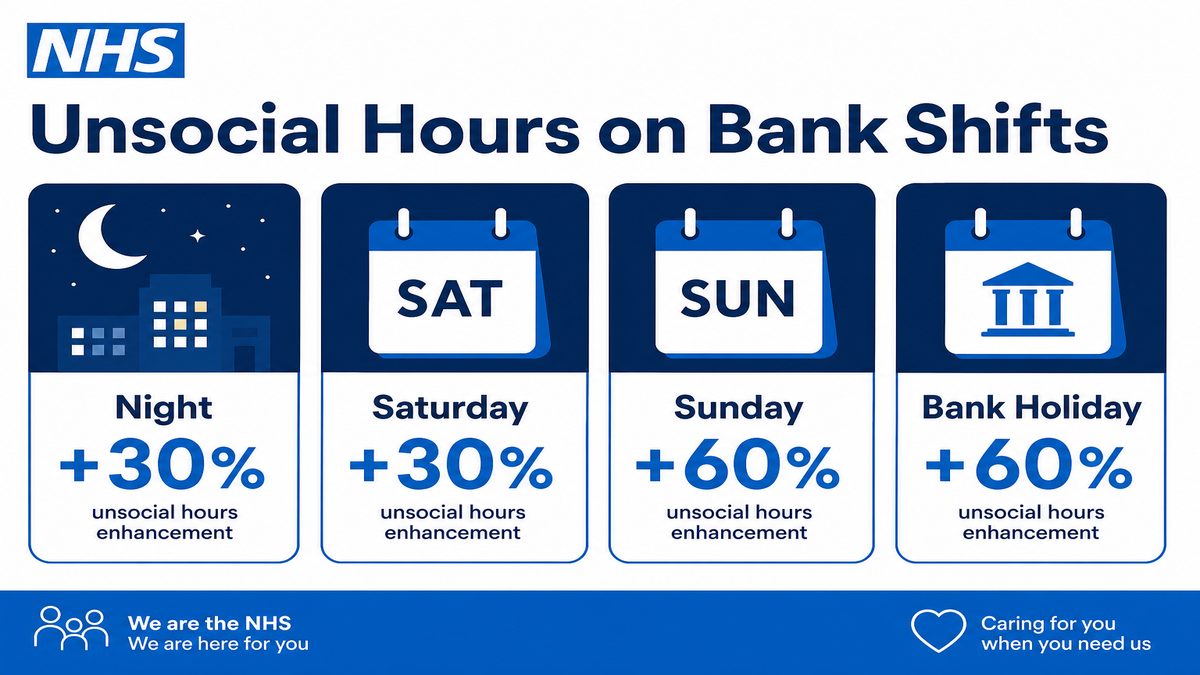
Bank shifts that fall in Section 2 unsocial times attract a percentage on basic hourly pay. NHS Employers confirms HCAS is excluded from the enhancement base. Percentages from 1 April 2020 onwards (still current for 2026/27) are:
| Pay band | Saturday (midnight–midnight) & weekday 8pm–6am | Sunday & public holidays |
| Band 2 | Time + 41% | Time + 83% |
| Band 3 | Time + 35% | Time + 69% |
| Bands 4–9 | Time + 30% | Time + 60% |
Rates do not stack. One hour gets one enhancement tier. If more than half of a weekday shift (not a public holiday) falls between 8pm and 6am, Section 2 can treat the whole shift as unsocial — the half-shift toggle models that rule.
For a month of recurring night patterns on a substantive contract, use the dedicated NHS unsocial hours calculator. This bank tool is built for one booked shift (or one rate-card scenario) at a time.
Most bank workers do not take paid annual leave in the same way as substantive staff. Employers therefore often pay rolled-up holiday pay under the Working Time Regulations. The common uplift is 12.07% — derived from 5.6 weeks’ statutory leave as a proportion of a 46.4-week working year (5.6 ÷ 46.4).
Three payslip patterns appear in practice:
If your gross looks “too low” compared with a colleague, check whether their rate card already includes WTD and yours does not — that single setting changes every comparison.
Staff comparing extra hours usually mix three different rules:
A Band 5 Saturday bank shift at time + 30% plus WTD can out-earn a plain weekday overtime hour even when the overtime multiplier looks larger on paper — always compare the same paid hours and the same tax treatment.
The calculator matches national AfC maths. Payslips diverge when:
Start with the assignment code on the booking confirmation, then reconcile break minutes and WTD line on the payslip. For the wider deduction picture, open the NHS tax calculator and the payslip explained guide.
Searches for “NHS bank nurse pay”, “Band 5 bank shift rate” and “how much is a night bank shift” map to Band 5 AfC points. England 2026/27 Band 5 entry is £16.40/hr; top of band is £19.97/hr. Night and Saturday enhancements for Band 5 are +30%; Sunday and public holidays are +60%.
Quick reference for 12 paid hours at Band 5 entry (before tax), with WTD added:
| Shift type | Enhancement | Gross before WTD | Gross + WTD |
| Weekday day | 0% | £196.80 | £220.56 |
| Weekday night / Saturday | +30% | £255.84 | £286.72 |
| Sunday / bank holiday | +60% | £314.88 | £352.89 |
Band 2 and Band 3 bank HCAs use higher percentage enhancements (41%/83% and 35%/69%), which is why a Band 2 Sunday can close the cash gap on a higher-band weekday day shift. Compare with the Band 5 salary page for substantive monthly take-home, and the bank shift pay guide for policy detail.
Multiply paid hours by the bank hourly rate, add the Section 2 enhancement for the shift type, then add 12.07% WTD if your rate excludes holiday pay. Deduct tax, NI and pension to estimate take-home.
Yes, when the hours fall in Section 2 times — weekday nights 8pm–6am, Saturdays, Sundays and public holidays — and your bank terms follow Agenda for Change. Local banks can still vary; check the rate card.
Rolled-up holiday pay is generally part of gross pay and subject to the same tax and NI rules as the underlying earnings. Net pay is lower than the gross WTD line.
Many NHS bank assignments are pensionable, but not all. If pension is deducted, tick the pension option and choose your tier. If unsure, check the pensionable pay line on the bank payslip.
HMRC often taxes a second employment at basic rate on all earnings from that job so you do not receive two personal allowances. The calculator’s BR mode models that. A P45/P46 mismatch can also trigger emergency codes until HMRC corrects them.
Yes, but the payment rules differ. Overtime multipliers and bank Section 2 enhancements are not interchangeable. Keep bank bookings and overtime claims coded correctly or payroll will apply the wrong formula.
Section 2 percentages are national AfC rules used across GB. Scotland’s standard week and some AfC cash points differ, so Scottish hourly rates can change even when the percentage uplift is the same. Override the hourly rate with your board’s published figure when needed.
Continue with unsocial hours, overtime, part-time pay, bank holiday pay, and the full calculators hub.