 Take Home Pay
Take Home Pay
Take Home Pay
The NHS Pension Calculator below estimates your annual pension income and tax-free lump sum from the 1995 Section (1/80th accrual, Normal Pension Age 60), 2008 Section (1/60th accrual, Normal Pension Age 65), and 2015 Scheme (1/54th career-average, Normal Pension Age = State Pension Age). Enter your pensionable pay, years of membership per scheme, and planned retirement age to generate your 2026/27 projection. Use it when salary changes, you hold split scheme membership, or you need CARE accrual and contribution cost in one place. Outputs cover member contributions, tier rate, yearly accrual and projected pension so NHS Pension Scheme planning stays clear against current tiers.
| Pensionable Pay Band | Contribution Rate |
|---|---|
| Up to £13,259 | 5.2% |
| £13,260 to £26,824 | 6.5% |
| £26,825 to £35,155 | 8.3% |
| £35,156 to £52,778 (Your Tier) | 9.8% |
| £52,779 to £67,668 | 10.7% |
| £67,669 and above | 12.5% |
For the 2015 NHS Pension Scheme, pension builds on a career-average basis. In broad terms, each scheme year builds pension equal to 1/54 of that year's pensionable earnings, and active-member benefits are revalued under scheme rules. NHSBSA
Direct answer: a reliable calculator should model scheme membership, pensionable earnings, service/retirement age and scheme section. It should not multiply final salary by years of service and call that a 2015 Scheme pension.
Users with legacy service can have benefits in more than one section/scheme. Keep the scheme as an explicit input:
Do not flatten all service into one formula. Link to the 1995 vs 2008 vs 2015 comparison when mixed service applies.
The amount deducted from pay is a member contribution, not the percentage used to calculate the pension benefit. For 2026/27, contribution tiers run from 5.2% to 12.5% based on actual annual pensionable pay. NHS Employers
The employer contribution is also not a personal investment pot. NHSBSA states that 14.38% is collected from employers in 2026/27 with additional central funding covering the remainder of the underlying employer contribution. NHSBSA
Show separate outputs for:
1. estimated annual pension at selected retirement age;
2. scheme/section used;
3. pensionable earnings assumptions;
4. early-retirement reduction if modelled;
5. optional lump-sum/commutation effect;
6. contribution estimate as a separate cash-flow figure;
7. prominent limitations and link to NHSBSA's official pension estimate/Total Reward Statement route.
Do not overload the standard retirement calculator with eligibility decisions. Partial retirement has its own rules, including the ability for eligible members to take 20% to 100% of benefits in up to two drawdowns, subject to conditions. NHSBSA
Ill-health retirement requires medical/eligibility assessment and should not be “approved” by a web calculator. Link to the NHS Ill-Health Retirement guide.
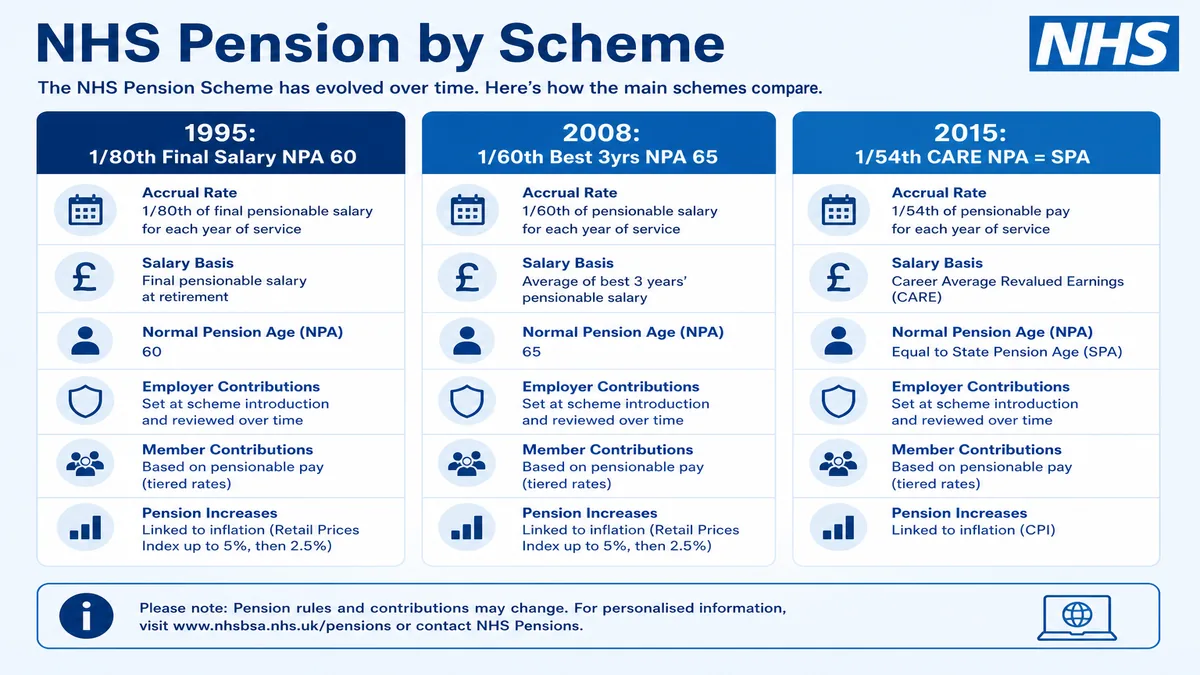
The amount of NHS pension you receive depends on your scheme, pensionable pay, and years of membership. Under the 2015 Scheme, the accrual rate is 1/54th of your pensionable pay per year of service. A nurse earning £35,000 accrues £648 of annual pension per year (£35,000 ÷ 54). After 20 years, that totals approximately £12,963 per year before income tax, rising each year with CPI revaluation.
The table below shows estimated annual pension figures at retirement under each scheme. All figures are before income tax. The 2015 Scheme totals carry a revaluation assumption of CPI at 2.5% per year applied to each year's accrual — your actual figure will vary with real CPI.
| Pensionable Pay | 10 Years | 20 Years | 30 Years |
|---|---|---|---|
| £25,000 | 1995: £3,125 / 2008: £4,167 / 2015: £4,630 (est.) | 1995: £6,250 / 2008: £8,333 / 2015: £9,259 (est.) | 1995: £9,375 / 2008: £12,500 / 2015: £13,889 (est.) |
| £35,000 | 1995: £4,375 / 2008: £5,833 / 2015: £6,481 (est.) | 1995: £8,750 / 2008: £11,667 / 2015: £12,963 (est.) | 1995: £13,125 / 2008: £17,500 / 2015: £19,444 (est.) |
| £45,000 | 1995: £5,625 / 2008: £7,500 / 2015: £8,333 (est.) | 1995: £11,250 / 2008: £15,000 / 2015: £16,667 (est.) | 1995: £16,875 / 2008: £22,500 / 2015: £25,000 (est.) |
| £60,000 | 1995: £7,500 / 2008: £10,000 / 2015: £11,111 (est.) | 1995: £15,000 / 2008: £20,000 / 2015: £22,222 (est.) | 1995: £22,500 / 2008: £30,000 / 2015: £33,333 (est.) |
1995 and 2008 figures are before any early retirement reduction. 2015 figures assume CPI revaluation of 2.5% annually and no pay changes — real outcomes will differ. Use your Annual Benefit Statement (ABS) for your official projected figure.
These numbers do not include early retirement reductions, McCloud Remedy adjustments, or Additional Pension purchased. Each of those factors is covered in its own section below.
Different NHS roles produce different pension outcomes. Here are three worked illustrations for the 2015 Scheme after 20 years of full-time service.
Band 5 nurse on pensionable pay of £32,073 (check current AfC Band 5 pay at nhsemployers.org): annual pension accrued per year = £32,073 ÷ 54 = £555. After 20 years: approximately £11,100/yr before income tax and before revaluation.
Band 6 nurse on pensionable pay of £38,682: annual accrual = £716/yr. After 20 years: approximately £14,327/yr before income tax and before revaluation.
Band 8a manager on pensionable pay of £53,755: annual accrual = £995/yr. After 20 years: approximately £19,909/yr before income tax and before revaluation.
Verify current AfC pay bands at NHS Employers (nhsemployers.org) before using these figures for planning decisions.
For part-time NHS staff, the 2015 Scheme accrues pension on actual pensionable pay — not a whole-time equivalent (WTE) projection. NHS pension contribution rates are calculated based on a member's actual annual pensionable pay, not a whole-time equivalent figure. This applies to accrual too. A 0.5 WTE Band 6 nurse earning £19,341 accrues £358 of annual pension per year (£19,341 ÷ 54), exactly half the full-time equivalent.
The 1995 and 2008 Sections work differently. The NHS 1995 Pension Scheme calculates retirement benefits based on a member's final pensionable pay, which is the highest earning over the last three consecutive years within the final ten years of service. For part-time staff in those sections, that final pay figure is based on actual part-time earnings — and service is counted in WTE terms. A member who worked 0.5 WTE for 20 years counts 10 WTE years of service.
NHS payroll professionals frequently see part-time employees overestimate their pension by applying the full-time formula to their banded salary. The correct approach for the 2015 Scheme uses actual pensionable pay, not the WTE full-time equivalent. If you work 0.6 WTE, your accrual is based on 0.6 of the full-time salary — every year.
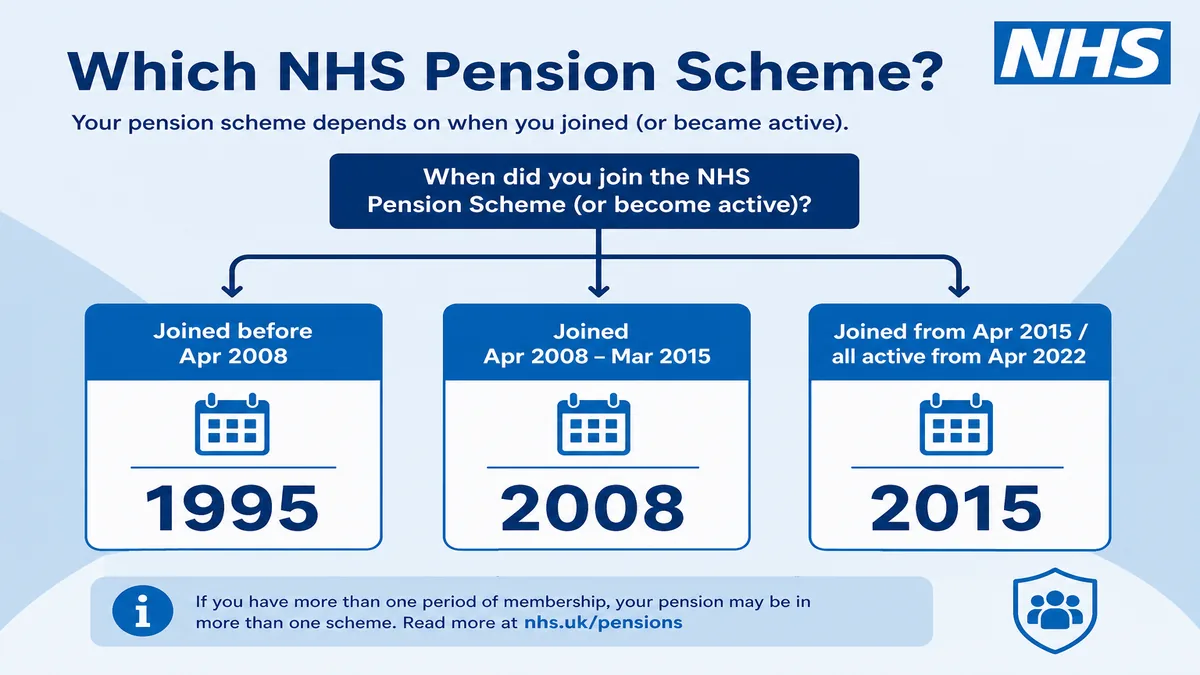
Your scheme depends on when you joined the NHS. Follow these three steps:
Most NHS staff who joined before April 2015 now hold pension across more than one section. As part of the McCloud remedy, the 1995 and 2008 sections closed on 31 March 2022, and since 1 April 2022 all active members contribute to the 2015 Scheme. Members that have already built up pension in the 1995 and 2008 sections can still access this after 1 April 2022 in line with the existing rules for each section.
The 1995 Section calculates your pension using a simple formula: Final Salary × Years of Membership ÷ 80. The accrual rate for this section is 1/80th, allowing members to earn 1/80th of their final pensionable pay for each year of service. The Normal Pension Age within this section is set at 60. A notable feature of the 1995 Section is the automatic tax-free lump sum, which is three times the annual pension.
The NHS 1995 Pension Scheme calculates retirement benefits based on a member's final pensionable pay, which is the highest earning over the last three consecutive years within the final ten years of service — not necessarily the salary on your last day of employment. (Source: nhspaycalculator.co.uk/pension/1995/)
Worked example 1: Pensionable pay £45,000 | Service: 20 years | Formula: £45,000 × 20 ÷ 80 = £11,250/yr pension | Automatic lump sum: £11,250 × 3 = £33,750
Worked example 2: Pensionable pay £35,000 | Service: 30 years | Formula: £35,000 × 30 ÷ 80 = £13,125/yr pension | Automatic lump sum: £13,125 × 3 = £39,375
The maximum service that counts toward the 1995 Section pension is 40 years, giving 40/80ths = 50% of final salary.
The 2008 Section uses a different salary basis from the 1995 Section. The NHS Pension 2008 Section is a final salary pension scheme, providing benefits based on the member's final pensionable pay. Benefits accrue at a rate of 1/60th for each year of service, offering a more generous accrual than the 1995 Section's 1/80th rate. The Normal Pension Age for this section is 65, which is later than the 1995 Section's age of 60. Unlike the 1995 Section, the 2008 Section does not automatically provide a tax-free lump sum at retirement; instead, members can commute part of their pension into a lump sum, subject to HMRC limits.
The salary used is your best 3 consecutive years within your last 10 years of service. (Source: nhsemployers.org/articles/comparing-different-sections-nhs-pension-scheme)
Worked example: Best 3-year average salary £45,000 | Service: 15 years | Formula: £45,000 × 15 ÷ 60 = £11,250/yr pension | Automatic lump sum: none (commutation available at £12 of lump sum per £1 of pension given up)
The 2015 Scheme builds your pension differently every year. Pension accrual in the NHS 2015 Pension Scheme occurs on an annual basis at a rate of 1/54th of pensionable pay. The 1/54th accrual rate means that each year, approximately 1.85% of a member's pensionable earnings is added to their pension pot.
The pension from all previous years is increased and added in to show the pension built up over the member's career so far: Pension built up in one year + Increased pension from previous years = Pension built up over career so far; increased pension from previous years — all pension built up over previous years, increased by CPI + 1.5%. (Source: nhsemployers.org/articles/comparing-different-sections-nhs-pension-scheme)
Worked example: Year 1 pensionable pay £35,000 | Year 1 accrual: £35,000 ÷ 54 = £648 added to pot | After year 1 revaluation at assumed CPI 2.5% + 1.5% = 4.0%: £648 × 1.04 = £674 carried into Year 2. This process repeats every year of service. After 20 years at £35,000 (no pay rises assumed, no revaluation applied for simplicity): base accrual = 20 × £648 = £12,963. With revaluation, the real figure is higher — the exact amount depends on actual CPI each year.
The NHS 2015 Pension Scheme does not provide an automatic tax-free lump sum at retirement, unlike its predecessor, the 1995 Scheme. Members can commute part of their pension for a lump sum using the same £12:£1 exchange rate as the 2008 Section.
| Feature | 1995 Section | 2008 Section | 2015 Scheme |
|---|---|---|---|
| Accrual rate | 1/80th per year | 1/60th per year | 1/54th per year |
| Normal Pension Age (NPA) | 60 | 65 | State Pension Age (currently 67) |
| Salary basis | Best year in final 10 | Best 3 of last 10 years | Each year's actual earnings |
| Automatic lump sum | Yes — 3× annual pension | No | No |
| Spouse/partner survivor pension | 50% of member's pension | 37.5% of member's pension | 33.75% of member's pension |
| Annual revaluation | Pay award increases | Pay award increases | CPI + 1.5% |
| Status | Closed from 1 April 2022 | Closed from 1 April 2022 | Open — all active members from April 2022 |
Survivor pension rates: 50% for the 1995 Section, 37.5% for the 2008 Section, 33.75% for the 2015 Scheme. (Source: nhspaycalculator.co.uk/pension/1995/ — confirmed via NHS Employers scheme comparison at nhsemployers.org/articles/comparing-different-sections-nhs-pension-scheme)
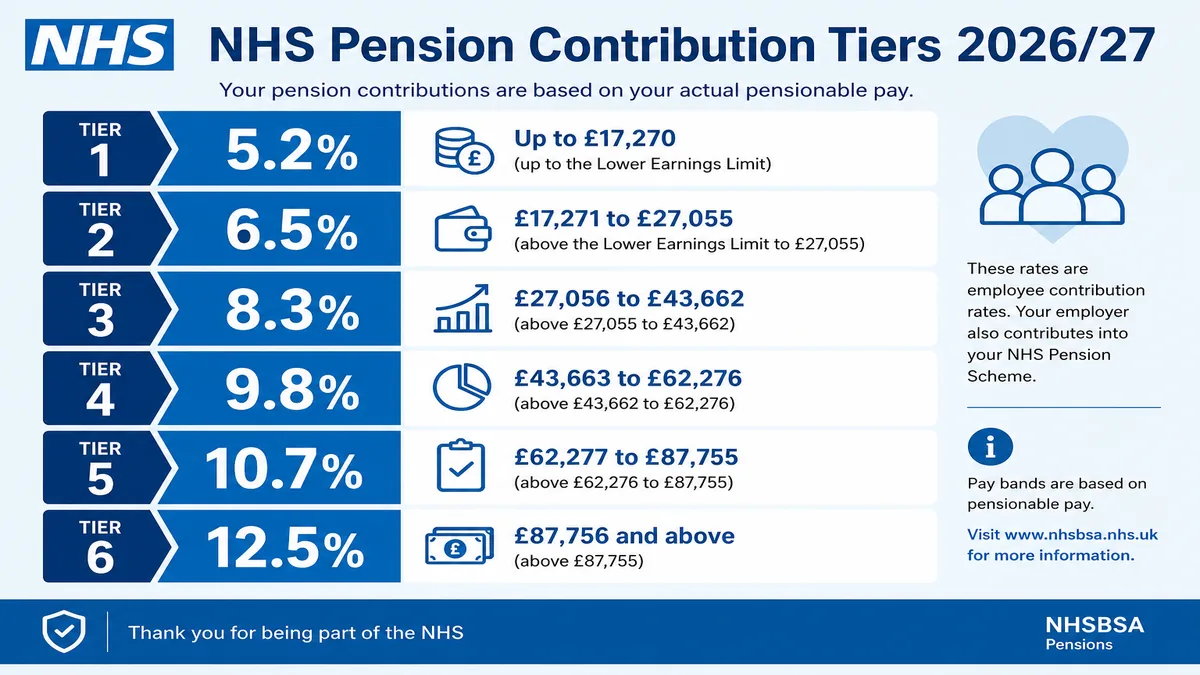
As of 1 April 2026, the employee contribution rates are: 5.2% for earnings up to £13,259; 6.5% for £13,260 to £28,854; 8.3% for £28,855 to £35,155; 9.8% for £35,156 to £52,778; 10.7% for £52,779 to £67,668; and 12.5% for earnings above £67,668. (Source: nhspaycalculator.co.uk/nhs-pension/contribution-rates/)
Your tier is based on your actual annual pensionable pay. Unlike income tax (which is marginal), NHS pension contributions apply to your entire salary based on which tier you fall into. This creates "cliff edges" at tier boundaries. For example, if your pensionable pay is £28,854 you pay 6.5% = £1,876/yr. If it rises by £1 to £28,855, you move to the 8.3% tier and pay £2,395/yr — an extra £519 annually for £1 more pay. (Source: mynhstakehomecalculator.co.uk/nhs-pension-contributions/)
These deductions are processed under HMRC Net Pay arrangements, meaning pension contributions are deducted from your gross pay before tax. That means you get tax relief automatically at your marginal rate — a 20% taxpayer paying 9.8% has a real net cost of approximately 7.8%.
| Pensionable Pay (Annual) | Employee Rate | Monthly Deduction | Annual Deduction |
|---|---|---|---|
| Up to £13,259 | 5.2% | Up to £57/month | Up to £690/yr |
| £13,260 – £28,854 | 6.5% | £72–£156/month | £862–£1,876/yr |
| £28,855 – £35,155 | 8.3% | £200–£243/month | £2,395–£2,918/yr |
| £35,156 – £52,778 | 9.8% | £287–£431/month | £3,445–£5,172/yr |
| £52,779 – £67,668 | 10.7% | £470–£603/month | £5,647–£7,241/yr |
| £67,669 and above | 12.5% | £705+/month | £8,459+/yr |
Source: nhspaycalculator.co.uk/nhs-pension/contribution-rates/ — effective 1 April 2026. Always verify current tiers at nhsbsa.nhs.uk.
These contribution rates are central to the funding of the NHS Pension Scheme, working alongside employer contributions, which are set at 23.7% in England and Wales. (Source: nhspaycalculator.co.uk/nhs-pension/contribution-rates/)
Important note on the employer rate: The Department of Health and Social Care (DHSC) has confirmed that the transitional approach that has operated since 2019/20 for employer contributions will continue in 2026/27. Employers should ensure that their payroll provider continues to apply an employer contribution rate of 14.38% for 2026/27. Of that, NHS organisations remit 14.38% directly to NHSBSA; the remaining 9.4% is paid centrally with the total going in on your behalf being 23.7%. (Source: nhsbsa.nhs.uk/nhs-pension-scheme-employer-contribution-rates-202627)
Employer contribution worked example: On a pensionable pay of £35,000: your employer's total contribution is £35,000 × 23.7% = £8,295/yr. Your own contribution at 9.8% = £3,430/yr. Total pension funding = £11,725/yr, representing 33.5% of your salary going toward your pension.
Standard NHS Pension Scheme contributions are deducted from gross pay before income tax — but this is not salary sacrifice by default. Since pension contributions are paid before income tax is calculated, you do not pay tax on that income. For a basic-rate taxpayer (20%), a £100 pension contribution only costs £80 in net take-home pay. However, standard contributions are not processed via salary sacrifice, so you still pay National Insurance (NI) on your full salary.
Some NHS trusts offer Shared Cost Additional Voluntary Contribution (AVC) schemes that are structured as salary sacrifice. Two main routes exist for boosting your pension: Additional Pension purchases (buying extra defined benefit pension within the scheme) and Money Purchase Additional Voluntary Contributions (MPAVCs), a separate DC pot, more flexible. (Source: pensionplain.co.uk/nhs-pension-scheme-explained/) Shared Cost AVCs via salary sacrifice reduce your gross salary, which saves both income tax and NI. On a salary of £38,000 with 8% NI applying (verify the current NI rate from gov.uk/national-insurance at time of use), every £100 in Shared Cost AVC contributions via salary sacrifice saves approximately £28 in combined tax and NI compared to a standard net contribution.
A common error: NHS staff assume their pension contribution automatically reduces via salary sacrifice. Standard NHS Pension Scheme contributions are deducted from gross pay before income tax (saving income tax but not NI). Only Shared Cost AVC schemes structured as salary sacrifice deliver NI savings. These are separate products — your standard pension deduction and a Shared Cost AVC are not the same thing.
NHS Scotland is administered by the Scottish Public Pensions Agency (SPPA) rather than NHSBSA. For England and Wales the tiers are: 5.2% (up to £13,259), 6.5% (to £28,854), 8.3% (to £35,155), 9.8% (to £52,778), 10.7% (to £67,668), 12.5% above. Scotland (SPPA) and NI (HSC) have different tier structures. (Source: nhstakehome.co.uk/nhs-pension-contribution-rates/)
For the exact 2026/27 SPPA contribution tiers, visit pensions.gov.scot and check the current member contribution tables directly — do not rely on England/Wales figures for Scottish payroll. The 2015 Scheme accrual rate (1/54th), CPI + 1.5% revaluation, and career-average structure are identical across Scotland and England/Wales.
Whether you receive an automatic lump sum depends on your scheme. The 1995 Section pays one automatically. The 2008 Section and 2015 Scheme do not — but you can choose to give up some annual pension in exchange for a tax-free cash lump sum. This exchange is called commutation.
Every 1995 Section member receives a tax-free lump sum automatically at retirement. A notable feature of the 1995 Section is the automatic tax-free lump sum, which is three times the annual pension. This requires no action at retirement.
You can also commute additional pension to increase your cash. The 1995 Section commutation factor is 5.36 — multiply your annual pension by 5.36 to find your approximate maximum total tax-free lump sum. (Source: bma.org.uk/pay-and-contracts/pensions/retirement/calculating-your-pension-lump-sum)
Worked example:
Unlike the 1995 Section, the 2008 Section does not automatically provide a tax-free lump sum at retirement; instead, members can commute part of their pension into a lump sum, subject to HMRC limits. The same applies to the 2015 Scheme. The exchange rate is £12 of tax-free lump sum for every £1 of annual pension given up. The commutation factor for 2008 Section and 2015 Scheme members is 4.28 — multiply your annual pension by 4.28 to estimate your maximum lump sum. (Source: bma.org.uk/pay-and-contracts/pensions/retirement/calculating-your-pension-lump-sum)
Worked example:
Commutation breakeven analysis:
| Scenario | Annual Pension | Lump Sum Received | Breakeven Point | Lifetime Value (to age 90) |
|---|---|---|---|---|
| No commutation | £18,000/yr | £0 | N/A | £414,000 (23 years from NPA 67) |
| Partial (£36,000 lump) | £15,000/yr | £36,000 | Age 79 | £414,000 (breakeven with no commutation) |
| Maximum (£77,040 lump) | £11,580/yr | £77,040 | Age 80 | £369,480 (less than no commutation to age 90) |
Taking the maximum lump sum from the 2015 Scheme means giving up £6,420/yr of index-linked guaranteed income for life to receive £77,040 now. If you retire at 67 and live to 90, the unreduced pension pays significantly more in total. But that calculation ignores what you could earn by investing the lump sum, your personal tax position, immediate cash needs, and debts. There is no universally correct answer — it depends on your health, other assets, and personal financial circumstances.
If you have a relevant benefit crystallisation event after 5 April 2024, you are entitled to a Lump Sum Allowance (LSA) of £268,275 unless you have HMRC protection that gives you a protected right to a higher LSA. (Source: nhsbsa.nhs.uk/member-hub/lump-sum-allowances-6-april-2024) The Spring Budget 2023 announced the abolition of the Lifetime Allowance Charge, with charges removed from 6 April 2023 and the abolition of the Lifetime Allowance itself from 6 April 2024. However, the Pension Commencement Lump Sum has been retained as a Lump Sum Allowance (LSA) pegged at £268,275 (25% of the last LTA of £1,073,100). (Source: bma.org.uk/pay-and-contracts/pensions/retirement/calculating-your-pension-lump-sum) Any excess lump sum taken above the LSA will be taxed at the individual's marginal income tax rates.
Most NHS staff will not reach the £268,275 limit. But members with long service in the 1995 Section at higher salaries, or those with additional private pension pots, should check their combined position before retirement. The LSA applies to all your registered pension schemes combined — not just the NHS scheme.
If you took pension benefits before 6 April 2024, a Transitional Tax Free Amount certificate allows the exact historical lump sums you received to be deducted from the £268,275 limit, rather than the assumed 25% of Lifetime Allowance used. This can increase the tax-free cash available on any remaining benefits. From 6 April 2024 the Lifetime Allowance was abolished. New allowances were introduced including the Lump Sum Allowance and the Lump Sum and Death Benefit Allowance. (Source: nhsbsa.nhs.uk/member-hub/increasing-your-pension/tax-implications)
Taking your NHS pension before your Normal Pension Age (NPA) results in an actuarial reduction — a permanent percentage decrease in your annual pension that applies for the rest of your life. The reduction is not a temporary penalty: it stays in place at the same rate for every year of your retirement.
The actuarial reduction is calculated from NHSBSA's Early Retirement factor tables. The percentage depends on how many years before your NPA you retire. Below are illustrative figures based on NHSBSA-published early retirement guidance — always verify the current reduction factors directly at nhsbsa.nhs.uk/member-hub/getting-estimate-your-pension before making any retirement decision.
2015 Scheme — Normal Pension Age 67
| Retirement Age | Years Before NPA | Approximate Reduction | Annual Pension on £18,000 at NPA |
|---|---|---|---|
| 65 | 2 | ~10% | ~£16,200 |
| 63 | 4 | ~20% | ~£14,400 |
| 60 | 7 | ~31% | ~£12,420 |
| 57 | 10 | ~43% | ~£10,260 |
| 55 | 12 | ~52% | ~£8,640 |
1995 Section — Normal Pension Age 60
| Retirement Age | Years Before NPA | Approximate Reduction | Annual Pension on £11,250 at NPA |
|---|---|---|---|
| 58 | 2 | ~8% | ~£10,350 |
| 56 | 4 | ~16% | ~£9,450 |
| 55 | 5 | ~20% | ~£9,000 |
| 50* | 10 | ~43% | ~£6,413 |
*Age 50 access is only available for 1995 Section members who joined before 6 April 2006.
The minimum age to take any NHS pension is currently 55, rising to 57 from 6 April 2028. Members of the 1995 Section who joined before 6 April 2006 can still access from age 50 under transitional protections. (Verify at gov.uk/government/publications/pension-schemes-and-normal-minimum-pension-age)
The reductions above are permanent. A pension reduced by 31% at age 60 is reduced by 31% forever — the reduction does not decrease as you get older.
The 85-year rule applies to the 1995 Section only. When your age plus qualifying membership years equals 85 or more, you can take your 1995 Section benefits with no actuarial reduction. For example, age 60 + 25 years of service = 85 — full benefits with no reduction.
This rule is only available to members who were in active membership before 1 October 2006. Members who joined on or after that date do not qualify. The 85-year rule does not apply to the 2008 Section or the 2015 Scheme. (Source: nhsbsa.nhs.uk/member-hub/getting-estimate-your-pension)
Early Retirement Reduction Buy Out (ERRBO) is available in the 2015 Scheme only. It allows you to pay additional contributions during your working life to remove or reduce the actuarial reduction that would otherwise apply if you retire before your Normal Pension Age.
To be eligible, you must be at least 50 and no more than 10 years from your NPA at the time of purchase. ERRBO is purchased via regular employee contributions — it cannot be bought in a single lump sum payment. The cost depends on your age and how many years of early retirement reduction you want to buy out.
The break-even calculation for ERRBO works like this: if you pay £X per year in ERRBO contributions for Y years (total cost = £Z), and ERRBO restores £A of annual pension that would otherwise have been reduced, ERRBO pays for itself in (£Z ÷ £A) years of retirement. If you expect to live well beyond that break-even point, ERRBO is likely worthwhile financially.
For current ERRBO costs and the formal application process, consult the NHSBSA ERRBO factsheet directly at nhsbsa.nhs.uk. Do not rely on third-party estimates of ERRBO costs — the factors are updated by NHSBSA and vary by age.
ERRBO costs are fixed at purchase and continue even if your circumstances change — for example, if you go part-time, take a career break, or find you cannot retire early after all. Members who purchase ERRBO and subsequently cannot retire early will have paid contributions without receiving the benefit. Assess your realistic likelihood of actually retiring early before committing to ERRBO.
Partial retirement allows you to access some of your pension benefits while remaining employed in the NHS. During partial retirement, ongoing pension accrual continues based on the reduced pay, with new pension pots building each year at the 1/54th rate.
From October 2023, partial retirement is available for benefits held in the 1995, 2008, and 2015 Sections. You can draw between 20% and 100% of your pension in one or two separate tranches while staying in your role. For 1995 and 2008 Section benefits, your employer must agree to a reduction in your salary or hours — this is commonly called the "step down" requirement. You continue building new 2015 Scheme pension benefits on your new, lower salary after accessing partial retirement. Benefits drawn before NPA will still attract the actuarial reduction described above. (Source: nhsbsa.nhs.uk/member-hub/partial-retirement)
Ill-health retirement allows your NHS pension to be paid before your Normal Pension Age with no actuarial reduction, provided you meet the qualifying medical criteria. There are two tiers.
Tier 1 applies when you are permanently incapable of undertaking your current NHS role AND any regular employment. Benefits are paid immediately. For 2015 Scheme members, an enhancement of projected service to your Normal Pension Age is added to the pension you have already accrued — giving you credit for the years you would have worked.
Tier 2 applies when you are permanently incapable of your current NHS role but are capable of some form of other regular employment. The pension already accrued is paid immediately without actuarial reduction, but no service enhancement is added.
Both tiers require medical evidence assessed by an occupational health physician or independent medical assessor approved by NHSBSA. For full Tier 1 and Tier 2 qualifying criteria and the enhancement formula, consult nhsbsa.nhs.uk/member-hub/applying-ill-health-pension-benefits.
The McCloud Remedy is a legal fix that ensures NHS staff who were moved from the 1995 or 2008 Section into the 2015 Scheme from April 2015 are not financially worse off because of that move. In 2018, the Court of Appeal ruled that the transition was age-discriminatory because older, longer-serving members were given temporary protection that younger members were denied. The Remedy corrects this for the period 1 April 2015 to 31 March 2022 — called the remedy period. (Source: nhsbsa.nhs.uk/member-hub/understanding-your-benefits-2015-scheme)
You are eligible for the McCloud Remedy if ALL of the following apply:
You are NOT eligible if any of the following apply:
Read more information on the public service pensions remedy — McCloud, and how members of the 1995/2008 Scheme who had full protection moved to the 2015 Scheme on 1 April 2022. Full eligibility details are at nhsbsa.nhs.uk/member-hub/understanding-your-benefits-2015-scheme.
At retirement, NHSBSA automatically calculates your pension benefits for the remedy period (1 April 2015 to 31 March 2022) under both the legacy scheme rules (1995 or 2008 Section) and the 2015 Scheme rules. You automatically receive whichever option gives you the higher pension value — no active decision is required for most members.
As part of the McCloud remedy, the 1995 and 2008 sections closed on 31 March 2022, and since 1 April 2022 all active members contribute to the 2015 Scheme. The remedy only affects pension built up during the 2015–2022 window. Service before April 2015 follows legacy scheme rules as normal. Service from April 2022 onward accrues in the 2015 Scheme for everyone.
Members who have already retired since 1 October 2023 may be subject to a "contingent decision" process. This means NHSBSA will contact them separately about a detriment payment or benefit recalculation depending on whether the legacy or 2015 rules give a better outcome for their remedy period. If you retired before October 2023, check your status directly at nhsbsa.nhs.uk.
No England/Wales third-party resource provides a worked numeric comparison of legacy versus 2015 Scheme benefits for the remedy period. Here is an illustrative example showing how the comparison works.
Example profile: Band 6 NHS nurse in England. Average pensionable pay during the remedy period (April 2015–March 2022): £34,000. Remedy period service: 7 years.
Legacy scheme (1995 Section rules for remedy period):
Reformed scheme (2015 Scheme rules for remedy period):
Result for this example: The 2015 Scheme provides higher annual income for the remedy period (approximately £4,407/yr vs. £2,975/yr). The 1995 Section provides the lump sum (£8,925 vs. £nil). NHSBSA will calculate both options using your actual records and award whichever gives higher overall value.
This example is illustrative only. The McCloud calculation uses your actual salary history, contribution records, and scheme-specific rules. Do not use this worked example as your personal McCloud outcome. NHSBSA performs the official calculation at the point of retirement using your real employment history.
Most NHS staff never face an Annual Allowance charge. For those who do, it is almost always higher earners — consultants, senior managers, and experienced Band 8+ staff whose pension grows rapidly in a single year. Understanding the basics protects you from an unexpected tax bill.
The Annual Allowance is £60,000 for 2026/27. (Source: pensionplain.co.uk/annual-allowance-public-sector-pensions-2026-27/ — confirmed by NHSBSA: "The annual allowance for tax year 2024/25 is £60,000." nhsbsa.nhs.uk/member-hub/increasing-your-pension/tax-implications)
The Annual Allowance is not tested against your contributions — it is tested against the growth in your pension's total value during the tax year. This growth is called the Pension Input Amount (PIA).
For a defined benefit scheme like the NHS Pension Scheme, the PIA formula for the 2015 Scheme is:
(Closing pension × 16) − (Opening pension × 16 × CPI revaluation factor for that year)
The multiplier of 16 is the HMRC-defined factor for converting defined benefit pension income into a capital value for Annual Allowance testing purposes.
Worked example (2015 Scheme):
In this example, PIA of £10,368 is well within the £60,000 Annual Allowance. No charge arises. The danger zone is when a large pay rise substantially increases both the new accrual and — more significantly — the capital value of the entire existing pension pot. Senior NHS clinicians often have both high pay and large pension growth, so they are more likely to face a charge, sometimes after taking on extra work.
The Annual Allowance is the maximum amount of tax-free growth your pension savings can grow by in a tax year. This doesn't include any State Pension. Growth in the NHS Pension Scheme includes any additional pension or Added Years bought or being bought during that tax year. If growth in all of your pension arrangements exceeds the Annual Allowance, you may incur a charge. (Source: nhsbsa.nhs.uk/member-hub/increasing-your-pension/tax-implications)
The standard £60,000 Annual Allowance reduces for very high earners. This can reduce to £10,000 in certain circumstances. Tapering applies when threshold income exceeds £200,000 AND adjusted income exceeds £260,000. For every £2 of adjusted income above £260,000, the Annual Allowance reduces by £1 — down to a minimum of £10,000.
Example: A consultant with adjusted income of £310,000: (£310,000 − £260,000) ÷ 2 = £25,000 reduction → Tapered Annual Allowance = £60,000 − £25,000 = £35,000. If their PIA exceeds £35,000, a charge applies on the excess.
Carry-forward allows you to use unused Annual Allowance from the previous three tax years to offset a charge in the current year. Unused allowance from three prior years often clears a one-off spike. (Source: pensionplain.co.uk/annual-allowance-public-sector-pensions-2026-27/)
NHS pension advisers consistently observe that the most common Annual Allowance error among NHS consultants is failing to account for pension growth from previous scheme sections when calculating total PIA. A consultant with 15 years in the 1995 Section and 10 years in the 2015 Scheme has PIA contributions from both sections in the same tax year — and both count toward the £60,000 limit. Calculating PIA for one section in isolation will understate the total charge exposure.
If you owe an Annual Allowance charge, Scheme Pays allows the NHS Pension Scheme to pay the charge on your behalf. In exchange, your pension is permanently reduced at retirement by an actuarially equivalent amount.
Mandatory Scheme Pays is available when both conditions are met: (a) the Annual Allowance charge exceeds £2,000, and (b) the PIA in the NHS scheme alone exceeds the Annual Allowance.
Voluntary Scheme Pays is available for smaller charges or where the excess comes from other pension savings. The scheme still pays the charge but reduces your pension accordingly.
Scheme Pays elections carry firm deadlines, and the voluntary route in particular must be submitted by your scheme's cut-off, typically the 31 July following the tax year in which the charge arose. (Source: pensionplain.co.uk/annual-allowance-public-sector-pensions-2026-27/) Missing this deadline removes the Scheme Pays option, leaving you to pay the charge directly to HMRC. If you believe you face an Annual Allowance charge, act promptly.
Two routes exist for boosting your NHS pension beyond what standard accrual delivers: Additional Pension (AP) and Additional Voluntary Contributions (AVCs). They are fundamentally different products with different risk profiles and cost structures.
Additional Pension is a 2015 Scheme-only product. From 6 April 2024 the Lifetime Allowance was abolished. New allowances were introduced including the Lump Sum Allowance and the Lump Sum and Death Benefit Allowance. Separately, the NHSBSA Additional Pension Calculator confirms that you cannot buy Additional Pension to increase benefits from the 1995 or 2008 Sections — those schemes closed to new Additional Pension purchases on 31 March 2022.
Additional Pension works like extra CARE accrual. Every £1 of Additional Pension you purchase is guaranteed, index-linked, and paid for life — just like your standard 2015 Scheme pension. It receives CPI revaluation and is passed on to your dependants as a survivor pension.
The cost is set by NHSBSA and depends on three factors:
Older members pay more per £1 of additional pension because there are fewer years before Normal Pension Age over which to spread the cost. A member aged 35 buying £1,000 of additional annual pension pays less per year than a member aged 55 buying the same amount.
Once purchased, the decision cannot be reversed. Additional Pension is not flexible like an investment — you cannot cash it in, adjust it, or transfer it out if your circumstances change.
For the current maximum Additional Pension you can purchase and the exact cost for your age and circumstances, use the official NHSBSA Additional Pension Calculator at additional-pension-calculator.nhsbsa.nhs.uk. The calculator produces a partially completed AP1 form that must be submitted to your employer or pension officer within 6 weeks of calculation. If your birthday falls within the next 6 weeks, wait until after your birthday — the cost is recalculated annually on your birthday and submitting too early creates an out-of-date form.
Should you buy Additional Pension? It is most cost-effective if you are in a lower Annual Allowance exposure position and want guaranteed DB-style additional income. It is less flexible than investing the same amount privately, but carries no investment risk. For a significant purchase, take regulated independent financial advice before committing.
AVCs build a separate defined-contribution (DC) investment pot alongside your main NHS defined-benefit pension. Your AVC pot grows based on investment performance and is available at retirement as a lump sum (up to the LSA of £268,275 combined with any other tax-free cash) or to buy an annuity.
Two main routes exist: Additional Pension purchases (buying extra defined benefit pension within the scheme) and Money Purchase Additional Voluntary Contributions (MPAVCs), a separate DC pot, more flexible. NHS Shared Cost AVCs can be structured via salary sacrifice through some employers, reducing gross salary and saving NI as well as income tax. Unlike Additional Pension, AVCs carry investment risk — the pot value depends on the funds you choose and market performance.
For current NHS AVC providers and how to set up a Shared Cost AVC, contact your NHS trust's HR or payroll department — providers vary by organisation.
Opting out entirely means you stop accruing pension benefits and your employer stops contributing on your behalf. If you leave with fewer than 2 years of qualifying membership, you can claim a refund of your own contributions, minus a statutory HMRC deduction. Your employer's contributions are not refunded under any circumstances.
If you have 2 or more years of qualifying membership, you cannot take a refund — your pension is preserved and paid at Normal Pension Age.
Opting out increases immediate take-home pay because member contributions stop, but future pension accrual and associated scheme benefits stop or change. Employer contributions help fund the defined-benefit scheme and are not a personal cash payment or individual investment pot that would otherwise be paid to the member. In England and Wales the employer contribution rate is currently 23.7% of pensionable pay; Scotland and Northern Ireland use different scheme rates. On a Band 5 salary of approximately £32,073 (verify current Band 5 pay at nhsemployers.org), the employer's contribution is approximately £7,103/yr — lost in full every year you are opted out. No private pension product available to an individual offers an employer match at that level.
NHS pension advisers consistently report that newly qualified nurses and allied health professionals who opt out in their first year — often citing the cost of contributions on a Band 5 starting salary — are unaware of how much the employer's contribution is worth. On Band 5 starting pay, staying opted in means the NHS contributes the equivalent of an additional 23.7% of your salary toward your pension every year — simply by staying in the scheme.
If you are considering opting out for affordability reasons, speak to your HR department first. A reduction in hours or a temporary opt-out should be weighed against the compounding loss of employer contributions. For regulated guidance, visit moneyhelper.org.uk.
The NHS Pension Scheme operates across all four nations of the UK, but it is not identical in every jurisdiction. Understanding which body administers your pension — and where to get your official estimate — matters for accuracy.
| Jurisdiction | Administering Body | Core Scheme Rules | Contribution Tiers | Official Portal |
|---|---|---|---|---|
| England | NHSBSA | 1995/2008/2015 standard | See 2026/27 table above | nhsbsa.nhs.uk/member-hub |
| Wales | NHSBSA | Identical to England | Identical to England | nhsbsa.nhs.uk/member-hub |
| Scotland | SPPA | Same 1995/2008/2015 structure; some policy differences | Verify at pensions.gov.scot | pensions.gov.scot |
| Northern Ireland | HSC Pension Service | Same 1995/2008/2015 structure | Verify at hscni.net | hscni.net |
The 2015 Scheme accrual rate (1/54th), CPI + 1.5% revaluation, and the career-average structure are identical across all four nations. Scotland (SPPA) and Northern Ireland (HSC) have different tier structures from England and Wales — so do not apply NHSBSA contribution tier percentages to a Scottish or Northern Irish payslip. (Source: nhstakehome.co.uk/nhs-pension-contribution-rates/)
The McCloud Remedy applies in all four nations but is administered separately. NHSBSA handles it for England and Wales. SPPA handles it for Scotland via the NHS Remedy Calculator at pensions.gov.scot/nhs/nhs-remedy-hub/nhs-remedy-calculator (available to eligible Scottish NHS members only). HSC handles it for Northern Ireland.
The employer contribution rate is confirmed as 23.7% for England and Wales. (Source: nhsbsa.nhs.uk/nhs-pension-scheme-employer-contribution-rates-202627) Verify the equivalent rate for Scotland at pensions.gov.scot and for Northern Ireland at hscni.net.
The calculator on this page provides an estimate based on the inputs you enter. Your Annual Benefit Statement (ABS) from NHSBSA uses your actual employment records — it is the authoritative figure for any serious retirement planning decision. Always use your ABS to cross-check and refine any calculator output.
Three ways to access your official NHS pension estimate:
Via Electronic Staff Record (ESR): Log in to ESR at your NHS trust. Access the Total Reward Statement (TRS). View your Annual Benefit Statement (ABS). The ABS refreshes annually in August based on your employer's data up to 31 March. Free, immediate, and personalised to your actual records.
Via My NHS Pension portal: Register at nhsbsa.nhs.uk/member-hub. Log in. Select "Benefits Dashboard" then "Current retirement benefits." This route is for non-ESR users — including some agency staff and community workers. (Source: faq.nhsbsa.nhs.uk/knowledgebase/article/KA-04244/en-us)
Request a manual estimate from NHSBSA: Use the Estimate Request Form (PDF: 323KB) available at nhsbsa.nhs.uk/member-hub/getting-estimate-your-pension. NHSBSA currently prioritises estimates for members who are within 1 year of retirement, are terminally ill, or need an estimate to comply with a court order or legal proceedings such as a mortgage application or divorce proceedings.
Your NHS pension sits alongside your State Pension. The full new State Pension is currently £11,502.40/yr for a full 35-year National Insurance record — verify the current rate at gov.uk/state-pension. These are separate entitlements. Having an NHS pension does not reduce your State Pension, and vice versa.
A Band 6 nurse on pensionable pay of £38,682 accrues £716 of annual pension per year in the 2015 Scheme (£38,682 ÷ 54). After 20 years, the estimated annual pension is approximately £14,327 before income tax and before CPI revaluation. The actual figure rises each year with CPI + 1.5% revaluation applied to each year's accrual.
Retiring 7 years before the 2015 Scheme Normal Pension Age of 67 results in an actuarial reduction of approximately 31%. A pension of £18,000 at Normal Pension Age reduces to approximately £12,420 at age 60. The reduction is permanent and applies for the full lifetime of the pension. Verify current reduction factors at nhsbsa.nhs.uk/member-hub/getting-estimate-your-pension.
The cost depends on your age and the amount of additional annual pension you want to purchase. Older members pay more per £1 of additional pension because fewer years remain before Normal Pension Age. Use the official NHSBSA Additional Pension Calculator at additional-pension-calculator.nhsbsa.nhs.uk to generate your specific cost and AP1 form.
The Annual Allowance is £60,000 for 2026/27. Your Pension Input Amount — the annual growth in your pension's capital value — must exceed £60,000 before a charge applies. Most NHS staff are unaffected. Consultants and senior managers with high pensionable pay and long service across multiple scheme sections face the greatest risk. (Source: pensionplain.co.uk/annual-allowance-public-sector-pensions-2026-27/)
Yes. NHS pension contribution rates are calculated based on a member's actual annual pensionable pay, not a whole-time equivalent figure — and the same applies to accrual. A 0.5 WTE Band 6 nurse earning £19,341 accrues £358 of annual pension per year (£19,341 ÷ 54), half the full-time equivalent. The 1995 and 2008 Sections use the WTE full-time salary but count service in WTE terms.
NHSBSA calculates both legacy (1995/2008) and 2015 Scheme benefits for the remedy period (April 2015 to March 2022) automatically at retirement and awards whichever is higher. You do not need to calculate this yourself. The result depends on your salary history, scheme section, and years of remedy service. For eligible Scottish NHS staff, use the SPPA Remedy Calculator at pensions.gov.scot/nhs/nhs-remedy-hub/nhs-remedy-calculator.