 Take Home Pay
Take Home Pay
Take Home Pay
2 The standard Personal Allowance for 2026/27 is £12,570. This calculator applies that threshold — along with the correct HMRC tax bands for England, Scotland, Wales, and Northern Ireland — to your NHS salary. It factors in your NHS Pension contribution (which reduces your taxable income), National Insurance, and student loan repayments to show your exact monthly and annual take-home pay after every deduction.
Select your Agenda for Change pay band or enter your gross NHS salary below. Results update instantly.
This tool estimates the income tax deducted from your NHS salary under the PAYE (Pay As You Earn) system for the 2026/27 tax year, which runs from 6 April 2026 to 5 April 2027. It performs five calculations in a fixed sequence:
The final output is your net monthly and annual take-home pay — the exact amount that reaches your bank account on payday.
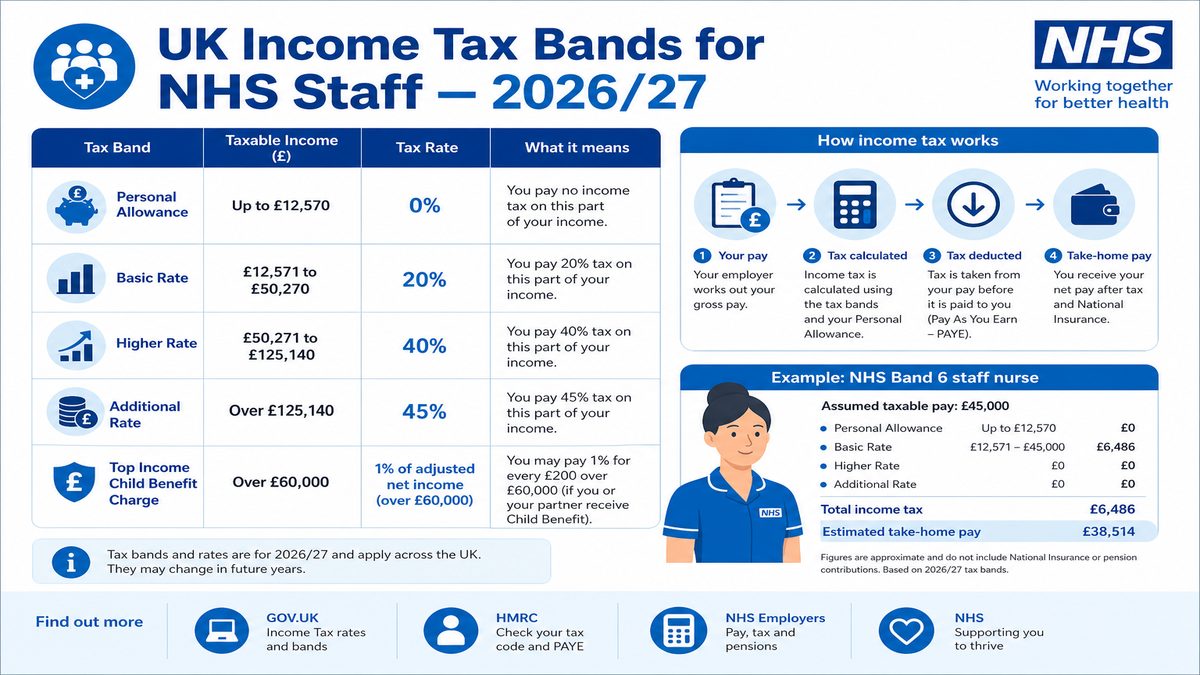
UK income tax is progressive. Each portion of your income is taxed only at the rate for the band it falls into. 2Earning £51,000 does not mean 40% tax on the whole £51,000, only on the £730 above the threshold.
Tax Band | Taxable Income Range | Rate |
Personal Allowance | £0 – £12,570 | 0% (tax-free) |
Basic Rate | £12,571 – £50,270 | 20% |
Higher Rate | £50,271 – £125,140 | 40% |
Additional Rate | Above £125,140 | 45% |
2 The standard Personal Allowance for 2026/27 is £12,570. Basic rate: 20% on income from £12,571 to £50,270. Higher rate: 40% on income from £50,271 to £125,140. Additional rate: 45% on income above £125,140. 5 For 2026/27, the thresholds for England, Wales and Northern Ireland remain unchanged, continuing the freeze that is currently due to last until 2031. This matters for NHS staff: 2 the thresholds are unchanged from 2025/26, which means pay rises quietly pull more of your income into higher bands (so-called fiscal drag). As the 31 2026/27 pay round delivered a 3.3% consolidated uplift to every Agenda for Change pay point in England, Wales and Northern Ireland, some staff will cross a tax band boundary while thresholds stay static.
8 Scottish income tax has 6 bands for 2026/27: Starter (19%), Basic (20%), Intermediate (21%), Higher (42%), Advanced (45%), and Top (48%). 8 Everyone gets a £12,570 Personal Allowance.
Scottish Tax Band | Gross Income Range | Rate |
Personal Allowance | £0 – £12,570 | 0% |
Starter Rate | £12,571 – £16,537 | 19% |
Basic Rate | £16,538 – £29,526 | 20% |
Intermediate Rate | £29,527 – £43,662 | 21% |
Higher Rate | £43,663 – £75,000 | 42% |
Advanced Rate | £75,001 – £125,140 | 45% |
Top Rate | Above £125,140 | 48% |
21 The Starter rate band limit increased by 40.3% — from £15,397 to £16,537. This means more of your income is taxed at just 19% instead of 20%. The Basic rate band limit increased by 13.6% — from £27,491 to £29,526. 21 The higher, advanced, and top rate thresholds remain frozen. 8 The Higher rate in Scotland starts at £43,663 for 2026/27, taxed at 42%. In England, the Higher rate starts at £50,271 at 40%. This means Scottish taxpayers enter the higher-rate bracket nearly £7,000 earlier and at a 2% higher rate.
Your tax code determines which rates apply. If your code starts with S (e.g., S1257L), you pay Scottish rates. HMRC assigns this code based on your home address, not your workplace.
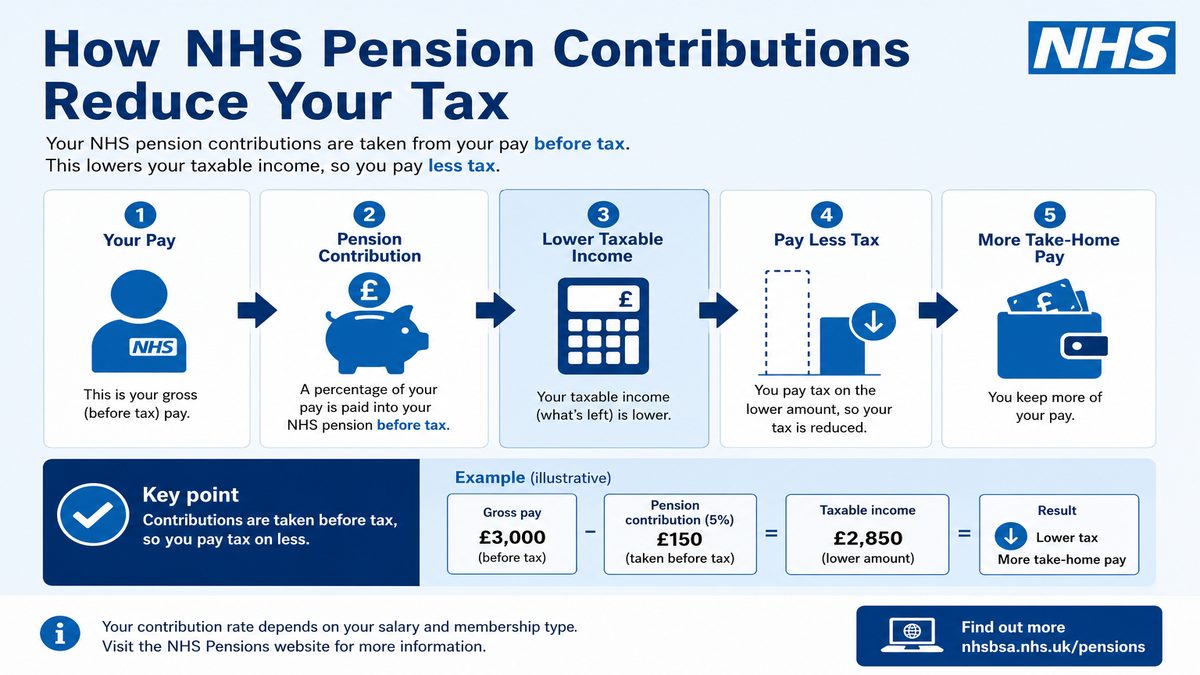
This is the single most important tax fact for NHS employees: your NHS Pension contribution is deducted from your gross salary before income tax is calculated.
17 Since pension contributions are paid before income tax is calculated, you do not pay tax on that income. For a basic-rate taxpayer (20%), a £100 pension contribution only costs £80 in net take-home pay. For a higher-rate taxpayer (40%), that same £100 contribution costs just £60 in real terms. You do not need to claim this relief — it happens automatically through NHS payroll.
16 NHS Pension Contribution Rates for 2026/27 are structured into six tier thresholds. As of 1 April 2026, the contribution rates are as follows: 5.2% for earnings up to £13,259; 6.5% for £13,260 to £28,854; 8.3% for £28,855 to £35,155; 9.8% for £35,156 to £52,778; 10.7% for £52,779 to £67,668; and 12.5% for earnings of £67,669 and above.
Tier | Pensionable Pay Range | Contribution Rate |
1 | Up to £13,259 | 5.2% |
2 | £13,260 – £28,854 | 6.5% |
3 | £28,855 – £35,155 | 8.3% |
4 | £35,156 – £52,778 | 9.8% |
5 | £52,779 – £67,668 | 10.7% |
6 | £67,669 and above | 12.5% |
15 Unlike income tax (which is marginal), NHS pension contributions apply to your ENTIRE salary based on which tier you fall into. This creates "cliff edges" at tier boundaries.
Cliff-edge warning: 15If your pensionable pay is £28,854 (top of Tier 2), you pay 6.5% = £1,876/year. If it rises by just £1 to £28,855, you move to Tier 3 and pay 8.3% on your entire salary = £2,395/year. That's £519 more in pension contributions for £1 more in gross pay.
16 Employers contribute a flat rate of 23.7% of pensionable pay, making the NHS Pension Scheme one of the most generous in the UK.
Below is the exact calculation sequence this calculator uses, shown with a real 2026/27 salary.
30 For a Band 5 newly qualified nurse in England, the headline figure rose from £31,049 to £32,073 (+£1,024).
Gross annual salary: £32,073
Step 1 — Identify the pension tier and deduct pension £32,073 falls in Tier 3 (£28,855–£35,155) = 8.3% Annual pension contribution: £32,073 × 8.3% = £2,662.06
Step 2 — Calculate taxable income Salary after pension: £32,073 – £2,662.06 = £29,410.94 Subtract Personal Allowance: £29,410.94 – £12,570 = £16,840.94 taxable income
Step 3 — Apply income tax bands (England) £16,840.94 falls entirely within the Basic Rate band (£12,571–£50,270) Income tax: £16,840.94 × 20% = £3,368.19
Step 4 — Calculate National Insurance NI is calculated on gross salary (pension does NOT reduce NI) £12,570 to £32,073 = £19,503 at 8% = £1,560.24
Step 5 — Assemble the full deductions breakdown
Deduction | Annual | Monthly |
NHS Pension (8.3%) | £2,662.06 | £221.84 |
Income Tax (20%) | £3,368.19 | £280.68 |
National Insurance (8%) | £1,560.24 | £130.02 |
Total deductions | £7,590.49 | £632.54 |
Step 6 — Net take-home pay
Annual | Monthly | |
Gross salary | £32,073.00 | £2,672.75 |
Total deductions | £7,590.49 | £632.54 |
Take-home pay | £24,482.51 | £2,040.21 |
A Band 5 nurse on £32,073 keeps approximately 76.3% of gross salary. The remaining 23.7% goes to pension contributions, income tax, and National Insurance.
Gross annual salary: £46,148 (Band 7 entry level, England rate — used for comparison; 30Scotland's separately negotiated deal delivered a 3.75% uplift, so Scottish Band 7 entry is higher)
Step 1 — Pension deduction £46,148 falls in Tier 4 (£35,156–£52,778) = 9.8% Annual pension: £46,148 × 9.8% = £4,522.50
Step 2 — Taxable income After pension: £46,148 – £4,522.50 = £41,625.50 After Personal Allowance: £41,625.50 – £12,570 = £29,055.50
Step 3 — Apply Scottish income tax bands
Step 4 — National Insurance (same rates UK-wide) £12,570–£46,148 = £33,578 at 8% = £2,686.24
Step 5 — Full breakdown
Deduction | Annual | Monthly |
NHS Pension (9.8%) | £4,522.50 | £376.88 |
Income Tax (Scottish) | £5,892.43 | £491.04 |
National Insurance (8%) | £2,686.24 | £223.85 |
Total deductions | £13,101.17 | £1,091.77 |
Take-home pay | £33,046.83 | £2,753.90 |
This Scottish Band 7 nurse keeps approximately 71.6% of gross salary — about 4.7 percentage points less than the England Band 5 example, driven by the higher salary entering the Scottish Intermediate (21%) band and the higher pension tier (9.8% vs 8.3%).
2 The Personal Allowance tapers away by £1 for every £2 of adjusted net income over £100,000, reaching nil at £125,140 — an effective 60% marginal rate in that window.
Between £100,000 and £125,140, every additional £1 earned costs you approximately 60p in combined tax: 40p in higher-rate income tax plus 20p from lost Personal Allowance. This is the highest effective marginal rate most NHS employees will face.
NHS roles affected by this trap:
How to mitigate it: Increasing NHS Pension contributions or Additional Voluntary Contributions (AVCs) reduces your adjusted net income. Gift Aid donations also count. If extra pension or charity payments bring your adjusted net income back below £100,000, you recover the full £12,570 Personal Allowance.
This calculator automatically applies the Personal Allowance taper when the salary you enter exceeds £100,000.
National Insurance is a separate deduction from income tax. It is calculated on gross salary. NHS Pension contributions do NOT reduce your NI liability — unlike income tax.
Earnings Band | Employee NI Rate |
Below £12,570 (Primary Threshold) | 0% |
£12,570 – £50,270 (Upper Earnings Limit) | 8% |
Above £50,270 | 2% |
21 National Insurance is UK-wide and not devolved to Scotland. The same rates apply to NHS staff in all four UK nations.
Every additional £1,000 earned between £12,570 and £50,270 costs £80 in NI on top of £200 in basic-rate income tax — a combined marginal deduction of 28% before pension is considered.
Student loan repayments are calculated on gross earnings above the plan-specific threshold and deducted automatically through PAYE. They are taken after tax and NI.
Plan | Annual Threshold | Deduction Rate |
Plan 1 (pre-2012 England/Wales, all NI/Scotland pre-2023) | £24,990 | 9% |
Plan 2 (post-2012 England/Wales) | £27,295 | 9% |
Plan 4 (Scotland post-1998) | £31,395 | 9% |
Plan 5 (from September 2023) | £25,000 | 9% |
Postgraduate Loan | £21,000 | 6% |
If you hold both an undergraduate and a postgraduate loan, both repayments apply simultaneously — 9% plus 6% = 15% on income above the respective thresholds.
Honesty note: The exact 2026/27 student loan thresholds listed above are projected figures based on 2025/26 rates and expected uprating. Verify the confirmed thresholds with the Student Loans Company (slc.co.uk) or HMRC before making financial decisions.
Your tax code tells your NHS Trust's payroll department how much Personal Allowance to apply. 2Most people receive it automatically through their tax code (1257L for a standard allowance).
Code | What It Means |
1257L | Standard — £12,570 tax-free allowance (England, Wales, NI) |
S1257L | Scottish taxpayer — same allowance, Scottish rates apply |
C1257L | Welsh taxpayer — same allowance, England/NI rates apply |
BR | All income taxed at Basic Rate (20%) — common for second jobs |
D0 | All income taxed at Higher Rate (40%) |
0T | No Personal Allowance applied (e.g., new joiner without P45) |
K code | You owe tax from a previous year — HMRC collects by reducing your allowance below zero |
If your tax code is wrong, you overpay or underpay tax every single month. Check your code on your NHS payslip or your HMRC Personal Tax Account at gov.uk/personal-tax-account. If your code is not 1257L (or S/C1257L) and you do not know why, contact HMRC on 0300 200 3300.
NHS employees who wear a uniform at work and are responsible for washing it can claim a flat-rate tax deduction from HMRC. The standard annual flat-rate deduction is £125 (£185 for ambulance staff).
This does not mean HMRC sends you £125. It means your taxable income is reduced by £125, saving you:
Claim online at gov.uk/tax-relief-for-employees/uniforms-work-clothing-and-tools. Claims can be backdated up to four tax years.
Fees paid to HMRC-approved professional bodies qualify for tax relief. For nurses, the NMC registration fee is £120/year. Allied health professionals pay HCPC registration fees. The full list of approved organisations is published at gov.uk/government/publications/professional-bodies-approved-for-tax-relief-list-3.
2 If you earn under the allowance and your spouse or civil partner is a basic-rate taxpayer, Marriage Allowance lets you shift a slice of it to them. The transferable amount is £1,260, reducing the receiving partner's tax bill by up to £252/year. The receiving partner must be a basic-rate taxpayer (not higher or additional rate).
Salary sacrifice arrangements reduce your gross pay before tax AND National Insurance, delivering a double saving. Common NHS salary sacrifice schemes include lease cars, Cycle to Work, and technology schemes. Because your gross pay is reduced, your taxable income drops, and your NI liability drops with it.
Important consideration: Salary sacrifice also reduces your pensionable pay. A large salary sacrifice could drop you into a lower pension tier, which slightly reduces your eventual pension benefit.
19 For NHS staff working in London and the surrounding counties, the standard Agenda for Change pay bands are supplemented by the High Cost Area Supplement. This is designed to compensate for the significantly higher cost of living in the capital. The amount of London Weighting you receive depends entirely on which zone your place of work falls into. This is based on your work location, not your home address.
Zone | Rate | Minimum (2026/27) | Maximum (2026/27) |
Inner London | 20% of basic salary | £5,302 | £8,095 |
Outer London | 15% of basic salary | £4,145 | £5,765 |
Fringe | 5% of basic salary | £1,234 | £2,055 |
19 HCAS is pensionable pay. This means that while it increases your monthly income, it also increases the likelihood of you being pushed into a higher pension tier. 15 If your basic salary is £32,073 but you receive £4,000 in HCAS, your pensionable pay is £36,073 — putting you in Tier 4 (9.8%) rather than Tier 3 (8.3%). That shift costs an additional £545/year in pension contributions.
HCAS also increases your taxable income. This calculator accounts for HCAS when you select a London zone.
Estimated annual income tax for each Agenda for Change band at entry level. Assumes standard tax code 1257L, no student loan, no HCAS, full-time hours (37.5/week), and the automatically determined pension tier.
Band | Gross Salary | Pension Tier | Annual Pension | Taxable Income | Annual Income Tax | Effective Tax Rate |
Band 2 | £25,272 | 6.5% | £1,643 | £11,059 | £2,212 | 8.8% |
Band 3 | £25,760 | 6.5% | £1,674 | £11,516 | £2,303 | 8.9% |
Band 4 | £28,392 | 6.5% | £1,845 | £13,977 | £2,795 | 9.8% |
Band 5 | £32,073 | 8.3% | £2,662 | £16,841 | £3,368 | 10.5% |
Band 6 | £39,959 | 9.8% | £3,916 | £23,473 | £4,695 | 11.7% |
Band 7 | £46,148 | 9.8% | £4,523 | £29,055 | £5,811 | 12.6% |
Band 8a | £55,597 | 10.7% | £5,949 | £37,078 | £7,416 | 13.3% |
Band 8b | £64,418 | 10.7% | £6,893 | £44,955 | £8,991 | 14.0% |
Band 8c | £73,664 | 12.5% | £9,208 | £51,886 | £10,997 | 14.9% |
Band 8d | £85,601 | 12.5% | £10,700 | £62,331 | £15,265 | 17.8% |
Band 9 | £99,891 | 12.5% | £12,486 | £74,835 | £20,267 | 20.3% |
How to read this table: The "Effective Tax Rate" column shows the percentage of gross salary that goes to income tax alone. For a Band 5 nurse, 10.5% of gross salary is income tax. Total deductions (pension + tax + NI) are higher — use the calculator above for your complete breakdown.
Salary source: 26NHS terms and conditions annual pay scales for 2026/27. Following government's announcement on the 2026/27 pay award, the annual and hourly rates have been updated. These rates are effective from 1 April 2026. Tax figures are calculated using the formula: Taxable Income = Gross − Pension − £12,570; Tax = Taxable Income × applicable band rate(s). Minor rounding differences vs your actual payslip may occur because HMRC operates payroll on a cumulative weekly/monthly basis.
10 The UK Government confirmed in the 2025 Autumn Statement that the UK-wide Personal Allowance will remain frozen at £12,570 and the Higher and Additional rate thresholds will remain frozen for a further three years, extending the freeze to the 2030 to 2031 tax year.
By 2026/27, thresholds have been frozen for five consecutive years while NHS salaries have risen each year. This pushes more of your salary into higher tax bands — a mechanism called fiscal drag.
Real-world impact of fiscal drag on NHS pay:
If you earned £50,000 in 2025/26 (just below the £50,270 Higher Rate threshold), the 3.3% AfC pay award takes your 2026/27 salary to £51,650. The £1,380 above £50,270 is now taxed at 40% instead of 20%, costing you an additional £276 in income tax that would not have applied if the threshold had risen with inflation.
Your gross pay rise: £1,650. Your additional tax (fiscal drag): £276. Your real increase after extra tax: £1,374 — 16.7% of the pay rise is absorbed by fiscal drag before pension and NI are considered.
A Band 5 nurse on the 2026/27 entry salary of £32,073 in England pays approximately £3,368 in income tax per year (£281/month). This assumes the standard 1257L tax code, no student loan, and an 8.3% pension contribution of £2,662 deducted before tax. The effective income tax rate is 10.5% of gross salary. Combined with NI (£1,560) and pension (£2,662), total deductions are £7,590/year, leaving take-home pay of approximately £2,040/month.
30 For a Band 6 specialist nurse, it went from £38,682 to £39,959 (+£1,277). At £39,959, the pension contribution is 9.8% (£3,916/year), reducing taxable income to £23,473. Every pound falls within the 20% basic-rate band. Annual income tax: approximately £4,695 (£391/month). Effective tax rate: 11.7%.
No. NHS employees pay the identical HMRC income tax rates as every other UK worker. The difference is that NHS Pension contributions are deducted before tax under the Net Pay Arrangement, which actually reduces the income tax NHS staff pay compared to a private-sector worker on the same gross salary with a non-salary-sacrifice pension.
Before. NHS Pension contributions are always deducted before income tax is calculated. This gives automatic tax relief at your marginal rate — 20% for basic-rate taxpayers, 40% for higher-rate taxpayers, 45% for additional-rate taxpayers. No claim is required. The relief happens through your payslip every month.
National Insurance is calculated on gross salary. Unlike income tax, NI is not reduced by your pension contribution. This is a common source of confusion when comparing payslip deductions. Both income tax and NI appear as separate lines on your NHS payslip, but only income tax benefits from the pre-tax pension deduction.
For most NHS staff, combined deductions (pension + income tax + NI) consume 23%–35% of gross salary depending on band, pension tier, region, and student loan status. A Band 5 nurse on £32,073 takes home roughly £24,483 — a gap of approximately £7,590 from the gross figure. 15This is the single most misunderstood aspect of NHS pensions and catches thousands of staff each year. Use the calculator above to see your exact breakdown with your personal inputs.
Yes. 8Scotland sets its own income tax rates independently from the rest of the UK. If you live in Scotland, your income tax is calculated differently — and for most earners above £30,300, you'll pay more than someone on the same salary in England.
At £46,148 (Band 7 entry), a Scottish NHS worker pays approximately £5,892 in income tax versus £5,811 in England — a difference of approximately £81/year. 8It's only above £50,000 that the gap becomes significant — over £1,500 per year.
1 If your income goes above £100,000, the allowance is reduced by £1 for every £2 of income over that figure. 3 The standard Personal Allowance is reduced by £1 for every £2 of adjusted net income above £100,000. It is fully withdrawn once adjusted net income reaches £125,140.
This creates an effective marginal tax rate of approximately 60% on income between £100,000 and £125,140. It affects Band 8d/9 staff, NHS Consultants, Clinical Directors, and anyone with locum or overtime income pushing their total above £100,000.
Log in to your HMRC Personal Tax Account at gov.uk/personal-tax-account. For 2026/27, the correct code for most NHS staff is 1257L (or S1257L in Scotland, C1257L in Wales). If your code differs and you do not know why, call HMRC on 0300 200 3300. A wrong tax code means you overpay or underpay tax every month until corrected.
Yes. If you were placed on an emergency tax code (0T or BR) when starting a new NHS role, HMRC will recalculate and refund the overpayment. For the current tax year, refunds are normally applied through your next payslip. For previous years (up to four years back), HMRC issues a direct payment. Initiate the process through your Personal Tax Account or by calling HMRC.
Yes. Enter your actual pro-rata annual salary (not the full-time equivalent). The calculator applies the correct tax bands and NI thresholds to your actual earnings. However, your NHS Pension tier is determined by your whole-time equivalent pensionable pay, not your actual part-time pay. 20Part-timers on a low actual pay can still be in a high-percentage tier; the percentage is applied to your actual pensionable pay, so total £ contributions scale with hours.
No. Overtime is taxed at the same HMRC rates as your regular salary. However, 17standard overtime payments are non-pensionable. Only your basic contract hours and regular enhancements (like unsocial hours shift pay) are pensionable. This means overtime income does not benefit from the pre-tax pension deduction. A higher proportion of overtime pay goes to income tax and NI compared to your basic salary.
Marginal tax rate = the rate you pay on your next pound of income. For example, 20% if your taxable income is within the Basic Rate band.
Effective tax rate = the percentage of your total gross salary that goes to income tax.
A Band 7 nurse on £46,148 has a marginal rate of 20% (their taxable income after pension falls within the Basic Rate band) but an effective rate of approximately 12.6% (£5,811 ÷ £46,148). The marginal rate matters for decisions about overtime and pay progression. The effective rate matters for understanding your overall tax burden.
Yes. Salary sacrifice reduces your gross pay before both income tax AND National Insurance, giving a double saving. If you sacrifice £1,000 for a Cycle to Work scheme, you save £200 in income tax (basic rate) and £80 in NI — a total saving of £280 on that £1,000. The benefit is tax-free because it is provided by your employer, not paid from your taxed income.
A pay rise increases your gross salary, which may push you into a higher tax band and/or a higher pension contribution tier. 15The rate applies to your entire salary — not just the portion within each tier. A small pay rise near a tier boundary can result in a larger pension deduction that temporarily reduces your take-home pay. Use this calculator to compare your current and projected salary side by side.
15 Not all NHS income is pensionable. The following ARE pensionable: basic salary, High Cost Area Supplements (HCAS), recruitment and retention premiums, on-call availability supplements. The following are NOT pensionable: overtime payments (in most cases), expense reimbursements, one-off non-consolidated payments, car allowances. Your pension tier is assessed against your total pensionable pay, not your total gross pay.
All tax calculations on this page use official 2026/27 thresholds:
Disclaimer: This calculator provides estimates for informational purposes. It does not constitute tax or financial advice. Actual deductions depend on your personal tax code, employment contract, additional income, salary sacrifice arrangements, and any HMRC adjustments. Verify figures with your NHS Trust payroll department or HMRC for decisions that affect your finances.