Last updated: 22 November 2026
NHS Agenda for Change pay in England for 2026/27 runs from £25,272 a year (£12.92 an hour) at Band 2 to £129,783 (£66.37 an hour) at the top of Band 9, for a 37.5-hour week, from 1 April 2026. The full scale — every band, every pay point, annual and hourly — is in the table below. Scotland, Wales and Northern Ireland use different values; they are compared further down.
NHS Agenda for Change pay scales for England, 2026/27
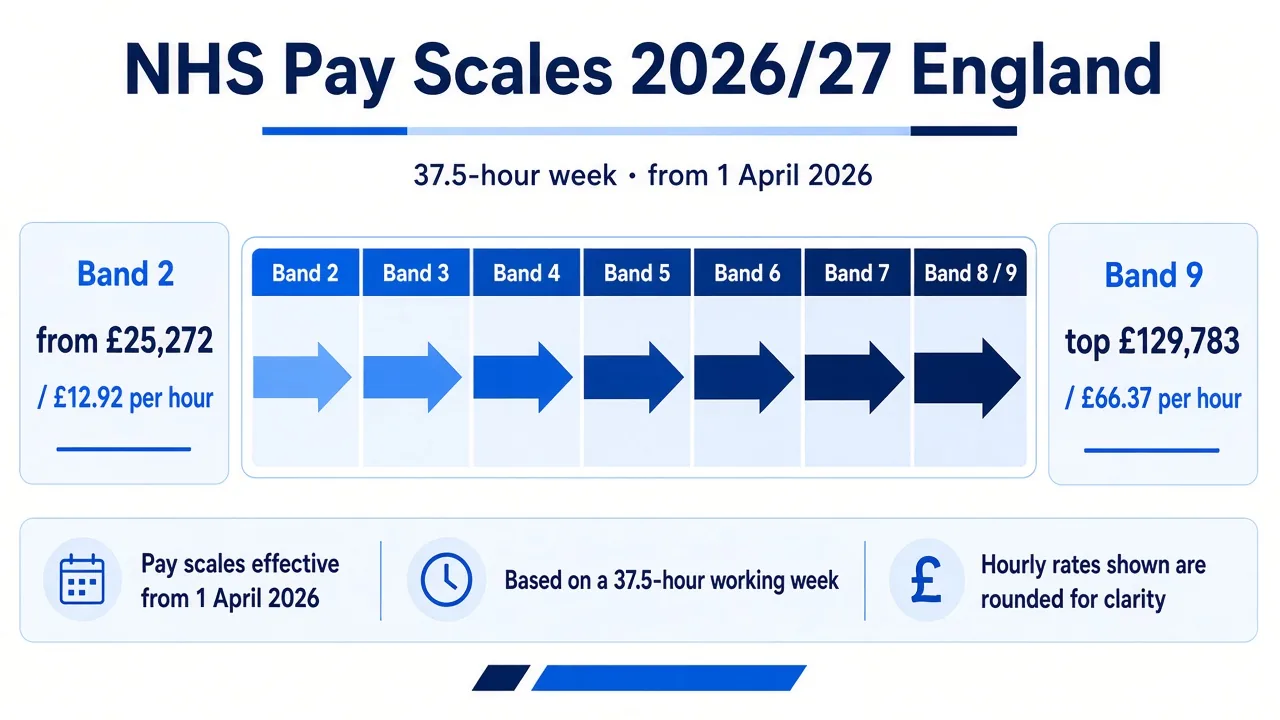
| Band | Entry | Intermediate | Top | Hourly entry→top |
|---|---|---|---|---|
| Band 1* | £25,272 | — | — | £12.92 |
| Band 2 | £25,272 | — | £25,272 (2) | £12.92 → £12.92 |
| Band 3 | £25,760 (2) | — | £27,476 | £13.17 → £14.05 |
| Band 4 | £28,392 (3) | — | £31,157 | £14.52 → £15.93 |
| Band 5 | £32,073 (2) | £34,592 (2) | £39,043 | £16.40 / £17.69 / £19.97 |
| Band 6 | £39,959 (2) | £42,170 (3) | £48,117 | £20.44 / £21.57 / £24.61 |
| Band 7 | £49,387 (2) | £51,932 (3) | £56,515 | £25.26 / £26.56 / £28.90 |
| Band 8a | £57,528 (2) | £60,417 (3) | £64,750 | £29.42 / £30.90 / £33.11 |
| Band 8b | £66,582 (2) | £70,896 (3) | £77,368 | £34.05 / £36.26 / £39.57 |
| Band 8c | £79,504 (2) | £84,346 (3) | £91,609 | £40.66 / £43.14 / £46.85 |
| Band 8d | £94,356 (2) | £100,140 (3) | £108,814 | £48.26 / £51.21 / £55.65 |
| Band 9 | £112,782 (2) | £119,583 (3) | £129,783 | £57.68 / £61.16 / £66.37 |
*Band 1 is a single point, closed to new entrants. Years in brackets = time in post before you become eligible to move to the next point. Source: NHS Employers, Pay scales for 2026/27.
What changed in 2026/27
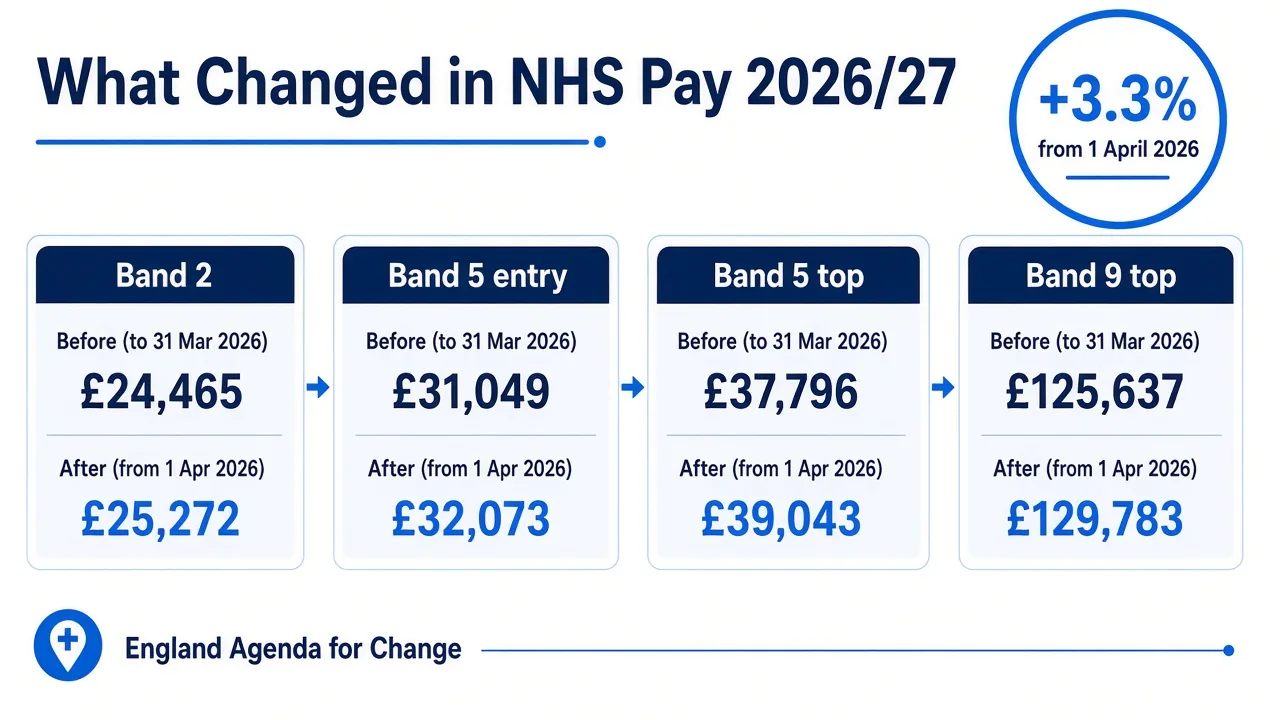
All England Agenda for Change salaries rose 3.3% from 1 April 2026. Band 2 rose from £24,465 to £25,272; Band 5 entry from £31,049 to £32,073 and Band 5 top from £37,796 to £39,043; Band 9 top from £125,637 to £129,783. One pressure point: Band 2’s £12.92 an hour is now only 21p above the National Living Wage of £12.71 (from 1 April 2026), and below the voluntary Real Living Wage of £13.45 — one reason the bottom of the scale is debated every year.
HCAS / London weighting
High Cost Area Supplements (HCAS) are paid as a percentage of basic Agenda for Change salary in three geographic zones, subject to national minimum and maximum cash caps.
| HCAS Geographic Zone | Percentage of Basic Salary | Minimum Annual Cash Payment (£) | Maximum Annual Cash Payment (£) |
| Inner London | 20% of basic salary | £5,794 minimum | £8,746 maximum |
| Outer London | 15% of basic salary | £4,870 minimum | £6,137 maximum |
| Fringe Zone | 5% of basic salary | £1,346 minimum | £2,270 maximum |
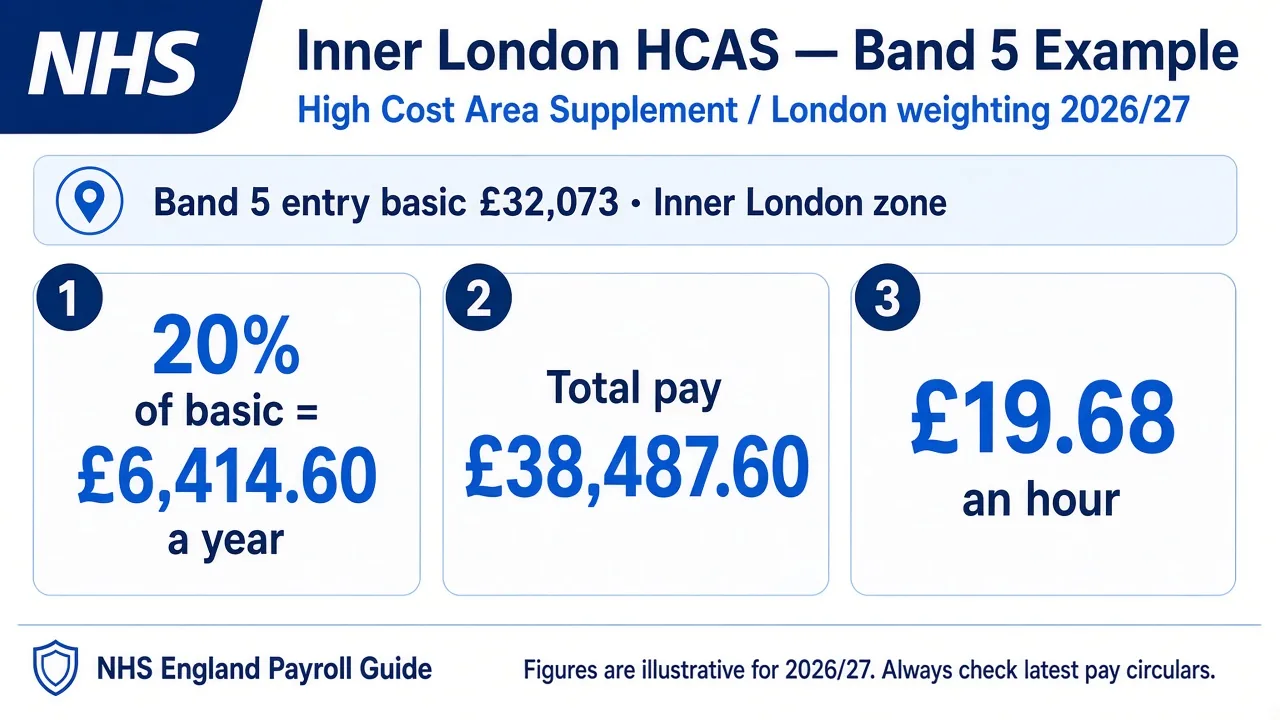
Example: a Band 5 nurse on the entry point (£32,073) working in Inner London receives 20% of basic pay = £6,414.60 a year, taking total pay to £38,487.60 (£19.68 an hour), before tax and pension. The percentage is always subject to the zone minimum and maximum, so higher bands hit the cap: the Inner London maximum of £8,746 applies from Band 6 top upwards.
Pay in Scotland, Wales and Northern Ireland
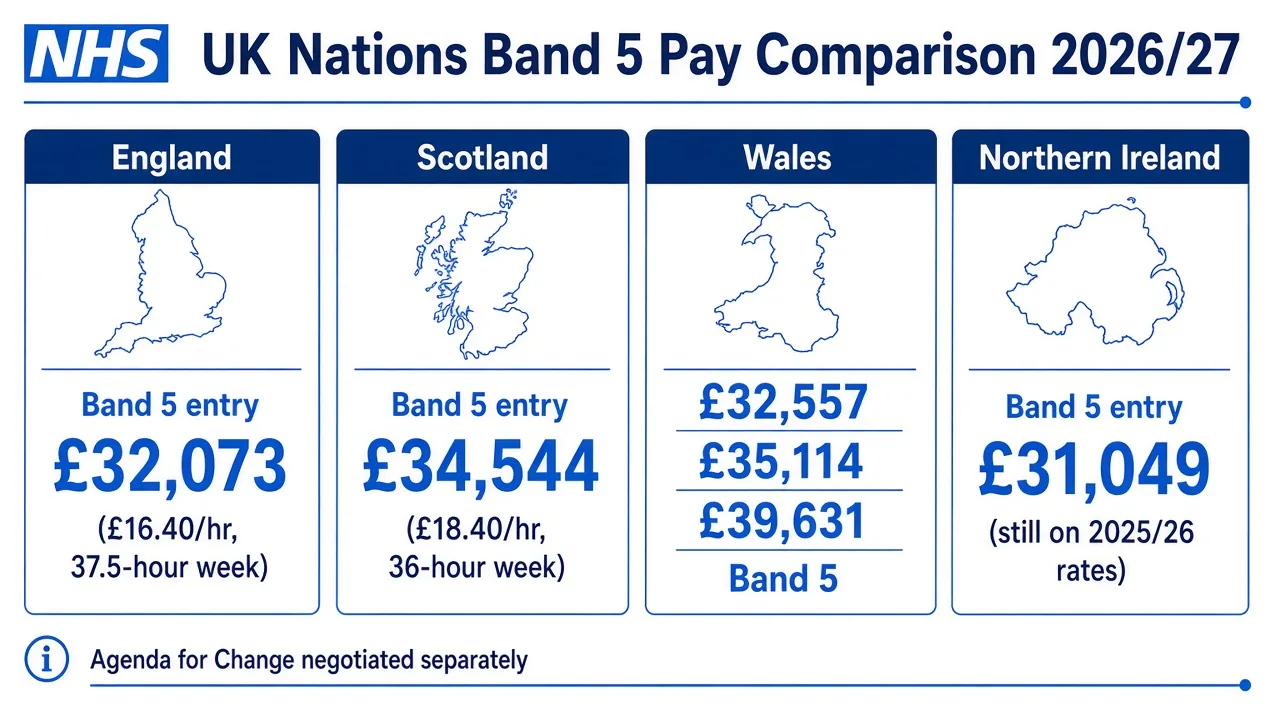
Agenda for Change is negotiated separately in each nation, and the same band does not pay the same across the UK.
- Scotland (36-hour week from 1 April 2026 — shortest standard week in UK NHS): Band 2 £26,696 → £28,988 (£14.22–£15.44/hr); Band 5 £34,544 / £36,911 / £43,039 (£18.40/hr at entry — higher than England’s £16.40 because same kind of role paid over fewer hours). Band 9 top £133,044. See the NHS Scotland pay rise guide and Scotland pay calculator.
- Wales: Band 5 £32,557 / £35,114 / £39,631. Band 2 is £26,300 — set by Real Living Wage floor (£13.45/hr), paid as advance from January 2026, which is why Welsh Band 2 sits above England’s. See the NHS Pay Wales calculator.
- Northern Ireland: 2026/27 award has NOT been implemented — staff remain on 2025/26 rates (Band 2 £24,465; Band 5 entry £31,049) with arrears due from 1 April 2026 once paid. See the Northern Ireland pay rise guide and NI pay calculator.
How bands and pay points work
Your band (sometimes called your banding) is set by job evaluation against the Agenda for Change profiles. Agenda for Change links the evaluated job to a pay band, then uses pay points within that band. A search for “NHS Band 6 pay”, “Band 6 salary”, “Band 6 hourly rate” or “Band 6 take home” is asking about attributes of the same Band 6 entity.
Band 1 is closed to new entrants and pays a single spot rate of £25,272, the same as Band 2. For Bands 5–9, the England table normally has entry, intermediate and top values. Bands 3–4 use entry and top values. Band 2 currently has the same salary shown at entry and top. Progression is subject to the NHS progression process, not simply a date counter. See the NHS Terms and Conditions.
Band 8 explained: 8a, 8b, 8c and 8d are separate pay bands
“Band 8” is often searched as if it were one salary, but the pay structure has four sub-bands:
- Band 8a: £57,528–£64,750
- Band 8b: £66,582–£77,368
- Band 8c: £79,504–£91,609
- Band 8d: £94,356–£108,814
A generic “Band 8 salary” answer should therefore show the sub-band choices rather than publishing a misleading single number.
What take-home pay looks like
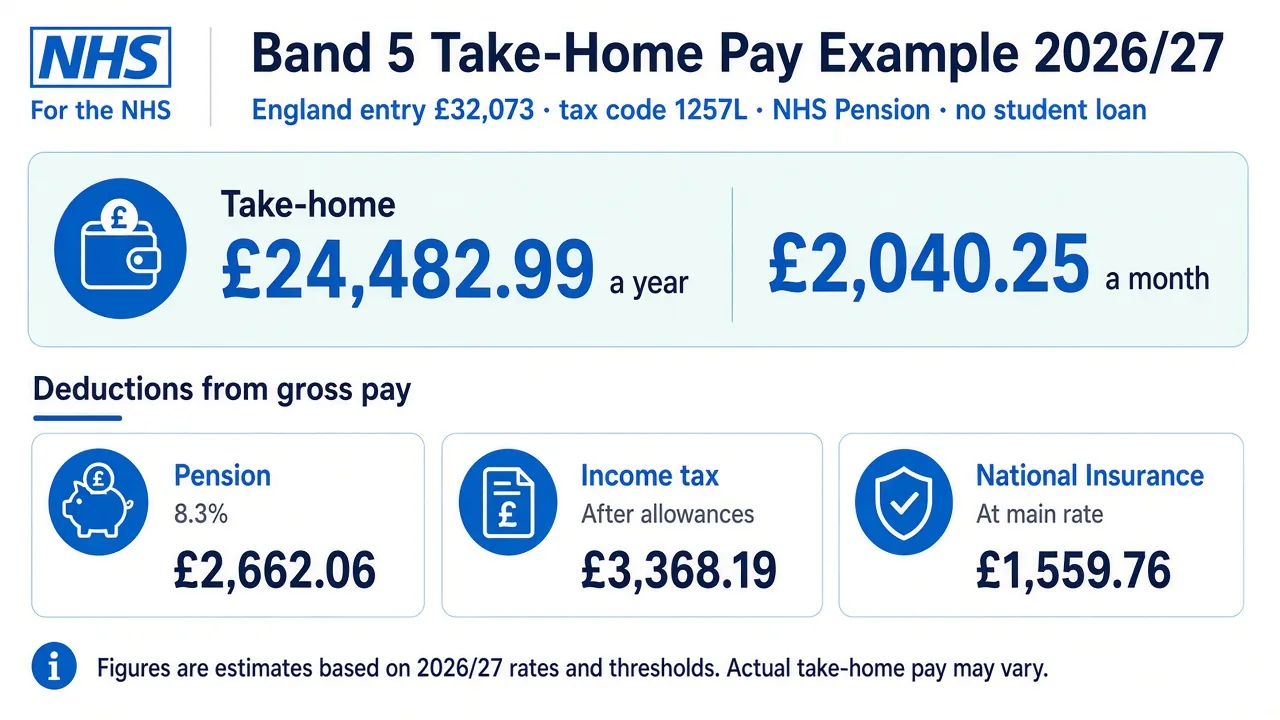
Example — Band 5 entry, England, £32,073, tax code 1257L, NHS Pension, no student loan: pension (8.3%) £2,662.06 a year; income tax £3,368.19; National Insurance £1,559.76. Take-home pay: £24,482.99 a year, £2,040.25 a month. Your own figure depends on your tax code, pension and loans — use the NHS take-home pay calculator for your exact band and circumstances.
For salary sacrifice schemes that change pensionable and taxable pay, see the NHS Pension explained guide. Payslip codes (including VPD — a three-digit code identifying your organisation’s payroll within ESR) are covered in the NHS payslip explained guide.
Unsocial hours and overtime
Unsocial hours enhancements under Section 2 of Agenda for Change are percentage uplifts applied to basic hourly pay for qualifying hours:
| Band | Weekday nights / Saturday | Sunday / public holiday |
|---|---|---|
| Band 1 | 47% | 94% |
| Band 2 | 41% | 83% |
| Band 3 | 35% | 69% |
| Bands 4-9 | 30% | 60% |
Staff promoted from Band 7 (£56,515 top basic) to Band 8a (£57,528 entry basic) under the NHS Employers 2026/27 pay bands can see an initial drop in total take-home if their previous Band 7 schedule relied heavily on weekend enhancements or paid overtime. Under Section 3, staff in Bands 8a–9 lose contractual entitlement to paid overtime and instead receive Time Off In Lieu (TOIL) at plain-time rates, or flat single-time pay if TOIL cannot be taken.
Unsocial-hours enhancements paid under Section 2 within your contracted hours are pensionable, and so is HCAS. Overtime paid beyond full-time hours is not pensionable.
Section 2 vs Annex 5: most staff are on Section 2 — you are paid the enhancement only for unsocial hours you actually work, and it stops during sickness absence. Annex 5 is the older arrangement kept by some ambulance staff who were in post before September 2018: a fixed percentage of salary based on your average unsocial hours, which continues through sickness and leave. In England, Annex 5 staff can move to Section 2 but cannot move back.
Annex 5 (formerly Annex E)
Ambulance service crews and mobile emergency staff who remain on Annex 5 (formerly Annex E) receive a pre-calculated prospective flat percentage supplement added to basic salary (typically 5% to 25%), instead of logging variable hourly enhancements per shift under Section 2.
Pay progression
NHS pay step progression works through structured appraisal reviews where staff must complete the required years of service (shown in brackets in the England table above) and satisfy three mandatory performance and compliance criteria on their anniversary review date. Advancement through Agenda for Change step points is conditional rather than automatic.
The pay step review process
Under Section 1.33 of the NHS Terms and Conditions of Service Handbook, line managers must conduct a formal Pay Step Review prior to an employee’s anniversary date. To unlock step point progression, the staff member must satisfy three mandatory compliance criteria:
- Complete 100% of statutory and mandatory training — up-to-date certification for all mandatory organisational modules by the review deadline.
- Achieve a satisfactory annual appraisal sign-off — the line manager confirms duties and agreed objectives were met.
- Absence of formal disciplinary or capability sanctions that explicitly block pay progression.
If a review is delayed without employee fault, rules require the employer to award the progression point and backdate the increase. Non-consolidated lump sums do not permanently increase your baseline hourly rate or advance your pay point. More detail: NHS pay progression.
Section 19 pay protection can preserve your former basic salary for a period if you are redeployed to a lower band because of organisational change or disability. See the NHS pay protection and redeployment guide.
Doctors’ pay
Doctors are not on Agenda for Change. For comparison, 2025/26 basic salaries in England: Foundation Year 1 £38,831; Foundation Year 2 £44,439; core/specialty training from £52,656 to £73,992 at the top; Specialty Doctor £61,542–£99,216; Consultant £109,725–£145,478. See the NHS doctor salaries guide.
Pay dates
Pay scales tell you how much; pay dates tell you when. There is no single NHS payday — most staff are paid monthly on a set date between the 24th and the end of the month, set by their employer. See the NHS pay dates guide for your employer’s calendar.
Frequently asked questions
What are the NHS Agenda for Change pay scales for 2026/27?
In England, Agenda for Change pay for 2026/27 runs from £25,272 a year (£12.92 an hour) at Band 2 to £129,783 (£66.37 an hour) at the top of Band 9, for a 37.5-hour week from 1 April 2026. The full scale — every band, every pay point, annual and hourly — is in the England table at the top of this page.
What is the hourly rate for Band 5 / Band 2?
Band 5 entry in England is £16.40 an hour (£32,073 a year). Band 2 is £12.92 an hour (£25,272 a year) on a 37.5-hour week.
What does “banding” mean?
Your band (sometimes called your banding) is set by job evaluation against the Agenda for Change profiles. The evaluated job is linked to a pay band, then to pay points within that band.
Why is Band 5 higher in Scotland?
Scotland’s Band 5 entry is £34,544 on a 36-hour week from 1 April 2026, which is £18.40 an hour — higher than England’s Band 5 entry of £16.40 because the same kind of role is paid over fewer contracted hours.
Is Band 2 above minimum wage?
England Band 2 at £12.92 an hour is 21p above the National Living Wage of £12.71 (from 1 April 2026), but below the voluntary Real Living Wage of £13.45.
When do the pay scales change?
Agenda for Change pay scales normally change on 1 April each year. The next scheduled change after 2026/27 is 1 April 2027, subject to the agreed national award.
How much does a Band 5 nurse take home?
Example — Band 5 entry, England, £32,073, tax code 1257L, NHS Pension, no student loan: pension £2,662.06; income tax £3,368.19; National Insurance £1,559.76. Take-home pay: £24,482.99 a year (£2,040.25 a month). Use the NHS take-home pay calculator for your exact band and circumstances.
Sources
- NHS Employers — Pay scales for 2026/27
- NHSBSA — NHS Pension contribution tiers
- Scottish Government — NHS staff pay (PCS(AFC) 2026/1)
- NHS Wales — AfC(W) 02/2026
- HSC (AfC) 06/2025 (NI)
- GOV.UK — National Living Wage 2026
Figures checked 22 November 2026. Last updated: 22 November 2026.