 Take Home Pay
Take Home Pay
Take Home Pay
Use this free NHS strike deduction calculator to find out exactly how much pay you lose for each day of industrial action. Select your Agenda for Change band or enter your annual salary, choose the month of the strike, enter the number of strike days, and get an instant breakdown of your gross deduction, net take-home impact, and pension effect.
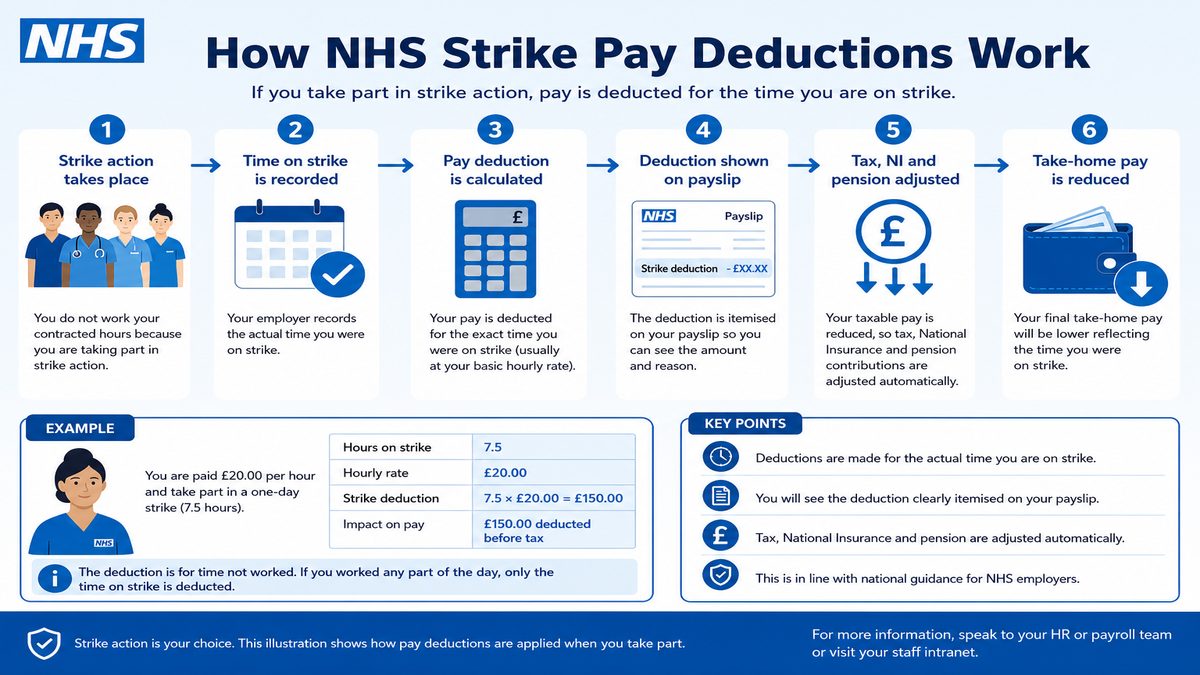
1 When a member takes strike action, it is typical that they would not be paid for that day. The deduction is not arbitrary. 1 NHS Employers have published advice to trusts that the pay deduction calculation for employers to use should be the equivalent of 1/365th of annual salary for each day striking, or an hourly calculation rate that crucially must be no greater a deduction than the 1/365th figure.
Two official methods exist. Your trust uses one of them.
This is the standard formula used by the majority of NHS trusts in England. It divides your gross annual salary by 365 calendar days:
Daily strike deduction = Annual salary ÷ 365
5 Band 5 entry level in England 2026/27 is £32,073. Under the 1/365th method, one strike day costs:
£32,073 ÷ 365 = £87.87 gross per day
4 The Supreme Court agreed with the position that the appropriate rate of deduction was 1/365. It reached this view because of an old piece of law, the Apportionment Act 1870. That makes the default position for annual contracts accrual at the rate of 1/365 per day. This method produces the lowest possible daily deduction because it treats every calendar day — including weekends and bank holidays — as an equal fraction of the year.
1 Contractually the calculation should be annual salary divided by 12 for monthly salary, then divided by the calendar days in the month for daily.
Daily strike deduction = (Annual salary ÷ 12) ÷ Number of calendar days in the strike month
Using the same Band 5 nurse (£32,073) striking in April (30 days):
(£32,073 ÷ 12) ÷ 30 = £2,672.75 ÷ 30 = £89.09 gross per day
In a 31-day month (e.g., January), the figure drops to £86.22. In February (28 days), it rises to £95.46. The month of the strike changes the daily loss.
7 Deductions from pay for junior doctors participating in strike action will be recorded in days and pay will be reduced by 1/31, 1/29 or 1/30th depending upon the month action takes place.
Component | Value |
Input | Your gross annual salary (basic pay + annualised pay elements) |
Method A divisor | 365 (fixed, all calendar days) |
Method B divisor | 12 × calendar days in the strike month (28, 29, 30, or 31) |
Output | Gross deduction per strike day |
Net impact | Gross deduction minus the tax, NI, and pension you would have paid on that amount |
The net (actual take-home) loss is always less than the gross deduction. When pay is deducted, the income tax, National Insurance, and NHS Pension contributions that would have been charged on that pay are also removed.
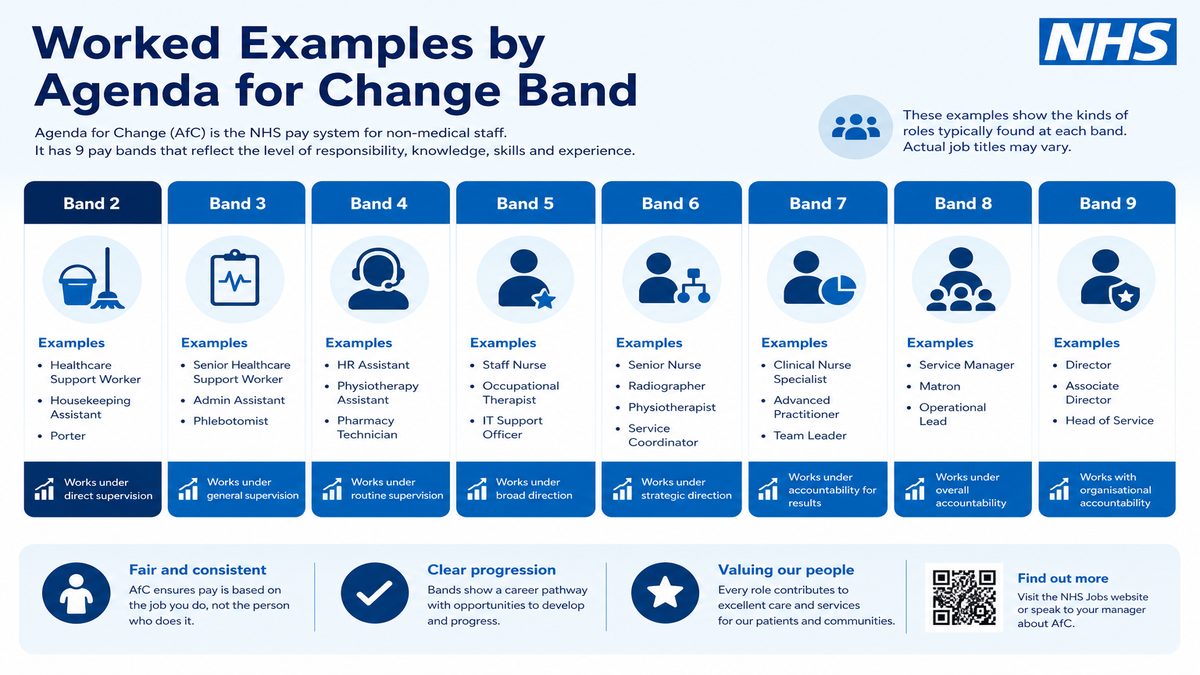
8 The current pay scales for 2026/27 include a 3.3% pay rise. Band 2 entry-level salaries start at £25,272 per year, while Band 9 top-step salaries reach £129,783.
The table below uses the 1/365th method and confirmed England pay scales. 24As of 1 April 2026, the NHS Pension contribution rates are: 5.2% for earnings up to £13,259; 6.5% for £13,260 to £28,854; 8.3% for £28,855 to £35,155; 9.8% for £35,156 to £52,778; 10.7% for £52,779 to £67,668; and 12.5% for earnings of £67,669 and above.
AfC Band | Entry Salary (England 2026/27) | Pension Tier | Gross Deduction per Strike Day (1/365) | Estimated Net Loss per Day* |
Band 2 | £25,272 | 6.5% | £69.24 | ~£55.67 |
Band 3 | £25,272+ | 6.5% | ~£69.24 | ~£55.67 |
Band 4 | ~£27,857 | 6.5% | ~£76.32 | ~£61.36 |
Band 5 | £32,073 | 8.3% | £87.87 | ~£63.26 |
Band 6 | £39,959 | 9.8% | £109.48 | ~£72.26 |
Band 7 | ~£48,527 | 9.8% | ~£132.95 | ~£79.77 |
Band 8a | ~£56,744 | 10.7% | ~£155.46 | ~£88.62 |
Band 8b | ~£67,669+ | 12.5% | ~£185.39 | ~£94.35 |
*Net loss estimates assume standard 1257L tax code, 58% NI on weekly earnings between £242 and £967, and 2% on anything above £967 per week, and the applicable NHS Pension tier. Use the calculator above for your exact personalised figure.
2 Colleagues-in-training are not entitled to be paid for any period during which they are taking industrial action. Days on industrial action are non-pensionable and no pension contributions should be deducted.
This means three things happen on every strike day:
1 No service or pay accrues towards your pension benefits, and the day(s) are disallowed, and therefore effectively ignored from active service. This is confirmed in guidance by NHSBSA. The way final pensionable pay is calculated is that, on the date of retirement, there is a countback of three lots of 365 days of active service. The highest of these 365 days is your pensionable final pay. If there are strike days, they do not form part of your active service and, therefore, these days are ignored and, consequently, this count back period will be increased by the corresponding number of strike days you have taken.
In practical terms, the count-back period simply extends by the number of strike days. For the vast majority of NHS staff, there is no impact on final salary pension benefits.
15 For all members this will affect the member's Final Salary Link for the 1995-2008 Scheme (depending upon retirement) and the amount of benefits accrued in the 2015 Scheme. Under the 2015 CARE scheme, each year's pensionable earnings are banked and revalued annually. A strike day removes that day's earnings from your pensionable pay for the year. The long-term effect is very small: one strike day for a Band 5 nurse removes approximately £0.04 per month from the eventual annual pension.
15 Where an employee undertakes action short of strike, i.e. they work to rule, there are no disallowed days to add to the member's pension record. 15 However, employers must reassess the member's pensionable pay and contribution tier if the pensionable pay reduces and apply any changes in the usual way.
No. 1This only applies to days when a resident doctor is actually striking from rostered duties — it does not apply to non-working days, 'zero days' or days of leave that overlap with the strike period.
20 If a member of staff is on annual leave or on a "zero hours" contract, they should not receive any deduction in pay (even if they attend picket lines or demonstrations).
The deduction applies only to shifts you were rostered to work and chose to strike instead. Rest days, zero days, and pre-approved annual leave are not deductible.
1 We expect a single shift to be treated as a single day for deduction purposes. This is regardless of whether it straddles one or two calendar days. So those working night shifts should not suffer greater pay deduction than colleagues working days.
If your night shift starts at 19:30 on Day 1 and ends at 07:30 on Day 2, it counts as one day's deduction — not two. If your trust deducts for two calendar days, this is incorrect. Raise it with your line manager and cite the BMA and NHS Employers guidance.
2 If you are a less than full time colleague-in-training and the strike days cover one working day only, the host will inform Lead Employer that you have participated in industrial action for 1 day and this will be deducted at 1/365th rate.
If you work part-time (e.g., 22.5 hours per week on a Band 6 contract), your annual salary is already pro-rata. The deduction formula applies to your actual pro-rata salary, not the full-time equivalent.
Example: Band 6 entry, full-time = £39,959. At 22.5 hours (0.6 WTE): £39,959 × 0.6 = £23,975.40. One strike day at 1/365th = £23,975.40 ÷ 365 = £65.69 gross.
The deduction is based on your total annualised salary — not basic pay alone. If your contract includes banding supplements, unsocial hours enhancements, or on-call payments that form part of your annualised salary, these are included before the 1/365th (or calendar-day) divisor is applied.
19 The 2026/27 pay award is not just a boost to your basic salary; it has a multiplier effect on your enhancements. Because the 30% or 60% uplift is calculated based on your hourly rate, every penny added to your base pay is amplified during unsocial shifts.
This means your strike deduction may be higher than expected if your annualised salary includes a significant enhancement component.
18 Industrial action can impact your eligibility for each component of maternity pay in different ways.
18 Going on strike should not affect your eligibility to OMP. Under Agenda for Change, OMP requires at least 12 months' continuous NHS service by the 11th week before your expected week of childbirth.
20 The key entitlement in question is Statutory Maternity Pay, which applies to NHS staff who have been in their current role for less than one year. To qualify for Statutory Maternity Pay, you must have worked for 26 continuous weeks in your role. If you are involved in a strike, your employer is legally entitled to deduct that week of continuous service from your record. 2 Going on strike can impact the amount of Occupational maternity pay or Statutory maternity pay a colleague-in-training receives. This can occur if a colleague-in-training goes on strike during the eight-week 'set period' in which their average weekly earnings are calculated for the purposes of OMP and SMP.
This is critical for newly appointed NHS staff. If you joined your trust within the last six months and are planning maternity leave, calculate whether strike participation could delay your SMP qualification.
18 You cannot strike whilst on maternity leave. This is because you would not be expected to be on a shift on the days of industrial action. 18 You can though attend protests and demonstrations in support of industrial action if you wish.
2 Colleagues-in-training can work elsewhere as long as it is not during the same hours you strike for. For example, if your shift was 9am-5pm and you choose to strike, you can't work elsewhere within those hours but could work 5pm-10pm.
2 Usual pay provisions would continue during any period of sickness absence or maternity leave. However, if a colleague-in-training takes part in the industrial action, even if they are unwell, this may result in the period of strike action being unpaid. 2 If you are sick on a day of industrial action, sickness absence should be reported in line with the normal reporting arrangements applicable to your host organisation. 2 In these circumstances you may be required to submit a Fit Note.
If you are on certified sick leave and choose to participate in industrial action, your sick pay stops for those days. You can resume sick leave status after the strike ends, but this break may affect your continuous sickness record.
2 Each day will also be deducted from their continuous service, which may have an impact on pension and annual leave entitlement.
Under Agenda for Change, annual leave accrues based on length of service: 27 days at under 5 years, 29 days at 5–10 years, and 33 days at 10+ years of continuous service. Strike days break continuous service, which could theoretically delay a move to the next annual leave tier. In practice, for one to five strike days, this impact is negligible for most staff.
2 The specific guidance referred to by the General Medical Council (GMC) is outlined within the Gold Guide which outlines that any resident doctor who misses 14 days or more of training (this excludes annual and study leave and rest days), in each 12 month period, will be reviewed as to whether the colleague-in-training needs to have their Certificate of Completion of Training (CCT) date extended. 2 Where non-attendance on these days will trigger the above threshold, NHSE would review this as part of your Annual Review of Competency Progression (ARCP) review.
If total strike days remain below 14 in any 12-month period, there is no automatic review or extension to your CCT date.
2 Payroll providers have advised that pay will be deducted in May or June depending on the date that host organisations confirm industrial action taken.
Most trusts process strike deductions in the pay period immediately after the strike. If a strike occurs in the first week of April, the deduction typically appears on your April payslip (paid at the end of April or early May). Some trusts with slower reporting may delay to the following month. The deduction appears as a line item on your ESR-generated payslip.
ESR stands for Electronic Staff Record. It is the integrated HR and payroll system used by all NHS trusts in England and Wales. 2It is extremely important that this information is entered directly into ESR. Your strike deduction reduces your gross pay, which in turn reduces income tax, NI, and pension charged in that pay period.
5 Plan 2 repayments (the most common for graduates who studied after 2012) are 9% of earnings above approximately £27,295 per year. Since strike deductions reduce your gross earnings for the month, your student loan repayment for that month drops slightly. One strike day reducing gross pay by £88 means approximately £7.92 less student loan deducted that month. Your PAYE tax code (usually 1257L) remains unchanged.
30 For NHS staff working in London and the surrounding counties, the standard Agenda for Change pay bands are supplemented by the High Cost Area Supplement. This is designed to compensate for the significantly higher cost of living in the capital. The amount of London Weighting you receive depends entirely on which zone your place of work falls into. This is based on your work location, not your home address. 28 If your basic salary is £32,073 but you receive £4,000 in HCAS, your pensionable pay is £36,073 — putting you in Tier 4 (9.8%) rather than Tier 3 (8.3%).
HCAS is part of your annualised salary. The strike deduction is calculated on the total figure including HCAS, which means staff in London lose more per strike day in absolute terms than staff outside London on the same band.
Example: Band 5 entry (£32,073) + Inner London HCAS (£5,302 minimum) = £37,375 total. One strike day at 1/365th = £37,375 ÷ 365 = £102.40 gross — compared to £87.87 without HCAS.
2 If you are not a member of any Trade Union, you are allowed to participate in strike action. Non-Union members who take part in legal, official industrial action have the same right as Union members not to be dismissed because of taking action. Pay will be deducted.
You do not need to be a BMA, RCN, UNISON, or any union member to legally participate in official industrial action. Your employment protections are identical. However, you will not have access to union strike funds or hardship support.
7 If a Junior Doctor returns to work for an emergency during a planned strike day, the part payment they receive will be non-pensionable as the day was disallowed.
If you are called back to provide emergency cover during a strike shift, you will be paid for the hours worked. However, the entire day remains "disallowed" for pension purposes — no pensionable service accrues regardless of whether you worked part of that shift.
2 Pay will not be deducted automatically. It will only be deducted once confirmation from a host organisation has been received by the Lead Employer.
Your trust or host organisation must report your participation in industrial action. If they do not confirm you took part, no deduction is processed. This is not an invitation to strike without consequence — it is a procedural fact about how ESR payroll works.
No. The calculation uses your total annualised salary, which includes basic pay, banding supplements, on-call payments, and unsocial hours enhancements that form part of your annual figure.
1 NHS Employers have published advice that the hourly calculation rate crucially must be no greater a deduction than the 1/365th figure. 4 The Supreme Court held that a college should only have deducted 1/365 of salary per day of strike action. The college's approach of deducting 1/260 of salary per day (based on a five day working week) was not correct. If your payslip shows a larger deduction, raise this with your payroll department immediately.
No. Strike days are treated as unpaid absence. No annual leave accrues for those days and they reduce your continuous service record.
20 If a member of staff is on annual leave, they should not receive any deduction in pay. However, requesting annual leave specifically to avoid striking during a scheduled ballot period may be scrutinised by your manager. Pre-approved annual leave that predates the ballot announcement is unaffected.
No. Your PAYE tax code remains unchanged. The lower gross earnings for the month simply mean less income tax is charged in that period. You do not need to contact HMRC.
Swapping strike days or requesting additional shifts after industrial action would constitute additional work outside contracted hours and must be agreed by your employer. Your trust is not obligated to offer make-up shifts.
The deduction principles apply regardless of whether you are on the 2016 Terms and Conditions of Service, local trust-grade terms, or a locum contract. Your exact calculation follows the same 1/365th or calendar-day formula applied to your annualised salary.
No. Participation in lawful, official industrial action is a legal right. 2Non-Union members who take part in legal, official industrial action have the same right as Union members not to be dismissed because of taking action. Your employer cannot subject you to disciplinary action, demotion, or any detrimental treatment for lawful strike participation.
26 From 1 April 2026, the NHS Pension Scheme uses a six-tier contribution structure with rates running from 5.2% to 12.5%. The rates are unchanged since April 2024. Only the thresholds move each year.
Tier | Pensionable Pay Range (2026/27) | Employee Contribution Rate |
1 | Up to £13,259 | 5.2% |
2 | £13,260 – £28,854 | 6.5% |
3 | £28,855 – £35,155 | 8.3% |
4 | £35,156 – £52,778 | 9.8% |
5 | £52,779 – £67,668 | 10.7% |
6 | £67,669 and above | 12.5% |
24 Employers contribute a flat rate of 23.7% of pensionable pay. On a strike day, both your contribution and your employer's 23.7% contribution are forfeited for that day.