 Take Home Pay
Take Home Pay
Take Home Pay
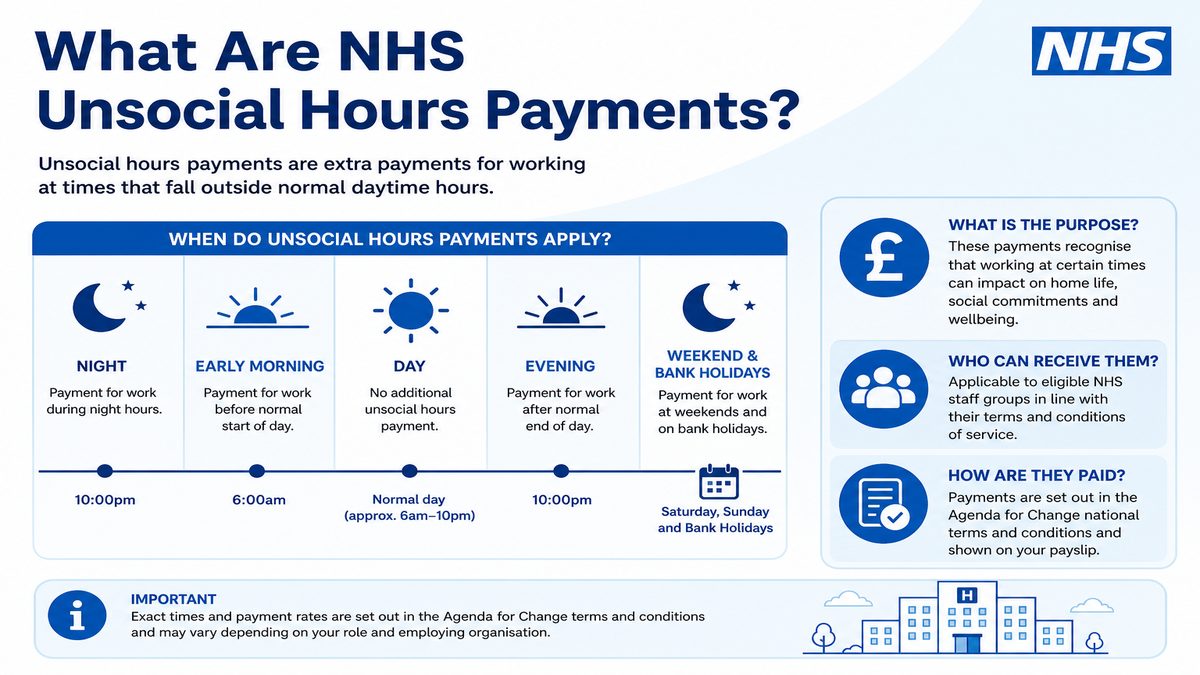
NHS unsocial hours payments are contractual percentage enhancements added to basic Agenda for Change (AfC) hourly pay when you work at night, on Saturdays, or on Sundays and public holidays. They are not discretionary bonuses. For staff covered by the national terms, the rules sit in Section 2 of the NHS Terms and Conditions of Service Handbook, with a clear summary on the NHS Employers unsocial hours payments page.
Unsocial hours pay matters because a large share of NHS clinical work happens outside Monday–Friday daytime. Ward nurses, healthcare assistants, midwives, ODPs, radiographers, porters, and many estates and facilities roles routinely work nights and weekends. The enhancement is designed so lower bands receive higher percentage uplifts, keeping the cash value of night and weekend work meaningful against a lower basic hourly rate.
This guide explains the qualifying time windows, band rates for 2026/27, how to calculate the enhancement on your hourly rate, the whole-shift rule for weekday nights, how unsocial hours interact with overtime and on-call, tax and pension treatment, worked examples for a Band 5 nurse, common payroll mistakes, and rota planning tips. Figures and rules below follow the England Section 2 table widely used across AfC; always check your nation’s handbook annex if you work in Scotland, Wales, or Northern Ireland, because local circulars can modify allowances even when the percentage table is the same.
Section 2 defines three qualifying windows. Only hours that fall inside these windows attract the enhancement (subject to the whole-shift rule for certain weekday night and evening shifts, explained later).
On Monday to Friday (excluding public holidays), any time worked after 8pm and before 6am attracts the lower of the two enhancement columns — commonly called the night/Saturday rate. A shift that starts at 7pm does not earn enhancement for the 7pm–8pm hour unless the whole-shift rule pulls that hour in. From 8pm onwards, the enhancement applies hour by hour until 6am.
The 8pm–6am window is ten hours long. Most traditional long-day night shifts place the majority of worked time inside that window, which is why the whole-shift rule frequently upgrades the entire duty.
All hours worked on Saturday, from 00:00 to 24:00, attract the same enhancement column as weekday nights. There is no separate “Saturday night” rate. A 07:00–19:00 Saturday day shift is enhanced for all twelve hours. A Saturday night shift that starts Friday evening and crosses into Saturday needs careful hour-by-hour coding: Friday night hours before Saturday midnight use the weekday night rules; Saturday hours use Saturday rates (same percentage column, but the calendar day still matters for Sunday crossovers).
All hours worked on Sunday, and all hours worked on a public holiday (midnight to midnight), attract the higher enhancement column. Christmas Day, Boxing Day, New Year’s Day, and other public holidays in your nation count as public holidays for this purpose when they fall on the calendar day you work. If a public holiday falls on a Saturday or Sunday and an alternative weekday is designated as a public holiday for leave purposes, payroll practice follows the published public holiday calendar for your employer — check ESR and your Trust’s leave policy rather than assuming.
When a shift crosses midnight from Saturday into Sunday, the hours before midnight attract Saturday rates and the hours after midnight attract Sunday rates. Rates do not stack for the same hour.
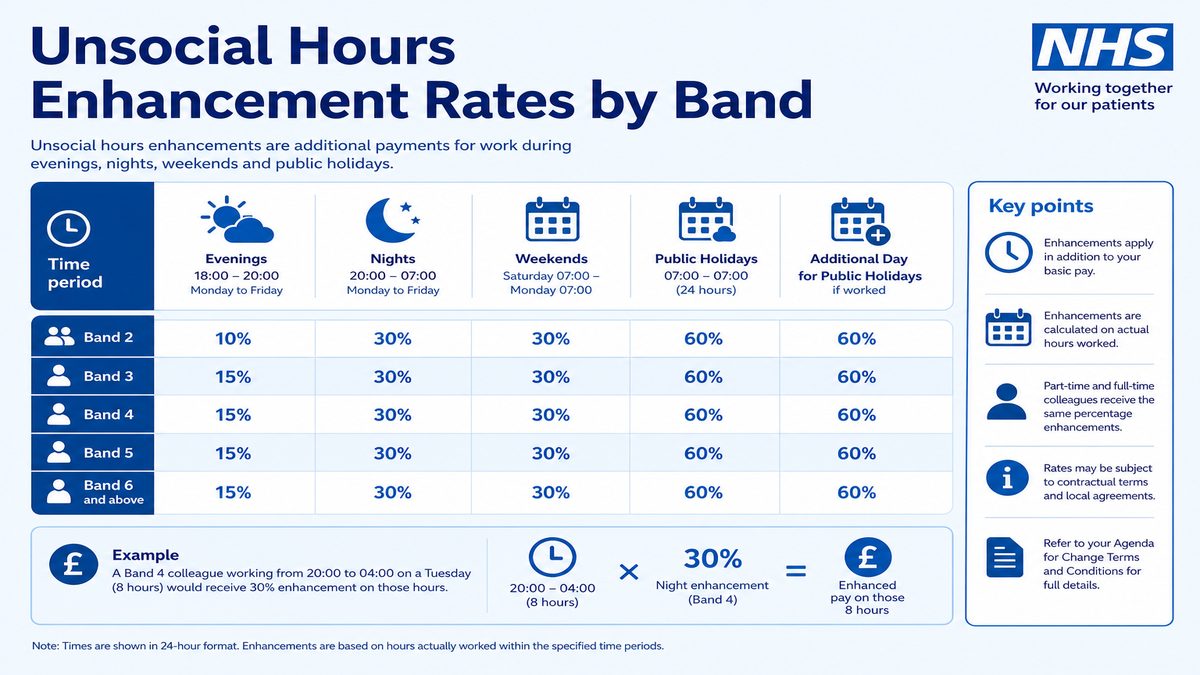
The national table (from 1 April 2020 onwards in the handbook, still the operative Section 2 rates for 2026/27 basic enhancements) is:
| Pay band | Saturday (midnight–midnight) and weekday after 8pm / before 6am | Sunday and public holidays (midnight–midnight) |
|---|---|---|
| Band 1 | Time plus 47% | Time plus 94% |
| Band 2 | Time plus 41% | Time plus 83% |
| Band 3 | Time plus 35% | Time plus 69% |
| Bands 4–9 | Time plus 30% | Time plus 60% |
Lower bands receive higher percentages so that a night or weekend hour produces a usable cash uplift. A Band 2 healthcare assistant on the Living Wage floor would see a thin cash premium at 30%; the 41%/83% structure corrects that. From Band 4 upwards — including registered nurses, midwives, and most AHPs — the rates are uniformly 30% for nights/Saturdays and 60% for Sundays/bank holidays.
Band 1 is closed to new entrants in England, but the rate remains in the handbook for any remaining Band 1 contracts. Most support staff now sit on Band 2 or Band 3.
Unsocial hours enhancements are percentage additions to your basic hourly rate. Basic hourly rate for AfC full-time staff is normally:
Annual basic salary ÷ 52.143 ÷ 37.5
High Cost Area Supplement (HCAS / London weighting) is not usually included in the base used for unsocial hours percentage calculations under the national agreement — enhancements apply to basic pay. Local payroll systems should follow the handbook; if your payslip looks wrong, ask payroll which base rate ESR used.
Part-time staff use the same percentages on the same hourly basic rate. Your annual salary is pro-rata, but the hourly basic rate for a given pay point is the same as full-time; unsocial enhancements therefore attach to hours actually worked in the windows.
Paragraph 2.11 of Section 2 is the rule many rotas forget. Where a continuous night shift or evening shift on a weekday (other than a public holiday) includes hours outside 8pm–6am, the night/Saturday enhancement applies to the whole shift if more than half of the time falls between 8pm and 6am.
Example: a 19:00–07:00 weekday night (12 hours). Hours inside 20:00–06:00 = 10 hours. Half of the shift = 6 hours. Because 10 > 6, the entire 12-hour shift is paid at time plus 30% (Bands 4–9), including the 19:00–20:00 and 06:00–07:00 shoulders.
Counter-example: a 18:00–02:00 evening shift (8 hours). Hours inside 20:00–06:00 = 6 hours. Half of 8 = 4. Six is more than four, so the whole shift is enhanced. A shorter late duty that keeps most hours before 20:00 may fail the threshold and only enhance the true 20:00–06:00 slice.
The whole-shift rule applies to weekday night/evening continuous shifts, not to Saturday or Sunday calendar days (those already enhance midnight-to-midnight). Public holidays use the higher Sunday/BH column for hours on that calendar day.
Staff receive only one unsocial hours rate for each hour worked. You cannot claim night rate plus Sunday rate for the same hour, and you cannot stack Saturday and bank holiday percentages on top of each other for one hour. When periods meet at midnight, allocate each hour to the correct calendar day and apply that day’s single rate.
This “one rate per hour” principle also frames how employers should treat conflicting premiums: the handbook is explicit that you do not double-count unsocial columns.
Overtime and unsocial hours answer different questions.
You should not assume overtime automatically includes an extra unsocial percentage on top. Many payroll configurations pay overtime at a single enhanced overtime rate rather than stacking overtime plus Section 2. Equally, unsocial enhancements inside your normal contracted week are not “overtime” — they are enhancements to standard hours. Check your Trust’s overtime protocol and the ESR earnings codes on your payslip. If you regularly work overtime at night, ask payroll in writing which code and rate apply so you can reconcile expected gross.
Section 2 and the on-call annexes draw a bright line: staff cannot receive unsocial hours payments and payments for on-call (or other extended service cover) for the same hours of work. If you are paid an on-call availability payment for a period, that period is not also paid as Section 2 unsocial hours. If you are called out and work, the worked time is paid under the call-out / overtime / applicable worked-time rules for your on-call scheme — not as a double dip with Section 2 for identical hours.
Wales publishes separate cash session rates for weekday/weekend on-call, public holiday on-call, and sleep-in under AfC(W) circulars; England trusts operate harmonised on-call under national principles with local agreements. Whatever the nation, the same-hours exclusion with unsocial payments remains the key compliance point. Guidance from the Royal College of Nursing on Agenda for Change is useful when you need to challenge a payslip with your steward.
Part-time staff receive unsocial hours enhancements on the same percentage basis as full-time colleagues for hours actually worked in the qualifying windows. There is no “pro-rata percentage.” What is pro-rata is contracted hours and annual basic salary. A 22.5-hour Band 5 nurse working every other weekend still receives 30% or 60% on each qualifying hour at the Band 5 hourly basic rate.
Compressed hours, annualised hours, and self-rostering do not remove the entitlement. They can, however, change how many qualifying hours appear in a pay period. Keep personal records of duties against the published rota, especially when e-rostering edits shifts after the fact.
Assume England Band 5 entry basic pay £32,073, hourly ≈ £16.40, enhancement Bands 4–9: +30% / +60%. (Wales Band 5 entry is £32,557 / ≈ £16.65 — same percentages, slightly higher cash.)
Duty: Tuesday 19:00–07:00 (12 hours). More than half falls in 20:00–06:00, so all 12 hours at ×1.30.
Duty: Saturday 07:30–20:00 (12.5 hours). Entire Saturday is enhanced at ×1.30.
Duty: Sunday 19:30–08:00 Monday. Allocate by calendar day:
Using a conservative split where Monday 00:00–06:00 is clearly night-enhanced and 06:00–08:00 may depend on whether the continuous Monday night portion meets the half-shift test, total Sunday portion alone already shows why Sunday nights pay materially more than weekday nights.
Suppose seven weekday long nights in a month, each 12 hours fully enhanced at ×1.30 under the whole-shift rule:
Add two Sunday long days (2 × 12 hours at ×1.60): extra per hour = £16.40 × 0.60 = £9.84; 24 × £9.84 = £236.16. Combined unsocial uplift ≈ £649 gross before tax, NI, and pension — material for Band 5 take-home planning.
Unsocial hours payments are taxable earnings and subject to Class 1 National Insurance like other pay elements, unless a specific statutory exemption applies (they generally do not). HMRC treats them as employment income through PAYE. See GOV.UK income tax guidance for personal allowance and rate bands, and your payslip YTD figures for the real effect.
Because enhancements increase gross pay in the months you work more nights and weekends, you may:
Take-home is therefore not “enhancement × (1 − 20%)” in every case. Pension contributions are deducted before tax under net pay / relief at source arrangements for the NHS scheme, which changes the marginal picture. Use a take-home estimator with your band, hours, and expected unsocial pattern, then reconcile to ESR.
In normal AfC employment, Section 2 unsocial hours payments form part of pensionable pay for the NHS Pension Scheme when they are paid as contractual earnings for hours worked. That increases both your contribution (tiered employee rate) and the pay used for Career Average Revalued Earnings (CARE) build-up in the 2015 Scheme. Confirm coding on your payslip (pensionable vs non-pensionable earnings lines) and with NHSBSA NHS Pensions if a non-standard allowance appears.
Local recruitment and retention premia, some temporary Covid-era supplements historically, or certain non-consolidated awards may have different pensionable status — unsocial hours under Section 2 are the mainstream contractual element and are ordinarily pensionable.
If you spot an error, raise it promptly with your line manager and payroll, keep screenshots of the roster, and involve your trade union if needed. Underpayment claims are easier with contemporaneous evidence.
Unsocial hours exist to compensate disruption, not to encourage unsafe consecutive nights. From a pay-literacy perspective:
Career pages on Health Careers Agenda for Change pay rates explain band structure; Section 2 remains the legal source for the enhancement mechanics.
Weekday time after 8pm and before 6am, all day Saturday (midnight to midnight), and all day Sunday and public holidays (midnight to midnight), plus whole weekday night/evening shifts when more than half the continuous shift falls inside 8pm–6am.
Section 2 of the NHS Terms and Conditions of Service Handbook (England table), summarised by NHS Employers. Nations may issue parallel handbook text; Wales, Scotland, and Northern Ireland publish their own circulars for related allowances.
Bands 4–9, including Band 5, receive time plus 30% for nights and Saturdays, and time plus 60% for Sundays and public holidays, applied to basic hourly pay.
Yes. Band 2 is 41%/83%; Band 3 is 35%/69%; Band 1 (closed) is 47%/94%. This protects the cash value of unsocial work at lower pay points.
Convert annual basic to hourly, apply ×1.30 for Bands 4–9 if the whole-shift rule or the 8pm–6am hours apply, then multiply by enhanced hours. For a typical 19:00–07:00 weekday night, the whole-shift rule usually enhances all 12 hours.
No. The handbook states you cannot receive unsocial hours payments and on-call/extended cover payments for the same hours of work.
No. Overtime is about hours beyond contract; unsocial hours are about when hours fall. Do not assume the percentages stack — check local overtime rules and payslip codes.
Yes, at the same percentage rates on hours actually worked in qualifying windows. Annual salary is pro-rata; the enhancement percentage is not reduced.
Yes. They are subject to income tax and National Insurance through PAYE like other earnings.
Ordinarily yes for Section 2 contractual enhancements. Confirm on your ESR payslip and with NHSBSA if a line looks non-pensionable.
HCAS increases your overall pay, but Section 2 percentages are calculated on basic pay, not on HCAS-inclusive pay, under the national framework. Verify your Trust’s ESR configuration if figures look inconsistent.
National Section 2 rates are contractual minima for AfC staff in scope. Some employers may have protected local agreements, but they should not pay below the handbook table for qualifying hours. Seek RCN, Unison, or other union advice if underpaid.
Public holiday hours use the higher Sunday/public holiday column (for example 60% for Bands 4–9), not the Saturday column. One rate per hour still applies.
Primary sources: NHS Employers — Unsocial hours payments; NHS Terms and Conditions Handbook; NHSBSA Pensions; RCN Agenda for Change advice.