 Take Home Pay
Take Home Pay
Take Home Pay
Last verified: July 2026 | Sources: NHS Employers Pay Circular, NHSBSA Member Hub, HMRC 2026/27 rates, Scottish Government MSG Circular
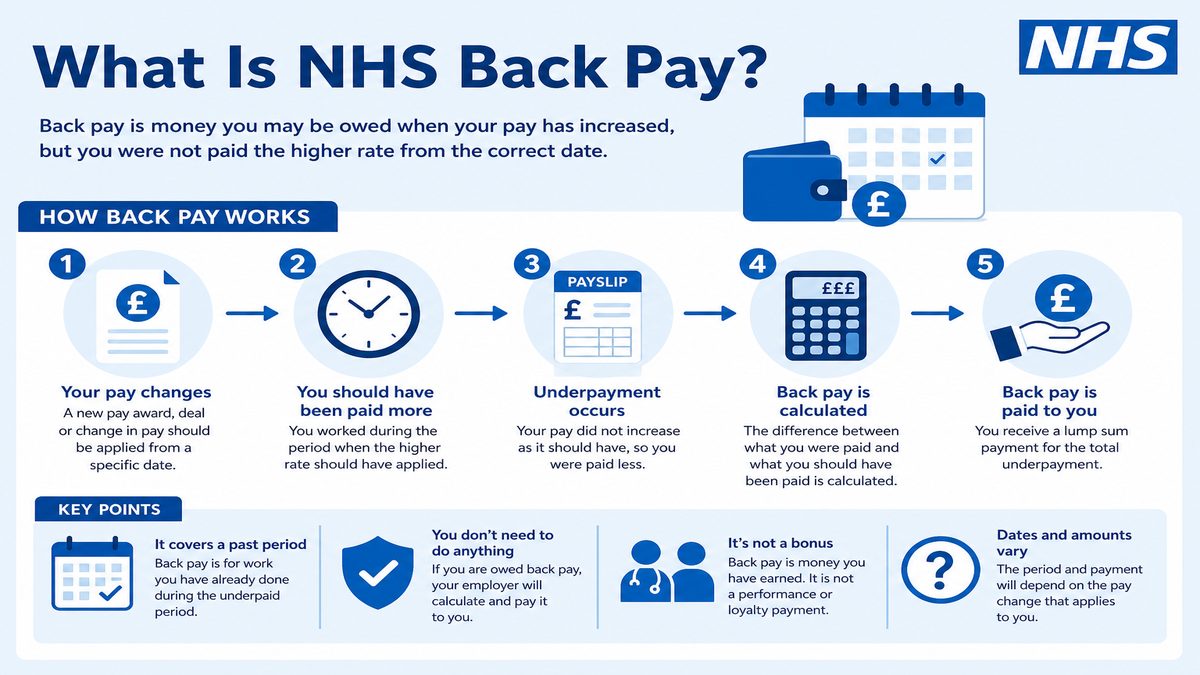
NHS back pay — referred to on your payslip as arrears of pay — is the difference between the salary you should have been paid and the salary you were actually paid, owed for a defined period of past work. It arises whenever a pay change is confirmed after the date it was supposed to take effect, creating a gap between your old salary and the correct new one.
2 An NHS pay award is the annual change applied to national pay scales. For Agenda for Change staff, the NHS Pay Review Body makes recommendations and the government confirms the settlement; a consolidated award permanently raises basic pay rather than providing a one-off bonus.
When the award is confirmed after 1 April — its intended effective date — every month between 1 April and the payroll implementation date generates arrears. Those arrears are paid to you as a single lump sum, processed through PAYE alongside your regular salary in the payment month.
Three situations create NHS back pay:
Annual Pay Award Backdating. The NHSPRB recommends a percentage uplift effective from 1 April each year. If government confirmation and payroll processing occurs after April, the salary difference for every missed month is owed to you as back pay.
Promotion or Re-Banding. When a job evaluation, Annex U re-banding application, or band change carries an effective date earlier than the date payroll processed the change, the salary differential for the intervening months is owed as arrears.
Acting-Up Assignment. When a staff member works temporarily at a higher band under Section 6 of the NHS Terms and Conditions Handbook and the acting-up allowance is confirmed after the assignment began, the unpaid difference for the covered period becomes back pay.
In every case, the arrears arrive as a single lump sum. That lump sum is subject to Income Tax, National Insurance, NHS Pension contributions, and — where applicable — student loan repayments.
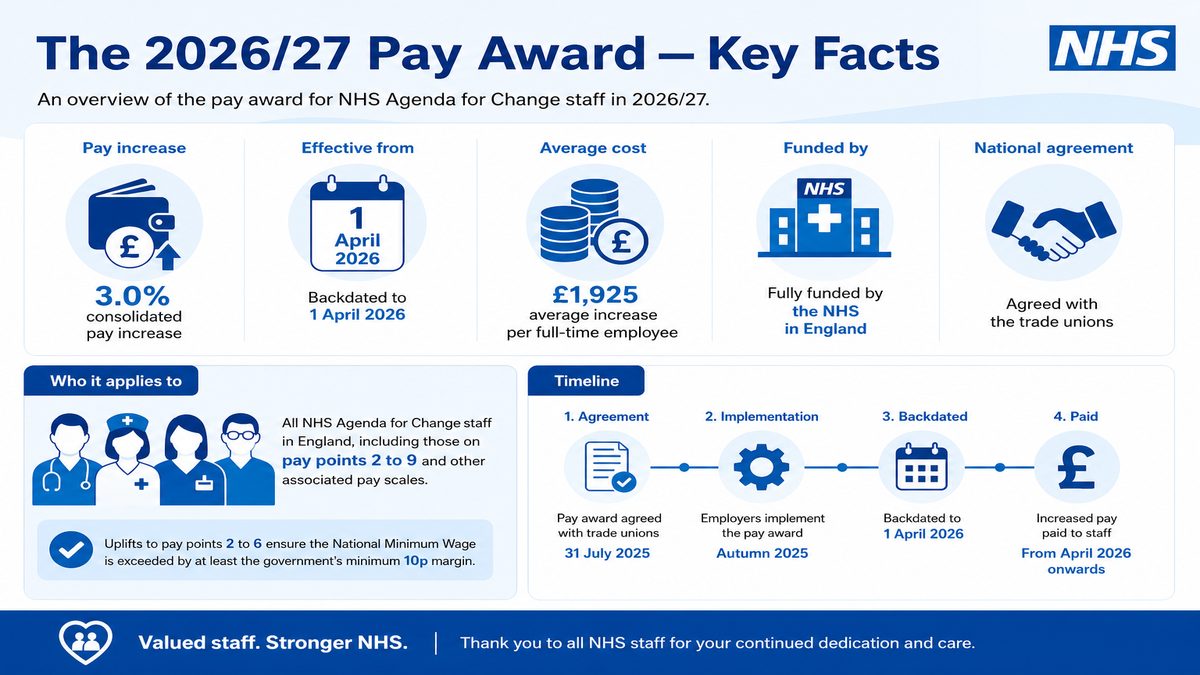
7 On 12 February 2026, the government announced the 2026/27 pay award. Staff on Agenda for Change NHS terms and conditions received a 3.3% consolidated uplift. 2 The 2026/27 Agenda for Change pay award is a confirmed 3.3% consolidated rise for NHS staff in England, effective 1 April 2026 and paid from April — the first on-time April payment in six years. 7 Electronic Staff Record (ESR) colleagues received the detail of the pay award and confirmed that the increase would be paid in April salaries, in line with ESR lead times. 9 The 2026/27 award is 3.3%, effective from 1 April 2026, and exceeds the Office for Budget Responsibility's forecast Consumer Price Index (CPI) of 2.2% for 2026, delivering a real-terms pay increase above projected inflation.
This means the majority of NHS staff on Agenda for Change contracts in England received zero months of arrears for 2026/27 — the new rate appeared in their April 2026 payslip with no backdating required. However, if your Trust's payroll processed the change late — for example in May, June, or July 2026 — you are still owed arrears from 1 April 2026 to your implementation date. Use the calculator above to check your exact position.
3 Scotland secured a better deal at 3.75% under a separate two-year agreement with the Scottish Government. 3 Scottish staff also move to a 36-hour working week from 1 April 2026 with no loss of pay, giving an additional hidden hourly rate boost of approximately 2.8%.
Understanding where 2026/27 sits in context helps you calculate what you are owed if you were employed across multiple back pay cycles.
Pay Year | Award | Effective Date | Payment Month | Months Backdated |
2024/25 | 5.5% | 1 April 2024 | October 2024 | 6 |
2025/26 | 3.6% | 1 April 2025 | August 2025 | 4 |
2026/27 | 3.3% | 1 April 2026 | April 2026 | 0 (on time) |
6 The 3.3% pay rise for 2026/27 was authorised two months before the start of the financial year, ensuring that more than 1.4 million NHS workers would see the increase in their April bank accounts, avoiding the frustration of late payments and complex back-tax calculations seen in previous cycles.
If you received a lump-sum arrears payment in October 2024 (2024/25 award) and are now checking your 2025/26 position, note that the August 2025 payment covered 4 months — April, May, June, and July 2025 — at the 3.6% differential. If you changed band, went part-time, or joined the NHS between April and August 2025, your arrears calculation differs from a standard full-time, same-band employee.
Every back pay calculation follows one formula:
(New Annual Salary − Old Annual Salary) ÷ 12 × Number of Months Backdated = Gross Back Pay
For part-time staff:
Gross Back Pay × (Contracted Weekly Hours ÷ 37.5) = Part-Time Gross Back Pay
The result is your gross arrears. Deductions for tax, NI, pension, and student loan are applied on top of this in the payment month. The net figure you actually receive will always be lower than the gross figure shown on this calculator or in any estimate.
Element | Value |
Old salary (2025/26, Band 5 entry) | £31,049 |
New salary (2026/27, Band 5 entry, +3.3%) | £32,073 |
Annual difference | £1,024 |
Monthly difference | £85.33 |
Months backdated | 4 |
Gross back pay | £341.33 |
Estimated Income Tax (20%) | −£68.27 |
Estimated NI (8%) | −£27.31 |
Estimated Pension (8.3%, Tier 3) | −£28.33 |
Estimated net back pay | ~£217 |
Element | Value |
Full-time gross back pay | £341.33 |
FTE fraction (22.5 hrs ÷ 37.5) | 0.6 |
Part-time gross back pay | £204.80 |
Estimated deductions (~35%) | −£71.68 |
Estimated net back pay | ~£133 |
Element | Value |
Old salary (2025/26, Band 7 entry) | £47,810 |
New salary (2026/27, Band 7 entry, +3.3%) | £49,396 |
Annual difference | £1,586 |
Monthly difference | £132.17 |
Months backdated | 4 |
Gross back pay | £528.67 |
Estimated Income Tax (20%) | −£105.73 |
Estimated NI (8%) | −£42.29 |
Estimated Pension (9.8%, Tier 4) | −£51.81 |
Estimated net back pay | ~£329 |
14 A Band 6 nurse at entry level earns £39,959 basic pay in Inner London. At 20% HCAS, that is £7,991.80 — below the £8,095 cap, so the full amount is received. Total pensionable pay is £47,950.80.
Element | Value |
Old base salary (2025/26, Band 6 entry) | £38,682 |
New base salary (2026/27, +3.3%) | £39,959 |
Base salary difference/month | £106.42 |
Old HCAS (20% of £38,682) | £7,736.40 |
New HCAS (20% of £39,959) | £7,991.80 |
HCAS difference/month | £21.28 |
Combined monthly difference | £127.70 |
Months backdated | 4 |
Gross back pay (base + HCAS arrears) | £510.80 |
Estimated deductions (~43%) | −£219.64 |
Estimated net back pay | ~£291 |
Note on HCAS: 14HCAS is pensionable pay. This means that while it increases your monthly income, it also increases the likelihood of you being pushed into a higher pension tier. Your payroll department calculates both the base salary arrears and the HCAS arrears retrospectively. Both appear as a combined figure in your lump-sum payment.
These figures assume: full-time (37.5 hours), standard 1257L tax code, England, no HCAS, no student loan, consistent band throughout. They are estimates only. Use the calculator above for your exact personalised figure.
Band | 2026/27 Entry Salary | 2025/26 Entry Salary | Gross Arrears (4 mths) | Est. Deductions | Est. Net Arrears |
Band 2 | £25,272 | £24,469 | ~£268 | ~£88 | ~£180 |
Band 3 | £25,883 | £25,053 | ~£277 | ~£90 | ~£187 |
Band 4 | £27,857 | £26,968 | ~£296 | ~£97 | ~£199 |
Band 5 | £32,073 | £31,049 | ~£341 | ~£124 | ~£217 |
Band 6 | £39,959 | £38,682 | ~£426 | ~£162 | ~£264 |
Band 7 | £49,396 | £47,810 | ~£529 | ~£199 | ~£330 |
Band 8a | £55,877 | £54,092 | ~£595 | ~£252 | ~£343 |
Band 8b | £65,664 | £63,567 | ~£699 | ~£320 | ~£379 |
Band 8c | £78,415 | £75,911 | ~£835 | ~£418 | ~£417 |
Band 8d | £93,848 | £90,851 | ~£999 | ~£500 | ~£499 |
Band 9 | £113,047 | £109,436 | ~£1,204 | ~£612 | ~£592 |
Deductions are higher as a percentage in Band 7 and above because earnings approach or exceed the higher-rate Income Tax threshold of £50,270, where marginal Income Tax rises from 20% to 40%.
Back pay is deferred salary — money you have already earned but have not yet received. HMRC treats it as normal income. It is not a bonus, it is not a windfall, and it does not receive any special tax treatment. In the payment month, your arrears are combined with your regular monthly salary, and the combined figure is processed through PAYE in exactly the same way as any other month's pay.
The 2026/27 Income Tax thresholds for England, Wales, and Northern Ireland are:
Threshold | Annual | Monthly |
Personal Allowance | £12,570 | £1,047.50 |
Basic Rate (20%) | £12,571 – £50,270 | £1,047.51 – £4,189.17 |
Higher Rate (40%) | £50,271 – £125,140 | £4,189.18 – £10,428.33 |
Additional Rate (45%) | Above £125,140 | Above £10,428.33 |
The critical point: if the combined total of your regular monthly pay plus your back pay exceeds £4,189 in the payment month, the excess is taxed at 40%, not 20%. This is a one-month effect, not a permanent change to your tax position.
HMRC's cumulative PAYE system automatically corrects any over-deduction. Tax code 1257L is a cumulative code, meaning HMRC recalculates your year-to-date tax liability every month. If you are over-taxed in the back pay month, the system automatically reduces your tax in the following months to compensate. You do not need to contact HMRC or file a separate claim.
Scotland: Scottish income tax operates on six bands — Starter (19%), Basic (20%), Intermediate (21%), Higher (42%), Advanced (45%), and Top (48%). Scottish NHS staff receiving back pay will have the lump sum assessed against Scottish tax bands, not UK bands. The Starter Band applies to earnings from £12,571 to £15,397. The Intermediate Band (21%) applies from £15,398 to £27,491. This means Scottish NHS staff in Bands 2–4 pay a marginally higher marginal rate than equivalent staff in England on the same income.
Employee National Insurance for 2026/27 operates as follows:
NI Category | Weekly Earnings | Annual Equivalent | Rate |
Below Lower Earnings Limit | Below £123/week | Below £6,396 | 0% |
Below Primary Threshold | £123–£242/week | £6,396–£12,570 | 0% |
Main Rate | £242–£967/week | £12,570–£50,270 | 8% |
Upper Rate | Above £967/week | Above £50,270 | 2% |
Your back pay is included in that month's NI calculation. If the combined pay for the month exceeds the Upper Earnings Limit of £967/week (annualised at £50,270), the excess is charged at only 2%, not 8%. NI is calculated month by month — there is no cumulative correction system for NI as there is for Income Tax.
Back pay is pensionable pay. 10As of 1 April 2026, the NHS Pension contribution rates are: 5.2% for earnings up to £13,259; 6.5% for £13,260 to £28,854; 8.3% for £28,855 to £35,155; 9.8% for £35,156 to £52,778; 10.7% for £52,779 to £67,668; and 12.5% for earnings of £67,669 and above. These thresholds have been uplifted by a 3.8% Consumer Price Index (CPI) indexation rate.
11 Thresholds for 2026/27 were uplifted by 3.8% (September 2025 CPI), above the 3.3% AfC pay award. Most members did not drift into a higher contribution band despite getting a pay rise. 11 Contributions are based on your actual pensionable pay, not whole-time-equivalent. Part-timers pay the rate that fits what they actually earn. 10 Employers contribute a flat rate of 23.7% of pensionable pay, making the NHS Pension Scheme one of the most generous in the UK. This employer contribution does not come out of your pay — it is an additional cost borne by your employer on top of your gross salary. 16 Since pension contributions are paid before income tax is calculated, you do not pay tax on that income. For a basic-rate taxpayer (20%), a £100 pension contribution only costs £80 in net take-home pay.
What is and is not pensionable:
15 The following ARE pensionable: basic salary, High Cost Area Supplements (HCAS), recruitment and retention premiums, and on-call availability supplements. The following are NOT pensionable: overtime payments (in most cases), expense reimbursements, one-off non-consolidated payments, and car allowances.
Northern Ireland (HSC Pension Scheme): 13Northern Ireland contribution rates are marginally higher than England and Wales at each tier. The maximum rate is 12.7% compared to 12.5% in England. The employer contribution rate in Northern Ireland is 23.2%.
Scotland (SPPA): Scottish NHS staff pay different contribution rates set by the Scottish Public Pensions Agency. 12Scottish NHS staff pay slightly different contribution rates set by the Scottish Public Pensions Agency (SPPA). Select "Scotland" in the calculator above to apply SPPA tiers automatically.
Annual Allowance: 15The standard Annual Allowance is £60,000 for 2026/27. This is the maximum total pension input — your contributions plus employer contributions plus growth in benefits — before tax charges apply. Back pay received in a single tax year contributes to your pensionable earnings for that year and therefore to your Annual Allowance calculation. Band 8c, 8d, and Band 9 staff should be aware of this.
If you have an active student loan, repayments are deducted on the earnings above your plan threshold in the payment month. The back pay is included in that month's earnings for this calculation.
Plan | Annual Threshold (2026/27) | Monthly Threshold | Deduction Rate |
Plan 1 | £24,990 | £2,082 | 9% above threshold |
Plan 2 | £27,295 | £2,275 | 9% above threshold |
Plan 4 (Scotland) | £27,660 | £2,305 | 9% above threshold |
Plan 5 | £25,000 | £2,083 | 9% above threshold |
Postgraduate Loan | £21,000 | £1,750 | 6% above threshold |
Example: A Band 5 nurse on Plan 2 earns £32,073/year (£2,673/month). She receives £341 in back pay. Combined monthly income is £3,014. The Plan 2 monthly threshold is £2,275. She repays 9% of (£3,014 − £2,275) = 9% of £739 = £66.51 in student loan deductions for that month, instead of her usual 9% of (£2,673 − £2,275) = £35.82. The extra student loan deduction on the back pay alone is £30.69.
Yes, and this is one of the most important practical considerations for lower-band NHS staff.
Universal Credit is calculated on a monthly assessment period. Your UC payment for each month is based on the earnings reported to DWP by HMRC through Real Time Information (RTI) for that assessment period. When your NHS employer reports your back pay lump sum to HMRC in the payment month, DWP receives that combined figure and uses it to calculate your UC entitlement for that period.
The effect:
Situation | Impact |
Back pay pushes earnings above work allowance | UC is tapered at 55p for every £1 earned above the work allowance |
Back pay pushes earnings to nil-award threshold | UC payment for that month may be reduced to £0 |
Nil award in back pay month | Passported benefits (free prescriptions, free school meals, housing benefit) may be suspended for that month |
The instalment option: Some NHS Trusts allow you to request that back pay is paid in multiple instalments spread across several months rather than as a single lump sum. Receiving the arrears across three or four months instead of one can keep your monthly earnings below the UC threshold and protect your entitlement each period. Contact your payroll department or ESR self-service portal to check whether your Trust offers this.
Tax and NI are the same either way. Whether you receive the back pay as one payment or across multiple instalments, the total Income Tax and National Insurance you pay across the year remains identical. The only thing the instalment option changes is the timing of income for benefits assessment purposes.
Part-time Agenda for Change staff receive back pay pro-rated to their contracted hours using the FTE (Full-Time Equivalent) fraction:
FTE = Contracted Weekly Hours ÷ 37.5
FTE Reference Table:
Contracted Hours | FTE | Back Pay Multiplier |
37.5 hrs (full-time) | 1.0 | × 1.0 |
30 hrs | 0.8 | × 0.8 |
26.25 hrs | 0.7 | × 0.7 |
22.5 hrs | 0.6 | × 0.6 |
18.75 hrs | 0.5 | × 0.5 |
15 hrs | 0.4 | × 0.4 |
Example: A Band 6 healthcare assistant working 22.5 hours per week (0.6 WTE) at entry point. Full-time gross back pay for 4 months = £426. Part-time gross back pay = £426 × 0.6 = £255.60 gross.
Pension tier for part-time staff: 11Contributions are based on your actual pensionable pay, not whole-time-equivalent. Part-timers pay the rate that fits what they actually earn. A Band 7 physiotherapist working 0.5 WTE earns an actual salary of approximately £24,698/year — placing them in Tier 2 (6.5% pension), not the Tier 4 (9.8%) rate that applies to the full-time equivalent salary. This means part-time staff retain a higher net percentage of their back pay.
Important exception for Scotland from April 2026: 3Scottish staff move to a 36-hour working week from 1 April 2026 with no loss of pay. If you are a Scottish NHS employee, your FTE denominator is 36 hours, not 37.5. The calculator above applies the correct 36-hour denominator automatically when you select Scotland.
If you work in a High Cost Area Supplement zone, your HCAS payment increases with the pay award. 14For NHS staff working in London and the surrounding counties, the standard Agenda for Change pay bands are supplemented by the High Cost Area Supplement, designed to compensate for the significantly higher cost of living in the capital.
14 The amount of HCAS you receive depends entirely on which zone your place of work falls into. This is based on your work location, not your home address.
HCAS Zones and 2026/27 Rates:
Zone | Rate | Minimum (Annual) | Maximum (Annual) |
Inner London | 20% of basic salary | £5,302 | £8,095 |
Outer London | 15% of basic salary | £4,304 | £5,765 |
Fringe | 5% of basic salary | £1,234 | £2,055 |
14 Inner London HCAS caps for 2026/27 are: minimum payment of £5,302 and a maximum payment of £8,095.
Because the 3.3% pay award raised basic salaries by 3.3%, HCAS amounts calculated as a percentage of basic salary also rose by 3.3%. The difference between your old HCAS amount and your new HCAS amount is owed to you as part of your arrears.
Pension tier risk with HCAS: 15If your basic salary is £32,073 but you receive £4,000 in HCAS, your pensionable pay is £36,073 — putting you in Tier 4 (9.8%) rather than Tier 3 (8.3%). The HCAS arrears added on top of your regular monthly pensionable pay in the payment month may temporarily push you into a higher contribution tier for that month.
Scottish NHS staff under Agenda for Change have a separate calculation from England, Wales, and Northern Ireland across every dimension of the back pay formula.
Factor | England / Wales / NI | Scotland |
2026/27 pay award | 3.3% | 3.75% |
Standard working week | 37.5 hours | 36 hours (from 1 April 2026) |
Pay circular source | NHS Employers | Scottish Government MSG Circular PCS(AFC)2025/8 |
Pension scheme | NHS Pension Scheme (NHSBSA) | SPPA (Scottish Public Pensions Agency) |
Income tax bands | UK rates (5 bands) | Scottish rates (6 bands) |
Tax on back pay | Max 20% basic / 40% higher | Max 21% Intermediate / 42% Higher |
3 Scotland negotiated a separate deal with the Scottish Government and secured a 3.75% rise for 2026/27 — part of a two-year agreement confirmed in 2025.
Scottish staff receive a higher gross back pay (3.75% uplift vs 3.3%) but may receive a lower net back pay than an equivalent English colleague due to Scotland's higher marginal income tax rates.
7 Electronic Staff Record (ESR) colleagues received confirmation that the increase would be paid in April salaries, in line with ESR lead times.
Your back pay should appear as a separate, identifiable line item on your payslip. Here is what to look for:
Payslip Line | What It Means |
Arrears of Pay or Back Pay | Your gross arrears as a distinct earnings line — separate from your regular monthly salary |
Basic Pay | Your new monthly salary at the uplifted rate |
HCAS Arrears (if applicable) | Backdated HCAS difference — appears separately or combined with Arrears of Pay depending on your Trust's payroll system |
Income Tax | Total tax deducted on the combined month's pay (regular + arrears) |
National Insurance | Total NI on the combined month's pay |
NHS Pension | Pension contribution on the combined pensionable pay for the month |
Student Loan (if applicable) | 9% or 6% on earnings above your threshold for the month |
Net Pay | Your total take-home: regular monthly salary + arrears, minus all deductions |
If your payslip does not show an arrears line: Contact your employer's payroll department and quote the NHS Employers pay circular for your nation, the effective date (1 April 2026), and your band and pay point. Your payroll team holds your definitive tax code, pension tier, and all local allowances. They are the authoritative source for your exact figure — not this calculator, which provides estimates only.
If your net pay looks lower than expected: Check whether the combined monthly income pushed you into the higher Income Tax band (above £4,189/month). If it did, your PAYE tax code should self-correct in the following month under the cumulative PAYE system.
Most NHS Trusts process back pay within one payroll cycle after the national pay circular is published by NHS Employers. 6For 2026/27, NHS workers received their pay award on time in April, avoiding the delays and backdating issues that have plagued previous pay rounds. If your Trust's April payroll closed before the ESR update was applied, processing in the May or June payroll cycle is normal.
Yes. If you were employed on an Agenda for Change contract during the backdated period, you are entitled to arrears for the months you worked. Your former employer's payroll department is legally obligated to calculate and pay the arrears. Contact them directly, providing your ESR number, employment dates, band, and pay point. You do not need to be currently employed to receive back pay owed to you.
Yes. NHS back pay is pensionable income. Pension contributions are deducted from your arrears at your applicable tier rate. The arrears count towards your pensionable earnings for the year under the 2015 NHS CARE Pension Scheme, which accrues 1/54th of pensionable earnings per year. A larger lump sum in a single month therefore contributes to a marginally higher annual pension accrual for that year.
No. 1Actual take-home pay may increase by less than 3.3% because of income tax, National Insurance and pension deductions. However, the cumulative PAYE system (tax code 1257L) recalculates your year-to-date tax liability every month. If the back pay month causes over-deduction, the system automatically reduces tax in subsequent months. Your total Income Tax for the full tax year is identical whether you receive the pay in monthly instalments or as a lump sum.
It can in the payment month, but it does not permanently change your contribution tier. Pension tiers are assessed on your annual pensionable pay. A single high-earning month does not reset your tier for the rest of the year. Your payroll department recalculates the annual position at the year end.
3 The NHS pay rise for 2026/27 is confirmed at 3.3% for all Agenda for Change staff in England, Wales, and Northern Ireland, effective 1 April 2026, with no delays or backdating. Wales and Northern Ireland received the same 3.3% award on the same timetable. Pension contribution rates differ marginally in Northern Ireland — the top tier is 12.7% versus 12.5% in England and Wales.
A consolidated pay award becomes part of your permanent base salary from the effective date. Every month's arrears is the difference between your new (higher) consolidated salary and your old salary. All AfC pay awards since 2023/24 have been 100% consolidated.
A non-consolidated payment is a one-off lump sum that does not affect your base salary, your pension accrual, or future pay award percentage calculations. The 2022/23 pay settlement included a non-consolidated element alongside a consolidated rise. For 2026/27, the entire 3.3% is consolidated — there is no non-consolidated component.
NHS bank staff who were paid at AfC-equivalent rates during the backdated period are typically entitled to back pay on the hours they worked. Arrears are calculated on the difference in hourly rate multiplied by the hours worked during the backdated months. The calculation requires your actual bank timesheets. Contact your Trust's temporary staffing unit or bank office for confirmation and to trigger the arrears calculation.
Use the same formula. Subtract your old band's monthly salary from your new band's monthly salary, then multiply by the number of months between the effective date of the promotion and the date payroll processed the change.
Example: Promoted from Band 5 (£32,073/year = £2,672.75/month) to Band 6 (£39,959/year = £3,329.92/month) effective 1 February 2026, but payroll processed the change in April 2026. Months owed: February, March = 2 months. Gross arrears = (£3,329.92 − £2,672.75) × 2 = £657.17 × 2 = £1,314.33 gross.
If you progressed from one pay point to the next (for example, from Band 5 entry to Band 5 top) during the backdated period, your arrears must be calculated in two segments: months at the old pay point and months at the new pay point, each with the correct before-and-after salary figures. Your employer's payroll department handles this calculation automatically if ESR is updated correctly.
Common reasons for the net figure being lower than estimated:
Contact your payroll department for the definitive breakdown.