 Take Home Pay
Take Home Pay
Take Home Pay
This NHS on-call and standby pay calculator separates the two cash questions staff actually ask: “What do I get just for being available?” and “What do I get when I am called out?” It models Agenda for Change Annex 29 principles using the national interim frequency percentages (still the usual Trust benchmark) or a local flat session rate, then adds work-done pay at time-and-a-half or double time on public holidays.
Official sources: NHS Employers on-call resources · NHS Terms and Conditions Handbook (Annex 29) · Pay scales 2026/27.
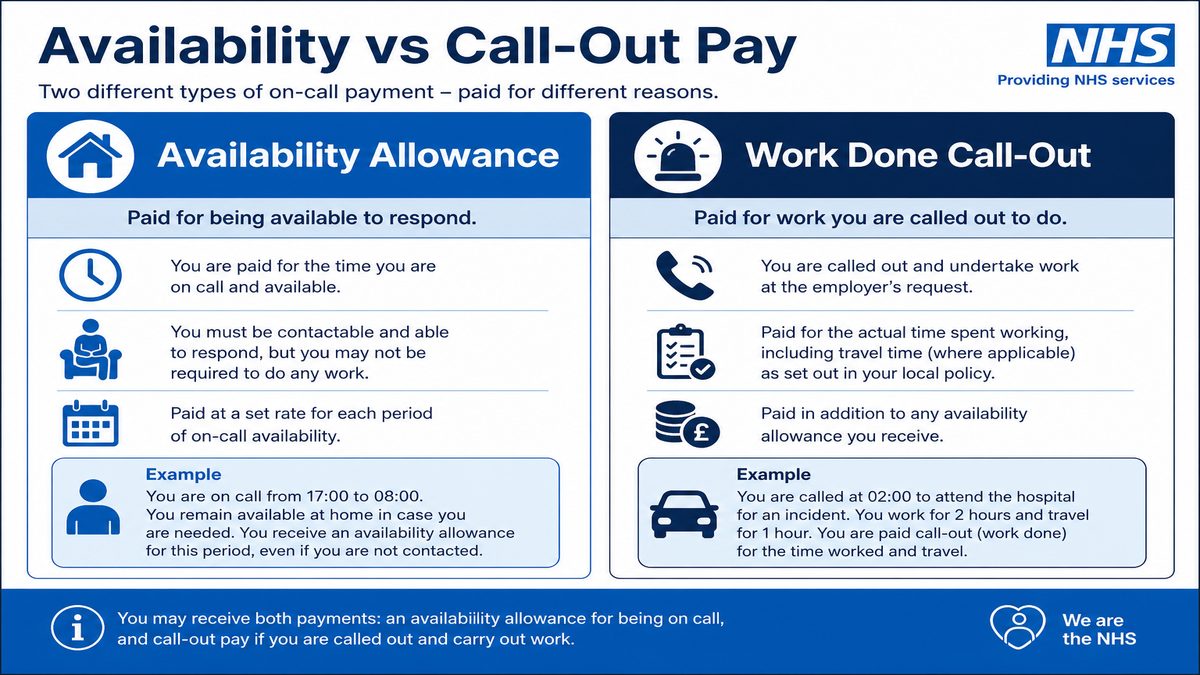
Under the NHS Terms and Conditions of Service Handbook, a member of staff is on-call when, as part of an established arrangement, they are available outside normal working hours — at home, at the workplace, or elsewhere — to work as and when required. From 1 April 2011, the availability allowance is agreed locally, but local schemes must follow the twelve principles in Annex 29.
Two payments must not be mixed up:
NHS Employers’ worked example: Alex is on-call 6pm–8am and called in 4am–8am. Alex receives the availability allowance for the rostered on-call window, then time-and-a-half for the four hours of work done (including travel). Staff cannot receive Section 2 unsocial-hours payments and on-call payments for the same hours.
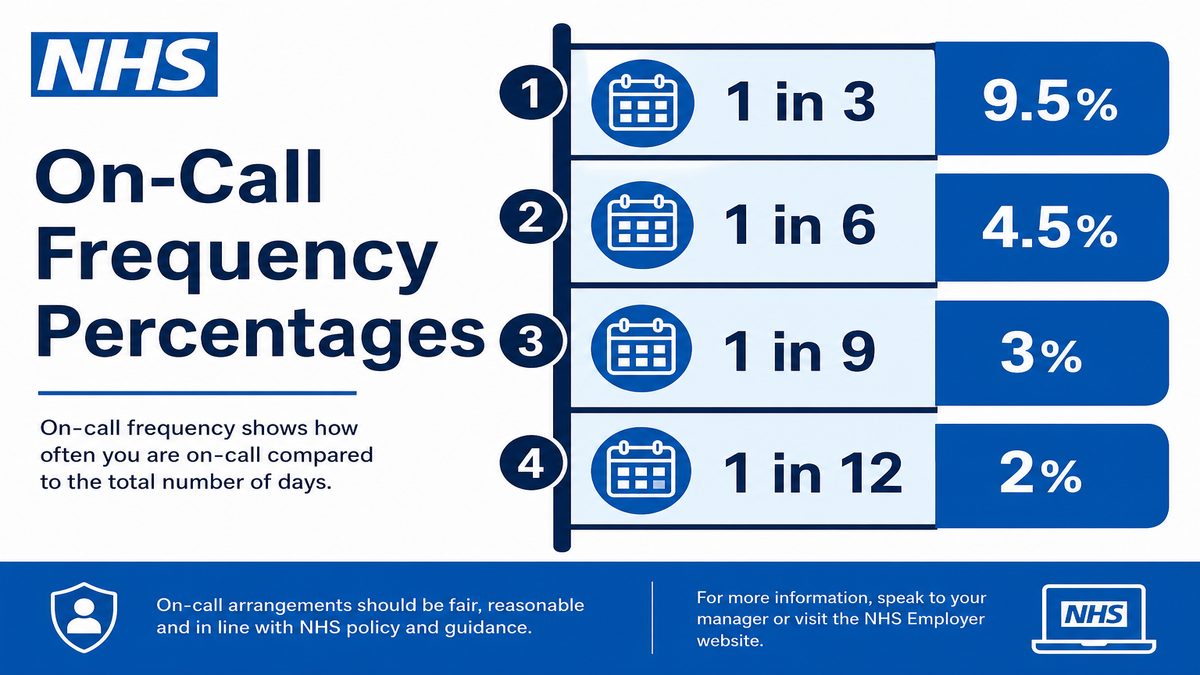
Many Trust policies still mirror the Agenda for Change interim regime archived in Annex 29. That model divides each week into nine on-call periods of at least 12 hours and pays a percentage of basic pay according to how often you cover those periods:
| Average frequency | Enhancement of basic pay |
| 1 in 3 or more frequent | 9.5% |
| 1 in 6 to less than 1 in 3 | 4.5% |
| 1 in 9 to less than 1 in 6 | 3% |
| 1 in 12 to less than 1 in 9 | 2% |
| Less frequent than 1 in 12 | Local agreement (not above the 2% floor band under interim fairness wording) |
Example: Band 5 entry £32,073 on a 1-in-3 rota → availability ≈ 9.5% × £32,073 = £3,046.94 a year (~£253.91 a month) before tax, before any call-outs.
HCAS is excluded from basic when calculating percentage-based on-call availability, matching the Handbook rule that high-cost area supplements do not count toward on-call availability calculations.
The interim regime requires part-time staff to receive a fair cash payment for the same length of availability as full-time colleagues. In practice that means matching full-time equivalent cash for the same rota slots, not mechanically applying 9.5% to a half-time salary (which would underpay). Toggle “Match full-time cash for the same rota” in the calculator when you are part-time on a shared on-call list.
When you are called to work during an on-call period, Annex 29 / interim text pays:
Bands 8 and 9 are not disqualified from call-out overtime under the interim wording. Local agreements may also set a minimum paid period (often one hour) instead of separately recognising short travel.
If your question is about night/Saturday enhancements while rostered (not on-call availability), use the unsocial hours calculator or the bank shift pay calculator instead.
Annex 29 recognises three availability types:
Some Trusts price all three with the same percentage table; others use flat session rates that differ by category (for example a lower £/hour for standby than for home on-call). Use the flat-rate mode when your policy quotes a fixed session payment. Sleeping-in also engages National Minimum Wage “expected wakefulness” rules — local partnerships must check those separately.
Availability allowances that are paid regularly are typically treated as pensionable under Trust practice and NHS Employers FAQs for certain entitlements (for example redundancy reference pay where regularly paid). Work done above contracted hours is often non-pensionable overtime. The calculator defaults to treating the availability line as pensionable and leaves call-out in the gross total — always reconcile against your ESR / pensionable pay lines.
Regular on-call also feeds annual leave pay calculations where Section 13.9 requires pay as if at work, including regularly paid outside-normal-hours payments.
Start with your Trust on-call policy PDF and the on-call line on your payslip, then paste the monthly total into the manual override if the local scheme is non-standard.
Under the interim reference model, availability is 2%–9.5% of basic pay depending on rota frequency, plus call-out at time-and-a-half (double time on public holidays). Local Annex 29 agreements can replace the percentage with a flat session rate.
It means you cover on-call for one defined period out of every three on average (measured over a full rota or 13 weeks). In the interim table that attracts a 9.5% enhancement of basic pay.
No. The Handbook states staff cannot receive unsocial hours payments and on-call / extended service cover payments for the same hours of work.
In the interim regime, the availability enhancement already recognises advice given by telephone during availability. Physical or remote work done is then paid as work done on-call.
Workers are entitled to 11 consecutive hours’ rest in each 24-hour period. If on-call work interrupts that, equivalent compensatory rest must be provided as soon as possible — see NHS Employers on-call FAQs.
Regularly paid on-call allowances can count for redundancy reference pay and for some parental-pay averages. For ordinary sickness, on-call is generally excluded unless the absence is work-related injury/disease under Section 14.4.
Compare with unsocial hours, overtime, bank shift pay, tax, and the full calculators hub.