 Take Home Pay
Take Home Pay
Take Home Pay
Use this calculator to estimate exactly how much you will receive if you claim a refund of your NHS Pension contributions. Enter your total pensionable pay, your scheme membership period, and your scheme section. The calculator applies the Contributions Equivalent Premium (CEP) deduction and HMRC income tax deduction to return your estimated net refund — the actual amount paid into your bank account.
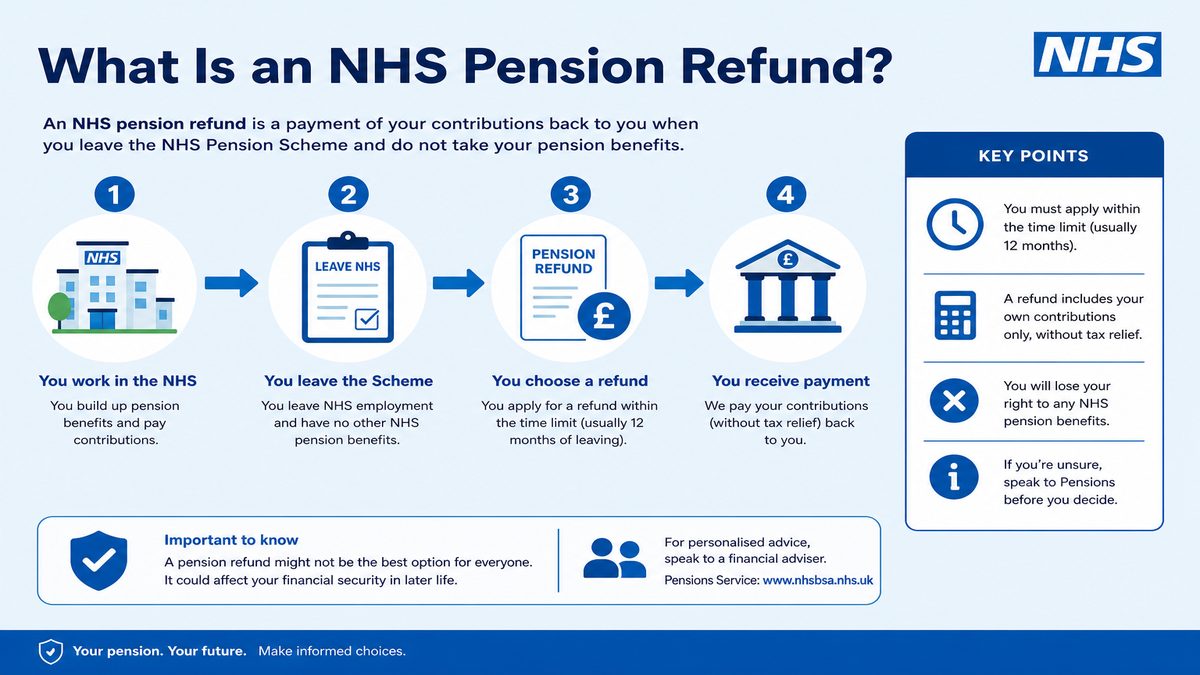
An NHS pension refund is the return of your own employee pension contributions when you leave the NHS Pension Scheme before building up enough qualifying membership to preserve your pension benefits. 28If you have less than two years' membership, including any linking membership in the 1995/2008 Scheme prior to moving to the 2015 Scheme, you may be able to have your own contributions refunded, less income tax and National Insurance deductions.
The refund amount you receive is always less than the total contributions you paid. Two mandatory deductions reduce your gross contributions before payment reaches you:
Deduction 1 — Contributions Equivalent Premium (CEP): 20When you receive a refund of pension contributions, you must be reinstated into the State Second Pension (S2P). A Contributions Equivalent Premium (CEP) is paid over to HMRC to reinstate you. Both you and your employer pay the CEP — a deduction is made from your refund for your share of the CEP.
Deduction 2 — Income Tax: 8Income tax is deducted before NHS Pensions refund your pension contributions. 15Tax is applied at 50% for refunded contributions over £20,000, after the Contributions Equivalent Premium deduction. Income tax is deducted regardless of any tax relief due at the time of the refund or allowable when contributions were originally paid. You cannot reclaim this tax from HMRC.
8 Employer pension contributions are not refunded. Only the employee contributions deducted from your payslips are eligible for return.
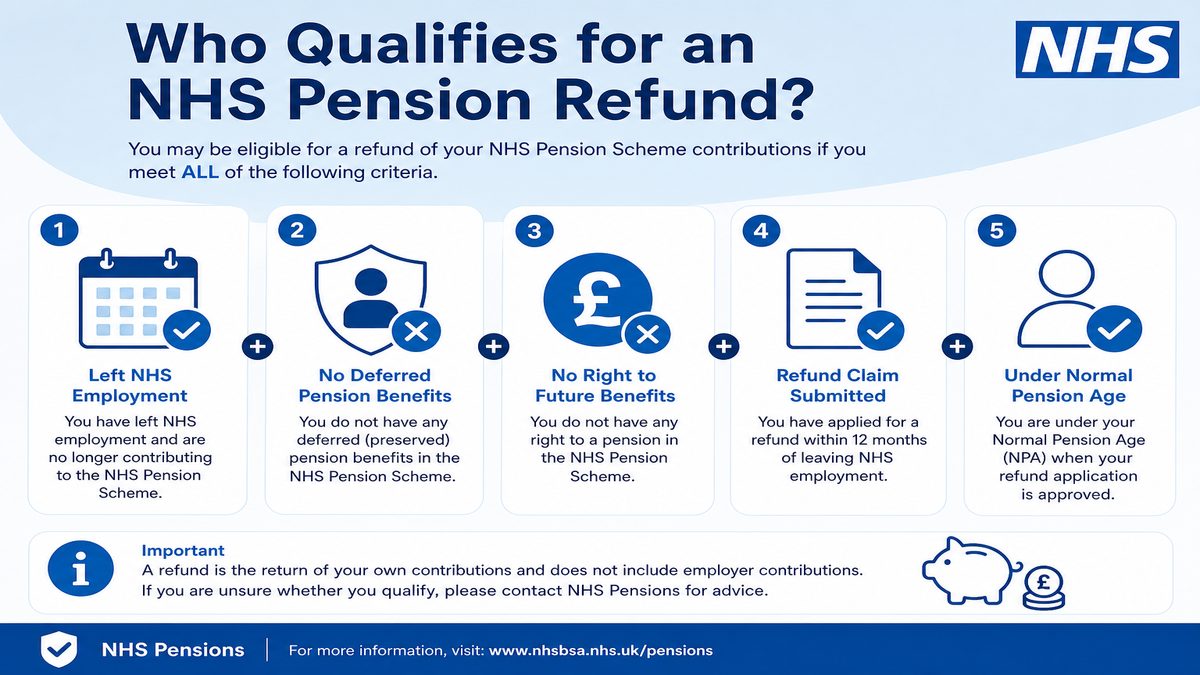
1 You may get a refund of your contributions if you left the scheme before your Normal Pension Age and have less than 2 years qualifying membership in the scheme, including membership in previous sections of the scheme.
Three conditions must all be met simultaneously:
25 Qualifying membership is your calendar length membership — the total number of days between your start and end date. 729 days is equal to 2 years. 25 All periods of membership are calculated together when working out your calendar length membership unless you have a disqualifying break in membership. 24 If you have more than two calendar years of service, your pension is preserved in the scheme and a refund is not possible. 28 If you were a member of the 1995/2008 Scheme before moving to the 2015 Scheme, your 1995/2008 Scheme membership is linked to your 2015 Scheme membership to determine whether, in total, you have more than two years' membership. You cannot isolate a short spell in one section if combined total membership exceeds two years.
15 A refund can only be made if a member has opted out of or left all pensionable NHS employments. 15 The exception is when a person has jobs that equate to more than whole time — in this case, an employer locally returns the contributions taken on any hours in excess of whole time. You do not need to complete an RF12 form; contact your employer directly instead.
If you transferred benefits into the NHS Pension Scheme from a personal or stakeholder pension at any point, you are not eligible for a refund of contributions.
8 If you claim your pension benefits, return to work and rejoin the scheme, you cannot claim a refund of any contributions made to the new membership.
If you have reached your Normal Pension Age during the period of membership for which you are requesting a refund, a refund is not available. At that point, your benefits are payable as a pension.
A disqualifying break is the length of time out of the scheme that separates one period of membership from another. When a disqualifying break occurs, periods of membership are treated independently for refund purposes.
8 A disqualifying break is a break of 12 months or more in the 1995 and 2008 Section, or more than 5 years in the 2015 Scheme.
Scheme Section | Disqualifying Break Threshold | Scheme Type |
1995 Section | 12 months or more | Final salary |
2008 Section | 12 months or more | Final salary |
2015 Scheme | More than 5 years | Career Average (CARE) |
24 Since 1 April 2022, all active members are contributing to the 2015 scheme. Service in the 1995/2008 section counts towards the two years' qualifying service required to preserve benefits.
Practical example of how disqualifying breaks work:
25 If you leave the 1995/2008 Scheme with less than two years' membership and do not return within 12 months of leaving, that period will be refundable — even if you return later and then accrue more than two years' membership. 25 If you leave the 2015 Scheme with less than two years' membership and do not return within five years of leaving, that period will be refundable — even if you return later and then accrue more than two years' membership.
This is the exact methodology this calculator applies to estimate your net refund:
Total all employee pension contributions deducted from your payslips across your membership period. Use your payslips or your annual pension statement from NHSBSA to confirm the exact figure. 10Not all NHS income is pensionable. The following are pensionable: basic salary, High Cost Area Supplements (HCAS), recruitment and retention premiums, and on-call availability supplements. The following are not pensionable: overtime payments (in most cases), expense reimbursements, one-off non-consolidated payments, and car allowances.
9 NHS Pension contribution rates are structured as tiered deductions from employees' pensionable pay. These rates are determined by the tier system, which categorises contributions based on actual annual pensionable pay. 9 As of 1 April 2026, the contribution rates are as follows: 5.2% for earnings up to £13,259; 6.5% for £13,260 to £28,854; 8.3% for £28,855 to £35,155; 9.8% for £35,156 to £52,778; 10.7% for £52,779 to £67,668; and 12.5% for earnings of £67,669 and above.
Tier | Pensionable Pay (2026/27) | Employee Contribution Rate |
1 | Up to £13,259 | 5.2% |
2 | £13,260 – £28,854 | 6.5% |
3 | £28,855 – £35,155 | 8.3% |
4 | £35,156 – £52,778 | 9.8% |
5 | £52,779 – £67,668 | 10.7% |
6 | £67,669 and above | 12.5% |
10 Unlike income tax (which is marginal), NHS pension contributions apply to your entire salary based on which tier you fall into. This creates "cliff edges" at tier boundaries. 11 The rates are unchanged since April 2024. Only the thresholds move each year. 9 Employers contribute a flat rate of 23.7% of pensionable pay, making the NHS Pension Scheme one of the most generous in the UK. Employer contributions are never refunded — only the employee percentages listed above are refundable.
The CEP is calculated by NHSBSA using your contracted-out earnings during the membership period. The CEP applies to contracted-out service between 6 April 1978 and 5 April 2016. After 5 April 2016, contracting-out ended for all public service schemes, so this deduction may not apply to members whose entire service falls after that date.
20 You and your employer both pay the CEP. A deduction is made from your refund of pension contributions for your share of the CEP. 20 The contributions your employer paid are not refundable. Neither you nor your employer can receive a refund of the employer's contributions — they remain in the fund.
The exact CEP amount is confirmed by NHS Pensions when your RF12 is processed. The calculator uses an estimated CEP based on your contracted-out earnings and membership dates.
Income tax is applied to your refund after the CEP deduction has been made.
Refund Amount After CEP | Income Tax Rate |
First £20,000 | 20% |
Amount over £20,000 | 50% |
15 Income tax is deducted regardless of any tax relief due at the time of the refund or allowable when contributions were originally paid. You cannot reclaim this tax from HMRC.
Net Refund = Gross Employee Contributions − CEP Deduction − Income Tax
This is the figure this calculator displays. It is the actual amount deposited into your bank account.
Scenario: A Band 5 nurse in England earns £32,073 annual pensionable pay (2026/27, pay point 2). They leave the NHS after 18 months of active pensionable membership — qualifying membership under the two-year threshold.
Contribution tier: Tier 3 = 8.3% (pensionable pay of £32,073 falls between £28,855 and £35,155)
Calculation Line | Amount |
Annual pensionable pay | £32,073 |
Monthly employee pension contribution (8.3%) | £221.84 |
Total employee contributions over 18 months | £3,993.12 |
Less: CEP deduction (estimated, pre-2016 contracted-out service) | − £320.00* |
Subtotal after CEP | £3,673.12 |
Less: Income tax at 20% (on £3,673.12 — under £20,000 threshold) | − £734.62 |
Estimated net refund to bank account | £2,938.50 |
*The CEP is illustrative. Your actual CEP figure will be confirmed by NHS Pensions when your RF12 is processed. Members with no contracted-out service before April 2016 will not have a CEP deduction.
Key takeaway: This nurse paid £3,993.12 in employee contributions but receives £2,938.50 — a net reduction of 26.4% from gross contributions. This is why understanding both the CEP and tax deductions before claiming is critical.
8 If you have left employment due to sickness or redundancy, interest is added automatically before NHS Pensions refund your pension contributions. This interest increases the gross refund amount before the CEP and tax deductions are applied. The interest rate is set by the scheme regulations and applied to the full period of membership.
24 If you are contributing to the NHS pension scheme in England and Wales, apply for a refund on form RF12. 1 The RF12 is an application form for a refund of pension contributions from the NHS Pension Scheme after ceasing payments. It includes instructions for completing the form, eligibility criteria for refunds, and options for payment methods. Applicants must provide personal details and submit the form to their last NHS employer, who completes additional sections before processing the refund.
In Scotland, use form REF1 through the Scottish Public Pensions Agency (SPPA). In Northern Ireland, use form RF12(NI) through the Health and Social Care Pension Service.
8 To claim a refund, complete an RF12 form. If you're in active NHS employment, send this to your employer. You must only submit one form if you have more than one NHS employer. This must go to the most recent employer the refund period relates to. If you left that employment over 7 years ago or are no longer working in the NHS, send your RF12 form directly to NHS Pensions.
8 If your RF12 form is processed through Electronic Staff Record (ESR), it can take up to 12 weeks to process your refund request. 8 Once authorised, NHS Pensions aim to make a payment to your bank account within 7 working days. If you opt to have the refund paid to a nominee, a cheque in their name will be sent to their address.
NHS Pensions sends a letter confirming the payment of your refund to your address on record. The payment will reflect the net amount after CEP and income tax deductions.
28 Taking a refund of your own contributions is usually the least beneficial outcome for you compared with long-term pension provision. Before submitting your RF12, consider these alternatives:
24 If you have more than two calendar years of service, your pension is preserved in the scheme and a refund is not possible. If you are approaching two years, it may be worth completing the threshold to earn deferred benefits rather than taking a reduced cash refund.
27 The 2015 scheme provides for linking periods of contributions separated by breaks of five years or less, so you may prefer to delay claiming a refund until you have a firmer idea of your long-term NHS career plans. 28 If you rejoin the 2015 scheme with a break of five years or less, your previous period of contributions will link with your current period, and the pension rights you built up before the break will receive full in-scheme revaluation for each scheme year during the break.
A Cash Equivalent Transfer Value (CETV) may exceed the net refund amount because it incorporates the actuarial value of the pension benefits built up — not just your raw employee contributions minus deductions. Request a CETV quotation from NHSBSA before deciding.
8 You must opt out in the first month, and your employer may refund your first month's contribution. A first-month opt-out is processed as an employer-level payroll correction — it avoids both the CEP deduction and the tax deduction entirely, because the contributions have not yet been submitted to NHSBSA.
24 Return to NHS pensionable employment within five years (for 2015 scheme members). Even if this is just for one day, this ensures a disqualifying break is avoided. This post must be pensionable. 24 Agency work is usually not pensionable (unless it is via a direct engagement model) and would therefore not be sufficient to avoid a disqualifying break. If you work for a direction employer, your NHS membership will be seen as continuous and you will not incur a disqualifying break.
No. 4You can have a refund of your contributions if your total membership in the NHS Pension Scheme is less than 2 years. After two years, your benefits are automatically preserved as a deferred pension and cannot be converted to a cash refund.
8 If your RF12 form is processed through Electronic Staff Record (ESR), it can take up to 12 weeks to process your refund request. Once authorised, NHS Pensions aim to make a payment to your bank account within 7 working days. Total timeline from RF12 submission to bank payment: typically 8 to 14 weeks.
Yes. 8Income tax is deducted before NHS Pensions refund your pension contributions. The rate is 20% on the first £20,000 and 50% on any refunded amount above £20,000, after the CEP deduction. This tax cannot be reclaimed from HMRC.
20 When you receive a refund of pension contributions you must be reinstated into the State Second Pension (S2P). A Contributions Equivalent Premium (CEP) is paid to HMRC to reinstate you. 20 Both you and your employer pay the CEP. A deduction is made from your refund of pension contributions for your share of the CEP. The CEP applies only to contracted-out service that fell between 6 April 1978 and 5 April 2016.
No. 8Employer pension contributions are not refunded. The balance of the scheme's funding is dependent on employers' contributions remaining in the scheme.
8 To claim a refund, complete an RF12 form. In England and Wales this is the RF12, obtained from your employer or directly from NHSBSA at nhsbsa.nhs.uk. In Scotland, use REF1 via SPPA. In Northern Ireland, use RF12(NI) via the Health and Social Care Pension Service.
8 If you've claimed a refund and rejoined within one month, the refunded membership counts as qualifying membership. If you rejoin after one month, a fresh membership period begins and the refunded service does not count.
Yes. 8If you've left employment due to sickness or redundancy, interest is added automatically before NHS Pensions refund your pension contributions. This increases the gross refund before CEP and tax deductions are applied.
8 A disqualifying break is a break of 12 months or more in the 1995 and 2008 Section, or more than 5 years in the 2015 Scheme.
24 If you do not apply for a refund, the relevant pensions agency will write to you once you have incurred a disqualifying break. The letter will inform you of how to apply. The refund entitlement is not lost by inaction, but it is not paid automatically.
15 A refund can only be made if a member has opted out of or left all pensionable NHS employments. The exception is when a person has jobs that equate to more than whole time — in this case an employer locally returns the contributions taken on any hours in excess of whole time. You do not need to complete an RF12 form; contact your employer directly.
2 Contributions made through salary sacrifice arrangements cannot usually be refunded, as these are treated as employer contributions rather than personal payments. If your NHS pension contributions were made via salary sacrifice, confirm with your employer whether those specific contributions are classified as employee or employer contributions before completing your RF12.
24 Historically, 1995/2008 section members could claim a refund of contributions if they had less than two years' service at the date of leaving or opting out of the pension scheme. Historically, 1995/2008 section members were also obliged to take a refund if they had a break of 12 months. Those rules still apply to the 1995/2008 periods of membership. However, 30 from 1 April 2022, all new and active members of the NHS Pension Scheme are members of the 2015 Scheme.
12 Tier assignment is based on your annualised whole-time-equivalent pensionable pay. Part-timers on low actual pay can still be in a high percentage tier — the percentage is applied to your actual pensionable pay, so total contribution amounts scale with hours.
10 The following are pensionable: basic salary, High Cost Area Supplements (HCAS), recruitment and retention premiums, on-call availability supplements. The following are not pensionable: overtime payments (in most cases), expense reimbursements, one-off non-consolidated payments, car allowances.