 Take Home Pay
Take Home Pay
Take Home Pay
Estimate your NHS voluntary redundancy payment in under 60 seconds. This calculator applies the 2Agenda for Change Section 16 formula — one month's pay for each complete year of reckonable service, capped at 24 years — alongside the UK statutory minimum, the £30,000 tax-free threshold, part-time pro-rata adjustments, and the salary floor and cap.
To use this calculator, enter:
The calculator returns:
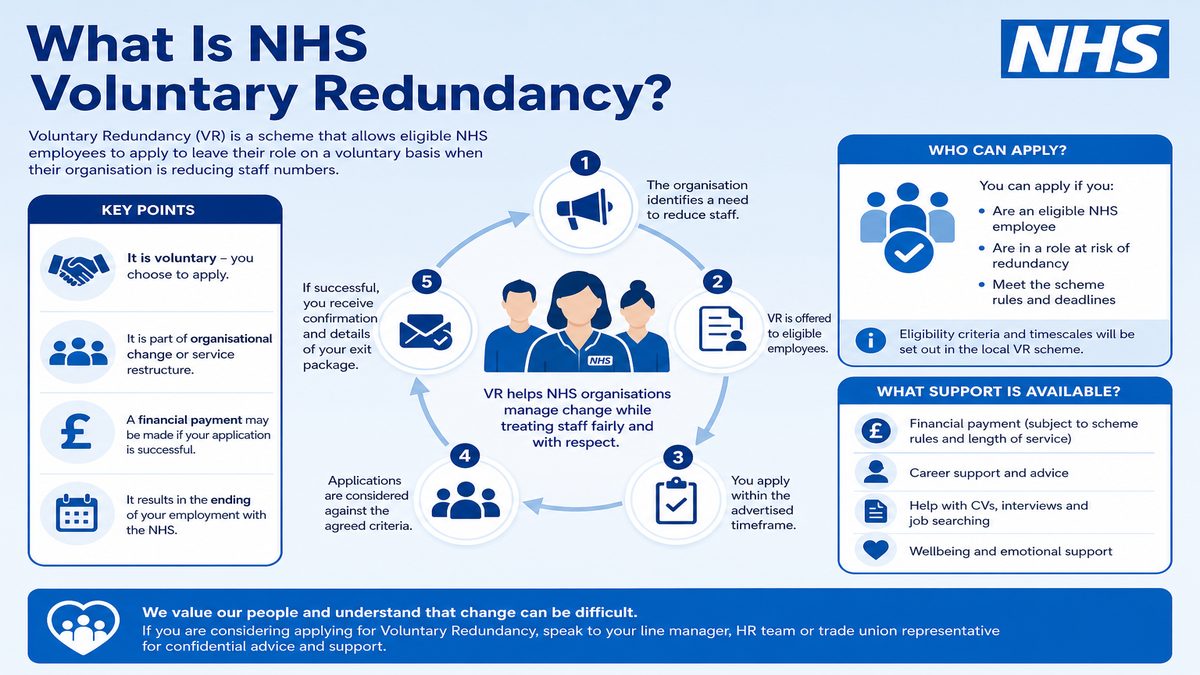
Voluntary redundancy (VR) is a process by which an NHS employee applies to leave their post during a period of organisational change, restructuring, or service closure. The employee volunteers; the employer decides whether to accept the application. There is no automatic entitlement to be accepted for voluntary redundancy — your Trust or Integrated Care Board (ICB) retains the right to refuse applications where accepting would result in the loss of critical skills.
9 Redundancy entitlements for NHS staff are determined by Section 16 of the NHS Terms and Conditions of Service (Agenda for Change) handbook, which covers employees directly employed on Agenda for Change contracts in England and those whose contracts refer to Section 16. 9 These arrangements are collectively agreed with NHS trade unions and also specify how previous NHS employment is defined and counted when determining redundancy pay.
Voluntary redundancy is a dismissal — not a resignation. Your employer dismisses you by reason of redundancy. You do not resign. This distinction has direct consequences for your eligibility for Jobseeker's Allowance, Universal Credit, and tax treatment of your payment.
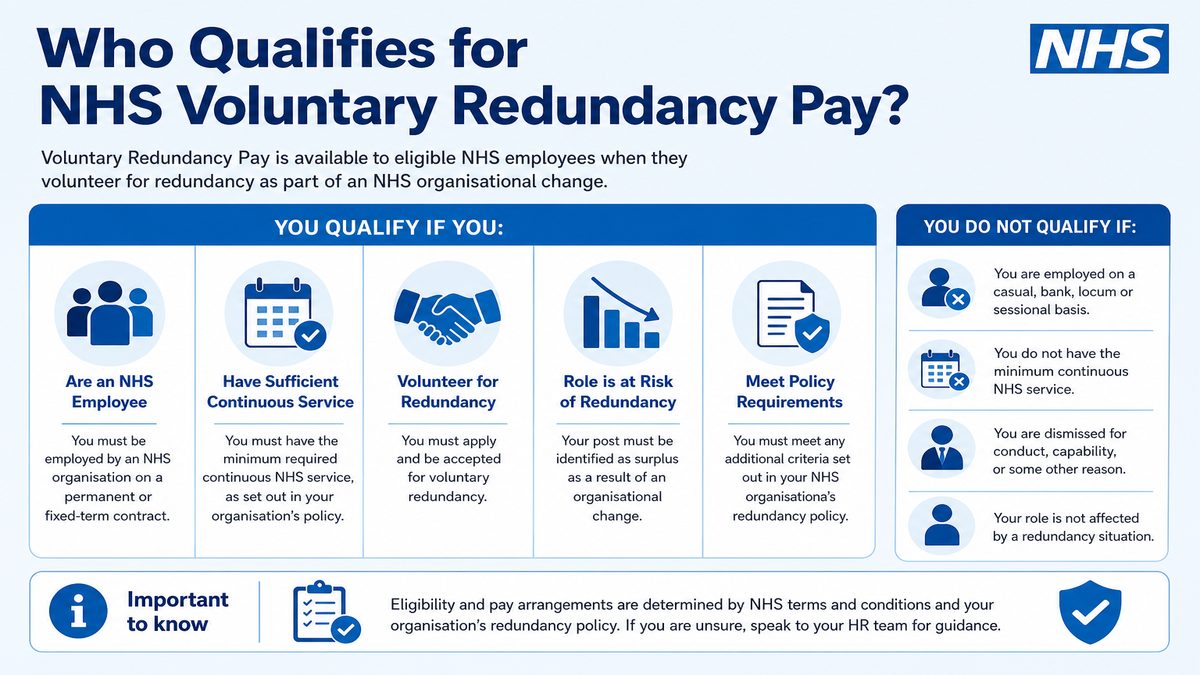
To receive a contractual redundancy payment under AfC Section 16, you must meet all four of the following conditions:
Condition 1 — Minimum continuous service:
3 To qualify for NHS contractual redundancy pay, you must have at least 2 years (104 weeks) of continuous service. This service can span more than one NHS employer, provided there are no disqualifying breaks between employments.
Condition 2 — Employment with an NHS employer:
7 Section 16.3 of the Agenda for Change handbook says that to qualify for a redundancy payment, the employee must be working under a contract of employment for an NHS employer. An NHS employer is any of the organisations listed in Annex A of the handbook, or any predecessor or successor body.
Condition 3 — Genuine redundancy: The post itself must be disappearing. Redundancy arises when a service closes, when roles are merged, or when an ICB or Trust reduces headcount due to structural reorganisation. Dismissal for conduct or capability does not trigger Section 16 entitlements.
Condition 4 — No unreasonable refusal of suitable alternative employment:
5 The NHS has a duty to try and find you suitable alternative employment to avoid making you redundant. If your Trust, or any other NHS employer, makes you a formal offer of a suitable alternative role before your current contract ends, and you unreasonably refuse that offer, you may forfeit your right to redundancy pay.
Part-time staff are fully eligible. Eligibility is not reduced by working fewer than 37.5 hours per week.
Hospital doctors, dentists, and very senior managers not employed on AfC contracts have separate arrangements and are not covered by Section 16.
8 Staff who are made redundant should receive one month's pay per year of reckonable service, with a maximum of 24 months' pay. Only full years of reckonable service can be counted when calculating redundancy pay — employment for part of a year should be disregarded. 8 A month's pay, subject to a total annual earnings floor of £23,000 and cap of £80,000, will be either an amount equal to 1/12th of the annual salary at the date of termination or 4.35 times a week's pay, whichever is more beneficial to the employee (the average month has 4.35 weeks). 8 The calculation of 4.35 times a week's pay should be made in accordance with the Employment Rights Act 1996.
Salary floor and cap (official NHSBSA position):
7 A lower limit of £23,000 and an upper limit of £80,000 has been set for the whole time equivalent salary used to calculate an employee's redundancy payment that is payable by the employer.
Part-time adjustment:
6 For part-time staff, the cap or floor is applied to the FTE salary first and then pro-rated using your contracted hours ÷ 37.5.
So a Band 5 nurse contracted to 30 hours per week has an FTE ratio of 30 ÷ 37.5 = 0.80. The full-time redundancy figure is calculated first, then multiplied by 0.80.
12 Statutory redundancy pay is calculated based on the employee's age, their completed years of service (up to 20 years), and weekly pay (capped at £751). The amount owed is worked out using set rates for each year of service: half a week's pay for each full year under age 22, one week's pay for each full year between ages 22 and 40, and one and a half weeks' pay for each full year aged 41 or over. 10 From 6 April 2026, the statutory weekly pay cap increased from £719 to £751 per week. 11 The maximum statutory redundancy pay is £22,530, reached only at 20 years' service with the highest age multiplier. 4 NHS redundancy terms are significantly more generous than the statutory minimum. In almost every case, AfC Section 16 produces a higher figure. Your employer pays whichever is higher — the contractual or the statutory amount. They do not pay both on top of each other.
Feature | NHS Contractual (AfC Section 16) | UK Statutory (ERA 1996) |
Formula | 1 month's actual pay × complete years of reckonable service | 0.5–1.5 weeks' capped pay × complete years of service |
Weekly pay cap | None — uses actual salary within £23k–£80k WTE corridor | £751 per week from 6 April 2026 |
Maximum service counted | 24 years | 20 years |
Age weighting | No | Yes (0.5 / 1.0 / 1.5 per year by age band) |
Maximum gross payment | £160,000 (24 months at £80k WTE salary) | £22,530 |
Salary floor | £23,000 WTE | No floor |
Salary cap | £80,000 WTE | £751 per week (equiv. ~£39,052/year) |
Minimum qualifying service | 2 years (104 weeks) continuous NHS service | 2 years continuous employment |
Part-time adjustment | Yes — FTE ratio applied after floor/cap | Yes — based on actual weekly pay |
Applies to | AfC employees in England | All UK employees |
This single distinction is the most frequent source of error in NHS redundancy calculations.
Continuous service is the unbroken period of NHS employment that determines whether you are eligible for redundancy pay at all. The minimum is 2 years (104 weeks). A break of more than one statutory week between NHS employers normally resets the continuous service clock.
Reckonable service is the period of qualifying service used to calculate the size of your payment. Reckonable service may be shorter than continuous service if any of the following apply:
Always confirm your reckonable service start date in writing with your NHS HR department before using this calculator. Your payslip start date and your reckonable service start date are not necessarily the same.
6 The first £30,000 of redundancy compensation is usually tax-free. Any amount above £30,000 is added to your taxable income for the year and taxed at your marginal rate. 5 Any amount above this £30,000 threshold will be subject to income tax at your normal rate — 20%, 40%, or 45%. However, National Insurance is typically not deducted from redundancy payments, even on the portion above £30,000. 6 Redundancy pay itself does not attract National Insurance, but PILON (payment in lieu of notice) usually does.
Critical distinctions for your tax calculation:
If your estimated total payment is close to £30,000, ask your employer whether any elements — such as outplacement support, career coaching, or retraining costs — can be structured outside the cash payment. These elements may qualify for separate tax treatment under HMRC rules.
Under standard AfC Section 16 terms, the base calculation formula is identical for both voluntary and compulsory redundancy. Some NHS Trusts and ICBs offer local enhancements specifically to incentivise volunteers during large-scale restructuring, but the nationally-agreed formula is the same.
Aspect | Voluntary Redundancy (VR) | Compulsory Redundancy (CR) |
Who initiates | Employee volunteers | Employer selects after fair process |
Payment formula (AfC) | Section 16 (identical base formula) | Section 16 (identical base formula) |
Local enhancements | Some Trusts offer enhanced terms to incentivise volunteers | Standard national terms only |
Redeployment obligation | Employer should explore alternatives | Employer must explore and offer alternatives |
Consultation period | Required — collective if 20+ employees affected | Required — collective if 20+ employees affected |
Right to appeal | Generally no appeal if you applied | Right to appeal selection and process |
Impact on Jobseeker's Allowance | Dismissed by reason of redundancy — you may claim | Dismissed by reason of redundancy — you may claim |
MARS is the most commonly confused alternative to voluntary redundancy. They are legally different, financially different, and strategically different.
MARS is not redundancy. 1Depending on length of reckonable service, MARS payments may be less favourable than standard AfC redundancy terms.
Feature | Voluntary Redundancy (VR) | MARS (Mutually Agreed Resignation) |
AfC Handbook section | Section 16 | Section 20 |
Legal status | Dismissal by reason of redundancy | Voluntary resignation |
Payment formula | 1 month × reckonable years (max 24 years) | Locally negotiated — varies by Trust |
Affects future redundancy? | Prior years excluded if later re-employed | Service paid out under MARS is excluded under Paragraph 20.18 |
NHS Pension access at 55+? | May trigger unreduced pension access | Does not automatically trigger pension access |
Suitable alternative employment required? | Yes — employer must explore redeployment | No redeployment period is required |
Impact on state benefits | Dismissed by redundancy — benefits claim possible | Treated as resignation — may affect benefit claims |
NHS England approval required? | No | Any proposed MARS in NHS Trusts and ICBs requires NHS England approval |
Reckonable service clock | Resets upon re-employment (6-month rule applies) | Paragraph 20.18 exclusion applies |
The most important question to ask before accepting MARS: Compare the MARS offer in writing against your AfC Section 16 entitlement using this calculator. In many cases, the redundancy entitlement is worth significantly more than the MARS offer. Once you sign a MARS agreement and resign, you cannot retrospectively claim redundancy.
5 If you are over the minimum pension age, currently 55 or 57 depending on your circumstances, you may face a choice between taking your redundancy payment as a lump sum or using it to buy out the actuarial reduction on your pension.
NHS redundancy pay and NHS pension benefits are two separate entitlements. You can generally receive both when dismissed by reason of redundancy, provided you are aged 55 or over with at least 2 years of pensionable service in the NHS Pension Scheme (1995, 2008, or 2015 section).
7 The NHSBSA can confirm whether the member is eligible to access their pension under the redundancy provisions of the NHS Pension Scheme.
For over-55s, the combined financial package — redundancy lump sum plus unreduced pension — can be substantially greater than redundancy alone. The pension calculation depends on:
Action step: Request a pension estimate from NHS Pensions before making any decision. Do not assume pension access is automatic — your employer and the NHSBSA must confirm eligibility.
Re-joining the NHS — any NHS employer — within 6 months of your redundancy date may require you to repay all or part of your redundancy payment. This applies whether you rejoin as a permanent employee, a bank worker, or through an agency supplying staff to NHS organisations.
If you are offered work within the NHS in the 6 months after your redundancy date, seek written confirmation from your new employer about the clawback position before you start work. A solicitor or your trade union can advise on the exact contractual position.
5 The NHS has a duty to try and find you suitable alternative employment to avoid making you redundant. Before accepting or applying for voluntary redundancy, confirm whether your employer has active vacancies that may constitute suitable alternative employment.
If your employer offers you a suitable alternative post before your current contract ends, and you refuse it without reasonable grounds, you lose your right to redundancy pay entirely. Whether a role is "suitable" depends on:
You have the right to a statutory four-week trial period in the alternative role. If the role proves unsuitable during that trial, you retain your redundancy entitlement.
Error 1 — Using total service instead of reckonable service. Your total NHS service and your reckonable service are not always the same number. Prior redundancy payments, MARS payments, and partial retirement all reduce reckonable service. Always obtain a written reckonable service confirmation from HR.
Error 2 — Forgetting to apply part-time pro-rata.
3 If you work part-time, floors and caps are applied to your FTE salary, not your actual salary. Apply the salary floor or cap first to the WTE figure, then apply the FTE ratio.
Error 3 — Confusing the salary floor with your actual salary. If your WTE salary is below £23,000, the calculation uses £23,000 — not your lower actual salary. 3If your FTE salary falls below the floor, it's raised to £23,000; if it exceeds the cap, it's limited to £80,000.
Error 4 — Counting partial years of reckonable service.
8 Only full years of reckonable service can be counted — employment for part of a year should be disregarded. 14 years and 11 months counts as 14 complete years, not 15.
Error 5 — Confusing statutory and contractual entitlements.
3 NHS AfC terms are usually more generous. Make sure you know which scheme applies to you.
Error 6 — Accepting MARS without comparing it to redundancy.
3 If you've received redundancy or MARS payments before, this may affect your entitlement. Run both calculations before accepting any offer.
Error 7 — Not accounting for income tax in the same year. Redundancy pay above £30,000 is taxed at your marginal rate for the whole tax year. If you receive your payment in April, you will have a full year's tax-free allowance available. If you receive it in March, most of your allowance has already been used. Timing your redundancy date can legally reduce the tax you pay.
Step 1: Confirm your reckonable service date in writing with your NHS HR department.
Step 2: Use this calculator to produce your estimated NHS contractual and statutory redundancy figures.
Step 3: If you are aged 55 or over, request a formal pension estimate from NHS Pensions before deciding.
Step 4: If MARS is also being offered, compare both figures side by side. Understand that MARS is a resignation, not a dismissal.
Step 5: Contact your trade union — UNISON, RCN, or Unite — for representation. Union reps can review your reckonable service calculation, challenge incorrect figures, and attend meetings with you.
Step 6: Do not refuse any offer of suitable alternative employment without first taking advice on whether refusal would disqualify you.
Step 7: Check the 6-month clawback position if you intend to work anywhere in the NHS after leaving.
Step 8: If a settlement agreement is presented — which is increasingly common with enhanced VR or VES packages — you are legally required to receive independent legal advice from a solicitor before signing. The employer typically contributes to this legal fee.
Step 9: If you believe the redundancy process has been conducted unfairly, contact ACAS. ACAS provides free, impartial advice and can assist with early conciliation before any Employment Tribunal claim.
2 The formula is straightforward: one month's pay for each complete year of reckonable service, capped at 24 years. A month's pay is the higher of 1/12 of your annual salary or 4.35 times your weekly pay. A salary floor of £23,000 and a cap of £80,000 applies to your FTE salary, and the maximum total payment is £160,000, pro-rated for part-time staff.
Yes. 6The first £30,000 of redundancy compensation is tax-free. Any amount above £30,000 is added to your taxable income for the year and taxed at your marginal rate. 5National Insurance is typically not deducted from redundancy payments, even on the portion above £30,000.
The base calculation formula under AfC Section 16 is identical for both voluntary and compulsory redundancy. 1Redundancy entitlements under Section 16 are collectively agreed with NHS trade unions and represent some of the most generous redundancy terms available in the UK public sector. Some Trusts offer local enhancements for voluntary redundancy only.
Reckonable service is the period of qualifying NHS service used to calculate your redundancy payment. It differs from continuous service because it excludes any years already paid out under a prior redundancy, MARS, or partial retirement. 6Paragraph 16.6 of the NHS Terms and Conditions Handbook prevents service that has already been paid out in a previous redundancy or used for pension benefits from being counted again.
2 A salary floor of £23,000 and a cap of £80,000 applies to your FTE salary, and the maximum total payment is £160,000, pro-rated for part-time staff. This maximum requires exactly 24 complete years of reckonable service and a WTE salary at or above £80,000.
10 From 6 April 2026, the statutory weekly pay cap increased from £719 to £751 per week. 11 The maximum statutory redundancy pay is £22,530, reached only at 20 years' service with the highest age multiplier. This cap applies only to the statutory calculation. NHS contractual redundancy uses your actual salary within the £23,000–£80,000 WTE corridor.
MARS (Mutually Agreed Resignation Scheme) is governed by Section 20 of the AfC handbook. It is a resignation by agreement, not a dismissal. 1Depending on length of reckonable service, MARS payments may be less favourable than standard AfC redundancy terms. MARS does not automatically trigger pension access for over-55s, and leaving under MARS may affect your entitlement to state benefits because you are treated as having resigned rather than been dismissed.
Re-joining any NHS employer within 6 months of your redundancy date may require you to repay all or part of your redundancy payment. Confirm the position with your new employer in writing before starting work.
No. Voluntary redundancy must be voluntary. Your employer cannot compel you to apply. If insufficient volunteers come forward and the Trust still needs to reduce headcount, it may begin a separate compulsory redundancy process with its own fair selection criteria.
6 The calculator converts your hours into an FTE ratio, applies the salary floor or cap to the FTE salary, calculates the full-time redundancy amount, and then pro-rates the result. Example: 18.75 hours per week equals 0.5 FTE. If the full-time redundancy amount is £21,336, the part-time payout is £10,668.
Yes. 6Paragraph 16.6 of the NHS Terms and Conditions Handbook prevents service that has already been paid out in a previous redundancy or used for pension benefits from being counted again. If you have taken partial retirement and used some of your reckonable service to access pension benefits, those years cannot be counted again in your redundancy calculation.
8 NHS Employers sets out key information and FAQs for NHS redundancy arrangements for employees under Section 16 (England) of the NHS Terms and Conditions of Service Handbook. The NHSBSA provides employer-facing guidance at nhsbsa.nhs.uk. Our calculator above applies the same Section 16 formula in a user-friendly online format.
Taking voluntary redundancy does not reduce your existing State Pension entitlement — it is based on your National Insurance record to date. However, if you stop working and making NI contributions, you may accrue fewer qualifying years going forward. 35 qualifying years are required for the full new State Pension (£11,973.60 per year in 2026/27). You can check your NI record and State Pension forecast at gov.uk/check-state-pension.
Not in every case. However, if a settlement agreement is presented alongside your voluntary redundancy package — which is increasingly common, especially with enhanced VES payments or where the employer wants a legally binding waiver of future claims — you are legally required to receive independent advice from a qualified solicitor or trade union representative before signing. Refusing to take legal advice before signing a settlement agreement makes the agreement void.
The NHS Voluntary Exit Scheme (VES) is a workforce reduction tool used during large-scale NHS England restructuring programmes. It offers a lump-sum severance payment to staff who voluntarily agree to leave, including those not currently at direct risk of redundancy. VES payment values vary between programmes and do not always follow the full AfC Section 16 formula. 1The NHS redundancy calculator for 2026/27 gives you an instant estimate of your contractual redundancy payment under Agenda for Change (AfC) Section 16, your statutory alternative, your MARS severance figure, and the tax-free breakdown. It covers all pay bands, part-time pro-rata, the salary floor and cap, over-55 pension options, and the clawback rules. Always compare a VES offer against your full Section 16 entitlement before accepting.
7 The NHSBSA can confirm whether the member is eligible to access their pension under the redundancy provisions of the NHS Pension Scheme. Redundancy pension access rules apply across the 1995 Section, 2008 Section, and 2015 Scheme, but the conditions, Normal Pension Age, and actuarial adjustment rules differ between sections. Request a multi-scheme estimate from NHS Pensions if you have service in more than one section.