 Take Home Pay
Take Home Pay
Take Home Pay
Agenda for Change staff in England, Wales and Northern Ireland receive a 3.3% consolidated pay rise for 2026/27, effective 1 April 2026, with no back pay owed. Scotland's NHS AfC staff receive 3.75% under a separate two-year deal. New Band 2–9 salaries and take-home figures follow below.
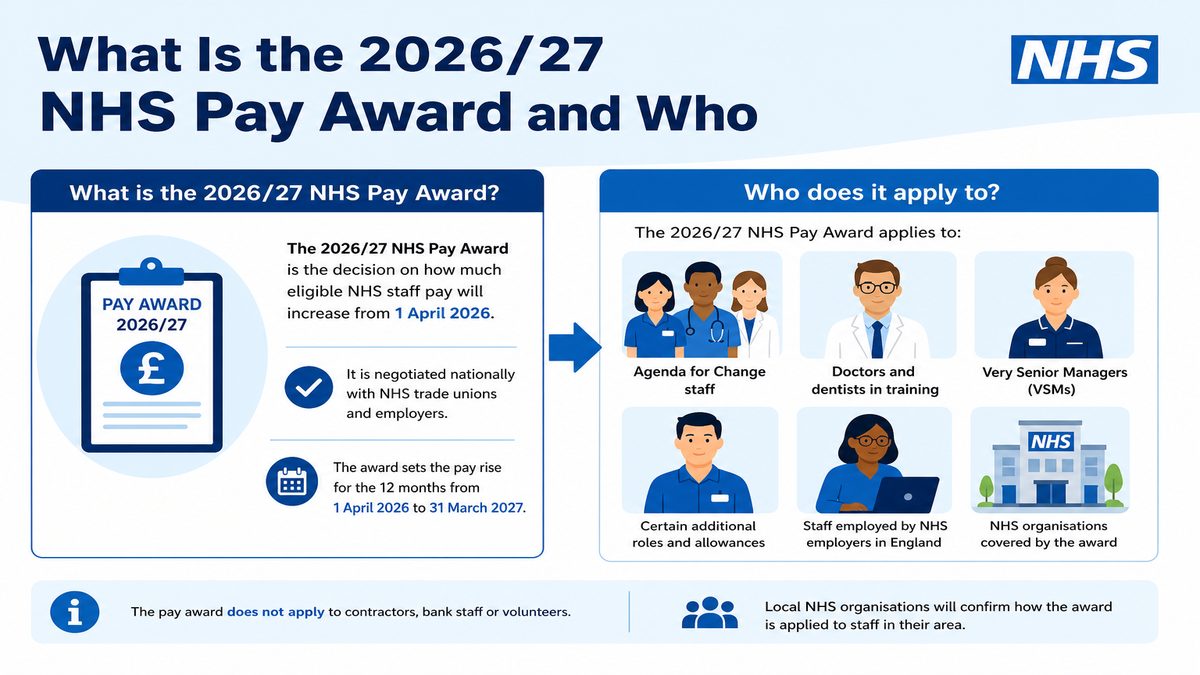
The 2026/27 NHS Agenda for Change pay award is a 3.3% consolidated uplift for staff in England, Wales and Northern Ireland, effective 1 April 2026. The NHS Pay Review Body recommended the rise, and the government accepted it on 12 February 2026 (NHS Employers). The recommendation is recorded in the written ministerial statement of 12 February 2026 (UK Parliament).
Scotland's NHS Agenda for Change staff receive 3.75% for 2026/27 under a separate two-year deal (Scottish Government). Northern Ireland confirmed the same 3.3% uplift, though its payment timing depends on the devolved budget (Health NI).
The confirmation chain moved through three steps:
"Consolidated" means the rise joins your basic salary permanently. It is not a one-off payment.
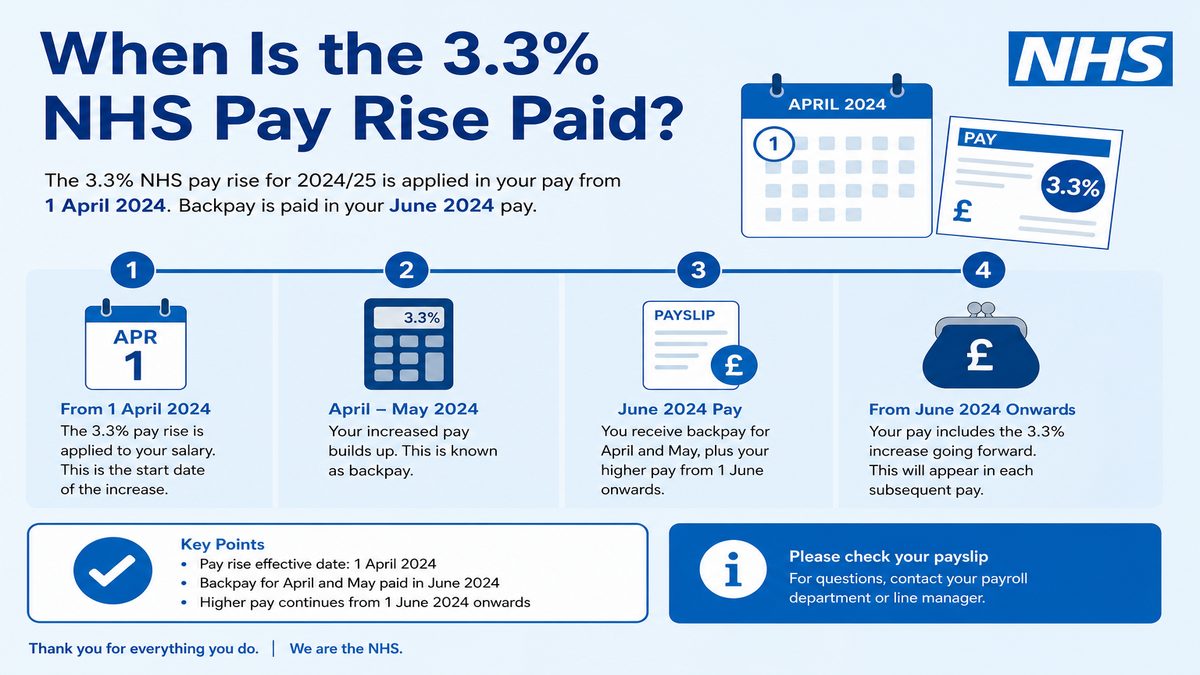
The 3.3% rise was paid in April 2026 payslips, on time for the first time in six years (DHSC). The Electronic Staff Record confirmed the increase would land in April salaries in line with its lead times (NHS Employers).
The payment followed this timeline:
A payroll lead who processes Agenda for Change batches notes the April uplift lands cleanly in a single payslip. The Electronic Staff Record applies the new spine points at the start of the 2026/27 cycle, unlike prior years that needed separate back-pay corrections.
No back pay is owed for the headline 3.3% award. The rise is paid from April 2026 on time. Only the separate structural reforms, if agreed through the NHS Staff Council, are backdated to 1 April 2026.
The 2026/27 Agenda for Change pay scales run from Band 2 to Band 9, with each band split into entry, intermediate and top step points (NHS Employers). Band 1 is closed to new entrants, so only staff already on Band 1 keep it (NHS Employers).
The annual salaries below are the base rates before any Higher Cost Area Supplement.
Band | Entry (£) | Intermediate (£) | Top (£) |
2 | 25,272 | — | 25,272 |
3 | 25,760 | — | 27,476 |
4 | 28,392 | — | 31,157 |
5 | 32,073 | 34,592 | 39,043 |
6 | 39,959 | 42,170 | 48,117 |
7 | 49,387 | 51,932 | 56,515 |
8a | 57,528 | 60,417 | 64,750 |
8b | 66,582 | 70,896 | 77,368 |
8c | 79,504 | 84,346 | 91,609 |
8d | 94,356 | 100,140 | 108,814 |
9 | 112,782 | 119,583 | 129,783 |
Source: NHS Employers 2026/27 pay scales (NHS Employers).
Band 2 pays £25,272 at every step point. Band 3 rises from £25,760 to £27,476. Band 4 rises from £28,392 to £31,157. Band 5, the largest nursing and allied-health band, rises from £32,073 at entry to £39,043 at the top step (NHS Employers).
Band 6 tops at £48,117. Band 7 tops at £56,515. Band 8a tops at £64,750. Band 8b tops at £77,368. Band 8c tops at £91,609. Band 8d tops at £108,814. Band 9, the highest AfC band, tops at £129,783 (NHS Employers).
The hourly rates use a 37-hour week in England, Wales and Northern Ireland. Band 5 tops at £19.97 per hour, and Band 9 tops at £66.37 per hour (NHS Employers). Scotland uses a 36-hour week, so its hourly figures differ (Scottish Government).
Band | Entry (£/hr) | Intermediate (£/hr) | Top (£/hr) |
2 | 12.92 | — | 12.92 |
3 | 13.17 | — | 14.05 |
4 | 14.52 | — | 15.93 |
5 | 16.40 | 17.69 | 19.97 |
6 | 20.44 | 21.57 | 24.61 |
7 | 25.26 | 26.56 | 28.90 |
8a | 29.42 | 30.90 | 33.11 |
8b | 34.05 | 36.26 | 39.57 |
8c | 40.66 | 43.14 | 46.85 |
8d | 48.26 | 51.21 | 55.65 |
9 | 57.68 | 61.16 | 66.37 |
Source: NHS Employers 2026/27 pay scales (NHS Employers).
The Higher Cost Area Supplement adds to base pay in costly regions. Inner London pays 20% of basic salary, subject to a minimum of £5,794 and a maximum of £8,746 per year. Outer London pays 15%, minimum £4,870 and maximum £6,137. The fringe pays 5%, minimum £1,346 and maximum £2,270 (NHS Employers; NHSBSA).
A payroll practitioner notes inner-London staff often misread their supplement as a straight percentage of new salary. The £5,794 to £8,746 caps can bind, so high earners receive the maximum rather than 20% of pay.
The 2025/26 rates show the rise in cash terms. Band 5 topped at £37,796 in 2025/26 and rises to £39,043 in 2026/27 (NHS Bands; NHS Employers).
Your take-home pay after the 3.3% rise is your new gross salary minus income tax, National Insurance and your NHS pension contribution. The pension contribution sits between 5.2% and 12.5% of pay, depending on your earnings tier (NHSBSA). Scotland uses a separate nine-tier scale from 5.7% to 12.7% (SPPA).
Income tax uses the 2026/27 bands: a personal allowance of £12,570, then 20% from £12,571 to £50,270, 40% to £125,140, and 45% above (TaxAid). National Insurance is deducted at the standard employee rates on top of tax.
The calculator applies three steps. First, it takes your new gross salary from 1 April 2026. Second, it removes your NHS pension contribution (5.2%–12.5%). Third, it deducts income tax and National Insurance. The remainder is your net monthly pay.
A payroll lead observes staff on Band 2 see the smallest cash gain, because Band 2 holds a single spine point at £25,272. The same practitioner notes the pension-tier jump at higher bands quietly reduces net gain more than staff expect.
The table shows the gross cash gain for each band's top point. Net take-home is lower after the three deductions above.
Band | 2026/27 top (£) | Gross uplift vs 2025/26 (£) |
2 | 25,272 | 807 |
3 | 27,476 | 878 |
4 | 31,157 | 995 |
5 | 39,043 | 1,247 |
6 | 48,117 | 1,537 |
7 | 56,515 | 1,805 |
8a | 64,750 | 2,068 |
8b | 77,368 | 2,472 |
8c | 91,609 | 2,927 |
8d | 108,814 | 3,477 |
9 | 129,783 | 4,146 |
Gross uplift calculated from NHS Employers 2026/27 scales against 2025/26 rates (NHS Employers; NHS Bands).
A worked example: a Band 5 nurse at the £39,043 top point takes home about £2,381 per month, or £28,570 per year, after tax, National Insurance and pension at the site's default settings. Use the NHS take-home pay calculator for your exact band, region and pension tier.
The four UK nations share the 1 April 2026 start date but set different percentages and conditions. England, Wales and Northern Ireland apply 3.3%, while Scotland applies 3.75% with an inflation guarantee (NHS Employers; Scottish Government; RCN).
Nation | 2026/27 uplift | Effective date | Key caveat |
England | 3.3% | 1 April 2026 | No back pay; paid on time |
Wales | 3.3% | 1 April 2026 | Matches England (RCN) |
Northern Ireland | 3.3% | 1 April 2026 | Timing depends on devolved budget (Health NI) |
Scotland | 3.75% | 1 April 2026 | Inflation guarantee of at least 1pp above CPI (Scottish Government) |
Scotland's 3.75% sits inside a two-year deal. The 2025/26 year moved from 4.25% to 4.4% after the inflation guarantee triggered at 3.4% CPI (Scottish Government). England, Wales and Northern Ireland have no such guarantee for 2026/27.
The 3.3% rise is not protected against inflation in England, Wales and Northern Ireland, so it can be a real-terms cut if CPI runs above 3.3%. Scotland's 3.75% carries an inflation guarantee that keeps pay at least one percentage point above average CPI (Scottish Government).
UNISON states the 3.3% has already been overtaken by the cost of living (UNISON). The trade union frames the award as below what members need, though it remains the confirmed figure for 2026/27.
The practical point is simple. A 3.3% gross rise loses buying power when prices rise faster. Scotland shields staff through its guarantee; the other three nations do not.
The 2026/27 award follows the 2025/26 rates without a back-pay reset. Band 5 topped at £37,796 in 2025/26 and moves to £39,043 in 2026/27, a 3.3% consolidated step (NHS Bands; NHS Employers).
Year | Band 5 top (£) | Note |
2025/26 | 37,796 | Prior year rates |
2026/27 | 39,043 | 3.3% consolidated uplift from 1 April 2026 |
Scotland shows the two-year pattern most clearly. Its 2025/26 uplift moved from 4.25% to 4.4% after the inflation guarantee triggered, and 2026/27 is set at 3.75% (Scottish Government). The 2018 pay deal ended the old spine-point system and introduced the year-based step progression now in force (NHS Employers).
Around 1.4 million Agenda for Change staff receive the 3.3% rise across England, Wales and Northern Ireland (DHSC). The award covers every AfC pay point from Band 2 to Band 9.
The rise does not cover everyone. The exclusions are clear:
If your contract is Agenda for Change and you are not a doctor, dentist or very senior manager, you receive the 3.3% from 1 April 2026.
The 3.3% lifts your gross band salary from 1 April 2026. Your net take-home is lower after income tax, National Insurance and your NHS pension contribution (5.2%–12.5%) (NHSBSA). Use the take-home calculator for your exact figure.
In England, Wales and Northern Ireland the 3.3% is not protected against inflation, so it can be a real-terms cut if CPI runs above 3.3%. Scotland's 3.75% carries an inflation guarantee of at least 1 percentage point above CPI (Scottish Government).
A Band 5 top salary rises from £37,796 (2025/26) to £39,043 (2026/27) — a £1,247 gross uplift (NHS Employers). Band 9 top rises to £129,783, a £4,146 gross uplift. The full per-band table is in the salaries section above.
No. Band 1 closed to new entrants on 1 December 2018, so only existing Band 1 staff on the roll receive the 3.3% uplift (NHS Employers). All other Agenda for Change bands (2–9) receive it.
No back pay is owed for the headline 3.3% award; it is paid from April 2026 on time (NHS Employers). Only the separate structural reforms, if agreed, are backdated to 1 April 2026.
Scotland's Agenda for Change staff receive 3.75% for 2026/27 under a two-year deal, plus an inflation guarantee that keeps pay at least 1 percentage point above CPI (Scottish Government). This is separate from the 3.3% England/Wales/NI award.