 Take Home Pay
Take Home Pay
Take Home Pay
Use this NHS Bursary Calculator to find out how much funding you could receive as a healthcare student in the United Kingdom in 2025/26. Enter your course type, study location, household income, and whether you have dependent children to generate your personalised estimate in seconds.
This calculator covers the NHS Learning Support Fund (LSF) for nursing, midwifery, and allied health profession students in England, the NHS Bursary Scheme for medical and dental students in England, and the NHS Wales Bursary Scheme for eligible students studying in Wales. All figures are updated for the academic year 1 September 2025 to 31 August 2026.
Select your details to calculate your NHS bursary:
Input Field | Your Options |
Nation of study | England / Wales / Scotland / Northern Ireland |
Course type | Nursing / Midwifery / Physiotherapy / Occupational Therapy / Dietetics / Radiography / Speech & Language Therapy / Podiatry / Orthoptics / Prosthetics & Orthotics / Operating Department Practice / Dental Therapy / Paramedics / Medicine (Year 5+) / Dentistry (Year 5+) / Pharmacy (TDAE only) |
Study mode | Full-time / Part-time |
Living situation | Away from home – outside London / Away from home – London / Living with parents |
Household income | Enter £ amount |
Dependent children? | Yes / No → how many / ages |
Eligible specialism? | Mental Health Nursing / Learning Disability Nursing / Diagnostic Radiography / Other |
Is this a second degree? | Yes / No |
Your estimated results:
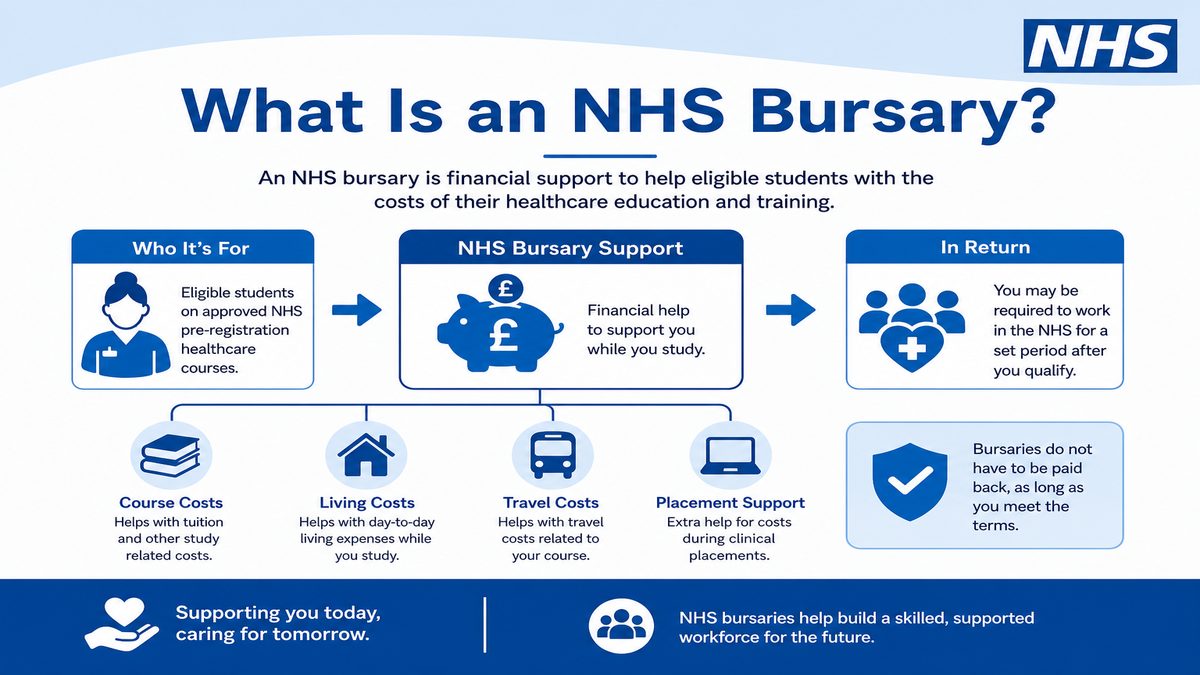
An NHS bursary is a non-repayable grant paid by the UK government to eligible students studying pre-registration healthcare courses. It does not need to be repaid after graduation. It is not a loan and does not appear on your credit record.
The phrase "NHS bursary" covers two separate funding systems that operate side by side in England:
System 1 — NHS Learning Support Fund (LSF): 8The Training Grant is a non-means-tested grant of £5,000 each academic year for eligible students. 2Students starting and continuing their course from 1 September 2020 onwards can apply for NHS LSF if they're on an eligible pre-registration undergraduate or postgraduate course. This system covers nursing, midwifery, and allied health profession students in England.
System 2 — NHS Bursary Scheme (Medical & Dental): 14The NHS Business Services Authority (NHSBSA) Student Services is responsible for administering the NHS Bursary Scheme to eligible medical and dental students on behalf of the Department of Health and Social Care. 14NHS Bursary funding is administered to eligible students under the arrangements set out in the NHS Bursary Scheme for the academic year from 1 September 2025 to 31 August 2026.
Both systems are separate from — and paid on top of — your Student Finance England maintenance loan.
The legal authority for NHS Bursary payments is Section 63(6) of the Health Services and Public Health Act 1968. 15The NHS Bursary Scheme new rules (14th edition) for the academic year 2025 to 2026 were published on 7 April 2025 and apply to England.
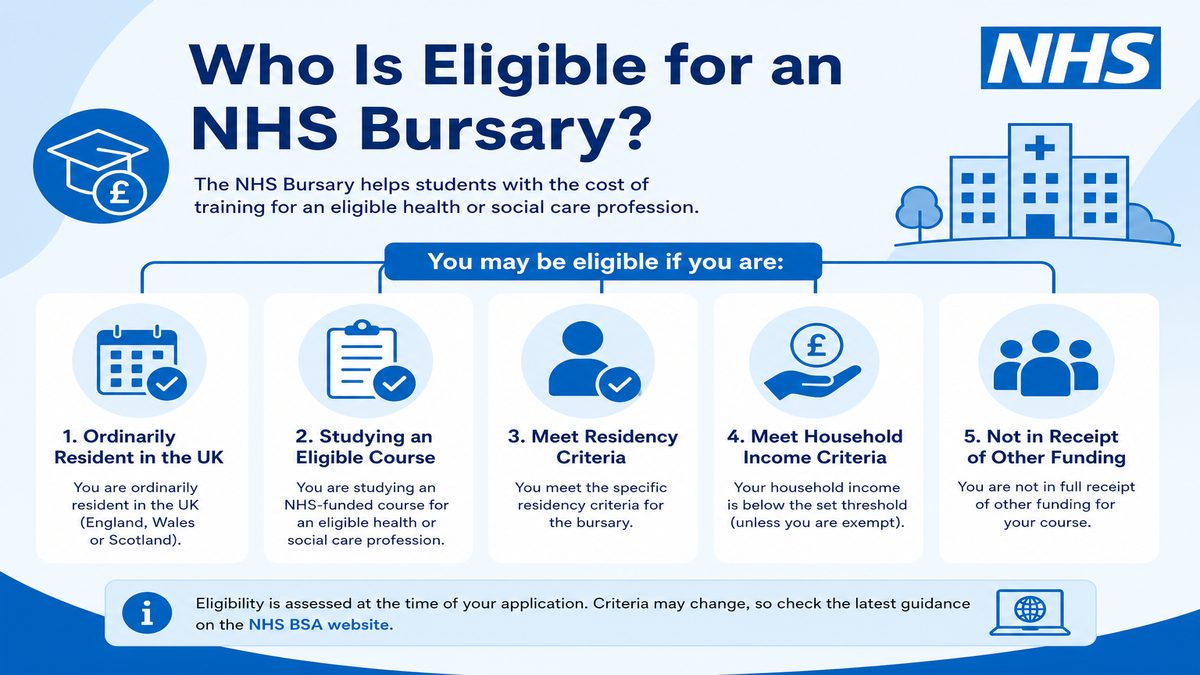
Eligibility depends on three factors: your nation of study, your course type, and your residency status.
9 The NHS LSF applies to new and continuing nursing, midwifery and allied health professional students who are: attending a higher education institution in England in the 2025/26 academic year; in active study, whether academic or practice learning; and eligible for both maintenance and tuition fee loan support from the Student Loans Company. 1 Training grant eligible students study in the following areas: nursing, midwifery, and many other allied health profession courses. The specialist subject payment of £1,000 applies for students on degrees that struggle to recruit, including mental health and learning disability nursing.
The full list of courses eligible for the NHS LSF Training Grant in England includes:
From 2025/26, pharmacy and healthcare science courses gained partial access. 5From 1 September 2025, eligible new and continuing students studying undergraduate pharmacy or pre-registration healthcare science courses are able to claim reimbursement towards practice placement expenses through the Travel and Dual Accommodation Expenses (TDAE) element of NHS LSF. They are not eligible for any of the other NHS LSF allowances.
5 Foundation years are not eligible for NHS LSF. 6 The NHS LSF is not available for any post-registration or Continuing Professional Development courses.
9 You will not be eligible if you are paid for time off by your employer to attend your course and continue to receive a wage or salary whilst you train, or if you are in receipt of salary support as provided by an NHS trust or other NHS entity, including NHS England, during any part of your course.
13 Medical and dental students can apply for an NHS bursary in the later years of their course. The scheme applies from year five of a standard five- or six-year undergraduate medical degree, or from year one of a graduate-entry medical programme. 13 Intercalating years at bachelors or masters (but not PhD) level can count towards the qualifying year of study for NHS Bursary funding.
25 The NHS Wales Bursary Schemes, administered by Student Awards Services, offer financial support to healthcare students enrolled in NHS-funded courses in Wales. 28 Health Education course commissioned students on full-time programmes are eligible to apply for the bursary (a full list of courses and current providers can be found in the NHS Wales Bursary Terms and Conditions May 2025 document). 28 The NHS Wales bursary scheme is coordinated by HEIW in collaboration with NWSSP, Universities, Health Boards and NHS Trusts.
The NHS LSF provides a package of non-repayable grants. No component is a loan.
1. Training Grant — £5,000 per year (non-means-tested)
5 You can apply for a Training Grant of £5,000 per academic year, or a pro rata amount for part-time students. Every eligible full-time student receives the same £5,000 — it is not reduced by household income.
2. Specialist Subject Payment (SSP) — £1,000 per year (non-means-tested)
5 Students on certain courses can get a Specialist Subject Payment, which is an extra £1,000. 4 Additional payments worth up to a total of £1,000 per academic year apply for specialisms such as Mental Health, Learning Disability, and Diagnostic Radiography. 8 If you are eligible for SSP, it will be added to your NHS Learning Support Fund (LSF) account when you apply for the Training Grant. If your course includes one of the above subjects and leads to dual registration, you can get SSP — for example, if you're studying adult and mental health nursing.
3. Parental Support — £2,000 per year (non-means-tested)
5 If you have at least one dependent child under 15 years old (or under 17 if registered with special educational needs) you can also receive Parental Support. 2 Parental Support is £2,000 per year. To qualify you need to have at least one dependent child under 15 years, or under 17 years if registered with special educational needs.
4. Exceptional Support Fund — up to £3,000 per year
3 The NHS Learning Support Fund offers eligible students a non-repayable package that includes up to £3,000 per year exceptional support in the case of severe hardship.
5. Travel and Dual Accommodation Expenses (TDAE)
2 TDAE reimburses excess travel and accommodation costs while you are on your practice placement. This is a reimbursement paid retrospectively after you submit evidence of placement travel costs above your normal daily travel.
Full NHS LSF Package Summary (England, 2025/26):
Component | Amount | Means-Tested? | Repayable? |
Training Grant | £5,000/year | No | No |
Specialist Subject Payment | £1,000/year | No | No |
Parental Support | £2,000/year | No | No |
Exceptional Support Fund | Up to £3,000/year | Assessed | No |
TDAE | Actual costs reimbursed | No | No |
Maximum non-means-tested total | £8,000/year | — | — |
10 A grant of £1,052 is available for all NHS bursary students; this is not means-tested. 12 All eligible students receive the full £1,052 per year for the non-means-tested grant, regardless of household income.
Tuition Fee Contribution (paid directly to your university):
10 For an undergraduate medical or dental degree (5–6 years), the NHS pays up to £9,535 in tuition fees. For a graduate-entry accelerated degree (3–4 years), the NHS pays up to £3,830 — or more if studying in Northern Ireland. 12 For English students studying in Northern Ireland, the maximum amount of tuition fee contribution goes up to £4,047.
Means-Tested Maintenance Bursary (maximum 2025/26 rates):
10 The amount reduces if your household income is above £27,423; students from higher-income households may not receive a bursary. Maximum rates are: up to £3,356 if you live in London; up to £2,780 if you live elsewhere; up to £2,321 if you live with your parents. 16 In the academic year 2025–26, eligible students in years 2–4 can apply for a means-tested bursary of up to £2,780 (living away from home and outside of London) and a non-means-tested grant of £1,052.
Extra Weeks Allowance:
16 Students can apply for an Extra Weeks Allowance of £89 per week (in 2025–26) if their course runs for more than 30 weeks and 3 days (excluding vacations).
NHS Bursary Hardship Grant:
12 NHS Bursary Hardship Grant — medical and dental students in financial hardship can apply for a grant of between £100 and £3,000. This grant is awarded at the discretion of the NHSBSA.
Disabled Students' Allowance (DSA):
12 Students with a disability, learning difficulty, or health problem (physical or mental) can receive DSA. Up to £27,648 is available to fund a helper, specialist equipment, and other costs. If you've previously received DSA support from Student Finance England, apply to the NHSBSA instead in the years you're eligible for the NHS Bursary.
Full NHS Bursary Package Summary (Medical/Dental, England, 2025/26):
Component | Amount | Means-Tested? | Repayable? |
Non-means-tested grant | £1,052/year | No | No |
Tuition fee contribution (UG 5–6 yr) | Up to £9,535/year | No | No |
Tuition fee contribution (GE 3–4 yr) | Up to £3,830/year | No | No |
Means-tested maintenance bursary (elsewhere) | Up to £2,780/year | Yes | No |
Means-tested maintenance bursary (London) | Up to £3,356/year | Yes | No |
Means-tested maintenance bursary (parental home) | Up to £2,321/year | Yes | No |
Extra Weeks Allowance | Up to £89/week | Yes | No |
Hardship Grant | £100–£3,000 | Assessed | No |
Disabled Students' Allowance (DSA) | Up to £27,648 | No | No |
The NHS LSF uses a flat-rate, non-means-tested model for its core components. 8The Training Grant is a non-means-tested grant of £5,000 each academic year for eligible students. Every eligible full-time student receives the same amount. Household income does not reduce your Training Grant, Specialist Subject Payment, or Parental Support.
For part-time students: 5You can apply for a Training Grant of £5,000 per academic year, or a pro rata amount for part-time students.
The means-tested bursary component for medical and dental students is calculated based on residual household income — the income of your parent(s), spouse, partner, or civil partner after standard deductions. 10The amount reduces if your household income is above £27,423; students from higher-income households may not receive a bursary at all.
If declared income exceeds the maximum threshold, 11the total income being more than the total allowances plus tuition fee contribution means no NHS Bursary support (including tuition fees for medical or dental students) will be available.
Sources of student income that count in the assessment include pensions, sponsorships, and bank or building society interest. Income from part-time or casual work is not counted in the assessment.
32 The maximum amount of bursary available depends on the course you are applying for and your personal living arrangements. 'Residual income' refers to household income (excluding the potential student) and 'Contribution' refers to the amount that will be deducted from the maximum bursary amount as a result of the household income.
In Wales, 25one component is a non-means-tested NHS grant of £1,000, and the other is a means-tested NHS bursary which can reach up to £4,491. The amount of bursary you receive depends on the duration of your course and your household income.
20 Funding is scheduled over the academic year and is paid in 3 instalments. Your university must confirm your attendance in term 1 for your first instalment to be paid. You must confirm your term 2 and 3 attendance in your NHS LSF account. Once you've done this, your university can check your details and confirm. 19 Training grant payments are paid in three instalments over the academic year. If your academic year commences in autumn, training grant payments will normally be credited to your bank account in November, March, and July. 18 NHS LSF payments are staggered across three terms in between your student finance payments. This allows you to receive a steady stream of funding throughout the academic year. 18 For new or continuing students whose academic year starts in September/October, NHSBSA Student Services opens invites to allow the University to confirm your attendance from 1 November. Once this is done your payments will be scheduled. You may notice an expected payment date in your account. This is an approximate date; depending on when your university confirms your attendance, you may receive your first payment earlier or later than this date. 20 Payments may be earlier or later than the dates stated depending on when you and your university confirm attendance. Payments cannot be fast tracked. The payments section in your NHS LSF account will show your actual payment dates.
2025/26 Payment Schedule (September/October start):
Term | Payment Month |
Term 1 | November 2025 |
Term 2 | March 2026 |
Term 3 | July 2026 |
For January starters: payments fall in March, July, and November.
12 The NHS Bursary is paid to you in three termly instalments throughout the year. The payment dates differ depending on the start month of your academic year.
Step 1: Apply for Student Finance England (SFE) first. You must have an active student loan application and a student finance award letter before you can complete your NHS LSF application.
Step 2: Create your NHS LSF account.
5 You can apply for NHS LSF by creating an NHS Learning Support Fund account. 5 You should not apply on any other systems as your application will be rejected.
Step 3: Upload your student finance award letter.
8 You can apply for the Training Grant (and SSP, if applicable) through your NHS LSF account at the start of each academic year. If you've applied for a student loan, you'll need to upload your student finance award letter when you apply. If you have not applied for a student loan, you'll need to upload identification such as a passport or driving licence.
Step 4: Submit your application within 6 months of your course start.
5 You need to apply within 6 months of the start of your academic year. Applying as early as possible increases the chance of receiving your first payment at the start of term.
Step 5: Your university confirms your attendance.
18 For new or continuing students whose academic year starts in September/October, NHSBSA Student Services opens invites to allow the University to confirm your attendance from 1 November. Once this is done your payments will be scheduled.
Step 6: Receive your payments in three instalments.
Reapplication — annual requirement:
5 You'll keep your NHS LSF account and will need to reapply each year. 5 If you're a continuing student, an email to re-apply will be sent to you so you can make a timely application for the start of your academic year.
Step 1: Register for an NHS Bursary account through the NHSBSA website (nhsbsa.nhs.uk).
Step 2: 13Check the application deadlines to make sure you apply at the right time. Detailed advice and information about NHS bursary funding, including the full eligibility criteria, is available in the NHSBSA guidance booklet.
Step 3: Submit evidence of income (dependent or independent student status, household income, number of dependants).
Step 4: 11If you are eligible for an NHS Bursary, and you have completed the bursary application process by the required deadline, the NHSBSA will pay the standard tuition fee contribution to your medical or dental school on your behalf.
Step 5: Your means-tested maintenance bursary and non-means-tested grant (£1,052) are paid to you in three termly instalments.
Yes. The NHS LSF is paid on top of your standard Student Finance England maintenance loan. They are administered by separate bodies and do not affect each other's calculation.
7 In addition to NHS LSF payments, you can also take out a student loan from the Student Loans Company, even if this is your second degree.
Exception for paramedics as a second degree: 7If you are studying paramedicine as a second degree, you are not currently eligible to access loans from the Student Loans Company, but you may be able to receive the NHS Learning Support Fund. Applications are considered on a case-by-case basis.
Medical and dental students in bursary years also receive a reduced-rate maintenance loan from Student Finance England alongside their NHS Bursary. 10You can still apply for student finance, but you'll only get a fixed reduced-rate maintenance loan in a bursary year.
No. Every component of the NHS Learning Support Fund and NHS Bursary Scheme is a non-repayable grant. 3The NHS Learning Support Fund offers eligible students a non-repayable package that includes the £5,000 per year training grant, £2,000 per year parental support for students with child dependants, and up to £3,000 per year exceptional support in the case of severe hardship.
The NHS bursary is never recovered through the student loans repayment system. It does not appear as a liability on the Student Loans Company's records. No repayment threshold, no interest rate, and no automatic deductions from future salary apply.
Wales exception: The NHS Wales Bursary Scheme includes a work commitment clause. Students who do not fulfil the required period of employment in Wales after qualifying may be required to repay a portion of their bursary funding under the terms of the NHS Wales Bursary Scheme Terms and Conditions (V5, May 2025). Students must commit to work in Wales for the required period as a condition of receiving funding.
25 The NHS Wales Bursary Schemes, administered by Student Awards Services, offer financial support to healthcare students enrolled in NHS-funded courses in Wales. 28 The NHS Wales bursary scheme is coordinated by HEIW in collaboration with NWSSP, Universities, Health Boards, and NHS Trusts.
Wales bursary components include:
25 The NHS provides financial support through various options. One is a non-means-tested NHS grant of £1,000. Another is a means-tested NHS bursary which can reach up to £4,491. The amount of bursary you receive depends on the duration of your course and your household income.
Tuition fees in Wales:
30 Some pre-registration healthcare programme students have mistakenly been advised they will need to contribute towards their tuition fees. All applicants are reassured this is not the case. 25 Tuition fees are covered in full by the NHS so no tuition fee payment is required.
Additional allowances available in Wales:
28 If eligible, students will be supported for costs such as travel, accommodation (whilst on placement), Childcare, Disabled Student Allowance, Dependents Allowance, and Parental Learning Allowance.
Wales Means-Test Reduction Table (example figures):
Household Residual Income | Bursary Reduced By |
Under £24,279 | Nil |
£27,500 | £384 |
£30,000 | £647 |
£40,000 | £1,699 |
£50,000 | £2,752 |
£60,000 | £3,805 |
£75,000 | £5,384 |
£99,833 | £7,998 |
Source: NWSSP Bursary Rates Document (nwssp.nhs.wales)
Maintenance loan access in Wales:
28 If eligible, students will have access (separately) to a maintenance loan, subject to the Student Loans Regulations.
Application system: Applications for the NHS Wales Bursary are made through the NWSSP Student Awards Services portal. Contact: HEIW.bursary@wales.nhs.uk
Students frequently confuse these two terms. Here is the exact distinction:
Feature | Non-Means-Tested | Means-Tested |
Amount varies with income? | No — fixed for all | Yes — reduces as income rises |
Who receives it? | Every eligible student equally | Depends on household income |
England LSF examples | Training Grant (£5,000), SSP (£1,000), Parental Support (£2,000) | Exceptional Support Fund (hardship-assessed) |
Medical/dental examples | Non-means-tested grant (£1,052) | Maintenance bursary (up to £2,780/£3,356/£2,321) |
Wales examples | Non-means-tested grant (£1,000) | Means-tested bursary (up to £4,491) |
Repayable? | No | No |
Key rule to remember: The fact that a bursary is means-tested does not make it a loan. Both means-tested and non-means-tested NHS bursary components are grants — they are never repaid.
The Childcare Allowance funds registered childcare costs for students with dependent children. 16Grants such as Childcare Allowance (CCA), Disabled Student Allowances (DSA), Dependants Allowance, Parent Learning Allowance (PLA), and Travel and Dual Accommodation Expenses (TDAE) are available to eligible students from the NHS Bursary Scheme.
31 Dependants Allowance is a means-tested allowance payable to students who are responsible for people who are wholly or mainly financially dependent on them during their time in training.
PLA is available to students with dependent children who need additional support with course-related learning costs. It is a means-tested component of the NHS Bursary Scheme for medical and dental students.
12 Students with a disability, learning difficulty or health problem (physical or mental) can receive DSA. Up to £27,648 is available to fund a helper, specialist equipment and other costs.
2 TDAE allows you to claim for excess travel and accommodation costs while you are on your practice placement. This is paid retrospectively after submission of receipts. 3 For further information on rules and eligibility, visit: nhsbsa.nhs.uk/nhs-learning-support-fund-lsf. In addition to support from the NHS LSF, you can also still access tuition fee loans and maintenance loans from your Student Finance Authority, even if this is your second degree.
An NHS bursary is a non-repayable government grant for eligible UK healthcare students. It covers living costs and, for medical/dental students, tuition fees. It never needs to be repaid.
10 A grant of £1,052 is available for all NHS bursary students (medical/dental); this is not means-tested. For nursing, midwifery, and AHP students: 8 the Training Grant is a non-means-tested grant of £5,000 each academic year.
9 Eligible students are those attending a higher education institution in England in 2025/26, in active study (academic or practice learning), and eligible for both maintenance and tuition fee loan support from the Student Loans Company.
3 The NHS Learning Support Fund (NHS LSF) offers eligible students a non-repayable package that includes a £5,000 per year training grant, £2,000 per year parental support for students with child dependants, and up to £3,000 per year exceptional support in the case of severe hardship.
19 Training grant payments are paid in three instalments over the academic year. If your academic year commences in autumn, training grant payments will normally be credited to your bank account in November, March, and July.
No. 3The NHS Learning Support Fund offers eligible students a non-repayable package. No component of the NHS LSF or NHS Bursary Scheme is a loan.
It depends on the component. 8The Training Grant is a non-means-tested grant of £5,000 each academic year for eligible students. The maintenance bursary for medical and dental students is means-tested based on household income.
5 You can apply for NHS LSF by creating an NHS Learning Support Fund account. You'll keep this account and will need to reapply each year. You need to apply within 6 months of the start of your academic year.
7 In addition to NHS LSF payments, you can also take out a student loan from the Student Loans Company, even if this is your second degree.
Nursing students in England receive the NHS Learning Support Fund, which includes 1a training grant of £5,000 per year, parental support payment of £2,000 per student per year, and specialist subject payment of £1,000 per year for students on degrees that struggle to recruit, including mental health and learning disability nursing.
13 Medical students can apply for an NHS bursary in the later years of their course. From year five of a standard 5- or 6-year degree, they receive the non-means-tested grant (£1,052), a means-tested maintenance bursary, and 10 tuition fee coverage of up to £9,535 for an undergraduate medical or dental degree.
11 If eligible for an NHS Bursary, and the bursary application process is completed by the required deadline, the NHSBSA pays the standard tuition fee contribution to your medical or dental school on your behalf. In years before NHS Bursary eligibility begins, students fund fees via Student Finance England tuition fee loans.
Midwifery is a fully eligible NHS LSF course. Midwifery students receive the £5,000 Training Grant per year, Parental Support (if applicable), Specialist Subject Payment (if applicable), and TDAE reimbursement for placement travel.
Occupational therapy is an eligible NHS LSF course. 4A non-repayable Training Grant of £5,000 from the LSF is available per academic year for Nursing and many other Allied Healthcare courses — including occupational therapy.
Physiotherapy students in England receive the NHS LSF package. 4A non-repayable Training Grant of £5,000 from the LSF is available per academic year for physiotherapy students, plus TDAE for placement costs.
25 The NHS Wales Bursary Schemes, administered by Student Awards Services, offer financial support to healthcare students enrolled in NHS-funded courses in Wales. It includes a £1,000 non-means-tested grant and a means-tested bursary of up to £4,491, with tuition fees covered in full.
20 Funding is scheduled over the academic year and is paid in 3 instalments. For autumn-start students, payments fall in November, March, and July.
Mental health nursing students in England receive the £5,000 Training Grant plus 5the Specialist Subject Payment, which is an extra £1,000 — bringing their non-means-tested annual award to £6,000.
Learning disability nursing is one of the specialist subjects that attracts the full Specialist Subject Payment. Students receive the £5,000 Training Grant plus £1,000 SSP = £6,000 non-means-tested per year.
18 For new or continuing students whose academic year starts in September/October, NHSBSA Student Services opens invites to allow the University to confirm your attendance from 1 November. 18 The expected payment date is approximate; depending on when your university confirms your attendance, you may receive your first payment earlier or later.
Paramedics are eligible for the NHS LSF but with conditions. 4If you are not eligible for Student Finance due to previous study, Paramedic Science students may still qualify for the Training Grant of £5,000 from the LSF. Applications are assessed on a case-by-case basis. You will need to apply to Student Finance England in the first instance so they can confirm eligibility with a zero entitlement before you can register and apply for the Training Grant.
Means-tested means the amount you receive is calculated using your household's residual income. 10The amount reduces if your household income is above £27,423; students from higher-income households may not receive a bursary. Non-means-tested components are paid at the same flat rate for all eligible students.
7 You can take out a student loan from the Student Loans Company, even if this is your second degree. The NHS LSF Training Grant is also available for second-degree students on eligible healthcare courses. This is a significant exception to the standard rule that second degrees do not attract government funding.
Postgraduate pre-registration programmes (e.g., MSc Nursing, PG Dip Physiotherapy) can be eligible for the NHS LSF if they lead to professional registration. 2Students starting and continuing their course from 1 September 2020 onwards can apply for NHS LSF if they're on an eligible pre-registration undergraduate or postgraduate course.
A student bursary is a grant — a sum of money paid to a student that does not need to be repaid. The NHS bursary is applied for annually, assessed by the NHSBSA or NWSSP, and paid directly into the student's UK bank account in three instalments across the academic year.
Dental therapy and dental hygiene students at Level 5 and Level 6 are eligible for the NHS LSF Training Grant of £5,000 per year plus TDAE for placement travel costs.
NHS-funded courses include: nursing (all fields), midwifery, occupational therapy, physiotherapy, dietetics, podiatry, radiography (diagnostic and therapeutic), speech and language therapy, orthoptics, prosthetics and orthotics, operating department practice, dental therapy/hygiene, paramedics (BSc/MSc), medicine (years 5+), and dentistry (years 5+). 5From 1 September 2025, eligible pharmacy and pre-registration healthcare science students also access TDAE through the NHS LSF.
For England (NHS LSF): NHSBSA Student Services — contact via the official FAQ portal at faq.nhsbsa.nhs.uk, or by email to lsfcomplaints@nhsbsa.nhs.uk for complaints. 28For Wales, specific queries should be sent to HEIW.bursary@wales.nhs.uk.
Both are non-repayable. The "NHS grant" refers to the non-means-tested component (£1,052 for medical/dental students; £1,000 in Wales). The "NHS bursary" refers to the means-tested maintenance component. In practice, eligible students receive both if their income qualifies.
Scottish healthcare students are funded through the Student Awards Agency for Scotland (SAAS), not the NHS LSF or NHS Bursary Scheme. Scottish student nurses receive bursary support through SAAS. Students should apply directly to SAAS (saas.gov.uk) for full details of Scottish healthcare student funding.