 Take Home Pay
Take Home Pay
Take Home Pay
This NHS midwife salary calculator answers the role question band pages cannot: what does a midwife earn across the midwifery pathway — not just “what is Band 6?” Use it for newly qualified / preceptorship (Band 5), qualified midwife (Band 6), senior and specialist posts (Band 7), and consultant midwife / matron roles (Band 8a), with take-home after pension, tax, NI, HCAS and optional unsocial hours.
Official sources: NHS Employers pay scales 2026/27 · NHS Terms and Conditions Handbook (Annex 20) · NHS England midwifery preceptorship framework · National profiles for midwifery (PDF) · Royal College of Midwives.
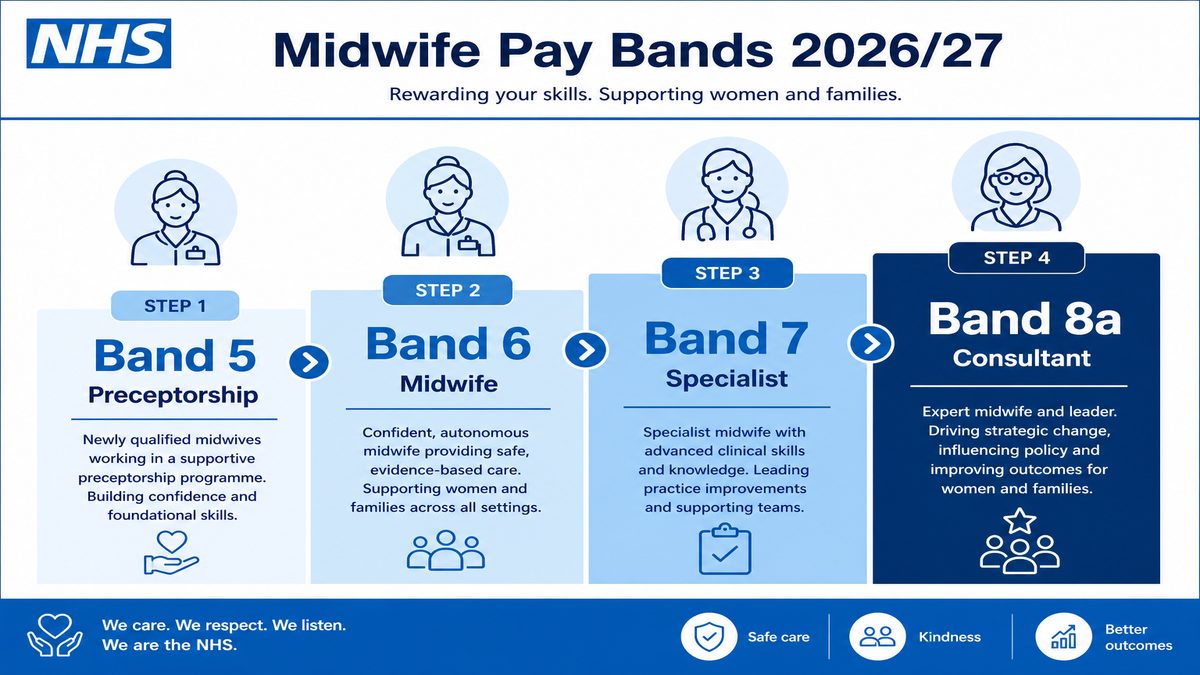
Midwives are paid on Agenda for Change. There is no separate “midwife pay scale” — cash points are the national AfC bands. For England from 1 April 2026:
| Career stage | Typical band | Basic pay 2026/27 |
| Newly qualified / preceptorship | Band 5 | £32,073–£39,043 |
| Qualified midwife (most common) | Band 6 | £39,959–£48,117 |
| Senior / specialist / coordinator | Band 7 | £49,387–£56,515 |
| Consultant midwife / matron / lead | Band 8a (some higher) | £57,528–£64,750 |
Example take-home (England, no HCAS, pension on, no student loan, no unsocial hours): Band 6 entry £39,959 basic is roughly £2,400–£2,500 a month net depending on exact tax coding — use the calculator above for your exact settings. Night, Saturday and Sunday shifts usually lift midwifery gross pay via Section 2 unsocial hours (typically +30% night/Saturday and +60% Sunday/bank holiday for Bands 4–9).
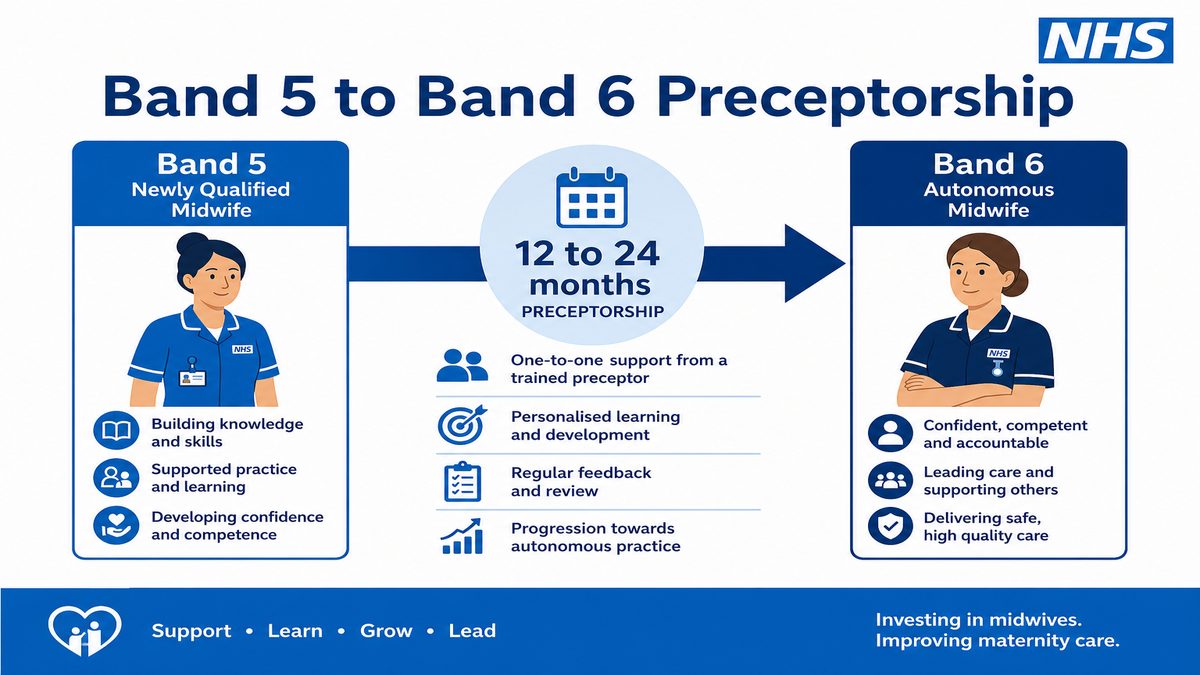
Newly registered midwives start on Band 5 because Agenda for Change recognises a supported transition into autonomous practice. The Royal College of Midwives and NHS England’s national midwifery preceptorship framework describe a structured period — commonly 12 months, and under Annex 20 of the Handbook not less than one year and not more than two — after which successful preceptees progress to Band 6.
That progression is a contractual development pathway: once preceptorship requirements are met, you should not need a competitive interview for a standard Band 6 midwife post. Local Trusts still define competencies, protected time and sign-off, so check your employer’s midwifery preceptorship policy.
Always read the NHS Jobs advert: job evaluation, not the job title alone, sets the band.
Basic pay is only the starting line. Midwives often work nights and weekends, so unsocial hours, London weighting (HCAS), overtime / bank shifts and on-call arrangements can move the payslip well above the published spine point. Offsetting that are:
For shift-level cash, pair this page with the unsocial hours calculator, bank shift calculator and on-call calculator.
Both usually sit on the same AfC band if the job evaluation outcome matches. Differences in take-home usually come from rota pattern (nights / weekends), on-call for community teams, mileage, and whether the post attracts HCAS — not from a separate “community midwife scale.”
Wales and Northern Ireland typically follow England AfC cash recommendations. Scotland negotiates separately and often pays higher cash points. This calculator’s tax-nation switch applies Scottish income tax bands to the England midwife cash scale for a quick comparison; for Scotland-specific AfC tables, cross-check your Board’s published scales or our nations tools.
Most qualified midwives are Band 6 (£39,959–£48,117 basic in England). Newly qualified midwives start on Band 5 (£32,073–£39,043) during preceptorship. Senior and consultant midwife roles sit at Band 7 and Band 8a+.
Under Annex 20 and national midwifery preceptorship practice, successful completion of preceptorship (usually 12–24 months) supports progression to Band 6 without a new recruitment exercise. Your Trust’s sign-off process still applies.
Band 7 England AfC 2026/27 is £49,387–£56,515 basic. Typical roles include labour ward coordinator, specialist midwife and team lead.
Consultant midwife posts commonly start at Band 8a (£57,528–£64,750). Some are evaluated at Band 8b or higher depending on scope.
Yes for the same AfC band and pay point — midwives and nurses share the national spine. Differences arise from banding outcomes, unsocial hours and local allowances, not from a separate midwife tariff.
Yes. Inner (20%), Outer (15%) and Fringe (5%) HCAS apply to eligible AfC posts in the same way as for other Agenda for Change staff.
See also Band 5, Band 6, Band 7, Band 8a, nurse salary guide, and the full calculators hub.