 Take Home Pay
Take Home Pay
Take Home Pay
Calculate your Bradford Factor score instantly. Enter your number of absence spells and total days absent in the rolling 12-month period. The calculator returns your exact score, the trigger band it falls into, and what that score means under standard NHS absence management policies.
The calculator applies the Bradford Factor formula (B = S² × D) and displays your score alongside the corresponding trigger band used by most NHS trusts.
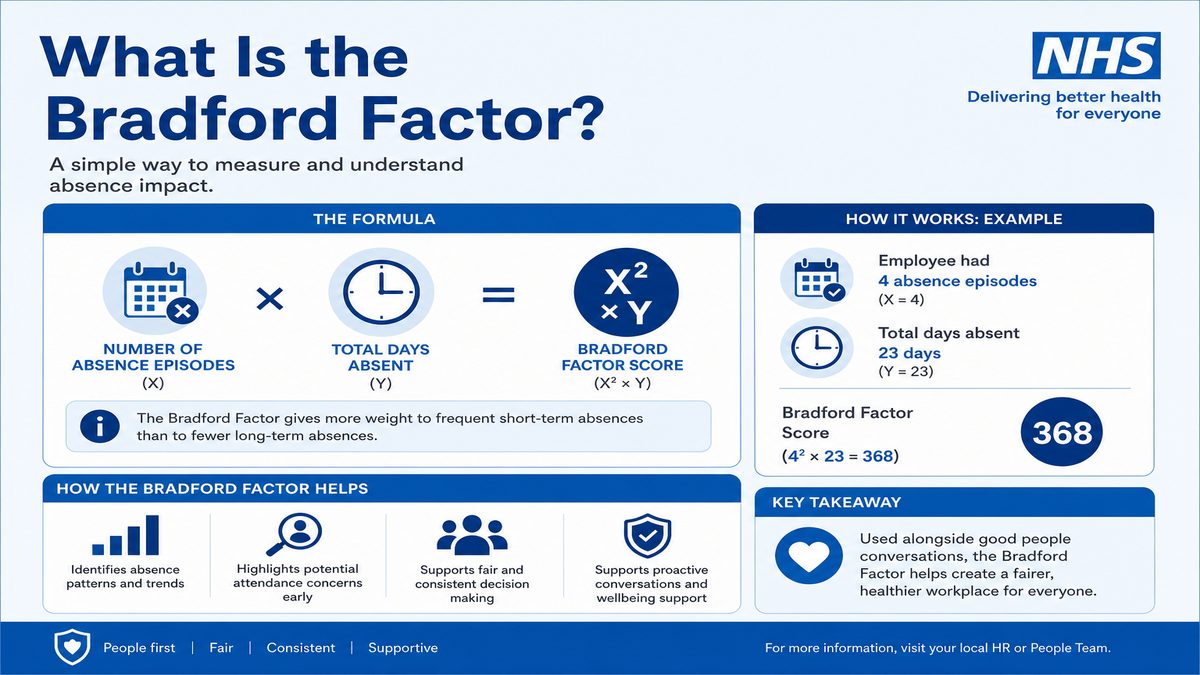
11 The Bradford Factor (also called the Bradford Formula) is used in human resource management as a means of measuring worker absenteeism. 11 The theory is that short, frequent, and unplanned absences are more disruptive than longer absences. 11 According to the Chartered Institute of Personnel and Development (CIPD), the term was first coined due to its supposed connection with research undertaken by the Bradford University School of Management in the 1980s. 11 Bradford University has not confirmed that the Bradford Factor originated there. 10 The Bradford Factor is otherwise known as the Bradford score, the Bradford scale, or the Bradford index. It assigns a single numerical value to each employee's absence record over a defined period, allowing line managers to compare patterns across a team or ward objectively. 35 The Bradford calculation is widely used throughout the United Kingdom by the NHS and across the public sector, including the UK Prison Service, local government, and the private sector.
For NHS staff on Agenda for Change contracts — nurses, healthcare assistants, allied health professionals, paramedics, administrative and clerical staff — the Bradford Factor is one of several tools used within the broader attendance management framework.
The Bradford Factor uses a single formula with two inputs:
Variable | Definition | Example Value |
B | Bradford Factor score (the output) | 250 |
S | Number of separate absence spells in a rolling 12-month period | 5 |
D | Total number of working days absent across all spells in the same 12-month period | 10 |
12 The design is intentional: repeated short absences generate a disproportionately higher score than a single, longer absence covering the same number of days. 11 The "set period" is typically set as a rolling 52-week period. This means the calculator does not reset on 1 April or 1 January. It continuously looks back exactly 12 months from today's date.
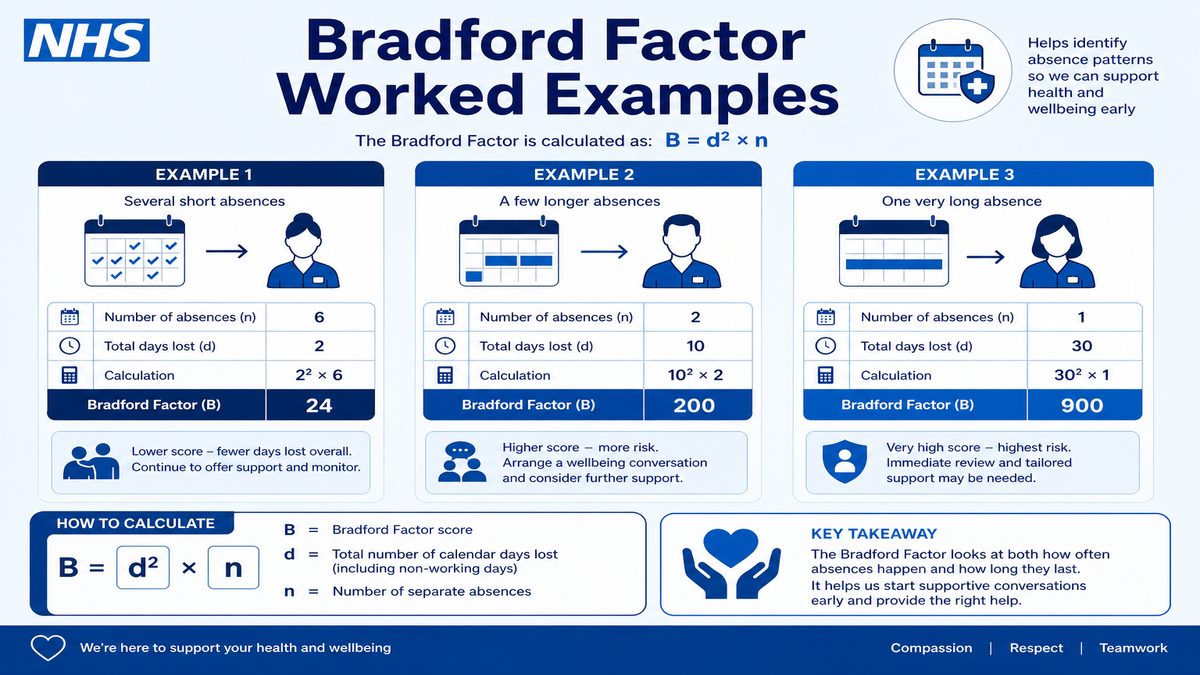
The following table demonstrates how the same 10 total days of absence produce vastly different scores depending on the number of separate spells:
Scenario | Spells (S) | Days (D) | Calculation | Bradford Score |
1 absence of 10 days | 1 | 10 | 1² × 10 | 10 |
2 absences of 5 days each | 2 | 10 | 2² × 10 | 40 |
5 absences of 2 days each | 5 | 10 | 5² × 10 | 250 |
10 absences of 1 day each | 10 | 10 | 10² × 10 | 1,000 |
An employee with 10 separate single-day absences scores 1,000 — exactly 100 times higher than an employee who takes a single 10-day block. The total days absent are identical.
A Band 5 staff nurse takes 3 separate sick days over a rolling 12-month period (each absence is 1 day):
The same nurse takes 1 absence of 3 consecutive days instead:
Same total absence. The fragmented pattern produces a score 9 times higher. This is the core mechanism of the Bradford Factor — it penalises frequency more heavily than duration.
34 There are no legally mandated trigger points in the UK; it's up to each organisation to define its own based on operational realities and company culture. This means every NHS trust sets its own thresholds.
However, a common tiered structure used across many NHS trusts looks like this:
Bradford Score Range | Concern Level | Typical NHS Trust Action |
0–49 | No concern | No formal action. Absence is within normal parameters. |
50–124 | Low concern | Informal return-to-work conversation with line manager. Absence pattern is noted. |
125–199 | Moderate concern | Formal attendance review meeting. Occupational health referral may be offered. A written record is created. |
200–399 | High concern | First formal warning under attendance/capability procedure. Improvement targets are set with a defined review period. The employee has the right to be accompanied. |
400–599 | Serious concern | Final written warning. Continued monitoring. Occupational health assessment if not already completed. |
600+ | Critical | Consideration of dismissal on grounds of capability. Never automatic — full investigation is required. |
28 Under Bradford Teaching Hospitals NHS Foundation Trust's Attendance Policy, in general terms a Bradford Factor score of between 20 and 99 triggers an attendance review meeting; a score of between 100 and 299 triggers an informal stage 1 meeting; and a score of over 300 triggers a formal stage 2 meeting. 32 Employers (including NHS providers) tend to use triggers that start at the 150–200 mark.
Some trusts have moved away from the Bradford Factor entirely. 31University Hospitals Bristol and Weston NHS Foundation Trust removed the Bradford Factor from its Supporting Attendance Policy in September 2018.
Action step: Check your own Trust's Attendance Management Policy (sometimes titled "Managing Sickness Absence Policy" or "Supporting Attendance Policy") for the exact trigger points that apply to you. Ask your line manager or HR department if you are unsure.
The Bradford Factor does not operate in isolation within NHS trusts. It functions as one metric within a broader absence management framework that includes:
26 Even where the Bradford Factor is used to support a capability dismissal, the employer must follow a fair process: investigating the reasons, obtaining medical evidence, consulting with the employee, considering reasonable adjustments. A Bradford score on its own does not establish capability. Tribunals expect employers to treat the score as a starting signal, not the conclusion.
Understanding the Bradford Factor requires context about actual NHS absence levels. The data below comes from NHS England Digital's official statistical publications:
2 Ambulance Trusts had the highest sickness absence rate at 7.0% in February 2026. 2 Anxiety, stress, depression, and other psychiatric illnesses was the most reported reason for sickness, accounting for over 636,400 full-time equivalent days lost and 28.5% of all sickness absence in February 2026.
A June 2026 Policy Exchange report found that 3the NHS had a 5.15% sickness absence rate in 2024 compared with a UK public sector average of 2.9% and a UK private sector average of 1.8%. The report also found that 3just 1% of NHS staff account for 12.5% of all sickness absence and 10% account for 55% of all sickness absence.
These figures mean the Bradford Factor operates within a system where absence rates are structurally high, making context, fairness, and occupational health support essential in its application.
Source: NHS England Digital — NHS Sickness Absence Rates (https://digital.nhs.uk/data-and-information/publications/statistical/nhs-sickness-absence-rates)
36 From April 2026, SSP is payable from the first full day of absence, and eligibility has widened. 37 The three waiting days are abolished.
This change directly impacts the Bradford Factor for NHS staff in two ways:
38 The standard weekly SSP rate from 6 April 2026 is £123.25. 38 Employees earning less will receive the lower of 80% of their average weekly earnings or £123.25 — whichever is smaller.
If your NHS trust has not updated its Bradford Factor trigger points since April 2026, this is worth raising with your HR department, as the abolished waiting days can inflate scores across the board.
21 Under the Equality Act 2010, employers must consider reasonable adjustments for employees with disabilities. This is the single most important legal consideration when any NHS trust applies the Bradford Factor.
20 One of the most significant Bradford Factor disadvantages is that it doesn't take individual circumstances into account, such as disabilities. A disabled employee taking frequent, short-term absences attributed to their disability could be punished for a reason relating to their disability, which would amount to disability discrimination. 12 Employers are subject to the duty to make reasonable adjustments under section 20 of the Equality Act 2010. If applying standard Bradford trigger points places a disabled employee at a substantial disadvantage, the employer must take reasonable steps to remove that disadvantage. This may include adjusting trigger thresholds, discounting certain absences, or ensuring that Bradford scores are not used as escalation triggers at all for that individual.
26 To stay on the right side of equality law, most employer policies exclude pregnancy-related absence from the Bradford calculation — required by section 18 of the Equality Act 2010. Penalising pregnancy absences is automatic discrimination.
27 A disability can arise from a wide range of impairments, including impairments with fluctuating or recurring effects such as rheumatoid arthritis, myalgic encephalitis (ME), chronic fatigue syndrome (CFS), fibromyalgia, depression, epilepsy, migraines, asthma, and other episodic conditions.
NHS trusts must consider whether a high Bradford Factor score results from a protected characteristic before taking formal action. The practical adjustments include:
30 A high Bradford Factor score should never lead to automatic disciplinary action. It must always be a trigger for a supportive, confidential conversation to understand what's really going on.
The Bradford Factor provides genuine value when used correctly within a broader framework:
1. Identifies disruptive absence patterns
12 Frequent short-term absences are operationally disruptive. They are harder to plan for, more difficult to cover at short notice, and more likely to create workflow instability than a known period of long-term sickness. The Bradford model mirrors that operational concern by flagging patterns that feel disruptive even where total absence days remain relatively low.
2. Provides a standardised, objective metric The formula produces a single number from two inputs — no subjective judgement is needed at the calculation stage. This allows NHS ward managers, department heads, and HR professionals to compare absence patterns across individuals, teams, and directorates consistently.
3. Triggers early support conversations
30 The key is to remember what the Bradford Factor is for: it's a management information tool, not a disciplinary weapon. By using a high score as a prompt to investigate, support, and make necessary adjustments, you can manage attendance effectively while upholding your legal and ethical responsibilities.
4. Simple to calculate The formula requires only 2 inputs (spells and days). No specialist software, statistical training, or complex data processing is needed — though NHS ESR automates it.
5. Proven track record in the public sector
11 In May 2001, HM Prison Service began using the Bradford Formula to identify staff with high absenteeism due to illness.
The Bradford Factor faces significant and valid criticisms that every NHS employee and manager should understand:
1. Penalises chronic conditions and disabilities
23 Some disabilities and illnesses may prevent a person from coming to work on occasion, thus negatively skewing their Bradford Factor score. To dismiss such an employee would be hugely unfair, not to mention in violation of the Equality Act 2010.
2. Encourages presenteeism
10 Its application requires care to ensure fairness and avoid unintended consequences — like encouraging presenteeism, where employees feel pressured to work while unwell. In clinical NHS settings (wards, operating theatres, emergency departments), presenteeism risks patient safety, infection control, and clinical outcomes.
3. No distinction by cause
16 The Bradford Factor does not take into account the reasons for an employee's absence and can lead to an incorrect assessment of the situation. The formula treats a stomach bug identically to a bereavement, a disability flare-up, or a mental health crisis.
4. Legacy tool that may not reflect current law
12 Many employers continue to rely on the Bradford Factor for historical reasons rather than legal suitability. It is often embedded in legacy absence management policies and has not been reassessed against developments in equality law, post-pandemic working practices, or increased awareness of fluctuating conditions such as long COVID and mental health disorders.
5. Should never be used in isolation
35 Any policy that uses the Bradford Factor should really be using it together with common sense rules allowing discretion and discussion on factors like employee well-being, employee health, or chronic conditions. Applying it blindly is likely to be as harmful as ignoring poor employee attendance altogether.
If your Bradford Factor score is approaching a trigger point, the following legitimate strategies can help:
If you are genuinely unwell, staying home until you have fully recovered — rather than returning too early and relapsing into a second separate absence — produces fewer spells and a lower Bradford score. Two spells of 2 days each (score: 16) is worse than one spell of 4 days (score: 4).
An occupational health assessment can result in workplace adjustments that prevent future absences: phased returns, modified duties, equipment changes, shift-pattern adjustments, or reduced patient caseloads during recovery periods.
If you have a condition that meets the definition under the Equality Act 2010 — a physical or mental impairment that has a substantial and long-term negative effect on your ability to carry out normal day-to-day activities — your NHS trust should discount related absences from your Bradford Factor calculation. Speak to HR to ensure this adjustment is applied to your ESR record.
Some trusts reset the Bradford Factor to zero after a formal warning is issued. Others apply a pro-rata system. Some have removed the Bradford Factor entirely and use alternative trigger mechanisms (e.g., percentage attendance or spell count). Know which system your trust uses.
The calculation uses a rolling 52-week period. Absences older than 12 months automatically drop off your score with each passing day. If your most disruptive spells were 10 months ago, your score will decrease naturally within 2 months.
Part-time NHS staff on Agenda for Change contracts must have Bradford Factor trigger points adjusted pro rata. A full-time employee working 5 days per week and a part-time employee working 3 days per week have different exposure to absence opportunities, so the trigger thresholds must reflect this.
The pro-rata formula:
Adjusted trigger = Full-time trigger × (contracted days per week ÷ 5)
Working Pattern | Full-Time Trigger (example) | Part-Time Adjusted Trigger |
5 days/week | 125 | 125 |
4 days/week | 125 | 100 |
3 days/week | 125 | 75 |
2.5 days/week | 125 | 62.5 |
NHS staff who work compressed hours (e.g., 3 × 12.5-hour shifts), annualised hours, or irregular rotational shifts should confirm the pro-rata method with their Trust's HR department, as application varies between organisations.
Measure | What It Tracks | Best For |
Bradford Factor (S² × D) | Frequency-weighted absence score | Identifying short-term, fragmented absence patterns |
Lost Time Rate | Percentage of total working time lost to absence | Organisation-level benchmarking |
Absence Frequency Rate | Average number of absence spells per employee | Comparing absence instances across teams |
Percentage Attendance | Proportion of scheduled time actually worked | Individual compliance monitoring |
Fit Note Count | Number of GP-issued fit notes | Tracking medically certified long-term absence |
Return-to-Work Interview Completion Rate | Whether RTW conversations are happening | Measuring management compliance with absence policy |
32 If you're super savvy, your trigger points won't rely on the Bradford Factor alone but will also have a useful "and/or" included — so, for example, you'd trigger on three absences in six months "and/or" a Bradford Factor score of 180. This is beneficial as it makes the system harder to game.
The most effective NHS trusts use the Bradford Factor as one metric within a broader framework that includes occupational health, wellbeing programmes, return-to-work interviews, and supportive line management.
This table shows Bradford Factor scores for common absence patterns, all calculated over a rolling 12-month period:
Spells (S) | Days (D) | Score (B) | Typical Band |
1 | 1 | 1 | No concern |
1 | 5 | 5 | No concern |
1 | 10 | 10 | No concern |
1 | 20 | 20 | No concern |
2 | 4 | 16 | No concern |
2 | 10 | 40 | No concern |
3 | 3 | 27 | No concern |
3 | 6 | 54 | Low concern |
3 | 9 | 81 | Low concern |
4 | 4 | 64 | Low concern |
4 | 8 | 128 | Moderate concern |
4 | 12 | 192 | Moderate concern |
5 | 5 | 125 | Moderate concern |
5 | 10 | 250 | High concern |
6 | 6 | 216 | High concern |
6 | 12 | 432 | Serious concern |
7 | 7 | 343 | High concern |
8 | 8 | 512 | Serious concern |
10 | 10 | 1,000 | Critical |
10 | 15 | 1,500 | Critical |
A Bradford Factor score of 0 means the employee has had zero unplanned absence spells in the rolling 52-week period. The formula produces 0 when S (spells) equals 0, because 0² × D = 0, regardless of the value of D. In practice, a score of 0 means perfect unplanned-absence attendance.
A Bradford Factor score below 50 is generally considered acceptable across most NHS trusts and UK employers. 17As a rough guide: scores below 100 are considered normal, from 200 a return-to-work conversation is advisable, and from 600 urgent action is recommended. The lower the score, the fewer disruptions to your team's rota and patient care.
17 There are no legally defined or industry-wide standardised thresholds. Organisations set these internally. Common NHS trust triggers range from 80 to 300 for the first formal stage, depending on the individual trust's attendance management policy. Always check your own trust's policy document.
No. The Bradford Factor applies only to unplanned absences — primarily sickness absence. Planned annual leave, study leave, maternity leave, paternity leave, adoption leave, compassionate leave, and other pre-authorised leave types are excluded from the calculation.
No. Under section 18 of the Equality Act 2010, pregnancy-related sickness absence must be recorded separately and must not count toward Bradford Factor calculations or trigger disciplinary action. Any NHS trust policy that includes pregnancy-related absence in the Bradford Factor calculation is unlawful.
No. 26Even where the Bradford Factor is used to support a capability dismissal, the employer must follow a fair process: investigating the reasons, obtaining medical evidence, consulting with the employee, considering reasonable adjustments. A Bradford score on its own does not establish capability. Dismissal requires a full capability procedure with a right to be accompanied at every stage.
Yes. NHS Scotland health boards and Health and Social Care (HSC) trusts in Northern Ireland also use the Bradford Factor, though trigger points, policy names, and escalation procedures differ from those in NHS England and NHS Wales. Each board or trust publishes its own attendance management policy.
Only contracted working days count as absent days (D). If an NHS employee working Monday to Friday is absent for one calendar week, D = 5, not 7. Weekends and bank holidays are excluded — unless they fall on the employee's rostered shift pattern (e.g., a nurse working a weekend rota would count Saturday and Sunday as working days if those are contracted shifts).
Yes. NHS trusts are required to consider mitigating circumstances before taking formal action. You can present evidence of disability-related absence, bereavement, work-related injury, or other protected circumstances at any stage of the attendance management process. Your trust's policy will outline the specific appeals or representation process. You also have the right to be accompanied by a trade union representative or workplace colleague at any formal meeting.
No. The Bradford Factor uses a rolling 52-week window, not a fixed annual calendar. Old absences drop off continuously as they pass the 12-month mark from today's date. Some trusts do reset the score to zero after a formal warning is issued, but this is a trust-level policy decision, not a universal rule.
S = 3, D = 5. B = 3² × 5 = 9 × 5 = 45.
S = 5, D = 5. B = 5² × 5 = 25 × 5 = 125.
S = 1, D = 20. B = 1² × 20 = 1 × 20 = 20. Despite 20 days off work, the score is low because there was only 1 spell.
S = 4, D = 10. B = 4² × 10 = 16 × 10 = 160.
Yes. 32A Bradford Factor score of 1,000 is unusually high and should normally trigger further investigation, with a formal warning or improvement notice being likely. A score of 1,000 requires 10 spells totalling 10 days, or equivalent high-frequency patterns, and places the employee firmly in the critical trigger band under most NHS trust policies.
24 If an employee's absences are a direct result of their disability, applying the formula without any adjustments could easily be seen as discriminatory. The Equality Act is about making sure disabled employees aren't put at a disadvantage. This often means the employer must discount some, or even all, disability-related absences from any Bradford Factor calculation. Raise this with your line manager, HR department, or trade union representative.
The abolition of the 3-day SSP waiting period from 6 April 2026 does not change the Bradford Factor formula itself. However, 26since 6 April 2026, Statutory Sick Pay is payable from day one of absence. That means more short absences will be recorded, and Bradford Factor scores will rise across the workforce. Employers who automatically trigger action at the same threshold as before will see more cases — and more risk — than they expect.