 Take Home Pay
This NHS sick pay calculator is for Agenda for Change employees checking Section 14 occupational sick pay entitlement against an absence in 2026/27. Enter band or salary, continuous NHS service tier, contracted hours, days off and prior sickness already used in the rolling year. It splits full pay, half pay and no-pay days, shows Statutory Sick Pay context, pay loss versus normal earnings and an estimated net comparison. Use it before long-term absence, phased return or Bradford Factor reviews. Figures follow AfC reckonable service bands so sickness pay planning matches NHS occupational sick pay rules.
Calculate full pay, half pay, Statutory Sick Pay (SSP) top-ups, and net pay loss for sickness absence
| Continuous Service | Full Pay Entitlement | Half Pay Entitlement |
|---|---|---|
| Up to 4 Months | 1 Month | 2 Months |
| 4 Months to 1 Year | 2 Months | 2 Months |
| 1 to 2 Years | 2 Months | 2 Months |
| 2 to 3 Years | 4 Months | 4 Months |
| 3 to 5 Years | 5 Months | 5 Months |
| After 5 Years | 6 Months | 6 Months |
For employees covered by the national Agenda for Change sickness provisions, contractual sick pay increases with reckonable service. The standard national pattern is:
| Reckonable service | Full pay | Half pay |
|---|---|---|
| During first year | 1 month | 2 months |
| During second year | 2 months | 2 months |
| During third year | 4 months | 4 months |
| During fourth and fifth years | 5 months | 5 months |
| After 5 years | 6 months | 6 months |
Source: NHS Terms and Conditions of Service
Direct answer: Band does not determine the number of months of sick pay. Reckonable service and the applicable sickness rules are the central attributes. Band/pay matters when working out the amount of full or half pay.
Do not let the calculator diagnose whether an absence is “authorised” or whether formal HR action should occur. That is an employment-policy decision, not an arithmetic output.
Half pay means the contractual sick-pay component changes; it does not necessarily mean every payslip line simply divides by two. Statutory Sick Pay, pensionable treatment and local payroll coding can interact with the final payslip. Show assumptions clearly.
Sick leave and annual leave are separate entitlements. Users searching “do I lose NHS annual leave when off sick?” should be directed to current contractual/legal guidance rather than having leave deleted automatically by this calculator.
This NHS sick pay calculator estimates Occupational Sick Pay under Agenda for Change based on your reckonable service and length of absence. AfC sick pay scales up with continuous service — from one month’s full pay (and two months’ half pay) in the first year, through to six months’ full pay and six months’ half pay after five years’ service. Local trust policies and previous sickness in the rolling period can change the remaining entitlement.
AfC sickness absence: NHS Terms and Conditions Handbook.
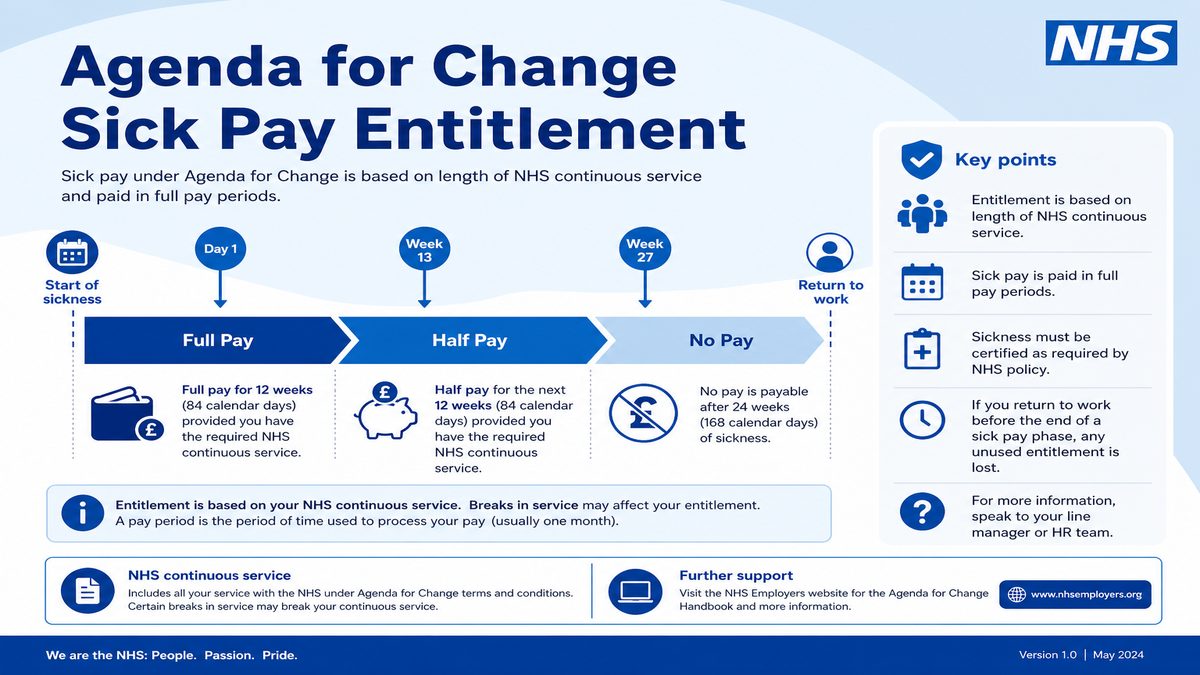
Occupational Sick Pay is separate from Statutory Sick Pay (SSP). Most NHS employees receive OSP, which is usually more generous than SSP alone. Entitlement depends on continuous reckonable service at the start of the absence and how much OSP you have already used in the relevant period.
Enter your service length, salary and absence duration to estimate remaining full-pay and half-pay weeks. Results are indicative — managers and Occupational Health decisions, phased returns and disability-related absences follow trust procedure. For absence scoring used in some trusts, see the Bradford Factor calculator.
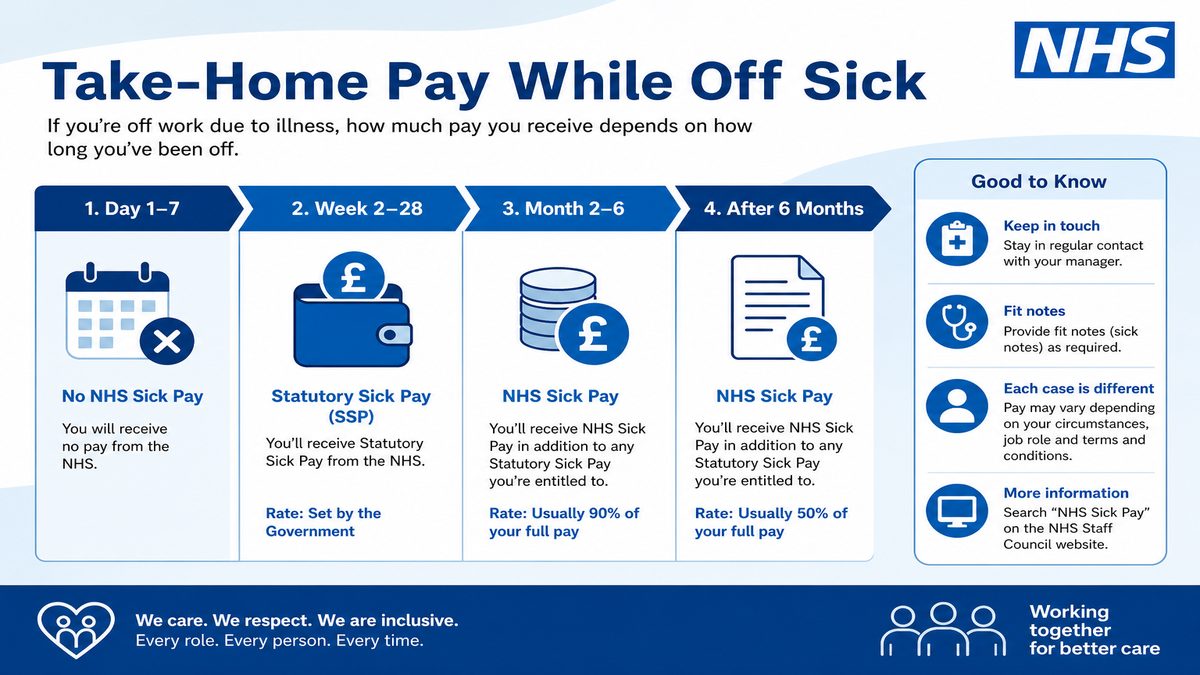
Half pay still attracts tax, NI and (where applicable) pension on the pensionable elements. If you need a normal-duty payslip estimate before absence, use your band calculator from the calculators hub. Related leave tools include the annual leave calculator and maternity pay calculator.