 Take Home Pay
Take Home Pay
Take Home Pay
Use this free NHS locum calculator to compare your exact take-home pay under direct PAYE versus an umbrella company. Built for NHS doctors, nurses, allied health professionals, and all NHS bank staff. Updated for the 2026/27 tax year using confirmed HMRC rates, verified NHS Pension tiers, and NHS-specific deductions.
Enter your hourly or daily rate, select your payment route, and see your net pay difference instantly — no account needed, no data stored.
This tool calculates two precise net pay figures side by side for any NHS locum worker:
Route 1 — Direct NHS PAYE: Your rate is paid by the NHS trust, health board, or staffing agency directly. The employer deducts Income Tax and Employee National Insurance at source. Employer National Insurance is paid by the trust on top of your rate. It does not reduce your gross pay.
Route 2 — Umbrella Company PAYE: Your assignment rate is paid to the umbrella company. 1The umbrella pays Employer National Insurance at 15% on your earnings above the Secondary Threshold of £5,000 per year. The Apprenticeship Levy (0.5%), the umbrella margin, Income Tax, and Employee National Insurance are all deducted before net pay reaches your bank account. Every one of these costs comes out of your assignment rate.
The calculator applies confirmed 2026/27 HMRC tax rates, 10NHS Pension contribution tiers effective from 1 April 2026, which are structured into six thresholds ranging from 5.2% on earnings up to £13,259 to 12.5% on earnings above £67,669.
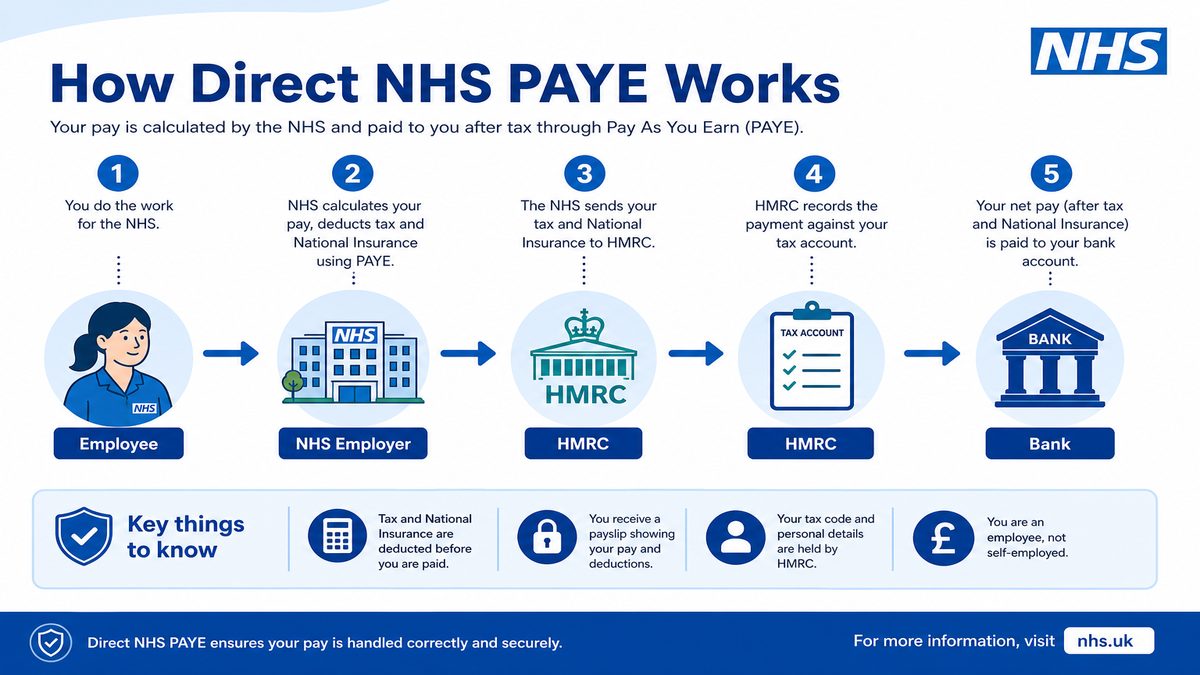
When an NHS trust, NHS health board, GP practice, or staffing agency employs you directly under PAYE, your payroll follows this exact deduction sequence:
Step 1 — Gross Pay Hourly rate × hours worked, or daily rate × days worked.
Step 2 — NHS Pension Contribution
13 The NHS Pension Scheme uses a six-tier contribution structure with rates running from 5.2% to 12.5%. The rates are unchanged since April 2024. Only the thresholds move each year. 14 The NHS Pension Scheme uses a net pay arrangement. Your contribution comes out of your salary before income tax is calculated, so you receive tax relief automatically without needing to claim it.
Step 3 — Income Tax
3 For 2026/27, the main personal allowance is set at £12,570. Income tax applies at 20% (Basic Rate) on taxable income between £12,571 and £50,270, at 40% (Higher Rate) between £50,271 and £125,140, and at 45% (Additional Rate) above £125,140.
Step 4 — Employee National Insurance
9 Employees pay Class 1 NI at 8% on earnings between the Primary Threshold (£12,570/year, £242/week) and the Upper Earnings Limit (£50,270/year, £967/week), then 2% above that.
Step 5 — Student Loan Repayment (if applicable) Repayments at 9% above your plan threshold. 5The threshold at which borrowers repay Student Loan Plan 1 loans rises to £26,900 per year for 2026/27.
Step 6 — Net Pay The amount deposited into your bank account after all deductions above.
The critical fact: 8employers pay Class 1 NI on top of gross salary — it is not deducted from the employee's pay. Under direct NHS PAYE, the trust absorbs this cost entirely. You do not lose it from your rate.
An umbrella company acts as your employer. The NHS trust or agency pays the umbrella your agreed assignment rate. The umbrella then processes payroll and pays you net salary. The deduction sequence is fundamentally different from direct PAYE — and the difference always reduces your take-home pay at the same assignment rate.
Step | Item | Rate / Amount | Who Pays It |
1 | Assignment Rate (agreed with agency/trust) | Your rate | — |
2 | Employer National Insurance | 15% on earnings above £5,000/yr | Umbrella deducts from your rate |
3 | Apprenticeship Levy | 0.5% of total pay bill | Umbrella deducts from your rate |
4 | Umbrella Margin | £80–£150/month typically | Umbrella deducts from your rate |
5 | = Gross Salary | What remains after steps 2–4 | — |
6 | Employee National Insurance | 8% (£12,570–£50,270) / 2% above | You pay |
7 | Income Tax | 20% / 40% / 45% on taxable income | You pay |
8 | NHS/Workplace Pension | Tiered (NHS) or min. 5% auto-enrolment | You pay |
9 | Student Loan Repayment (if applicable) | 9% above threshold | You pay |
10 | = Net Take-Home Pay | What reaches your bank | — |
4 Employers saw a significant hike from October 2024 onward — a rise from 13.8% to 15% Employer NI, and a drop in the threshold from £9,100 to just £5,000. 1 The rate and threshold are unchanged from 2025/26. This means the umbrella deducts Employer NI at 15% from your assignment rate from the very first pound above £5,000 per year.
This is the most important concept on this page. Read it once and the rest of the calculator makes complete sense.
Under direct PAYE, the NHS trust pays Employer NI (15%) and Apprenticeship Levy (0.5%) on top of your rate. Your £30/hour is your gross pay. The trust absorbs the employer cost separately.
Under umbrella, Employer NI (15%) and Apprenticeship Levy (0.5%) are deducted from within your £30/hour assignment rate. Your gross pay is approximately £25.50/hour — not £30.
The rest of the calculation (Income Tax, Employee NI) then applies to a lower gross figure.
That is why umbrella take-home pay at £30/hour is lower than direct PAYE at £30/hour. The rate looks identical. The net pay is not.
Item | Direct NHS PAYE | Umbrella Company |
Agreed Rate | £30.00/hr | £30.00/hr (assignment rate) |
Employer NI (15%) | Paid by trust — not from your rate | ~£3.70/hr deducted from your rate |
Apprenticeship Levy (0.5%) | Paid by trust — not from your rate | ~£0.15/hr deducted from your rate |
Umbrella Margin | N/A | ~£0.65/hr (£25/week) |
Your Gross Pay | £30.00/hr | ~£25.50/hr |
Income Tax + Employee NI | Applied to £30.00 | Applied to ~£25.50 |
Your Net Pay | Higher | Lower |
The exact difference depends on your annual income, tax code, pension status, student loan plan, and NHS region. That is what the calculator resolves for your specific numbers.
All calculations in this tool use the following confirmed rates and thresholds.
Band | Taxable Income | Rate |
Personal Allowance | Up to £12,570 | 0% |
Basic Rate | £12,571 – £50,270 | 20% |
Higher Rate | £50,271 – £125,140 | 40% |
Additional Rate | Above £125,140 | 45% |
Source: House of Commons Library, Direct Taxes: Rates and Allowances for 2026/27 — parliament.uk
Type | Threshold | Rate |
Employee NI (Primary) | £12,570 – £50,270/yr | 8% |
Employee NI (Primary) | Above £50,270/yr | 2% |
Employer NI (Secondary) | Above £5,000/yr | 15% |
5 The rates and thresholds for the calculation of employee (primary) and employer (secondary) NIC remain unchanged from 2025/26. 8 The employee Primary Threshold is £12,570 per year (£1,048/month, £242/week). The employer Secondary Threshold is £5,000 per year (£417/month, £96/week). The Upper Earnings Limit, where employee NI drops from 8% to 2%, is £50,270.
Source: HMRC — gov.uk/national-insurance-rates-letters
10 As of 1 April 2026, the contribution rates are: 5.2% for earnings up to £13,259; 6.5% for £13,260 to £28,854; 8.3% for £28,855 to £35,155; 9.8% for £35,156 to £52,778; 10.7% for £52,779 to £67,668; and 12.5% for earnings of £67,669 and above.
Tier | Pensionable Pay (2026/27) | Contribution Rate |
1 | Up to £13,259 | 5.2% |
2 | £13,260 – £28,854 | 6.5% |
3 | £28,855 – £35,155 | 8.3% |
4 | £35,156 – £52,778 | 9.8% |
5 | £52,779 – £67,668 | 10.7% |
6 | £67,669 and above | 12.5% |
Important — pension tiers use whole-salary rates, not marginal rates. 15Unlike income tax (which is marginal), NHS pension contributions apply to your entire salary based on which tier you fall into. This creates "cliff edges" at tier boundaries. If your pensionable pay is £28,854, you pay 6.5% = £1,876/year. If it rises by just £1 to £28,855, you move to Tier 3 and pay 8.3% on your entire salary = £2,395/year — that is £519 more in pension contributions for £1 more in gross pay.
Important — HCAS affects your pension tier. 15Basic salary, High Cost Area Supplements (HCAS), recruitment and retention premiums, and on-call availability supplements are all pensionable pay. If your basic salary is £32,073 but you receive £4,000 in HCAS, your pensionable pay is £36,073, putting you in Tier 4 (9.8%) rather than Tier 3 (8.3%).
Source: NHS Employers — nhsemployers.org; NHSBSA — nhsbsa.nhs.uk
13 The total employer rate for the NHS in England for 2026/27 is 23.7% of pensionable pay. Of that, NHS organisations remit 14.38% directly to NHSBSA; the remaining 9.4% is paid centrally by NHS England on their behalf. 14 When you combine your contribution with your employer's, the total going into your pension can be as high as 36.2% of your pensionable pay.
Source: NHSBSA — nhsbsa.nhs.uk/nhs-pension-scheme-employer-contribution-rates-202627
This is the most financially significant difference between working via direct NHS PAYE and working via an umbrella company — and it is the one most locums overlook when comparing pay rates.
When an NHS trust or NHS-registered agency pays you directly via PAYE, you are eligible for the NHS Pension Scheme (2015 CARE Scheme) if you meet the qualifying criteria.
Benefit | Detail |
Employer Contribution | 23.7% of pensionable pay |
Your Contribution | 5.2% – 12.5% (tiered) |
Pension Type | Defined Benefit (Career Average Revalued Earnings) |
Death in Service | Included |
Ill-Health Retirement | Included |
CPI-Linked Annual Increase | Yes — statutory guarantee |
Annual Allowance | £60,000 (standard) for 2026/27 |
14 The NHS employer contribution of 23.7% is one of the highest in the UK. Most private sector employers contribute between 3% and 8%.
When you work via an umbrella company, you are the umbrella's employee, not the NHS trust's employee. You do not qualify for the NHS Pension Scheme.
The umbrella must auto-enrol you into a workplace pension under the Pensions Act 2008. The statutory minimum employer contribution is 3% of qualifying earnings. The statutory minimum employee contribution is 5% of qualifying earnings.
The difference:
NHS Pension | Umbrella Workplace Pension | |
Employer contributes | 23.7% of pensionable pay | Minimum 3% of qualifying earnings |
Your contribution | 5.2%–12.5% (tiered) | Minimum 5% of qualifying earnings |
Pension type | Defined Benefit | Defined Contribution (typically) |
Guaranteed annual increase | Yes (CPI) | No |
Death in Service | Yes | Rarely |
Ill-Health Retirement | Yes | No |
14 Opting out of the NHS Pension means losing employer contributions worth 23.7% of your salary. Most financial advisers recommend staying in the scheme unless you have specific annual allowance problems.
A locum earning £40,000 pensionable pay through an NHS trust receives £9,480/year of employer pension contribution. The same locum working via umbrella receives a maximum of £1,200/year employer pension contribution (3% of £40,000). The annual pension value gap is £8,280 — before any other differences in take-home pay are considered.
The off-payroll working rules (commonly called IR35) determine whether a locum working through an intermediary (umbrella company or limited company) is taxed as an employee or as a self-employed contractor.
For NHS locum work, the rules operate as follows:
NHS trust shifts: The NHS trust is the end client. The trust (or the first agency in the contractual chain) issues the Status Determination Statement (SDS). The vast majority of trust-based locum shifts are determined to be inside IR35. This means Income Tax and National Insurance are deducted at source, exactly as they would be for an employee.
GP practice shifts: Most GP practices qualify as small companies under the Companies Act 2006 small-company test (turnover below £10.2 million, balance sheet below £5.1 million, fewer than 50 employees — two of three conditions must be met). Small companies are exempt from the off-payroll working rules. This means the status determination falls back to the locum and their intermediary.
What IR35 status means in practice for your pay method:
IR35 Status | Limited Company | Umbrella Company |
Inside IR35 | Tax paid at source — no dividend advantage | Tax paid at source — same tax position |
Outside IR35 | Can extract income as salary + dividends — more tax-efficient | Makes no difference — umbrella always taxes as employee |
An umbrella company produces the same tax outcome whether you are inside or outside IR35. The umbrella always taxes you as a PAYE employee. If your work is outside IR35, a limited company becomes the more tax-efficient vehicle.
Any NHS locum with adjusted net income exceeding £100,000 faces an effective 60% marginal income tax rate.
The mechanism: the £12,570 Personal Allowance reduces by £1 for every £2 of adjusted net income above £100,000. The allowance disappears entirely at £125,140. On income between £100,000 and £125,140, you simultaneously pay 40% Income Tax and lose 20p of allowance per pound earned — a combined effective rate of 60%.
This affects:
How to escape the trap:
A consultant locum earning £110,000 adjusted net income who contributes an additional £10,000 to AVC pension reduces their adjusted net income to £100,000 — restoring the full Personal Allowance and recovering £5,027 in Income Tax.
11 Scotland (SPPA) and Northern Ireland (HSC) have different pension tier structures from England and Wales.
Scottish NHS locum workers pay Scottish Income Tax rates, administered by Revenue Scotland via HMRC systems. Scottish income tax uses a six-band structure for 2026/27 with rates distinct from England, Wales, and Northern Ireland.
The calculator automatically applies Scottish Income Tax rates when you select Scotland as your NHS region. This produces materially different net pay figures from those in England.
Scottish NHS staff also have a separate pension scheme (the Scottish NHS Pension Scheme, administered by the Scottish Public Pensions Agency — SPPA). Contribution tiers differ slightly from the England and Wales scheme.
Northern Ireland NHS staff are covered by the HSC Pension Scheme. 14Northern Ireland contribution rates are marginally higher than England and Wales at each tier. The maximum rate is 12.7% compared to 12.5% in England. The employer contribution rate in Northern Ireland is 23.2%.
Select your region in the calculator to apply the correct rates for your situation.
NHS locum workers carry student loan obligations across multiple plan types. Repayments are calculated at 9% of income above the relevant annual threshold (Plan 5: 9% from £25,000; Postgraduate: 6% from £21,000).
Plan | 2026/27 Annual Threshold | Who It Applies To |
Plan 1 | £26,900 | Pre-2012 UK undergraduates |
Plan 2 | £28,470 | Post-2012 England & Wales undergraduates |
Plan 4 | £31,395 | Scottish undergraduates |
Plan 5 | £25,000 | England undergraduates from 2023 onwards |
Postgraduate | £21,000 | Masters and Doctoral loans |
5 The threshold at which borrowers repay Student Loan Plan 1 loans rises to £26,900 per year for 2026/27.
Critical point for locums working inside IR35 via limited company: Your agency will not deduct student loan repayments from agency payments made to your limited company. You must declare and repay these through Self Assessment. Failing to do so results in an unexpected HMRC demand after the tax year ends.
Student loan repayments under direct PAYE and umbrella PAYE are deducted automatically at source by the employer, provided the employer holds a correct tax code with student loan indicators.
Expense | Direct NHS PAYE | Umbrella PAYE | Self-Employed Locum (Sole Trader) |
Travel to temporary workplace | No (SDC test applies) | Possible (SDC test applies) | Yes (if genuinely temporary) |
GMC / NMC / GPhC annual fee | Tax relief via P87 (up to £2,500) | Tax relief via P87 | Fully deductible |
BMA / RCN / Royal College subscription | Tax relief via P87 | Tax relief via P87 | Fully deductible |
Indemnity insurance (MDU/MPS/MDDUS) | Tax relief via P87 | Tax relief via P87 | Fully deductible |
CPD courses | No (PAYE) | No (PAYE) | Fully deductible |
Uniform washing | HMRC flat rate (£185/yr nurses) | HMRC flat rate | Deductible (actual cost) |
Medical equipment (stethoscope, etc.) | No | No | Deductible |
Home office | No | No | Partial deduction |
The Supervision, Direction, and Control (SDC) test determines whether an umbrella locum can claim travel expenses to their assignment site. If the end client (NHS trust) has the right to supervise, direct, or control how you do your work, you fail the SDC test and cannot claim travel expenses. Most clinical locum work fails SDC because NHS trusts retain clinical governance oversight.
A self-employed GP locum invoicing practices directly and meeting HMRC's self-employment criteria can claim the full list of allowable expenses, reducing their taxable profit significantly. GMC fees alone are £421 for 2026. Indemnity insurance for a GP locum ranges from £6,000 to £12,000 per year. Both are fully deductible against taxable profit for a sole trader.
6 One of the biggest changes for the 2026/27 tax year is the launch of HMRC's Making Tax Digital (MTD). Under MTD, self-employed workers with income from self-employment of £50,000 per year or more will be required to file their tax information quarterly using HMRC-approved software.
This affects GP locums and consultant locums operating as sole traders with gross income above £50,000. Key obligations:
Locums working purely through PAYE (direct NHS or umbrella) are not affected by MTD, as their tax is handled by their employer.
Non-compliant umbrella arrangements carry severe penalties under HMRC's disguised remuneration rules. If you participated in a non-compliant umbrella scheme, HMRC can pursue outstanding tax from you personally — even years later.
Follow this six-step compliance check before using any umbrella company:
Step 1 — Check FCSA membership Visit fcsa.org.uk/fcsa-accredited-members. The FCSA (Freelancer & Contractor Services Association) is the UK's compliance body for umbrella companies. FCSA-accredited umbrellas are audited annually against HMRC-aligned standards.
Step 2 — Request your Key Information Document (KID) Since 6 April 2020, agencies must provide a KID before your assignment begins. The KID must show your assignment rate, employer costs, umbrella deductions, and expected net pay. If your agency refuses to provide one, this is a legal breach under the Employment Agencies Act 1973.
Step 3 — Check your payslip Your payslip must show: assignment rate, Employer NI deduction, Apprenticeship Levy deduction, umbrella margin, gross pay, Employee NI, Income Tax, and net pay. All figures must be itemised separately. Any payslip that shows only gross pay and net pay without the employer cost waterfall is non-transparent and warrants investigation.
Step 4 — Apply the 60–65% take-home rule For a Basic Rate taxpayer, compliant umbrella take-home pay is 60–68% of the assignment rate. For a Higher Rate taxpayer, it is 55–62%. Any umbrella offering above 75% of the assignment rate as net pay is operating a non-compliant model.
Step 5 — Verify auto-enrolment pension Every compliant umbrella must auto-enrol you into a workplace pension within 3 months of your start date (or immediately if you are already eligible). If your umbrella has not provided pension documentation, this is a statutory breach under the Pensions Act 2008.
Step 6 — Never accept loan schemes If any part of your pay is described as a "loan," an "advance," a "credit," or a "non-taxable payment," this is a disguised remuneration scheme. HMRC actively pursues these under the Disguised Remuneration rules. Settlements can include all unpaid tax, interest, and penalties going back years.
Choose direct NHS PAYE when:
Consider an umbrella company when:
The key is not which model sounds better in principle. The key is entering your actual rate into the calculator above and comparing the precise net figures.
No. Both routes use the PAYE tax collection system — Income Tax and Employee NI are deducted at source in both cases. The difference is the starting point. Under direct PAYE, your agreed rate becomes your gross pay. Under an umbrella, 1employers pay 15% National Insurance on earnings above the Secondary Threshold of £5,000 per year, and that cost is deducted from your assignment rate before gross pay is established. The umbrella also deducts Apprenticeship Levy (0.5%) and its own margin before calculating your gross. You pay Income Tax and Employee NI on a lower gross — that is why net pay is lower.
The difference depends on your rate, working hours, and tax position. At a £30/hour rate working 37.5 hours per week, a direct PAYE locum pays Employer NI zero from their own rate. An umbrella locum at the same £30/hour sees approximately £3.85/hour deducted for Employer NI and Apprenticeship Levy before gross pay is set. Over a full working year (46 weeks), this difference is approximately £6,640 in pre-tax gross pay — translating to approximately £4,000–£5,000 less in net take-home pay, before umbrella margin costs.
No. Umbrella company employees are employed by the umbrella, not by the NHS trust. NHS Pension Scheme membership requires NHS employment. 14The NHS employer contribution of 23.7% is one of the highest in the UK. Most private sector employers contribute between 3% and 8%. You lose access to the 23.7% employer contribution and receive a minimum 3% auto-enrolment employer contribution instead — a reduction of 20.7 percentage points of employer pension value per year.
If all your income is processed through PAYE via an umbrella and you have no other untaxed income, no significant investment income, no rental income, and no expense claims above £2,500, you do not need to register for Self Assessment. If you have multiple income sources, earn above £100,000, or have student loan obligations not deducted at source (e.g., you work inside IR35 via a limited company), Self Assessment registration is mandatory.
4 National Insurance rates for 2026/27 are 8% for employees on earnings between £12,570 and £50,270, dropping to 2% on earnings above that. Factoring in Employer NI (15%), Apprenticeship Levy (0.5%), umbrella margin, Employee NI (8%/2%), and Income Tax (20%/40%), a compliant umbrella take-home percentage is 60–68% of the assignment rate for Basic Rate taxpayers and 55–62% for Higher Rate taxpayers. Any umbrella offering above 75% should be treated as non-compliant.
9 Employers pay 15% above £5,000/year with no upper limit. 1 The rate and threshold are unchanged from 2025/26. The umbrella company deducts this from your assignment rate before calculating your gross pay.
No. The umbrella margin is deducted from your assignment rate before gross pay is calculated. It is not a tax-deductible expense for you because the deduction occurs at the employer cost level — before you receive any earnings on which tax relief could apply.
From 6 April 2026, HMRC's Joint and Several Liability rules for umbrella companies are in effect. Agencies are now legally responsible for ensuring the umbrella companies they use comply with HMRC requirements. If an umbrella fails to remit tax, HMRC can pursue the agency or the NHS trust as the end client. This creates stronger incentives for agencies to vet umbrella providers and removes non-compliant umbrellas from the supply chain.
It depends on your work pattern and clinical setting. IR35 does not apply to sole traders — the off-payroll working rules specifically target workers using an intermediary company. A self-employed GP locum invoicing GP practices directly under a genuine self-employment arrangement can claim significantly more expenses (indemnity, GMC fees, Royal College subscriptions, CPD, travel, equipment), deduct pension contributions as a business cost, and access the NHS Pension Scheme via Form A and Form B. However, self-employed locums bear their own professional indemnity liability, manage all tax obligations via Self Assessment, and pay Class 4 NI at 6% on profits between £12,570 and £50,270. 8Self-employed people pay Class 4 NI on their annual profits, paid through Self Assessment rather than PAYE. There is no employer NI on self-employed income.
Yes. Your pension tier is assessed on your annualised whole-time-equivalent pensionable pay. 11Your tier is set based on your annualised whole-time-equivalent pensionable pay, not your actual gross pay. For example, a part-time worker at 0.5 FTE on £20,000 actual pay has a WTE pay of £40,000, placing them in the 9.8% tier. The 9.8% applies to the actual £20,000, so they pay £1,960 per year in contributions. Locum income on top of a salaried contract can push your pensionable pay into a higher tier, increasing your contribution rate on your entire pensionable earnings — not just the locum portion.
Standard daytime GP locum session rates (Monday to Friday, 3-hour session): £800–£950 across most of England. London and South East: £850–£1,000 per session. Rural and hard-to-fill areas: £900–£1,100 per session. Out-of-hours urgent care: £90–£130 per hour. These are post-agency-margin rates paid to the locum GP. Pre-margin rates paid by the practice are higher. Rates vary by region, practice, session type, and demand. This calculator accepts any hourly or session rate and returns your net pay under PAYE or umbrella.