 Take Home Pay
Take Home Pay
Take Home Pay
A gross daily locum rate and a permanent salary are not comparable figures. Every deduction — income tax, National Insurance, NHS Pension, student loan, professional indemnity, and forfeited employer contributions — sits between the headline number and the money that reaches your bank account. This calculator removes all of that noise and gives you one number: the exact pound-for-pound difference between working as an NHS locum and staying in a permanent (substantive) NHS post in 2026/27.
20 The Personal Allowance for income tax is set at £12,570 for 2026/27. Like the basic rate limit, it has been fixed in value since 2021/22 and is due to remain at this level until 2030/31. 20 The main rate of National Insurance contributions for employees is set at 8% for 2026/27. The calculator applies every current rate in real time to both routes simultaneously. Enter your figures below and get your side-by-side result in seconds.
This tool runs two parallel payslip calculations and displays them side by side. It does not divide your salary by 12. It deducts every mandatory and elective charge in the correct legal sequence — the same sequence your employer's payroll system uses.
1 Your actual take-home pay depends on your pension scheme contributions, income tax, National Insurance, student loan plan, and any additional payments such as unsocial hours enhancements or High Cost Area Supplements. The calculator applies all of these to the permanent side. On the locum side, it applies the deduction set that corresponds to your working structure — self-employed sole trader, PAYE via agency, or limited company.
Income tax (PAYE, England): Start with your gross pay, subtract the £12,570 Personal Allowance, then tax what remains band by band: 20% on £12,571–£50,270, 40% on £50,271–£125,140, and 45% above £125,140.
Employee National Insurance (Class 1): 17The employee Primary Threshold is £12,570 a year (£242/week). The Upper Earnings Limit, where employee NI drops from 8% to 2%, is £50,270.
NHS Pension employee contribution: 7NHS Pension Contribution Rates for 2026/27 are structured into six tier thresholds. As of 1 April 2026, the contribution rates are: 5.2% for earnings up to £13,259; 6.5% for £13,260 to £28,854; 8.3% for £28,855 to £35,155; 9.8% for £35,156 to £52,778; 10.7% for £52,779 to £67,668; and 12.5% for earnings of £67,669 and above.
Student loan: Repayment at 9% of income above your plan threshold, applied after income tax and National Insurance have been deducted.
High Cost Area Supplement: 3The High Cost Area Supplement (HCAS) is an additional pensionable payment for Agenda for Change staff working in or around London. HCAS is calculated as a percentage of the basic salary across three geographic zones: Inner London at 20%, Outer London at 15%, and the Fringe area at 5%.
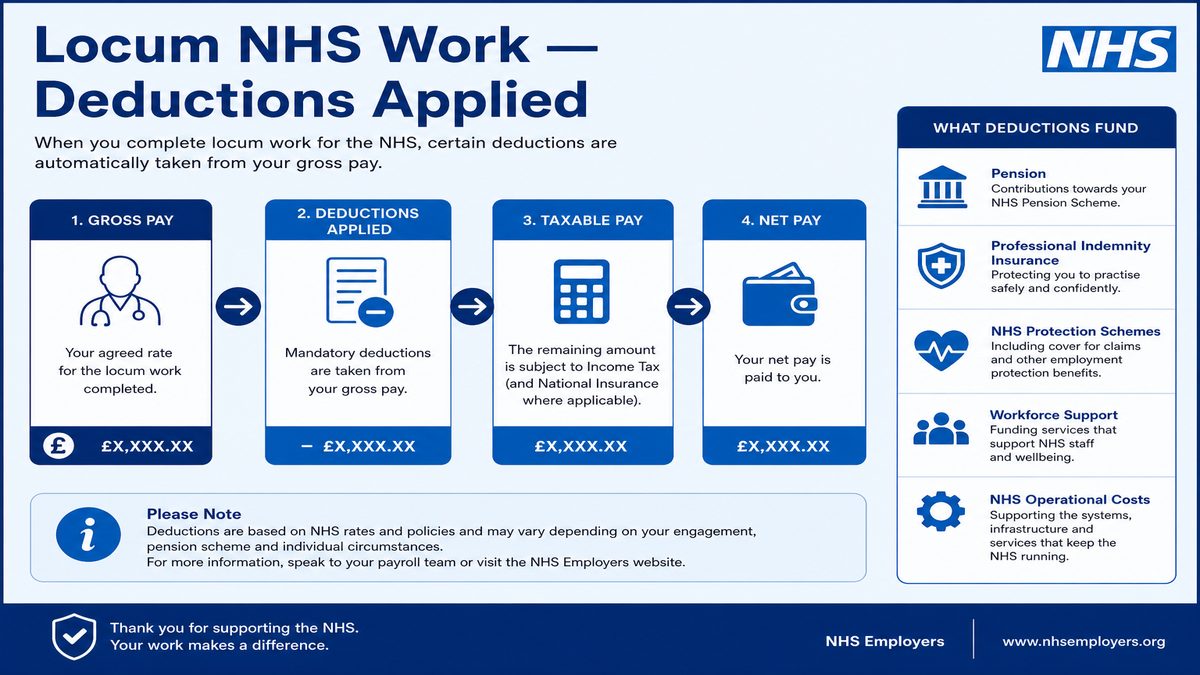
The locum side applies a different deduction set depending on your working structure. Three structures are available in the calculator:
Self-Employed (Sole Trader): You invoice NHS trusts or GP practices directly. You complete a Self Assessment tax return and pay income tax on profit — gross income minus allowable business expenses minus pension contributions. 17Self-employed people pay Class 4 NI at 6% on profits between £12,570 and £50,270, and 2% on profits above £50,270.
PAYE via Agency (Inside IR35): The agency deducts income tax and Class 1 employee NI before paying you. 17Employees pay 8% on earnings £12,570–£50,270 (2% above). Employers pay 15% above £5,000. Inside IR35 status means you cannot offset business expenses against this income stream.
Limited Company: Subject to Corporation Tax on profits, then income tax and dividend tax on extraction. 15The dividend allowance is £500 for the 2026/27 tax year. Any dividends received above this allowance are taxed at the applicable dividend rates.
1 Agenda for Change (AfC) is the national pay system covering more than a million NHS staff — nurses, healthcare assistants, paramedics, allied health professionals, administrative and support staff. It does not cover doctors and dentists, who are paid on separate contracts. 2 The full Agenda for Change pay scales for 2026/27 took effect on 1 April 2026 following the government's pay award. 5 The 2026/27 deal is a 3.3% consolidated uplift, recommended by the NHS Pay Review Body and accepted by the government in early 2026. 1 On the 2026/27 England scale, the lowest Agenda for Change salary is Band 2 at around £25,272, and the highest is the top of Band 9 at around £129,783. 4 In the 2026/27 table, Band 5 runs from £32,073 to £39,043, Band 6 from £39,959 to £48,117, and Band 7 from £49,387 to £56,515. 4 Wales accepted a 3.3% AfC uplift for 2026/27. Northern Ireland's Health Minister stated an intention to proceed with 3.3%, subject to budget clarity, while Scotland agreed a separate 3.75% award and uses different income-tax bands.
3 The Inner London High Cost Area Supplement under the Agenda for Change pay system is set at 20% of the basic salary. For the 2026/27 period, the Inner London HCAS has a minimum of £5,794 and a maximum of £8,746 per year.
HCAS is pensionable pay and directly affects your pension tier. 13If your basic salary is £32,073 but you receive £4,000 in HCAS, your pensionable pay is £36,073 — putting you in Tier 4 (9.8%) rather than Tier 3 (8.3%). Select your HCAS zone in the calculator to ensure your tier is correctly assigned.
The following elements of your pay are pensionable and affect your tier assessment: basic salary, HCAS, recruitment and retention premiums, and on-call availability supplements. 13Overtime payments (in most cases), expense reimbursements, one-off non-consolidated payments, and car allowances are NOT pensionable.
4 Scotland agreed a separate 3.75% award and uses different income-tax bands. 19 The Scottish Budget 2026/27 uplifted the Starter band by 40% and the Basic band by 7.4%. The Starter band now runs to £16,537 and the Basic band to £29,526. The Intermediate, Higher, Advanced and Top thresholds remain frozen. Select Scotland in the calculator to apply the correct Scottish rates.
The NHS Pension Scheme is the most significant variable in the entire locum vs permanent financial comparison. It affects take-home pay through employee contributions, and it adds enormous invisible value through employer contributions that self-employed locums do not receive.
8 From 1 April 2026, the NHS Pension Scheme uses a six-tier contribution structure with rates running from 5.2% to 12.5%. The rates are unchanged since April 2024. Only the thresholds move each year. 8 Thresholds are uplifted each April by whichever is higher: September CPI from the previous year or the AfC pay award. For 2026/27, September 2025 CPI was 3.8%. The AfC award was 3.3%. CPI won, so tier ceilings moved up by 3.8% while pay moved up by 3.3%. This means the majority of staff did not drift into a higher contribution tier as a result of the 2026/27 pay award.
Tier | Pensionable Pay Range (2026/27) | Contribution Rate |
1 | Up to £13,259 | 5.2% |
2 | £13,260 – £28,854 | 6.5% |
3 | £28,855 – £35,155 | 8.3% |
4 | £35,156 – £52,778 | 9.8% |
5 | £52,779 – £67,668 | 10.7% |
6 | £67,669 and above | 12.5% |
Source: NHS Employers — Member Contribution Rates 2026/27
Unlike income tax — where each band applies only to the slice of income within it — NHS pension contribution rates apply to your entire pensionable pay based on your assigned tier. A member at the very top of Tier 2 (£28,854) pays 6.5% on every pound. A member one pound higher (£28,855) moves to Tier 3 and pays 8.3% on their entire pensionable pay. That single-pound difference costs £519 per year in additional pension contributions. The calculator flags this automatically when your salary sits within £500 of any tier boundary.
9 The employer contribution rate is 23.7% of members' pensionable pay. This is a key benefit that helps make the NHS Pension scheme one of the most comprehensive and generous schemes in the UK and an important part of the overall reward offer for NHS staff. 8 Your employer contributes 23.7% on top of your contribution. NHS organisations remit 14.38% directly to NHSBSA; the remaining 9.4% is paid centrally on their behalf. 11 When you combine your contribution with your employer's, the total going into your pension could be as high as 36.2% of your pensionable pay.
A self-employed locum who is not opted into the NHS Pension Scheme receives £0 of this employer contribution. This single factor is worth between £8,000 and £17,000 per year depending on grade and is the most common reason the locum gross-rate vs permanent gross-salary comparison overstates the real financial benefit of locum work.
11 The NHS Pension Scheme uses a net pay arrangement. Your contribution comes out of your salary before income tax is calculated. You get tax relief automatically without needing to claim. A 20% taxpayer paying 8.3% has a true net cost of approximately 6.6%. A 40% taxpayer paying 12.5% has a true net cost of approximately 7.5%.
12 As of April 2022, all active members of the NHS Pension were moved to the 2015 Scheme. This is a Career Average Revalued Earnings (CARE) scheme. Unlike final salary schemes, your pension is not based on what you earn at the end of your career. Instead, it is built up based on 1/54th of your pensionable earnings every year. Each slice of pension is then revalued annually by the Consumer Price Index (CPI) plus 1.5%. 11 The NHS Pension Scheme is one of the largest and most valuable pension arrangements in the UK, with over 1.5 million active members. It is a defined benefit scheme, which means your retirement income is guaranteed based on your earnings and service. There is no investment risk, no fund management fees, and no annuity to purchase.
The locum gross rate always looks higher. The net comparison requires accounting for every item that permanent employment provides at zero direct cost to you.
Permanent NHS employees are covered by NHS Resolution — the government's state-backed clinical negligence indemnity body — for clinical work carried out as part of their NHS contract. This costs the permanent employee £0 directly. A locum must hold personal medical indemnity through the MDU, MPS, or MDDUS. Premiums are set individually by each medical defence organisation based on specialty, work type, and claims history. A self-employed locum must enter this annual cost into the calculator — leaving it at zero produces an inaccurate result.
A permanent NHS employee with five or more years' service receives 33 days of annual leave plus 8 bank holidays — 41 paid non-working days per year. A locum receives zero paid leave. Every non-working day is an unpaid day.
18 For 2026/27, Statutory Sick Pay (SSP) is set at £123.25 per week or 80% of average weekly earnings (whichever is lower), and is paid from the first day of illness. A locum who cannot work due to illness receives SSP only. A permanent NHS employee with five or more years' service receives full pay for six months and half pay for six months. Enter an income protection insurance premium into the calculator to model this gap accurately.
If your adjusted net income exceeds £100,000, your £12,570 Personal Allowance reduces by £1 for every £2 above that threshold. The allowance reaches £0 at £125,140. The effective marginal income tax rate on earnings between £100,000 and £125,140 is 60%.
20 The Personal Allowance for income tax is set at £12,570 for 2026/27. It has been fixed in value since 2021/22 and is due to remain at this level until 2030/31. Every locum consultant and many senior locum GPs earning £700+/day cross this threshold. The calculator automatically detects when your locum income enters this band, applies the correct marginal rate, and models the impact of pension contributions on your adjusted net income.
19 The employer NI rate remains at 15% with the £5,000 secondary threshold. When an NHS trust or practice engages a locum, the trust pays employer NI on that engagement where applicable. This cost influences the day rate a trust is willing to offer — the trust's total cost of a locum shift includes employer NI on top of the locum's gross rate. This is one reason locum gross rates are higher than the equivalent permanent salary expressed as a daily figure.
Locums are frequently modelled on 52 working weeks. That figure is wrong for any locum taking equivalent time off to a permanent employee. If you intend to take the same holidays as a permanent Band 6 nurse (33 days annual leave plus 8 bank holidays = 41 days), your effective working weeks are approximately 43 per year, not 52. Enter your actual planned working weeks — not 52 — to produce an accurate annual income figure.
Eligibility to contribute to the NHS Pension Scheme depends entirely on your working structure and the type of NHS work:
11 Opting out means losing employer contributions worth 23.7% of your salary. Most financial advisers recommend staying in the scheme unless you have specific annual allowance problems.
The calculator lets you toggle NHS Pension on or off for the locum side. If opted out, enter a private pension (SIPP) contribution instead — the calculator applies the correct income tax relief and shows your adjusted take-home.
IR35 is a set of off-payroll working rules designed to ensure that workers who provide services through an intermediary — typically a limited company — but who would otherwise be employees, pay broadly the same income tax and National Insurance as direct employees.
Since April 2017, public sector engagers — including NHS trusts and GP practices — are responsible for determining whether an engagement falls inside or outside IR35, not the worker. The practical effect: if your trust determines that your locum engagement is inside IR35, the agency or trust deducts income tax and Class 1 employee NI from your gross rate before paying you. You cannot offset business expenses against this income in the same way a self-employed sole trader can.
Structure | IR35 Status | Tax Treatment | NI Class |
Self-employed sole trader | Not applicable | Self Assessment on profit | Class 4 |
PAYE via agency | Inside IR35 | PAYE deducted at source | Class 1 employee |
Ltd company, outside IR35 | Outside IR35 | Self Assessment + dividends | Class 1 + dividend tax |
Ltd company, inside IR35 | Inside IR35 | PAYE through fee payer | Class 1 employee |
Select your structure in the calculator. The entire deduction logic changes between these options.
Self-employed locums reduce taxable profit by deducting legitimate business expenses before income tax and Class 4 NI are calculated. An expense is allowable if incurred wholly and exclusively for business purposes.
Allowable Expense | 2026/27 Rate / Note |
GMC registration fee | Fully deductible |
Medical indemnity (MDU / MPS / MDDUS) | Fully deductible |
BMA / RCN / professional body subscription | Fully deductible |
Business mileage — first 10,000 miles | 45p per mile (HMRC approved rate) |
Business mileage — above 10,000 miles | 25p per mile (HMRC approved rate) |
DBS check (enhanced) | £44 per check, fully deductible |
CPD courses and clinical education | Deductible if directly related to current practice |
Accountancy and tax return fees | Fully deductible |
Clinical equipment | Capital allowance via Annual Investment Allowance |
Locum agency / platform fees | Fully deductible |
Each pound of allowable expense reduces your taxable profit — saving you 20%, 40%, or 45% in income tax at your marginal rate, plus 6% or 2% in Class 4 National Insurance.
Commuting is not allowable. Travel from your home to a regular workplace is not deductible. Travel to a temporary workplace — one where you work for fewer than 24 months — is deductible.
15 If you are self-employed, Class 4 National Insurance contributions will automatically be calculated when you file your Self Assessment tax return for 2026/27.
Any self-employed locum — sole trader or limited company director — must register with HMRC for Self Assessment. The deadline to notify HMRC of self-employment in the 2026/27 tax year is 5 October 2026. The tax return for 2026/27 must be filed online by 31 January 2027. The balancing payment for 2026/27 tax is due on the same date, along with the first payment on account toward 2027/28.
19 Voluntary Class 2 NI rises to £3.65/week for 2026/27, used to fill gaps in your National Insurance record. Self-employed locums who pay voluntary Class 2 NI protect their entitlement to the State Pension and certain contributory benefits.
Set aside 25–30% of every locum payment into a separate account throughout the year. Spending money that belongs to HMRC is the single most common financial mistake made by newly self-employed NHS professionals.
14 The threshold at which borrowers repay Student Loan Plan Type 1 loans rises from £26,065 to £26,900 per year. Plan 2 repayments begin at £27,295 per year. All active plans deduct 9% of income above the threshold. For self-employed locums, student loan repayment is calculated on taxable profit — not gross income — and is collected through Self Assessment, not through payroll.
Student Loan Plan | Annual Repayment Threshold (2026/27) | Rate |
Plan 1 | £26,900 | 9% above threshold |
Plan 2 | £27,295 | 9% above threshold |
Plan 4 (Scotland) | £31,395 | 9% above threshold |
Plan 5 | £25,000 | 9% above threshold |
Postgraduate Loan | £21,000 | 6% above threshold |
This example compares a permanent Band 7 NHS post against an equivalent locum working the same clinical hours, using confirmed 2026/27 rates.
Permanent post: Band 7, Year 1, England. 4Band 7 starts at £49,387 in 2026/27. No HCAS. No student loan. 7NHS Pension Tier 4 at 9.8%, as pensionable pay falls between £35,156 and £52,778.
Locum equivalent: £280/day × 230 days (46 weeks × 5 days) = £64,400 gross. Self-employed. £3,500 in allowable expenses. Taxable profit: £60,900.
Item | Permanent Band 7 | Locum (Self-Employed) |
Gross income | £49,387 | £64,400 |
Allowable expenses | — | −£3,500 |
Taxable amount | £49,387 | £60,900 |
Income tax | £7,515 | £12,210 |
National Insurance | £3,586 (Class 1) | £2,856 (Class 4) |
NHS Pension (employee) | £4,840 (9.8%) | £0 |
Take-home pay | £33,446/year | £45,834/year |
Monthly take-home | £2,787 | £3,820 |
Employer pension value | +£11,705 (23.7%) | £0 |
Paid leave value (~41 days) | +£8,300 (est.) | £0 |
Indemnity cost | £0 | −£1,200 |
Adjusted total reward | ~£53,451 | ~£44,634 |
All figures are estimates based on 2026/27 HMRC rates, NHS Employers pension tiers, and AfC pay scales. They are illustrative only. Use the calculator above for your personal figures. This is not financial advice.
Key finding: The locum monthly take-home is £1,033/month higher. But when the 23.7% employer pension contribution and paid leave are valued, the permanent total reward package exceeds the locum by approximately £8,800/year at this rate. The locum needs approximately £320/day — not £280/day — to achieve genuine parity on total reward in this scenario.
Permanent post: 4Band 7 starts at £49,387. For consultants, the NHS pay is set separately. Entry-level consultant basic salary from 1 April 2026: £113,565. NHS Pension Tier 6 (12.5%). England.
Locum equivalent: Consultant locum rate £900/day × 230 days = £207,000 gross. Inside IR35 (PAYE). No NHS Pension.
Item | Permanent Consultant | Locum Consultant (Inside IR35) |
Gross income | £113,565 | £207,000 |
Personal Allowance | £12,570 | £0 (fully tapered — income above £125,140) |
Income tax | £35,226 | £76,886 |
Employee NI | £5,559 | £8,134 |
NHS Pension (12.5%) | £14,196 | £0 |
Take-home pay | £58,584/year | £122,001/year |
Monthly take-home | £4,882 | £10,167 |
Employer pension value | +£26,915 (23.7%) | £0 |
Paid leave (41 days) | +£18,200 (est.) | £0 |
Indemnity | £0 | −£4,500 |
Adjusted total reward | ~£103,699 | ~£117,501 |
Figures are estimates. Permanent consultant receives Clinical Excellence Award eligibility not modelled here. Not financial advice.
Key finding: At consultant grade and £900/day inside IR35, the locum retains a genuine financial advantage of approximately £13,800/year on adjusted total reward — even after employer pension and leave are valued. However, the 45% additional rate applies to all locum income above £125,140. At this income level, every pension contribution decision, Gift Aid donation, and expense claim carries a 45p-in-the-pound tax consequence. This is where specialist NHS accountancy advice pays for itself many times over.
Gross daily rates for locums are always higher than the equivalent permanent salary expressed per day — this is by design. 9The employer contribution rate is 23.7% of members' pensionable pay — a key benefit that helps make the NHS Pension scheme one of the most comprehensive and generous in the UK. Locum rates are set higher because the trust or practice shifts the employer pension contribution, paid leave, sick pay, and indemnity costs directly onto you. Whether a locum earns more in real terms depends entirely on grade, rate, structure, working weeks, expenses, and pension decisions — which is exactly what this calculator determines.
8 From 1 April 2026, the NHS Pension Scheme uses a six-tier contribution structure with rates running from 5.2% to 12.5%. The rates are unchanged since April 2024. Only the thresholds move each year. 9 Because the 2026/27 Agenda for Change pay award (3.3%) is lower than the CPI from September 2025 (3.8%), there was no further amendment to the member contribution pensionable pay thresholds in 2026/27.
9 The employer contribution rate is 23.7% of members' pensionable pay. This is a key benefit that helps make the NHS Pension scheme one of the most comprehensive and generous schemes in the UK. 8 NHS organisations remit 14.38% directly to NHSBSA; the remaining 9.4% is paid centrally on their behalf. 11 When you combine your contribution with your employer's, the total going into your pension could be as high as 36.2% of your pensionable pay.
12 In 2024, the government moved to a system where tiers are based on actual earnings rather than whole-time equivalent salary. This means if you work part-time, you only pay based on what you actually earn. 8 Contributions are based on your actual pensionable pay, not whole-time equivalent. Part-timers pay the rate that fits what they actually earn.
A self-employed sole trader locum pays income tax on profit (gross income minus allowable business expenses minus pension contributions) via Self Assessment. 17Self-employed people pay Class 4 NI at 6% on profits between £12,570 and £50,270, and 2% on profits above £50,270. 19Voluntary Class 2 NI is £3.65/week for 2026/27, used to fill gaps in your National Insurance record.
20 The Personal Allowance for income tax is set at £12,570 for 2026/27. It has been fixed since 2021/22 and remains at this level until 2030/31. If your adjusted net income exceeds £100,000, this allowance reduces by £1 for every £2 above the threshold — reaching £0 at £125,140 and creating an effective marginal rate of 60% on income between £100,000 and £125,140. Consultant locums earning £700+/day cross this threshold easily. The calculator detects this automatically and models the effect of pension contributions on your adjusted net income.
17 Self-employed people pay Class 4 NI at 6% on profits between £12,570 and £50,270, and 2% on profits above £50,270. 17 The Primary Threshold is £12,570 a year (£242/week). The Upper Earnings Limit, where the rate drops to 2%, is £50,270. 14 The rates and thresholds for employee and employer NIC remain unchanged from 2025/26.
5 The 2026/27 deal is a 3.3% consolidated uplift, recommended by the NHS Pay Review Body and accepted by the government in early 2026. 4 Wales accepted a 3.3% uplift. Northern Ireland's Health Minister stated an intention to proceed with 3.3%, subject to budget clarity, while Scotland agreed a separate 3.75% award.
14 The threshold at which borrowers repay Student Loan Plan Type 1 loans rises from £26,065 to £26,900 per year. Plan 2 repayments begin at £27,295/year. 15 If you are self-employed, Class 4 National Insurance and student loan repayments will automatically be calculated when you file your Self Assessment tax return for 2026/27.
18 For 2026/27, Statutory Sick Pay is set at £123.25 per week or 80% of average weekly earnings (whichever is lower), and is paid from the first day of illness. A permanent NHS employee with five or more years' service receives full pay for six months and half pay for six months. This gap in sick pay protection is one of the most significant financial risks of working as a self-employed locum without income protection insurance.
Yes. Many NHS staff supplement their permanent income with bank or agency shifts. The critical point is that this additional locum income is taxed at your highest marginal rate — often 40%, and 60% if the combined income pushes your adjusted net income above £100,000. The calculator models this scenario by stacking locum income on top of your permanent salary and displaying the marginal rate impact on each additional shift you work.
There is no universal answer. The financially correct answer for you depends on your grade, your achievable day rate, your pension position, your planned working weeks, your allowable expenses, and your risk tolerance. 9Because the 2026/27 Agenda for Change pay award (3.3%) is lower than the CPI from September 2025 (3.8%), there was no further amendment to the member contribution pensionable pay thresholds. Market conditions, ICB locum caps, and specialty demand all affect the rates achievable in practice. This calculator gives you the accurate financial answer for your specific inputs.
This tool is built for every NHS professional who needs a precise, defensible number — not an estimate based on a rule of thumb:
The calculator applies the full £12,570 Personal Allowance for adjusted net income at or below £100,000. For income above £100,000, it reduces the allowance at £1 for every £2 above the threshold. 20The Personal Allowance is set at £12,570 for 2026/27, fixed since 2021/22, and due to remain at this level until 2030/31. The allowance reaches £0 at £125,140. This taper is applied before income tax bands are calculated — it is not a separate tax but a reduction in your tax-free amount.
8 Contributions are based on your actual pensionable pay, not your whole-time-equivalent. 13 Basic salary, HCAS, recruitment and retention premiums, and on-call availability supplements are pensionable. Overtime payments (in most cases), expense reimbursements, one-off non-consolidated payments, and car allowances are not pensionable. The calculator uses your pensionable pay (basic salary plus any HCAS you select) to assign your tier, then applies the tier rate to your actual pensionable pay amount.
11 The NHS Pension Scheme uses a net pay arrangement. Your contribution comes out of your salary before income tax is calculated. You get tax relief automatically without needing to claim. The pension contribution is deducted before the income tax calculation runs — reducing your taxable income and your tax bill in a single step.
4 Scotland agreed a separate 3.75% pay award for 2026/27 and uses different income-tax bands. 19 The Scottish Budget 2026/27 uplifted the Starter band by 40% and the Basic band by 7.4%. The Starter band now runs to £16,537 and the Basic band to £29,526. The Intermediate, Higher, Advanced and Top thresholds remain frozen. Select the Scotland toggle to apply all Scottish-specific rates.
17 Self-employed people pay Class 4 NI at 6% on profits between £12,570 and £50,270, and 2% on profits above £50,270. 14 The rates and thresholds for NIC remain unchanged from 2025/26. Class 4 NI is calculated on your taxable profit after allowable expenses — not on gross income. This is one of the key reasons the expense entry in the calculator matters; every allowable expense reduces both your income tax bill and your NI bill simultaneously.