 Take Home Pay
Take Home Pay
Take Home Pay
This free NHS pregnancy leave calculator gives every NHS employee — nurses, midwives, paramedics, healthcare assistants, physiotherapists, pharmacists, and all Agenda for Change staff — a complete, personalised breakdown of their maternity pay entitlement for 2026/27. Enter your due date, annual salary, and NHS start date to instantly receive your qualifying week, EWC, OMP eligibility verdict, notification deadline, leave start and end dates, and a full week-by-week pay schedule showing exactly how much you take home at each phase of your 52-week leave.
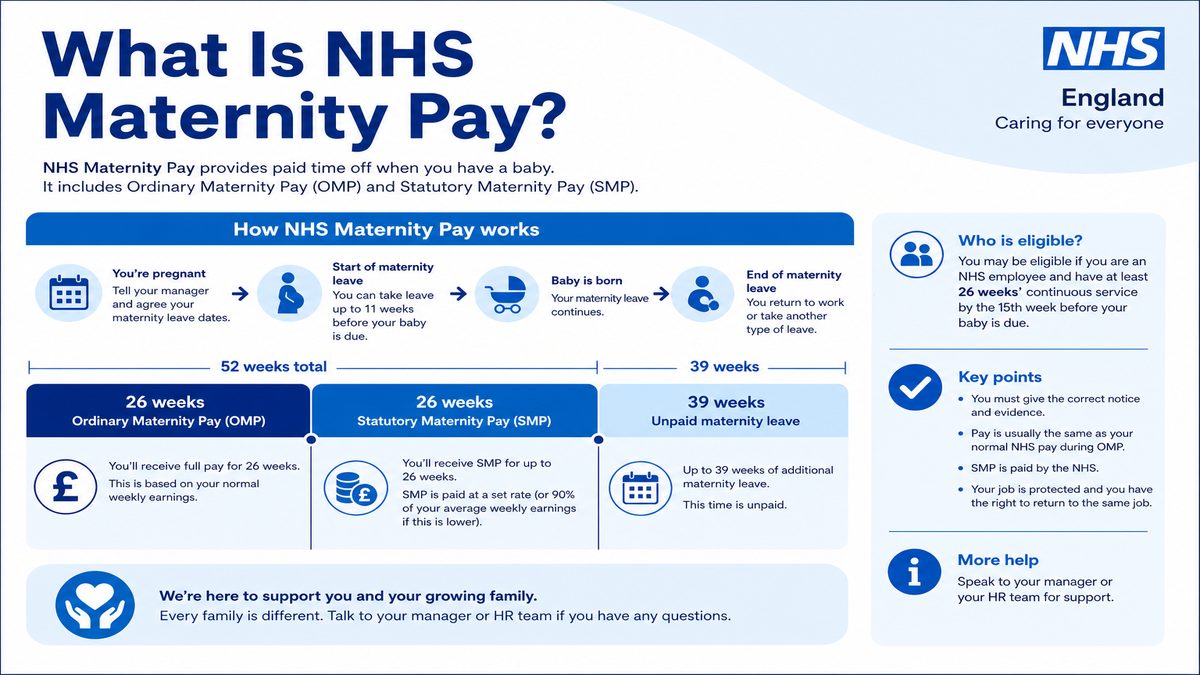
NHS maternity pay combines two separate payment streams under the Agenda for Change (AfC) framework: Occupational Maternity Pay (OMP) — the enhanced pay provided directly by your NHS Trust — and Statutory Maternity Pay (SMP) — the legal minimum funded through HMRC. Unlike standard private-sector employers, who typically pay SMP only, the NHS Agenda for Change contract significantly enhances maternity income during the first 26 weeks of leave.
9 The confirmed 2026/27 AfC pay award of 3.3% took effect from 1 April 2026. This uplift directly affects the Average Weekly Earnings (AWE) used to calculate your SMP, and triggers your right to an AWE recalculation under the Alabaster ruling if the pay rise falls within or adjacent to your reference period. 8 Statutory Maternity Pay is a legal minimum payment your employer must make if you qualify. It is paid for 39 weeks — the first 6 weeks at 90% of your average weekly earnings, followed by up to £194.32 per week for the remaining 33 weeks from 6 April 2026.
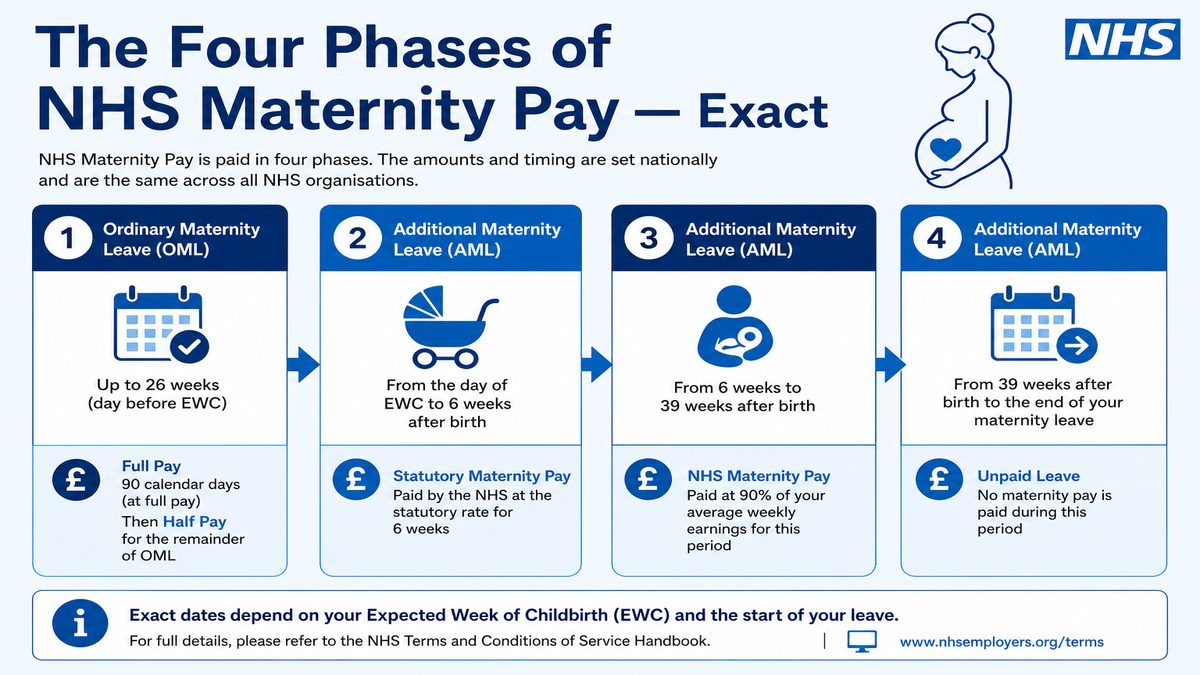
This is the most important table on this page. Every NHS Agenda for Change employee on qualifying service receives pay across exactly four phases.
Phase | Weeks | What You Receive | Notes |
Phase 1 | Weeks 1–8 | Full salary | SMP is offset within full pay, not added on top |
Phase 2 | Weeks 9–26 | Half salary + SMP | Combined total capped so it cannot exceed full pay |
Phase 3 | Weeks 27–39 | SMP only | £194.32/week or 90% AWE — whichever is lower |
Phase 4 | Weeks 40–52 | Unpaid | Job and continuous service fully protected |
Phase 1 — Full Pay (Weeks 1–8) You receive your full contractual salary. SMP is already embedded within this figure — your Trust pays you the difference between SMP and your full salary, so your gross take-home equals 100% of pay.
Phase 2 — Half Pay + SMP (Weeks 9–26) You receive half your basic salary plus your full SMP entitlement. The combined total is capped at your normal full weekly pay, which means if half pay + SMP exceeds 100% of salary, the excess is deducted. For most AfC Band 2–5 staff earning below approximately £20,000, half pay + SMP will equal or exceed full pay, providing additional income protection.
Phase 3 — SMP Only (Weeks 27–39) OMP ceases. 4You receive a flat rate of £194.32 per week (April 2026 – April 2027) or 90% of your average weekly earnings, whichever is lower.
Phase 4 — Unpaid (Weeks 40–52) No pay is received. Your employment contract, NHS pension record, annual leave accrual, and seniority are fully protected throughout this period.
To receive NHS OMP (full pay and half pay phases), you must meet all three of the following conditions:
If you meet these conditions, your Trust is contractually required to pay OMP under the NHS Terms and Conditions of Service Handbook. If you do not return to work with the NHS for the agreed minimum period (typically 3 months), your Trust may reclaim the OMP element paid above SMP.
To qualify for SMP you must meet three separate tests:
Test 1 — Service: You must have worked for your current employer continuously for at least 26 weeks by the end of your qualifying week (the 15th week before your EWC).
Test 2 — Earnings: 1As a rough guide, average weekly pay should be above £129 in 2026/27, and employees should have worked for 26 weeks prior to the qualifying week.
Test 3 — Notification: You must provide written notification of pregnancy and your intended maternity start date, supported by a MATB1 maternity certificate, by the end of the 15th week before your due date.
8 Maternity Allowance from DWP is the alternative route for self-employed people, those who have not worked for their current employer long enough, and those whose average earnings fall below the lower earnings limit. MA pays up to £194.32 per week for 39 weeks from April 2026 and is tax-free. 8 If you do not qualify for SMP, your employer must give you a form SMP1 explaining why. That form is what you use to start a claim for Maternity Allowance from DWP instead.
To claim Maternity Allowance, complete form MA1 available at GOV.UK. You can apply from 26 weeks of pregnancy.
Understanding five dates unlocks every other calculation on this page.
The Expected Week of Childbirth (EWC) — also called the Expected Week of Confinement (EWC) in HMRC and legal documentation — is the Sunday-to-Saturday calendar week in which your baby is due. Your midwife or GP issues the MATB1 certificate after 20 weeks of pregnancy, and this certificate confirms your EWC. All other key dates flow backwards from the EWC.
EWC = the Sunday-to-Saturday week containing your estimated due date.
The Qualifying Week is the 15th week before your EWC. It is the single most important date in the entire maternity pay process because:
How to find your Qualifying Week: Take the Saturday of your EWC. Count back 15 complete weeks. The Sunday that begins the 15th week back is the start of your Qualifying Week.
3 Average weekly earnings (AWE) are calculated over the 8-week reference period ending with the qualifying week — the 15th week before the expected week of childbirth.
Your AWE includes: basic salary, contractual overtime, London Weighting and High Cost Area Supplement (HCAS), unsocial hours shift premiums, Statutory Sick Pay received in the reference period, holiday pay, and any pay arrears paid in the reference period.
Do not round your AWE to whole pence. GOV.UK requires full decimal precision (for example: £617.3077, not £617.31) throughout the SMP calculation chain.
You must notify your employer in writing by the end of your qualifying week — the 15th week before your due date. Your notification must state: that you are pregnant, your EWC, and the date you intend to start maternity leave.
Maternity leave can begin no earlier than 11 weeks before your expected due date. You choose the exact start date within this window.
If you are absent from work with a pregnancy-related illness during the 4 weeks before your due date, your maternity leave is automatically triggered the day after the first day of that absence. This applies regardless of your chosen leave start date.
Key Date | Calculation Method | Example — EDD 15 June 2026 |
EWC | Sunday–Saturday week of EDD | 14–20 June 2026 |
Qualifying Week | 15 weeks before EWC | Week of 1–7 March 2026 |
Notification Deadline | End of Qualifying Week | Saturday 7 March 2026 |
AWE Reference Period | 8 weeks ending at QW Saturday | 6 January – 7 March 2026 |
Earliest Leave Start | 11 weeks before EDD | Sunday 29 March 2026 |
Automatic Trigger Window | 4 weeks before EDD | 17 May 2026 onward |
Leave End (52 weeks) | Start date + 52 weeks | Varies by chosen start |
This section answers: how is maternity pay calculated, how to calculate maternity pay, how is NHS maternity pay calculated, calculating maternity pay, average weekly earnings calculator, how to work out maternity pay, working out maternity pay.
Step 1 — Identify your reference period
Your reference period is the 8 complete weeks immediately before the end of your qualifying week. If you are paid monthly, HMRC provides a conversion method: add all gross pay received in the reference period, then divide by the number of months (or weeks) it covers to produce a weekly figure.
Step 2 — Add all qualifying earnings
Include in AWE: basic salary, contractual shift premiums, unsocial hours enhancements, overtime, HCAS (London weighting), Statutory Sick Pay paid in the period, holiday pay paid in the period, and any pay arrears received in the period.
Exclude from AWE: expenses, benefits in kind, one-off discretionary bonuses not contractually due, and redundancy payments.
Step 3 — Check for salary sacrifice
If you participate in an NHS salary sacrifice scheme — for example, a lease car, Cycle to Work, or childcare vouchers — your AWE is calculated on your reduced post-sacrifice gross salary, not your notional full salary. This can materially reduce your SMP. Confirm your salary sacrifice position with your Trust payroll team before your qualifying week arrives, as you may be able to pause the salary sacrifice arrangement.
Step 4 — Apply the Alabaster Ruling
The Alabaster v Hesse [2005] ruling requires your employer to recalculate your AWE if you received a pay rise — including the 3.3% AfC uplift effective 1 April 2026 — at any point between the start of your AWE reference period and the end of your statutory maternity pay period. 12The 2026/27 pay round delivered a 3.3% consolidated uplift to every Agenda for Change pay point in England, Wales and Northern Ireland. If this rise falls within or after your reference period, your Trust must apply the Alabaster recalculation to protect your SMP from being artificially suppressed.
Step 5 — Apply the SMP formula
Worked Example — Band 5 Nurse, AWE = £640/week
Period | Calculation | Weekly SMP |
Weeks 1–6 | £640 × 90% | £576.00 |
Weeks 7–39 | Lower of £576 or £194.32 | £194.32 |
This section answers: nhs maternity pay example, nhs maternity pay example band 5, nhs maternity pay example band 6, how much maternity pay will I get, nhs maternity pay calculator band 5, nhs maternity pay calculator band 6.
All figures are gross estimates based on 2026/27 AfC pay scales for England, full-time 37.5 hours/week, standard tax code 1257L. Actual net take-home will differ based on NHS pension tier, tax position, HCAS, and any salary sacrifice. Use the calculator above for your exact personalised figure.
9 In the 2026/27 table, Band 5 runs from £32,073 to £39,043, Band 6 from £39,959 to £48,117, and Band 7 from £49,387 to £56,515.
14 Band 5 staff include nurses, newly qualified midwives, paramedics, physiotherapists, occupational therapists and speech therapists.
Example salary: £32,073 (entry point) | Service: 12+ months
Phase | Weeks | Gross Weekly Pay (Approx.) |
Phase 1 — Full Pay | 1–8 | ~£617 |
Phase 2 — Half Pay + SMP | 9–26 | ~£503 |
Phase 3 — SMP Only | 27–39 | £194.32 |
Phase 4 — Unpaid | 40–52 | £0 |
14 Band 6 staff include junior sisters, charge nurses, midwives, paramedics, newly-qualified pharmacists and biomedical scientists. 10 Band 6 experienced specialists like senior nurses and paramedics earn between £37,338 and £48,117 in 2026/27.
Example salary: £37,338 (entry point) | Service: 12+ months
Phase | Weeks | Gross Weekly Pay (Approx.) |
Phase 1 — Full Pay | 1–8 | ~£718 |
Phase 2 — Half Pay + SMP | 9–26 | ~£553 |
Phase 3 — SMP Only | 27–39 | £194.32 |
Phase 4 — Unpaid | 40–52 | £0 |
14 Band 7 staff include ward sisters, charge nurses, senior physiotherapists, occupational therapists, pharmacists and senior midwives.
Example salary: £49,387 (entry point) | Service: 12+ months
Phase | Weeks | Gross Weekly Pay (Approx.) |
Phase 1 — Full Pay | 1–8 | ~£950 |
Phase 2 — Half Pay + SMP | 9–26 | ~£669 |
Phase 3 — SMP Only | 27–39 | £194.32 |
Phase 4 — Unpaid | 40–52 | £0 |
⚠️ All figures are gross estimates only. Tax, National Insurance (Class 1), NHS pension contributions, and any salary sacrifice deductions will reduce net take-home pay. NHS pension contribution tiers are based on actual annual pensionable pay — 13pension contributions are based on actual annual pensionable pay, not simply on the Agenda for Change band, which means two staff members in the same band can pay different contribution rates if they sit in different salary ranges. Use the calculator above for your net take-home estimate.
This section answers: nhs maternity pay calculator spread over 12 months, nhs maternity pay calculator spread over 9 months, monthly maternity pay, monthly statutory maternity pay, statutory maternity pay monthly.
The NHS Agenda for Change framework allows you to request that your Occupational Maternity Pay is averaged and spread over a longer period rather than paid in the standard four phases.
Spread over 12 months: The total gross OMP from Phases 1 and 2 (8 weeks full pay + 18 weeks half pay) is divided into 12 equal monthly payments. This creates a steady, predictable monthly income across the entire 52-week leave period. SMP continues to be paid separately on its statutory weekly schedule alongside the spread OMP.
Spread over 9 months: The same total OMP is divided into 9 equal monthly payments, resulting in a higher monthly figure than the 12-month spread but covering fewer months.
Critical point — spreading does not increase your total pay. The total gross maternity income across 52 weeks is identical under all spread options. Spreading only redistributes when payments arrive. Some NHS staff prefer the spread option to avoid the sharp drop in income at week 27 when OMP ceases. Others prefer the standard schedule to maximise cash flow during early leave.
SMP cannot be spread. Statutory Maternity Pay is a legal entitlement controlled by HMRC and must be paid according to its statutory schedule. Only the OMP element can be spread.
You must request spread pay before your maternity leave starts. Confirm your Trust's specific spread pay options and election deadline with your HR or payroll team.
This section answers: kit day pay calculator, kit days NHS, keeping in touch days maternity.
A KIT day is a day on which you work during your maternity leave without losing your SMP entitlement for that week. 3KIT days are allowed during maternity leave, and up to 10 KIT days are allowed without losing SMP.
The full rules governing KIT days are:
KIT day pay: Your Trust pays you your contractual daily rate for each KIT day. Where SMP has already been paid for that week, your employer may offset the SMP amount against the KIT day payment. The most common NHS approach is to pay the KIT day at your full daily rate and consider any SMP already paid as part of that amount, so you receive the difference.
This section answers: nhs scotland maternity pay calculator, maternity pay scotland, statutory maternity pay scotland, how long is maternity leave scotland.
NHS Scotland employees work under the NHS Scotland Agenda for Change terms, which follow the same four-phase OMP structure as England and Wales: 8 weeks full pay, 18 weeks half pay + SMP, 13 weeks SMP only, 13 weeks unpaid.
Key Scotland-specific differences:
Pay scales: 12Scotland's two-year deal added a further 3.75% on top of its revised 2025/26 baseline, producing different gross salary figures and therefore different AWE and OMP calculations compared to England.
SMP rate: SMP is set by UK Parliament and applies equally across all four nations. 7From 6 April 2026, those who qualify for Statutory Maternity Pay or Statutory Adoption Pay are entitled to 39 weeks' pay at 90% of their gross weekly earnings, subject to a maximum of £194.32 per week. This applies to Scotland identically.
OMP eligibility: NHS Scotland requires the same 12-month continuous service by Week 11 before EWC as in England.
HR framework: NHS Scotland maternity policy is administered through the NHS Workforce Scotland framework at workforce.nhs.scot. Always confirm your specific entitlements with your NHS Scotland board HR team.
This section answers: maternity leave return date calculator uk, when does my maternity leave end, maternity leave calculator return date, 52 weeks maternity leave calculator, calculate maternity leave return date, maternity leave date calculator.
Your return date is calculated as: Maternity Leave Start Date + 52 weeks.
You are not required to take the full 52 weeks. If you wish to return before your full leave period ends, you must give your employer a minimum of 8 weeks' written notice.
Leave Length Chosen | Return Date Example (Leave Start: 6 April 2026) |
26 weeks (Ordinary Maternity Leave only) | 5 October 2026 |
39 weeks (full paid period) | 5 January 2027 |
52 weeks (full entitlement) | 5 April 2027 |
If you return on a phased basis, your Trust may agree a temporary reduction in hours or a flexible working arrangement. A request for flexible working can be made from your first day of employment under the Employment Rights Act 1996 (as amended).
Your NHS continuous service record is preserved throughout your full 52 weeks of maternity leave, including the unpaid additional period.
NHS staff continue to accrue annual leave at their full contractual rate throughout the entire 52-week maternity leave period — including the 13 unpaid weeks. The following rules apply:
This section answers: shared parental leave calculator, shared parental leave NHS, how does shared parental leave work NHS.
Shared Parental Leave allows you and your partner to share the remaining maternity leave and pay between you, after the first 2 weeks of compulsory maternity leave.
7 Statutory Paternity Pay, Statutory Shared Parental Pay, Statutory Parental Bereavement Pay and Statutory Neonatal Care Pay are paid at £194.32 per week or 90% of average weekly earnings, whichever is lower.
Key rules for NHS employees:
This section answers: paternity leave calculator, paternity leave eligibility calculator, NHS paternity pay.
NHS fathers, co-parents, and partners are entitled to the following statutory paternity rights:
Many NHS Trusts offer enhanced occupational paternity pay above the statutory rate. Check your AfC contract or contact your Trust HR department to confirm your enhanced entitlement.
This section answers: maternity allowance calculator, maternity allowance calculator uk, how much is maternity allowance, maternity test period calculator, maternity allowance test period calculator, test period table, ewc maternity, what is the qualifying week for maternity pay.
Who needs to claim Maternity Allowance?
Maternity Allowance (MA) applies to NHS workers who do not qualify for SMP. This includes:
The 66-Week Test Period
The test period is the 66-week window ending on the Saturday before your EWC. From within this 66-week period, you identify your 13 highest-earning weeks and use those weeks to calculate your average weekly earnings for MA. Your 13 chosen weeks do not need to be consecutive.
MA Rate 2026/27
3 Maternity Allowance is up to 39 weeks at the same statutory rate (£194.32 from April 2026) or 90% of average weekly earnings, whichever is lower. 8 MA is tax-free.
Test Period Table — Worked Examples
EDD | Test Period Start | Test Period End | Claim From |
15 June 2026 | 25 February 2025 | 13 June 2026 | 26 weeks of pregnancy |
1 September 2026 | 19 May 2025 | 29 August 2026 | 26 weeks of pregnancy |
1 December 2026 | 17 August 2025 | 28 November 2026 | 26 weeks of pregnancy |
How to Claim MA Apply using form MA1, available at GOV.UK. Include your SMP1 form (issued by your employer confirming you do not qualify for SMP). Apply from 26 weeks of pregnancy. MA is paid directly by the DWP, not your employer.
This section answers: nhs maternity pay eligibility, nhs maternity pay repayment, occupational maternity pay repayment NHS.
SMP is never repayable. It is a statutory right and cannot be reclaimed by your employer under any circumstances.
OMP may be repayable if you do not return to work with the NHS for the required minimum period after your leave ends. Under standard NHS AfC terms, the return-to-work requirement is typically 3 months of NHS service. Returning to any NHS Trust counts — you do not need to return to the same organisation.
If you leave the NHS entirely without returning for the required period, your Trust may recover:
Returning for the full required period removes any repayment obligation entirely. If you are considering not returning, request written confirmation of your Trust's specific repayment policy before your leave starts. Some Trusts factor in exceptional circumstances such as serious illness.
If your fixed-term NHS contract expires during your maternity leave:
Request written confirmation from your Trust HR team before your leave starts regarding how contract expiry during maternity leave is handled.
Bank and agency workers have different maternity pay rights that depend on their employment structure.
NHS Bank workers directly employed by a Trust: If you are employed by the Trust directly through the bank (not via an agency), and you have 12 months' continuous service with qualifying earnings, you may be entitled to NHS OMP. Whether regular bank shifts count as continuous employment varies by Trust. Obtain written confirmation of your service status from HR well before your qualifying week.
Agency workers placed within the NHS: Agency workers typically receive SMP from their agency (not the Trust) if they meet the 26-week service and earnings tests with the agency. If you have worked in the same placement for at least 12 weeks, you have the right to paid antenatal appointments under the Agency Workers Regulations 2010.
12 All four UK nations do not pay the same NHS rates. Each nation negotiates its own pay scale. England, Wales and Northern Ireland usually follow the NHS Pay Review Body recommendation, while Scotland negotiates directly between the Scottish Government and trade unions.
The four-phase OMP structure (8 weeks full pay, 18 weeks half pay, 13 weeks SMP, 13 weeks unpaid) applies across all four nations. The gross figures within each phase differ because pay scales differ. SMP is a UK-wide statutory rate of £194.32/week from April 2026 and is identical in all four nations.
Use the nation selector in the calculator above to apply the correct 2026/27 pay scale for your location.
Understanding the exact meaning of every term in this area removes calculation errors and protects your pay entitlement.
Term | Exact Definition |
AfC | Agenda for Change — the NHS pay framework governing all Band 1–9 staff in England, Wales, Scotland, and Northern Ireland |
AWE | Average Weekly Earnings — total qualifying gross pay ÷ 8 weeks in the reference period; used to calculate SMP |
EWC | Expected Week of Childbirth — the Sunday–Saturday calendar week containing your estimated due date |
EWC (alternate) | Expected Week of Confinement — identical meaning to EWC; used in HMRC and statutory legislation |
EDD | Estimated Due Date — your specific due date, confirmed on your MATB1 certificate |
OML | Ordinary Maternity Leave — the first 26 weeks of maternity leave |
AML | Additional Maternity Leave — weeks 27–52 of maternity leave |
OMP | Occupational Maternity Pay — the enhanced NHS pay above SMP, provided under AfC terms |
SMP | Statutory Maternity Pay — £194.32/week from April 2026; the legal minimum funded via HMRC |
SMP1 | HMRC form issued by your employer confirming you do not qualify for SMP; required to claim MA |
MA | Maternity Allowance — DWP benefit for those who do not qualify for SMP; tax-free |
MA1 | DWP form used to apply for Maternity Allowance |
ShPP | Shared Parental Pay — statutory rate, currently £194.32/week, paid during Shared Parental Leave |
KIT Day | Keeping in Touch Day — up to 10 working days during leave without losing SMP |
QW | Qualifying Week — the 15th week before EWC; the single most important date in the SMP system |
MATB1 | Maternity Certificate — issued by GP or midwife after 20 weeks; required by your employer |
LEL | Lower Earnings Limit — minimum average weekly earnings to qualify for SMP (£129/week in 2026/27) |
Alabaster Rule | Court ruling (Alabaster v Hesse 2005) requiring AWE recalculation if a pay rise occurs within or adjacent to the reference period |
Spread Pay | Election to average NHS OMP across 9 or 12 months for smoother monthly income |
Test Period | The 66-week lookback period used to calculate Maternity Allowance eligibility and rate |
Compulsory Leave | The mandatory 2-week period immediately after birth; work is prohibited; KIT days cannot occur |
WTE | Whole Time Equivalent — contracted hours as a fraction of full-time (e.g., 0.8 WTE = 30 hrs/37.5 hrs) |
HCAS | High Cost Area Supplement — London weighting; included in AWE calculation |
Pensionable Pay | Salary component on which NHS pension contributions are calculated |
NHS maternity pay in 2026/27 consists of four phases: Weeks 1–8 at full contractual salary; Weeks 9–26 at half salary plus SMP (capped at 100% of full pay); Weeks 27–39 at SMP only, which is £194.32 per week from 6 April 2026 or 90% of AWE — whichever is lower; and Weeks 40–52 at unpaid. The total amount is entirely dependent on your AfC pay band, salary step, and qualifying service length. Use the calculator above for your exact figure.
4 All employees have the right to 52 weeks maternity leave and most women can qualify for 39 weeks' Statutory Maternity Pay or Maternity Allowance. The first 26 weeks are Ordinary Maternity Leave (OML). The final 26 weeks are Additional Maternity Leave (AML). You do not have to take the full 52 weeks.
The qualifying week is the 15th week before your Expected Week of Childbirth (EWC). SMP eligibility, OMP 12-month service, your AWE reference period, and your notification deadline are all assessed at this week. 3Average weekly earnings are calculated over the 8-week reference period ending with the qualifying week.
EWC stands for Expected Week of Childbirth (or Expected Week of Confinement in HMRC documentation). It is the Sunday-to-Saturday calendar week in which your baby is due. Your midwife or GP confirms your EWC on your MATB1 certificate. Every key maternity date — qualifying week, notification deadline, and AWE reference period — is calculated backwards from the EWC.
3 SMP is £194.32 per week from April 2026 for weeks 7 to 39, or 90% of average weekly earnings if lower. The first 6 weeks are paid at 90% of average weekly earnings without the statutory rate cap. NHS OMP then tops this up to full pay (weeks 1–8) and half pay (weeks 9–26) using your AfC salary as the base.
Yes. You can request to average your Occupational Maternity Pay across 12 months, creating equal monthly payments across your entire leave period. Statutory Maternity Pay cannot be spread — it is paid on its statutory weekly schedule. The 12-month spread option does not increase your total maternity pay; it only changes when payments are received. Request this before your leave starts.
OMP (Occupational Maternity Pay) is the enhanced pay provided by your NHS Trust above the statutory SMP minimum. It covers full pay during weeks 1–8 and half pay during weeks 9–26. OMP requires 12 months' continuous NHS service by the 11th week before your EWC. SMP is embedded within OMP — your Trust pays you the difference between SMP and the OMP level.
Your NHS pension contributions continue during paid maternity leave, calculated on your actual pensionable pay received (not notional full salary). During unpaid maternity leave (weeks 40–52), you can elect to pay both employee and employer pension contributions to protect your pension record for that period. Contact NHS Pensions directly before your leave starts to confirm your options and deadlines.
SMP is never repayable under any circumstances. OMP above SMP may be reclaimed by your Trust if you fail to return to NHS employment for the minimum required period — typically 3 months. Returning to any NHS Trust (not just your current one) satisfies the return-to-work obligation. Confirm your Trust's specific repayment policy in writing before your leave begins.
8 Maternity Allowance pays up to £194.32 per week for 39 weeks from April 2026 and is tax-free. To qualify, you must have worked for at least 26 weeks in the 66-week test period before your EWC and have earned at least £30 in at least 13 of those weeks. Apply using form MA1 at GOV.UK from 26 weeks of pregnancy.
Maternity leave can begin up to 11 weeks before your baby's expected due date at the earliest. You choose the exact start date within this window when you notify your employer. If you are off work with a pregnancy-related illness during the 4 weeks before your due date, maternity leave is automatically triggered from the day after the first day of that absence.
5 From 6 April 2026, the standard weekly rate for Statutory Maternity Pay rises to £194.32, while the earnings threshold for SMP also rises to £129 a week. If your average weekly earnings in the reference period fall below £129/week, you do not qualify for SMP and should apply for Maternity Allowance instead.
The MATB1 is the official maternity certificate issued by your midwife or GP after 20 weeks of pregnancy. It confirms your pregnancy and EDD. You must submit the original MATB1 to your employer by the end of your qualifying week (15th week before EDD). Without it, your employer cannot legally begin paying SMP. If your MATB1 is lost, contact your midwife or GP for a replacement.
39 weeks of NHS maternity leave are paid. This breaks down as: 8 weeks full pay + 18 weeks half pay + 13 weeks SMP only = 39 paid weeks, followed by 13 weeks of unpaid Additional Maternity Leave if desired.
The Alabaster v Hesse [2005] ruling requires your NHS employer to recalculate your AWE if you received a contractual pay rise between the start of your AWE reference period and the end of your maternity pay period. 12The 2026/27 pay round delivered a 3.3% consolidated uplift to every Agenda for Change pay point in England, Wales and Northern Ireland. If this rise falls near your reference period, notify your payroll team and request a recalculated AWE figure to ensure you are not underpaid.
A KIT (Keeping in Touch) day is a day worked during maternity leave. 3Up to 10 KIT days are allowed without losing SMP. Both you and your employer must agree to each KIT day. KIT days cannot be taken during the first 2 weeks after birth. Working any part of a day — even 1 hour — counts as 1 full KIT day.