 Take Home Pay
Take Home Pay
Take Home Pay
Quick Reference — AfC Annual Leave Entitlement (England, full-time 37.5 hours/week)
| Years of NHS Service | Annual Leave | Bank Holidays | Total Days | Total Hours |
|---|---|---|---|---|
| 0–4 years | 27 days | 8 days | 35 days | 262.5 hours |
| 5–9 years | 29 days | 8 days | 37 days | 277.5 hours |
| 10+ years | 33 days | 8 days | 41 days | 307.5 hours |
Full-time = 37.5 hours/week in England and Wales. Scotland uses 36 hours/week from 1 April 2026. Wales: 28/30/34 days. Northern Ireland: 10 bank holidays.
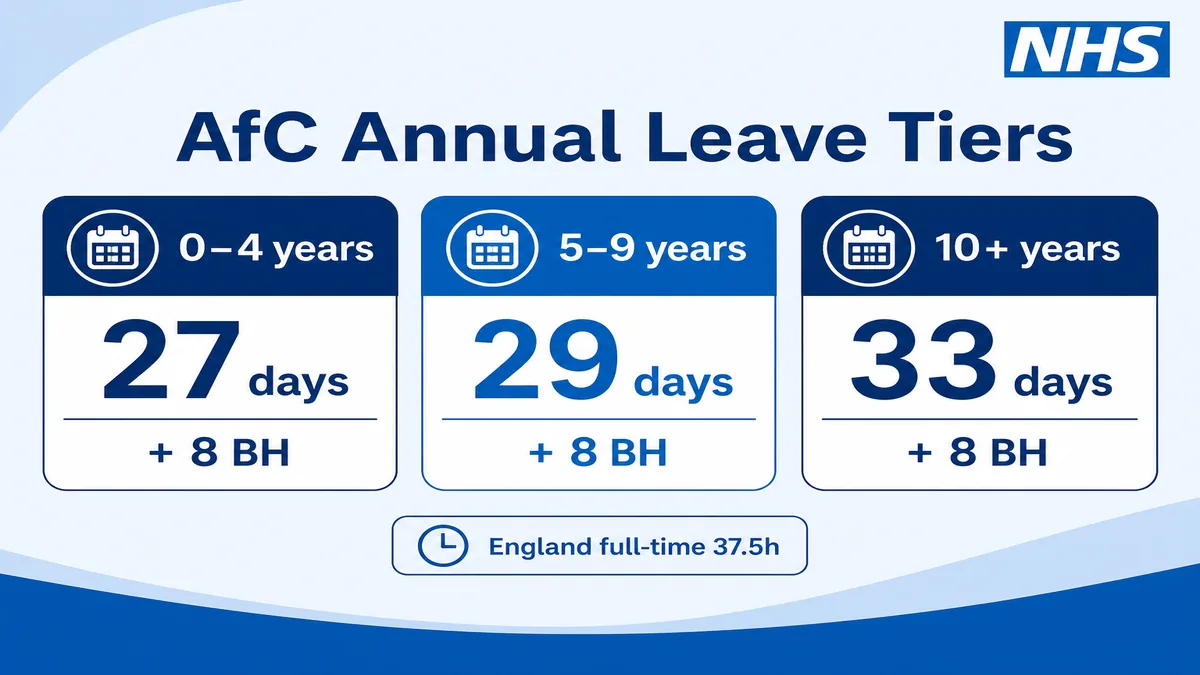
NHS annual leave entitlement under Agenda for Change gives full-time staff 27 days on appointment, rising to 29 days after 5 years and 33 days after 10 years of NHS service. All figures are in addition to bank holidays. Part-time staff receive the same entitlement pro-rated to their contracted hours.
The following entitlements come from Section 13 of the NHS Terms and Conditions of Service Handbook. On appointment: 27 days leave plus 8 general public holiday days. After 5 years' service: 29 days plus 8 general public holiday days. After 10 years' service: 33 days plus 8 general public holiday days.
The entitlement does not vary by AfC pay band. A Band 2 healthcare assistant and a Band 7 nurse with the same years of service receive the same number of leave days.
Full entitlement table — England (full-time, 37.5 hours/week)
| Years of NHS Service | Annual Leave | Bank Holidays | Total Days | Total Hours |
|---|---|---|---|---|
| 0–4 years | 27 days | 8 days | 35 days | 262.5 hours |
| 5–9 years | 29 days | 8 days | 37 days | 277.5 hours |
| 10+ years | 33 days | 8 days | 41 days | 307.5 hours |
Wales gives one extra leave day at each tier: 28, 30, and 34 days (see the Wales section below). Northern Ireland uses the same leave days as England but receives 10 bank holidays instead of 8.
The official formula for NHS annual leave in hours is: (weekly hours ÷ 5) × days entitlement = annual leave in hours. Yearly entitlement in hours is calculated by taking working time, dividing by 5 and multiplying by the relevant number of days — 27, 29, or 33. This is confirmed by the Scottish Terms and Conditions Committee at stac.scot.nhs.uk, which publishes the official AfC calculation guidance.
The commercial equivalent formula — (contracted hours ÷ 37.5) × full-time entitlement in hours — produces the same result. Both are mathematically identical. The ÷5 version shows the daily logic clearly: it calculates the hours in one working day, then multiplies by the number of leave days owed.
Step-by-step: how to calculate NHS annual leave in hours
Worked example — 30 hours/week, 7 years' service (England)
The Whole Time Equivalent (WTE) is the master multiplier. Once you know your WTE, you apply it to every leave component — annual leave, bank holidays, and sick pay bands — to get your pro-rated figure. NHS payslips and the Electronic Staff Record (ESR) both use WTE as the standard operational variable.
For part-time staff, the entitlement is rounded to the nearest 0.5 decimal point at the end of the calculation.
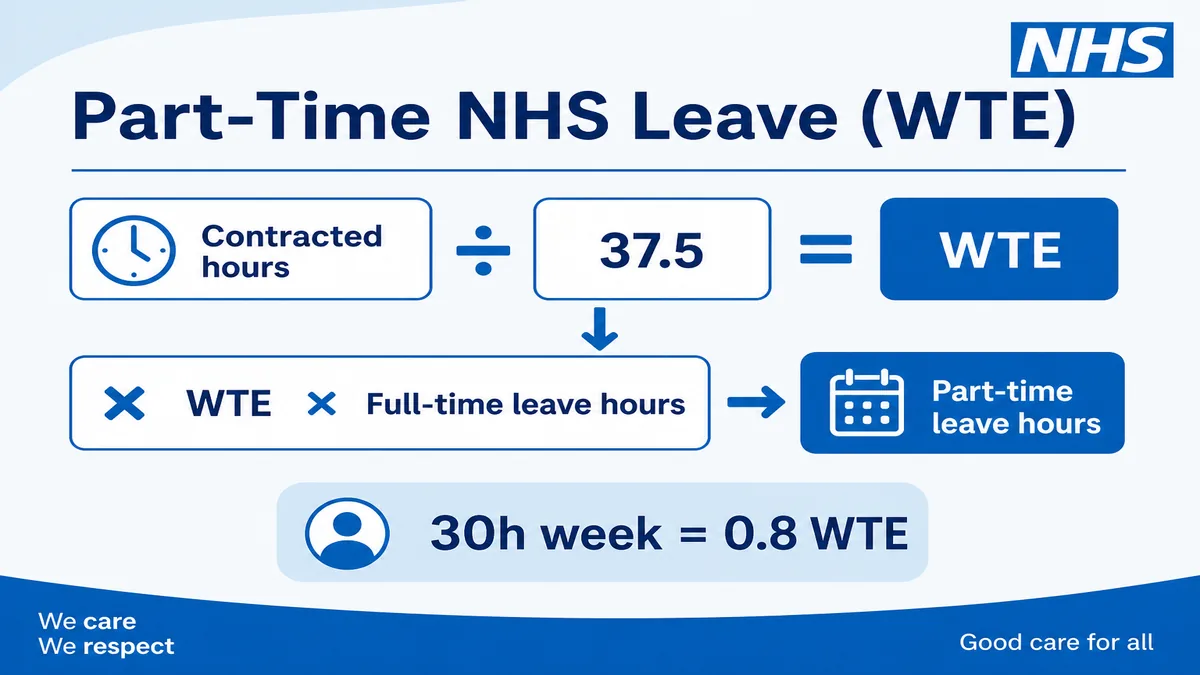
Part-time NHS staff receive annual leave on a pro-rata basis. The entitlement is proportional to contracted hours compared to the full-time standard.
Formula: (contracted hours ÷ 37.5) × full-time entitlement in hours = part-time entitlement in hours.
Bank holidays are also pro-rated using the same formula. Part-time staff do not simply receive fewer leave days — they receive the full entitlement expressed in fewer hours. Part-time staff receive a pro-rata amount of annual leave and public holiday days.
Worked Example A — 22.5 hours/week, 3 years' service (England)
Worked Example B — 20 hours/week, 6 years' service (England)
The same three service tiers apply regardless of full-time or part-time status. A part-time nurse at 5 years' service moves from the 27-day tier to the 29-day tier on exactly the same date as a full-time colleague — only the hours value changes.
Rounding rule: For part-time staff, the result is then rounded to the nearest half hour. Complete all multiplication steps before rounding — rounding too early is the most common cause of small but irritating discrepancies between a staff member's own calculation and their ESR balance.
In practice, ESR displays all part-time leave in hours rather than days. Staff who compare their ESR figure to a "days" entitlement often conclude the system has made an error. In almost every case, the discrepancy is a units issue — the hours are correct; the days figure needs converting using the staff member's own daily hours, not a standard 7.5-hour day.
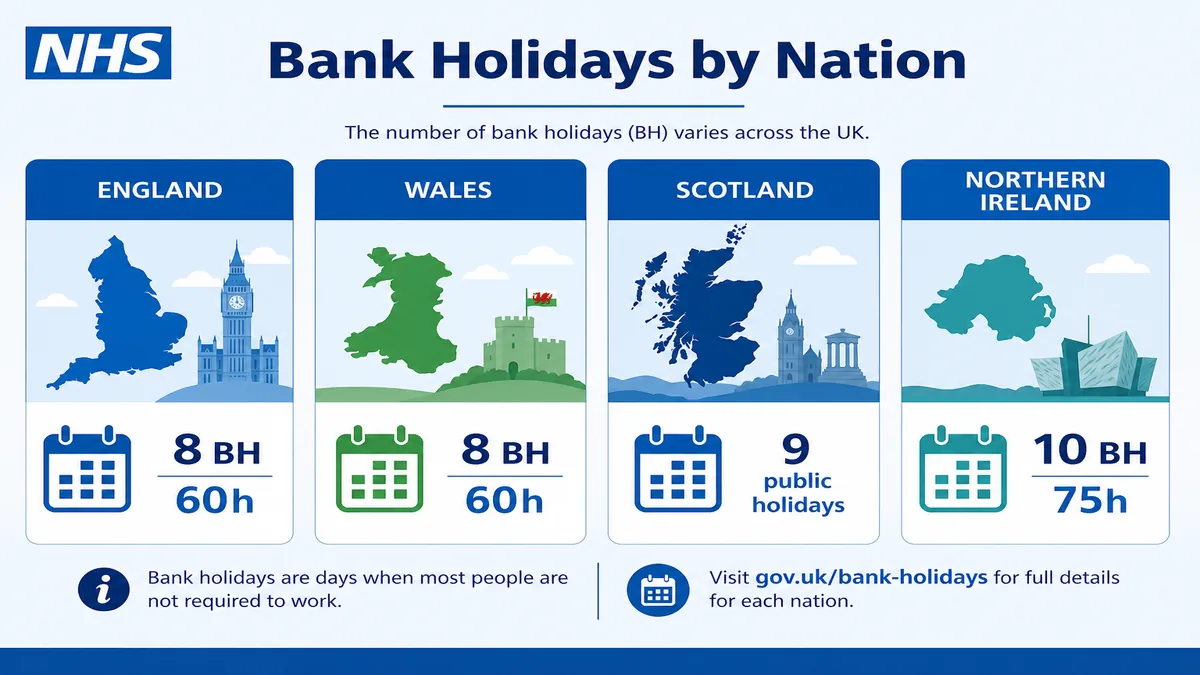
Bank holidays are separate from and in addition to annual leave days under Agenda for Change. Public holiday entitlement is in addition to annual leave entitlement, which is based on reckonable service. The AfC annual leave and general public holiday entitlements are set out in Section 13 of the handbook.
Full-time staff in England receive 8 bank holidays = 60 hours. For part-time staff, this 60-hour figure is pro-rated using the same WTE formula.
The notional guarantee — what it means in practice
The 8 bank holiday days are a notional entitlement. They represent an amount of time off equivalent to 8 working days — they are not tied to the specific calendar dates. This matters most for part-time shift workers.
Worked scenario: A staff member works Tuesday to Friday only. Easter Monday falls on a Monday — not one of their working days. They still receive their full pro-rated bank holiday allocation in hours. They do not lose the entitlement because the date fell on a non-working day. The hours are added to their total leave balance and can be taken at a different time.
Staff required to work on a bank holiday receive time off in lieu (TOIL) equivalent to the hours worked. NHS Employers guidance specifically addresses TOIL for staff rostered to work on a public holiday.
Bank holiday entitlement by nation
| Nation | Bank/Public Holidays | Full-Time Hours |
|---|---|---|
| England | 8 | 60 hours |
| Wales | 8 | 60 hours |
| Scotland | 9 public holidays | See below |
| Northern Ireland | 10 | 75 hours |
Scotland uses the term "public holidays" rather than "bank holidays." The entitlement includes 9 days — but 4 of those are set locally by each NHS Board, not nationally. Check with your NHS Board for the specific dates that apply to your workplace.
The NHS leave year runs from 1 April 2026 to 31 March 2027. The 8 bank holidays falling within this period for England are:
Key dates include Good Friday (3 April 2026), Easter Monday (6 April 2026), Early May Bank Holiday (4 May 2026), Spring Bank Holiday (25 May 2026), Summer Bank Holiday (31 August 2026), Christmas Day (25 December 2026), Boxing Day substitute (28 December 2026), and New Year's Day (1 January 2027).
Note: Christmas Day 2026 falls on a Friday, and Boxing Day falls on a Saturday — Monday 28 December is therefore recognised as the substitute for Boxing Day. This gives England exactly 8 bank holidays within the 2026/27 NHS leave year.
If you are completing the calculator for a full leave year in England, enter 8 as the bank holiday count.
For Scotland: There are nine bank holidays in Scotland in 2026. Four are determined locally by each NHS Board — contact your Board's HR department to confirm which dates apply in your workplace.
For Northern Ireland: Enter 10 as the bank holiday count. The two additional public holidays are St Patrick's Day (17 March — falls outside the 2026/27 leave year; relevant for part-year calculations) and the Battle of the Boyne substitute (14 July 2026, falling within the leave year).
Official confirmed bank holiday dates are published at gov.uk/bank-holidays.
Mid-year starters, leavers, and staff whose hours change during the year all receive a pro-rated entitlement. The standard NHS leave year runs from 1 April to 31 March, as the annual leave year for all employees is from 1 April to 31 March.
A) Mid-year starters — the 7-day joining rule
Starting in the first 7 days of a month gives you a full month's entitlement for that month. Starting on the 8th of the month or later means that month is excluded from your calculation.
Formula: (complete months remaining in leave year ÷ 12) × full-year entitlement in hours = part-year entitlement.
Alternative method: (days in employment ÷ 365) × full-year entitlement. Use this when a staff member joins very late in the leave year and the monthly method produces a different result.
B) Mid-year leavers
Employees who leave employment are entitled to annual leave entitlement for each full month worked in the current year on a pro-rata basis. If you have taken more leave than you have earned at the point of leaving, where annual leave taken exceeds entitlement, an appropriate deduction will be made from final monies due to the employee.
C) Mid-year hours change
If your contracted hours change during the leave year, split the calculation at the point of change.
Worked example: You work full-time (37.5 hours) April–September, then reduce to 22.5 hours October–March. You have 7 years' service (29 days = 217.5 hours full-time entitlement).
D) Trust-level leave year variation
Most NHS trusts run the standard 1 April to 31 March leave year. Individual trusts may have local policies affecting your leave. A small number of trusts have historically used different year-start dates during rostering system transitions, as confirmed by hdft.nhs.uk. If your trust uses a non-April leave year, the calculator's leave year start and end fields are editable to accommodate your exact dates. Confirm your trust's leave year boundaries with your HR department before calculating a partial-year entitlement.
Your annual leave entitlement increases automatically at two service milestones. The increase takes effect on the first day of the month following your 5th or 10th anniversary of NHS service.
Example: You started NHS employment on 15 June 2021. Your 5-year anniversary falls on 15 June 2026. Your entitlement increases from 27 days to 29 days from 1 July 2026.
A) The three service tiers in hours (England, full-time)
| Milestone | Annual Leave | Annual Leave Hours | Total with BH |
|---|---|---|---|
| On appointment (0–4 years) | 27 days | 202.5 hours | 262.5 hours |
| After 5 years | 29 days | 217.5 hours (+15 hours) | 277.5 hours |
| After 10 years | 33 days | 247.5 hours (+30 hours) | 307.5 hours |
B) What counts as reckonable service
All proven NHS service is reckonable for the purposes of calculating annual leave entitlement, regardless of the length of any breaks in that service.
Reckonable service includes employment at:
C) What does not count as reckonable service (standard AfC position)
Bank staff service and locum agency work generally do not count toward the AfC entitlement tiers. However, note that individual trust policies can vary. At some trusts, bank service is reckonable where individuals can evidence they have worked a minimum of two shifts per month or 488 hours per year. Where identified, such bank service would be counted towards service for annual leave purposes when appointed to a permanent or fixed-term post. Always ask your new employer's HR department whether your bank hours will be counted before accepting a substantive offer.
GP practice employment is outside the AfC framework — check with your new NHS employer whether that service counts toward your AfC reckonable service record.
D) How to prove previous NHS service
Provide at least one of the following to your new employer's HR department on the day you join:
HR departments frequently need chasing on this. Staff who join without declaring previous service may receive the lower 27-day entitlement for weeks or months before the correction is processed. The correction is backdated to the join date — but the administrative back-and-forth is avoidable. Submit the documentation on day one.
NHS bank staff do not receive a fixed annual leave entitlement. Instead, they accrue annual leave proportionally based on hours worked.
Accrual rate: 12.07% of every hour worked.
The 12.07% calculation method effectively converts the UK statutory holiday entitlement for full-time workers of 5.6 weeks' holiday into a percentage of holiday against working time (5.6 ÷ (52 – 5.6) = 12.07%). The legal basis is the Working Time Regulations 1998, as confirmed at klglaw.co.uk/changes-to-calculating-holiday-pay/.
Formula: Total hours worked × 0.1207 = hours of annual leave accrued.
Worked example: You work 120 hours in October.
Two payment models used by NHS trusts
| Model | How It Works | What This Means for You |
|---|---|---|
| Rolled-up holiday pay | Accrual added to your hourly rate and paid automatically each period | You receive holiday pay continuously but cannot "book" leave separately |
| Separate accrual | Leave builds as a balance in your bank staff record | You book time off from the accrued balance when needed |
Rolled-up pay is calculated at 12.07% of total pay each pay period and must be itemised separately on the payslip. Many bank staff receive rolled-up holiday pay without realising it — it appears as a small supplementary line on the payslip. If your trust uses Model A and you also book time off, you may end up with a deduction. Check your bank staff agreement before booking extended periods of leave.
Bank staff service and the AfC entitlement tiers
A healthcare worker who spends 7 years on the NHS bank, then accepts a substantive post, does not automatically receive 29 days' leave from day one. Bank staff service generally does not count toward the 5-year or 10-year reckonable service tiers under standard AfC terms. That worker starts at the 0–4 year tier (27 days) unless their specific trust policy states otherwise. This is the most common misconception among staff making the transition from bank to substantive employment. Confirm the position in writing with HR before accepting the post.
AfC terms apply across all four nations of the UK, but the entitlement figures differ by nation due to variations in the working week and bank/public holiday counts.
Scotland is the only nation where the standard working week for AfC staff has changed in recent years. Section 13.1 of the handbook provides that all full-time staff where the full-time hours for their staff group are 37.5 hours per week — but in Scotland this baseline has been formally reduced.
From the official STAC guidance at stac.scot.nhs.uk/annual-leave-and-public-holidays:
This reduction is governed by the PCS(AFC)2025/6 circular, published by the Scottish Terms and Conditions Committee (STAC).
Part-time staff in Scotland must use the updated Scottish baseline when calculating WTE. From April 2026, the formula is: contracted hours ÷ 36 (not ÷ 37.5).
The number of leave days (27/29/33) has not changed. Only the hours value per day has reduced. This means Scottish staff effectively gain slightly more actual days off for the same hours entitlement, as each day is shorter.
Scotland full-time entitlement from April 2026 (36-hour week)
| Period | Full-Time Week | Standard Day | 0–4 Yrs AL Hours | 5–9 Yrs AL Hours | 10+ Yrs AL Hours |
|---|---|---|---|---|---|
| Before April 2024 | 37.5h | 7.5h | 202.5h | 217.5h | 247.5h |
| April 2024–March 2026 | 37h | 7.4h | 199.8h | 214.6h | 244.2h |
| From April 2026 | 36h | 7.2h | 194.4h | 208.8h | 237.6h |
Add public holiday entitlement (8 public holiday days × 7.2h = 57.6 hours from April 2026) for the combined total.
Scotland's 9 public holidays include 4 fixed national dates (Christmas Day, Boxing Day, New Year's Day, 2 January), St Andrew's Day (30 November), and 4 dates set locally by each NHS Board. There are nine bank holidays in Scotland in 2026. Contact your NHS Board's HR department to confirm the 4 locally-determined dates that apply to your workplace.
The official NHS Scotland calculator is available at workforce.nhs.scot/calculators/annual-leave-calculator and handles the post-April 2026 36-hour week automatically.
NHS Wales AfC staff receive one additional leave day at each service tier compared to England.
| Years of NHS Service | Annual Leave | Bank Holidays | Total Days | Total Hours |
|---|---|---|---|---|
| 0–4 years | 28 days | 8 days | 36 days | 270 hours |
| 5–9 years | 30 days | 8 days | 38 days | 285 hours |
| 10+ years | 34 days | 8 days | 42 days | 315 hours |
The full-time working week in Wales remains 37.5 hours (7.5h standard day). Pro-rata calculations use the same ÷ 37.5 formula as England.
Northern Ireland AfC staff receive the same annual leave as England but with 10 public holidays instead of 8. The two additional holidays are St Patrick's Day (17 March) and the Battle of the Boyne (12 July — substitute as required).
| Years of NHS Service | Annual Leave | Bank Holidays | Total Days | Total Hours |
|---|---|---|---|---|
| 0–4 years | 27 days | 10 days | 37 days | 277.5 hours |
| 5–9 years | 29 days | 10 days | 39 days | 292.5 hours |
| 10+ years | 33 days | 10 days | 43 days | 322.5 hours |
Agenda for Change covers most NHS employees. The formula set out in Section 13 of the NHS Terms and Conditions of Service Handbook governs Agenda for Change employment in England. If you are employed on an AfC pay band (Band 1 through Band 9), this calculator applies to you.
Included — AfC applies to:
| Role Group | Covered by AfC? |
|---|---|
| Nurses and midwives | Yes — Yes |
| Healthcare assistants | Yes — Yes |
| Allied health professionals | Yes — Yes |
| Pharmacists and pharmacy technicians | Yes — Yes |
| Radiographers | Yes — Yes |
| Scientific and technical staff | Yes — Yes |
| Administrative and clerical staff | Yes — Yes |
| Facilities and estates staff | Yes — Yes |
| Bank staff (irregular hours) | Yes — Yes — accrual basis only |
| Temporary / fixed-term staff | Yes — Yes — pro-rata basis |
Excluded — AfC does not apply to:
The Agenda for Change NHS Terms and Conditions of Service Handbook does not apply to Medical and Dental Staff.
This calculator provides estimates based on the national AfC framework. Individual trusts may have local policies affecting leave — for example, some trusts offer an additional day for long service or allow carry-over of unused days. Always confirm your entitlement with your HR department.
If your trust runs a buy or sell leave scheme, estimate the salary impact with the buying annual leave calculator.
Yes — but within strict limits. The standard carry-over allowance is up to 5 days (or one contracted week's hours for part-time staff) into the following leave year, subject to manager approval.
Standard carry-over
Carry-over requires explicit manager agreement before the leave year ends. Carried-over leave must normally be used within the early weeks of the new leave year — and pensionestimate.uk notes a deadline of 18 months from the end of the leave year before the entitlement is permanently lost.
Exceptional circumstances
In exceptional circumstances, your manager may allow you to carry over annual leave equivalent to your contracted weekly hours into the following leave year. This applies when operational demands prevented you from taking leave during the final weeks of the leave year. Raise this with your manager no later than 3 months before the leave year end — do not wait until March.
Long-term sick leave
Staff on long-term sick leave who cannot use their annual leave retain the right to carry over their statutory minimum of 20 days (pro-rata for part-time staff). For staff on long-term sick leave, this represents significant value that should be factored into any return-to-work planning. Leave above the 20-day statutory floor may be lost unless your trust operates a more generous policy.
Maternity leave
Annual leave accrues throughout all maternity leave at the full contractual rate. Taking outstanding leave before maternity starts maximises pay — it is paid at full salary rather than Statutory Maternity Pay. Accrued leave during maternity must be carried over by agreement and cannot be taken during the maternity period itself.
Mistakes to avoid: Staff who reach the carry-over deadline with unused leave above 5 days — without prior manager agreement — have no guaranteed right to that leave. Untaken leave that cannot be carried over is permanently lost with no cash value for substantive NHS employees at year end. Raise carry-over requests with your manager at least 3 months before the leave year end — this is the only reliable protection.
NHS staff can take outstanding annual leave during their notice period, subject to manager approval. On leaving, any annual leave earned but not taken is paid out in the final salary at the basic rate. Leave taken in excess of the pro-rated entitlement may be recovered from final pay.
Line managers should support employees with taking any outstanding annual leave where service provision allows — however, if the employee is unable to take their outstanding annual leave, payment will be made in their final salary.
The leaver's entitlement for the leave year is calculated as:
(Months worked in leave year ÷ 12) × full-year entitlement in hours = earned entitlement
If you have taken more hours than you have earned by your leaving date, where annual leave taken exceeds entitlement, an appropriate deduction will be made from final monies due to the employee.
Key rules for leavers:
Worked example: You resign on 31 July 2026 (4 months into the 2026/27 leave year). You have 3 years' service, work 37.5 hours/week, and are in England.
Six specific errors account for the majority of NHS annual leave calculation disputes between staff and HR departments.
| # | Mistake | Why It Happens | Correct Approach |
|---|---|---|---|
| 1 | Rounding hours to whole days too early | Instinctively thinking in days rather than hours | Complete all multiplication first; round only the final hours result to the nearest half-hour |
| 2 | Using 7.5h/day for Scotland post-April 2026 | Most online calculators default to England | From 1 April 2026, Scotland's standard day is 7.2 hours — using 7.5h overstates entitlement by 4% |
| 3 | Assuming bank staff years count toward the 5-year or 10-year tier | Bank service feels like NHS service | Bank staff service generally does not count as reckonable service for AfC entitlement tiers |
| 4 | Treating bank holidays that fall on non-working days as lost | Thinking specific calendar dates are required | Bank holiday entitlement is in hours — non-working-day bank holidays are still owed via the pro-rated allocation |
| 5 | Dividing contracted hours by 5 days first, then multiplying by leave days — without a WTE step | Intuitive school-level maths applied to a WTE formula | Always calculate WTE first (contracted hours ÷ 37.5), then apply WTE to the full-time hours entitlement |
| 6 | Not declaring previous NHS service at the point of joining | Bureaucratic oversight or unawareness of the rule | Entitlement reverts to the 0–4 year tier until evidence is submitted; submit documentation on day one |
The ESR hours/days confusion deserves a specific note. ESR displays leave balances in hours, not days. When a staff member sees "157.5 hours" on ESR and calculates 21 days at 7.5 hours/day, they get 21 days. But if they work a non-standard shift pattern — say, 8-hour shifts — they get 19.7 shifts. Neither is wrong; they are the same entitlement expressed in different units. ESR is not broken when the days figure looks different from expectations — the units of measurement are almost always the issue, not the system.
Use your service band to find your full-time entitlement in hours (202.5, 217.5, or 247.5 hours for 27, 29, or 33 days). Calculate your WTE (contracted hours ÷ 37.5). Multiply WTE by the full-time hours entitlement, then add your pro-rated bank holiday allocation. Round the final result to the nearest half-hour.
Yes. Under Agenda for Change, annual leave increases from 27 days to 29 days after 5 years of NHS service. The increase takes effect from the first day of the month following your 5th anniversary. If you have previous reckonable service in the NHS, this will also be counted towards your annual leave entitlement.
Full-time NHS staff (37.5 hours/week) in England receive 202.5 hours annual leave (27 days) on appointment, 217.5 hours (29 days) after 5 years, and 247.5 hours (33 days) after 10 years. Bank holiday entitlement adds 60 hours, giving combined totals of 262.5, 277.5, and 307.5 hours respectively.
262.5 hours equals 35 days at the standard NHS working day of 7.5 hours. This is the total combined annual leave and bank holiday entitlement for a full-time NHS employee in England with 0–4 years of service — 27 days of annual leave plus 8 bank holiday days.
You can request annual leave during your notice period, but your manager can refuse if operationally necessary. If you are unable to take outstanding annual leave, payment will be made in your final salary. Leave taken in excess of your pro-rated entitlement may be recovered from your final pay.
For NHS Agenda for Change staff, calculate your WTE (contracted hours ÷ 37.5 in England), multiply by your full-time hours entitlement (202.5, 217.5, or 247.5 hours), then add your pro-rated bank holiday hours (WTE × 60 hours in England). The result is your total annual leave entitlement in hours for the year.
Full-time NHS staff in England with 10 or more years of service receive 247.5 hours of annual leave (33 days) plus 60 hours of bank holiday entitlement (8 days) — a total of 307.5 hours per year. In Scotland from April 2026, the equivalent is 237.6 hours annual leave plus 57.6 hours public holidays = 295.2 hours total under the 36-hour week.