 Take Home Pay
Take Home Pay
Take Home Pay
Financial year: 1 April 2026 – 31 March 2027 Scheme: NHS Pension Scheme (England & Wales) | SPPA (Scotland) | HSC (Northern Ireland) Sources: NHSBSA Member Hub | NHS Employers | DHSC | Lincolnshire LMC (NHSBSA mirror) Last reviewed: July 2026
Enter your annual pensionable pay → Select your region → Select your tax band The calculator returns:
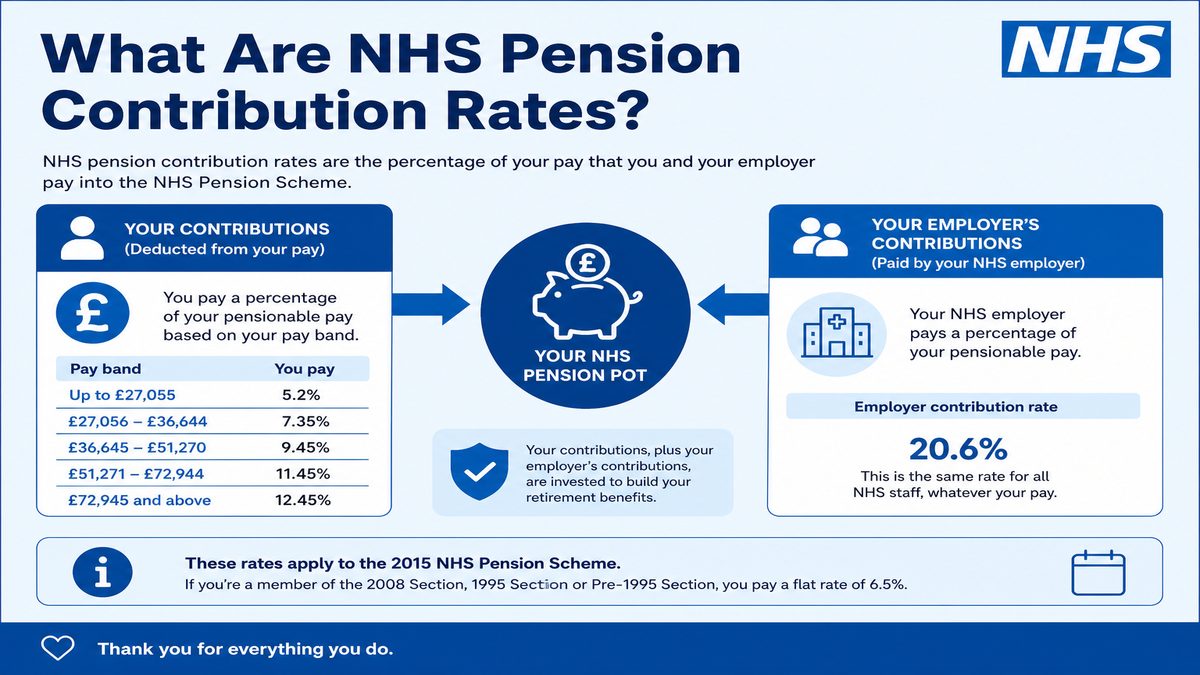
NHS pension contribution rates are the fixed percentages of pensionable pay deducted from an NHS employee's salary every month. Every active member of the NHS Pension Scheme pays these contributions automatically through payroll. 11Unlike workplace pensions, the NHS pension guarantees a specific income in retirement based on your career average earnings. Contributions fund that guarantee — they are not a savings pot subject to investment risk.
1 The NHS Pension Scheme uses a tiered structure to determine employee contribution rates, based on actual annual pensionable pay, with contributions set in proportion to earnings. 1 Each tier reflects the principle that higher earners contribute a larger percentage of their income. 2 Contributions are deducted from gross pay before income tax — a "net pay arrangement" — so you get automatic tax relief at your marginal rate. No HMRC claim is required. The real cost of your pension is always lower than the headline percentage.
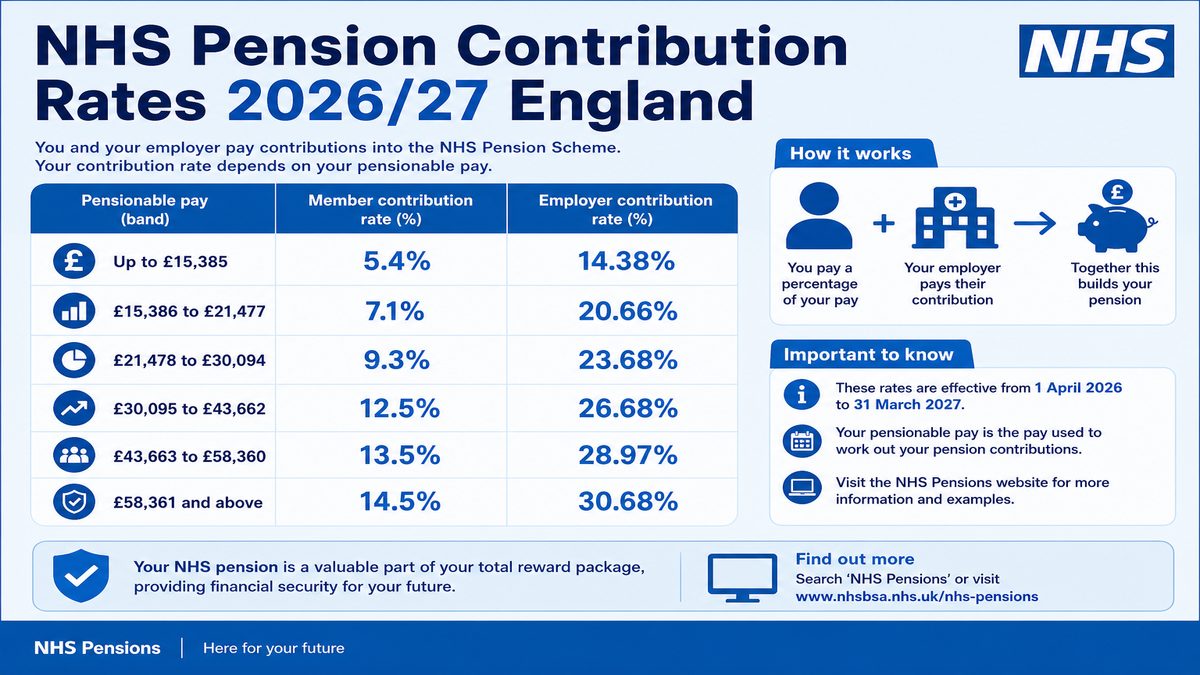
3 From 1 April 2026, the NHS Pension Scheme uses six contribution tiers, running from 5.2% to 12.5%. 3 The rates are unchanged since April 2024. Only the thresholds move each year. 1 As of 1 April 2026, the contribution rates are: 5.2% for earnings up to £13,259; 6.5% for £13,260 to £28,854; 8.3% for £28,855 to £35,155; 9.8% for £35,156 to £52,778; 10.7% for £52,779 to £67,668; and 12.5% for earnings of £67,669 and above.
Tier | Annual Pensionable Pay | Member Rate | Monthly Deduction* | Net Cost 20% Tax | Net Cost 40% Tax |
1 | Up to £13,259 | 5.2% | £52.00 | 4.16% | 3.12% |
2 | £13,260 – £28,854 | 6.5% | £113.36 | 5.20% | 3.90% |
3 | £28,855 – £35,155 | 8.3% | £221.55 | 6.64% | 4.98% |
4 | £35,156 – £52,778 | 9.8% | £359.06 | 7.84% | 5.88% |
5 | £52,779 – £67,668 | 10.7% | £537.44 | 8.56% | 6.42% |
6 | £67,669 and above | 12.5% | Varies by salary | 10.00% | 7.50% |
*Monthly deduction calculated at mid-point of each tier band. Source: 9NHS Employers member contribution rates for 2026/27, increased in line with CPI indexation. See comparison of 2025/26 and 2026/27 member contribution rate tables at nhsemployers.org.
3 From 1 April 2026, those thresholds went up by 3.8% (September 2025 CPI). 3 If you got a pay rise this year under the Agenda for Change settlement, you are almost certainly paying the same percentage you were paying before, because the thresholds rose faster than your pay. 1 These thresholds have been uplifted by a 3.8% Consumer Price Index (CPI) indexation rate to adjust for inflation, so that the contribution rates remain unchanged while only the salary thresholds are adjusted when the Agenda for Change pay award is lower than the CPI. 4 Step 1 on 1 April: Salary thresholds increase by the previous September's CPI rate. Step 2 after the pay award announcement: if the Agenda for Change pay award exceeds CPI, thresholds are adjusted again and backdated to 1 April. This two-step approach was specifically introduced to stop NHS staff experiencing a drop in take-home pay because of a national pay award. 9 There will be no change to the lowest tier or the entry to the second tier. 4 The lowest tier threshold stays frozen because staff earning below this amount do not benefit from tax relief on their pension contributions.
This is the single fact most NHS staff get wrong.
3 Contributions are based on your actual pensionable pay, not your whole-time-equivalent.
Before 1 October 2022, tiers were set using the whole-time-equivalent (WTE) salary for your role — even if you worked part-time. A nurse working 0.6 FTE would be placed in the tier matching their full-time salary. Since Phase 1 of the 2022 reforms, tiers are based on actual pensionable pay.
4 The NHS uses a six-tier system based on your actual pensionable pay — not your whole-time-equivalent salary if you work part-time.
2 A part-timer at 0.5 FTE on £20,000 actual pay — with a WTE pay of £40,000 — is in the Tier 4 (9.8%) bracket. The 9.8% applies to their actual £20,000, so they pay £1,960 per year in contributions.
Important clarification — WTE vs Actual Pay: One competitor source states tiers are based on WTE. Another confirms tiers are based on actual pay since October 2022. 9From 1 April every year, pensionable pay ranges increase by the rate of CPI from the previous September and are automatically updated on ESR. Always check your own payslip's pensionable pay figure and compare it to the tier table above.
Your tier is determined by your annual pensionable pay — not your total gross earnings. Knowing what is and is not pensionable prevents tier miscalculation.
5 The following ARE pensionable: basic salary, High Cost Area Supplements (HCAS), recruitment and retention premiums, and on-call availability supplements. The following are NOT pensionable: overtime payments (in most cases), expense reimbursements, one-off non-consolidated payments, and car allowances.
5 If your basic salary is £32,073 but you receive £4,000 in HCAS, your pensionable pay is £36,073 — putting you in Tier 4 (9.8%) rather than Tier 3 (8.3%).
The HCAS adds £4,000 gross to your earnings but simultaneously moves your entire salary to a higher contribution tier. 7For NHS staff working in London and the surrounding counties, the standard Agenda for Change pay bands are supplemented by the High Cost Area Supplement, designed to compensate for the significantly higher cost of living in the capital. 7Your zone is based on your work location, not your home address.
7 If you work part-time, your HCAS is calculated on a pro-rata basis. If you work 18.75 hours, or 0.5 WTE, in an Inner London zone, you receive 50% of the relevant HCAS payment.
This is the most financially significant feature of NHS pension contributions. Unlike income tax — where only the slice of income above a threshold is taxed at the higher rate — NHS pension contributions are not marginal. Your tier rate applies to your entire pensionable pay, not just the portion within that band.
Scenario | Pensionable Pay | Tier | Rate | Annual Contribution |
Just below Tier 3 | £28,854 | 2 | 6.5% | £1,875.51 |
Just inside Tier 3 | £28,855 | 3 | 8.3% | £2,395.10 |
Difference | +£1 gross pay | — | +1.8% | +£519.59/year |
A single pound increase in pensionable pay at the Tier 2–3 boundary costs £519.59 in additional annual pension contributions. Monthly take-home pay falls despite a gross pay rise.
Key insight: The additional contributions are not lost — they build a higher pension at retirement. But your monthly take-home pay will fall in the short term. Plan for this before a pay change takes effect.
On top of every member's contribution, the NHS pays an employer contribution directly into the scheme.
9 The employer contribution rate is 23.7% of members' pensionable pay. 5 This is one of the highest employer pension contributions in the UK — private sector employers typically contribute 3–8%.
8 Employers should apply an employer contribution rate of 14.38% for 2026/27. For NHS organisations, the NHSBSA will continue to collect only 14.38% from employers; central payments will be made by NHS England for the remaining 9.4%.
This arrangement has been confirmed by the DHSC for 2026/27. 4Since 2019/20, NHS employers have not paid the full rate directly. Instead, they pay 14.38% through their payroll. NHS England covers the remaining 9.4% through central funding. The Department of Health and Social Care has confirmed this arrangement continues for 2026/27.
4 When you combine your contribution with your employer's, the total going into your pension could be as high as 36.2% of your pensionable pay.
Tier | Member Rate | Employer Rate | Total Rate | Total on £35,000 |
1 | 5.2% | 23.7% | 28.9% | £10,115 |
2 | 6.5% | 23.7% | 30.2% | £10,570 |
3 | 8.3% | 23.7% | 32.0% | £11,200 |
4 | 9.8% | 23.7% | 33.5% | £11,725 |
5 | 10.7% | 23.7% | 34.4% | £12,040 |
6 | 12.5% | 23.7% | 36.2% | £12,670 |
5 For a Band 5 nurse: 23.7% × £32,073 = £7,601 per year. This money is invested in the NHS Pension Scheme on their behalf and funds future pension benefits.
11 Your pension contributions are taken before tax, so the actual cost to you is lower than the headline rate.
The NHS Pension Scheme operates a net pay arrangement. Contributions are deducted from gross salary before PAYE income tax is calculated. HMRC receives a reduced tax bill automatically. No separate relief claim is needed.
Headline Rate | Basic Rate (20%) Net Cost | Higher Rate (40%) Net Cost | Additional Rate (45%) Net Cost |
5.2% | 4.16% | 3.12% | 2.86% |
6.5% | 5.20% | 3.90% | 3.58% |
8.3% | 6.64% | 4.98% | 4.57% |
9.8% | 7.84% | 5.88% | 5.39% |
10.7% | 8.56% | 6.42% | 5.89% |
12.5% | 10.00% | 7.50% | 6.88% |
2 A 20% taxpayer paying 8.3% sees a net cost of about 6.6%. A 40% taxpayer paying 12.5% sees a net cost of about 7.5%. 7 If you are a 40% taxpayer — often Bands 8b and above — the net cost of your pension is even lower, as the government effectively subsidises your contribution through higher tax relief.
Scotland applies six income tax bands (Starter 19%, Basic 20%, Intermediate 21%, Higher 42%, Advanced 45%, Top 48%). Tax relief on NHS pension contributions is awarded at the rate applicable to each slice of income. Scottish NHS staff should always select "Scotland" in the calculator above for an accurate net cost figure. The Scottish bands mean both the relief amount and the take-home pay result differ from England & Wales.
All examples use England & Wales rates, standard 1257L tax code, full-time 1.0 FTE, no London Weighting, and confirmed 2026/27 Agenda for Change pay points.
Tier 2 | Rate: 6.5%
Amount | |
Annual pensionable pay | £24,169 |
Annual contribution (gross) | £1,570.99 |
Monthly deduction (gross) | £130.92 |
Tax relief saved (20%) | £314.20 |
Net annual cost | £1,256.79 |
Net monthly cost | £104.73 |
Employer contribution (23.7%) | £5,728.09 |
Total pension investment/year | £7,299.08 |
Tier 2 | Rate: 6.5%
Amount | |
Annual pensionable pay | £25,329 |
Annual contribution (gross) | £1,646.39 |
Monthly deduction (gross) | £137.20 |
Tax relief saved (20%) | £329.28 |
Net annual cost | £1,317.11 |
Net monthly cost | £109.76 |
Employer contribution (23.7%) | £6,002.97 |
Total pension investment/year | £7,649.36 |
Tier 2 | Rate: 6.5%
Amount | |
Annual pensionable pay | £27,857 |
Annual contribution (gross) | £1,810.71 |
Monthly deduction (gross) | £150.89 |
Tax relief saved (20%) | £362.14 |
Net annual cost | £1,448.56 |
Net monthly cost | £120.71 |
Employer contribution (23.7%) | £6,602.11 |
Total pension investment/year | £8,412.82 |
Tier 3 | Rate: 8.3%
Amount | |
Annual pensionable pay | £29,970 |
Annual contribution (gross) | £2,487.51 |
Monthly deduction (gross) | £207.29 |
Tax relief saved (20%) | £497.50 |
Net annual cost | £1,990.01 |
Net monthly cost | £165.83 |
Employer contribution (23.7%) | £7,102.89 |
Total pension investment/year | £9,590.40 |
Tier 4 | Rate: 9.8%
Amount | |
Annual pensionable pay | £36,483 |
Annual contribution (gross) | £3,575.33 |
Monthly deduction (gross) | £297.94 |
Tax relief saved (20%) | £715.07 |
Net annual cost | £2,860.27 |
Net monthly cost | £238.36 |
Employer contribution (23.7%) | £8,646.47 |
Total pension investment/year | £12,221.80 |
Tier 4 | Rate: 9.8%
Amount | |
Annual pensionable pay | £37,338 |
Annual contribution (gross) | £3,659.12 |
Monthly deduction (gross) | £304.93 |
Tax relief saved (20%) | £731.82 |
Net annual cost | £2,927.30 |
Net monthly cost | £243.94 |
Employer contribution (23.7%) | £8,849.11 |
Total pension investment/year | £12,508.23 |
Tier 4 | Rate: 9.8%
Amount | |
Annual pensionable pay | £44,962 |
Annual contribution (gross) | £4,406.28 |
Monthly deduction (gross) | £367.19 |
Tax relief saved (20%) | £881.26 |
Net annual cost | £3,525.02 |
Net monthly cost | £293.75 |
Employer contribution (23.7%) | £10,655.99 |
Total pension investment/year | £15,062.27 |
Tier 4 | Rate: 9.8%
Amount | |
Annual pensionable pay | £46,148 |
Annual contribution (gross) | £4,522.50 |
Monthly deduction (gross) | £376.88 |
Tax relief saved (40%) | £1,809.00 |
Net annual cost | £2,713.50 |
Net monthly cost | £226.13 |
Employer contribution (23.7%) | £10,937.08 |
Total pension investment/year | £15,459.58 |
Tier 5 | Rate: 10.7%
Amount | |
Annual pensionable pay | £53,755 |
Annual contribution (gross) | £5,751.79 |
Monthly deduction (gross) | £479.32 |
Tax relief saved (40%) | £2,300.71 |
Net annual cost | £3,451.07 |
Net monthly cost | £287.59 |
Employer contribution (23.7%) | £12,739.94 |
Total pension investment/year | £18,491.73 |
Tier 6 | Rate: 12.5%
Amount | |
Annual pensionable pay | £67,669 |
Annual contribution (gross) | £8,458.63 |
Monthly deduction (gross) | £704.89 |
Tax relief saved (40%) | £3,383.45 |
Net annual cost | £5,075.18 |
Net monthly cost | £422.93 |
Employer contribution (23.7%) | £16,037.55 |
Total pension investment/year | £24,496.18 |
Tier 6 | Rate: 12.5%
Amount | |
Annual pensionable pay | £105,000 |
Annual contribution (gross) | £13,125.00 |
Monthly deduction (gross) | £1,093.75 |
Tax relief saved (40%) | £5,250.00 |
Net annual cost | £7,875.00 |
Net monthly cost | £656.25 |
Employer contribution (23.7%) | £24,885.00 |
Total pension investment/year | £38,010.00 |
Your contributions do not sit in a savings pot. They fund a defined benefit — a guaranteed, formula-calculated income paid from retirement until death. 11Unlike workplace pensions, the NHS pension guarantees a specific income in retirement based on your career average earnings.
Annual pension = 1/54th of each year's pensionable pay, revalued annually by CPI + 1.5%
Every year you work and contribute, you build 1/54th of that year's pensionable pay as guaranteed pension income. These yearly amounts are stacked and revalued with inflation until retirement. 12The 2015 Scheme revalues at CPI + 1.5% in-service.
12 The 1995 Section provides benefits accrued at 1/80th of your final pensionable salary per year of membership, plus an automatic tax-free lump sum of 3× your annual pension. This section has a normal pension age of 60 (55 for special-class members).
The 2008 Section provides benefits at 1/60th of final pensionable pay per year of service, with no automatic lump sum but the option to commute pension for a lump sum at 12:1.
If you have service across multiple scheme sections (1995, 2008, and 2015), your benefits are calculated separately for each period and combined at retirement.
Quick 2015 CARE pension estimate — 20 years' service: If your average revalued pensionable pay across 20 years is £35,000: Pension = 20 × (£35,000 ÷ 54) = £12,963 per year, guaranteed, inflation-linked for life.
For a full personalised projection including McCloud, commutation, and early retirement reductions, use the NHS Pension Calculator.
5 You can opt out of the NHS Pension Scheme, but it is almost never advisable. Opting out means: you lose the 23.7% employer contribution (the single biggest benefit); you lose death-in-service cover (a 2× salary lump sum); you lose ill-health retirement protection; you lose CPI+1.5% revaluation on accrued benefits; and auto-enrolment will re-enrol you every three years anyway. 11 Your employer contributes 23.7% — if you opt out, that money is simply lost. Even factoring in your own contributions and tax relief, it is extremely difficult to replicate this value with a private pension. 5 The only scenario where opting out might make sense is if you are very close to the Annual Allowance (£60,000 for most people). 5 Even then, seek independent financial advice first.
5 The standard Annual Allowance is £60,000 for 2026/27. 6 For high earners in the NHS — particularly senior doctors, consultants, and Band 8–9 managers — the tapering of the Annual Allowance can result in significant tax charges if pension growth exceeds the threshold. 6 If you are affected, "Scheme Pays" allows you to meet an Annual Allowance charge from your pension pot rather than from your cash income.
Your monthly NHS pension deduction = (Annual pensionable pay × Your tier rate) ÷ 12.
4 NHS pension contributions for 2026/27 range from 5.2% to 12.5% of your actual annual pensionable pay. A Band 6 nurse on £40,000 pays 9.8% = £3,920 per year = £326.67 per month gross. After 20% tax relief, the net monthly cost is £261.33.
1 As of 1 April 2026, the contribution rates are: 5.2% for earnings up to £13,259; 6.5% for £13,260 to £28,854; 8.3% for £28,855 to £35,155; 9.8% for £35,156 to £52,778; 10.7% for £52,779 to £67,668; and 12.5% for earnings of £67,669 and above.
1 Tiers are determined by the tier system, which categorises contributions based on actual annual pensionable pay. Find your annual pensionable pay on your payslip and compare it to the six-tier table above.
3 Every April the NHS Pension Scheme moves the pay thresholds that determine which contribution tier you are in. From 1 April 2026, those thresholds went up by 3.8% (September 2025 CPI). 3 The rates themselves did not move — they have been fixed since April 2024.
Yes. 5If your basic salary is £32,073 but you receive £4,000 in HCAS, your pensionable pay is £36,073 — putting you in Tier 4 (9.8%) rather than Tier 3 (8.3%). Always add your HCAS to your basic salary when finding your tier.
4 The NHS uses a six-tier system based on your actual pensionable pay — not your whole-time-equivalent salary if you work part-time. 2 The applicable tier rate applies to your actual pensionable pay, so your total £ contributions scale with hours worked.
5 Overtime payments are NOT pensionable in most cases. Bank shift payments through NHS Professionals or trust bank staff arrangements are also generally not pensionable. Check your specific contract or ask your payroll department, as individual trust arrangements vary.
5 The employer contribution rate for 2026/27 is 23.7% of your pensionable pay. 10 Employers are responsible for paying 14.38% of contributions; the remaining 9.4% is funded centrally. This does not come out of your salary — it is an additional benefit on top of your gross pay.
Under the 2015 CARE Scheme, your pension after 10 years = 10 × (average revalued annual pensionable pay ÷ 54). On an average revalued pensionable pay of £32,000: pension = 10 × (£32,000 ÷ 54) = £5,926 per year. For a personalised estimate across all three scheme sections, use our NHS Pension Calculator.
Under the 2015 CARE Scheme: pension after 20 years = 20 × (average revalued annual pensionable pay ÷ 54). On an average revalued pensionable pay of £35,000: pension = 20 × (£35,000 ÷ 54) = £12,963 per year, guaranteed, inflation-linked. This is before commutation for a tax-free lump sum and before State Pension.
Under the 2015 CARE Scheme: pension after 25 years = 25 × (average revalued annual pensionable pay ÷ 54). On an average revalued pensionable pay of £38,000: pension = 25 × (£38,000 ÷ 54) = £17,593 per year.
Under the 2015 CARE Scheme: pension after 30 years = 30 × (average revalued annual pensionable pay ÷ 54). On an average revalued pensionable pay of £40,000: pension = 30 × (£40,000 ÷ 54) = £22,222 per year. Members with 1995 Section service also receive a tax-free lump sum of 3× their 1995 pension amount.
The average NHS pension per month varies significantly by career length, pay band, and scheme section. A nurse completing 30 years' service at an average band 5–6 career level might retire on approximately £18,000–£22,000 per year = £1,500–£1,833 per month. A Band 8a manager with 30 years' service could retire on approximately £25,000–£35,000 per year = £2,083–£2,917 per month. These are illustrative estimates — use the NHS Pension Calculator for an exact projection.
The NHS Pension Scheme is a defined benefit scheme. You cannot cash it in as a lump sum. You can take your pension early (from age 55, rising to 57 in 2028) but early retirement reduces your annual pension by actuarial reduction factors. The 1995 Section Normal Pension Age is 60, the 2008 Section is 65, and the 2015 Section is State Pension Age. Taking a pension before the Normal Pension Age applies a permanent percentage reduction to your annual pension amount. Use our NHS Early Retirement Calculator to see the exact reduction.
4 Your payslip shows your pensionable pay separately, so you can always check.
Log in to the NHSBSA Member Hub at nhsbsa.nhs.uk/member-hub using your NHS login. Your Total Reward Statement (TRS) and Annual Benefit Statement (ABS) show your accrued pension to date, projected pension at Normal Pension Age, and annual contribution history. If you do not have login access, contact your NHS trust's HR or pensions team to request your TRS.
11 The NHS Pension Scheme is one of the most generous in the UK, with employer contributions of 23.7%. 4 When you combine your contribution with your employer's, the total going into your pension could be as high as 36.2% of your pensionable pay. No private-sector equivalent matches this. The scheme provides guaranteed, inflation-linked income for life, death-in-service benefits, ill-health retirement protection, and automatic CPI + 1.5% revaluation on accrued CARE benefits — all without investment risk.
The contribution rate for 1995 Section members is determined by the same six-tier table as all other NHS Pension Scheme members. The section you belong to (1995, 2008, or 2015) does not change the contribution percentage — it only changes the formula used to calculate your retirement benefit.
The 2015 NHS Pension Scheme is a Career Average Revalued Earnings (CARE) scheme. Every year of pensionable service builds 1/54th of that year's pensionable pay as pension, revalued annually by CPI + 1.5%. All active NHS staff accrue benefits in the 2015 Scheme from 1 April 2022 onwards (as a result of the McCloud remedy). Members with pre-2015 service retain legacy scheme benefits for that period.
If you leave the NHS Pension Scheme with fewer than two years' qualifying membership, you are entitled to a refund of your own contributions (not the employer contributions). The refund is subject to a 20% deduction to recover tax relief already given (standard rate), and a further reduction for National Insurance rebate that was claimed. If you have between two and five years' qualifying service, you have a preserved (deferred) pension instead of a refund.
4 GPs in England and Wales are subject to annualising. This means actual income is grossed up to what would be earned in 365 days of the scheme year. This mainly affects GP locums who do not have a regular salaried or partner role.
5 The standard Annual Allowance is £60,000 for 2026/27. This is the maximum pension growth permitted in a tax year before a tax charge applies. For most NHS staff below Band 8c or equivalent, the Annual Allowance is not a concern. 6 For high earners in the NHS — particularly senior doctors, consultants, and Band 8–9 managers — the tapering of the Annual Allowance can result in significant tax charges if pension growth exceeds the threshold.
6 "Scheme Pays" allows you to meet an Annual Allowance charge from your pension pot rather than from your cash income. This permanently reduces your pension at retirement but avoids the need to pay a tax charge directly to HMRC.
Understanding how the system arrived at the current six-tier structure helps you interpret changes on your payslip year-to-year.
Date | Change | Detail |
Pre-2012 | 3-tier structure | Low, mid, and high earner bands |
2012–2022 | 12-tier structure | WTE-based, complex, penalised part-timers |
1 Oct 2022 (Phase 1) | Switched to actual pay | Tiers based on actual pensionable pay, not WTE |
1 Apr 2024 (Phase 2) | Simplified to 6 tiers | Current structure introduced, top rate reduced |
1 Apr 2025 | CPI uplift applied | Thresholds increased, rates unchanged |
1 Apr 2026 | 3.8% CPI uplift | 3Thresholds uplifted by 3.8% (September 2025 CPI), above the 3.3% AfC pay award. |
2 The percentage rates themselves are reformed less frequently — the current tier structure was reformed on 1 April 2022; the top rate was reduced from 14.5% to 12.5%, the bottom tier was expanded, and the middle tiers were widened.