 Take Home Pay
Take Home Pay
Take Home Pay
Most NHS employees hold pension benefits across two or three scheme sections simultaneously, yet the differences between them determine tens of thousands of pounds of retirement income. This calculator computes your annual pension, tax-free lump sum, and projected monthly income under all three NHS pension scheme sections — side by side — so you can see exactly which rules produce the best outcome for your situation.
To use this calculator you need:
If you do not have your Annual Benefit Statement, log in to the NHSBSA Member Hub or request one by emailing nhsbsa.pensionsmember@nhsbsa.nhs.uk with your membership number.
Last updated: July 2026 | Tax year: 2026/27 | Data sources: NHSBSA, NHS Employers, HM Treasury
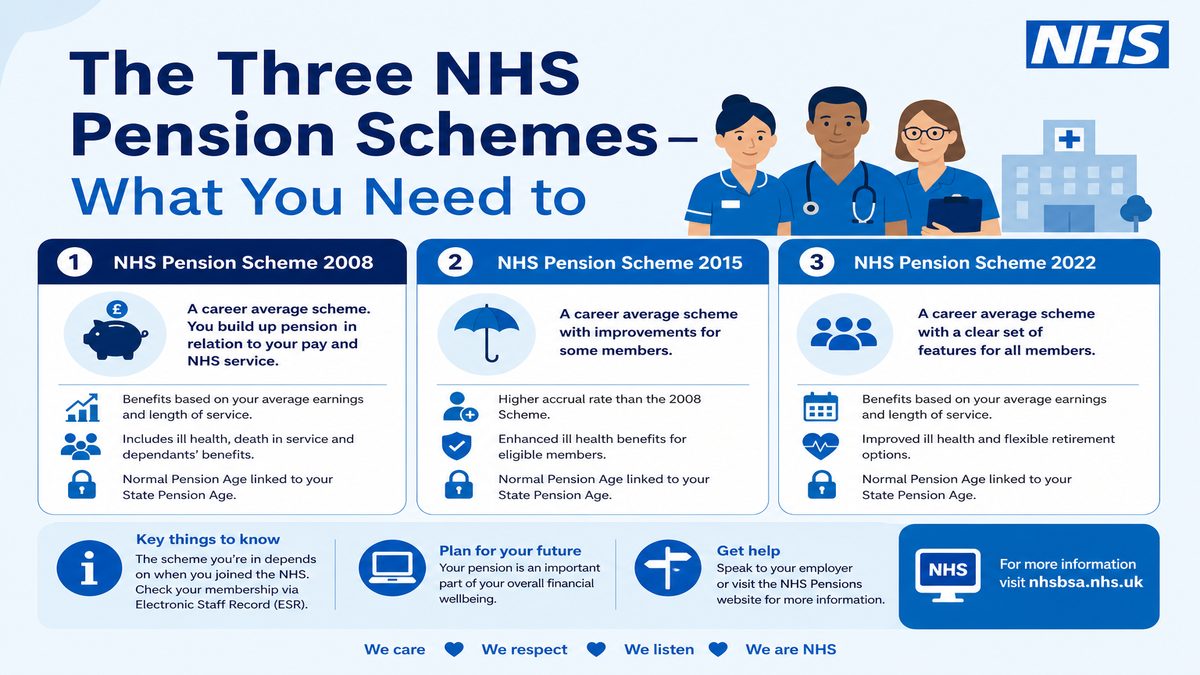
As part of the McCloud remedy, the 1995 and 2008 sections closed on 31 March 2022, and since 1 April 2022 all active members contribute to the 2015 Scheme. Members that have already built up pension in the 1995 and 2008 sections can still access this after 1 April 2022 in line with the existing rules for each section.
The move to the 2015 Scheme means that more members are likely to have pension across multiple parts of the scheme. Your total NHS pension at retirement is the sum of every section's benefits added together — each calculated under its own distinct set of rules.
The three sections are not interchangeable. Your accrual rate, lump sum entitlement, and Normal Pension Age all depend on which section your service falls under.
This table sets out every structural difference across the three NHS pension scheme sections that directly affects your retirement income.
Feature | 1995 Section | 2008 Section | 2015 Scheme |
Pension Type | Final Salary | Final Salary | Career Average Revalued Earnings (CARE) |
Accrual Rate | 1/80th | 1/60th | 1/54th |
Salary Basis | Best 3 consecutive years in last 10 | Best 3 consecutive years in last 10 | Each year's actual pensionable pay |
Normal Pension Age (NPA) | 60 | 65 | State Pension Age (min. 65) |
Minimum Retirement Age | 55 | 55 | 55 |
Automatic Tax-Free Lump Sum | ✅ Yes — 3× annual pension | ❌ No | ❌ No |
Optional Lump Sum (Commutation) | ✅ Yes — additional commutation available | ✅ Yes — approx. 12:1 | ✅ Yes — approx. 12:1 |
Revaluation (Active Members) | N/A — final salary linked | N/A — final salary linked | CPI + 1.5% per year |
Revaluation (Deferred Members) | CPI | CPI | CPI |
Revaluation (Pensions in Payment) | CPI | CPI | CPI |
Death-in-Service Lump Sum | 2× pensionable pay | 2× pensionable pay | 2× pensionable pay |
Survivor Pension | 50% of member's pension | 37.5% of member's pension | 33.75% of member's pension |
Special Class / MHO NPA | 55 ✅ | ❌ Not available | ❌ Not available |
Maximum Service Cap | 40 years | None | None |
Closed to New Accrual | 31 March 2022 | 31 March 2022 | Open — all active members |
McCloud Remedy Applies | ✅ (remedy period 2015–2022) | ✅ (remedy period 2015–2022) | ✅ (as the reformed scheme) |
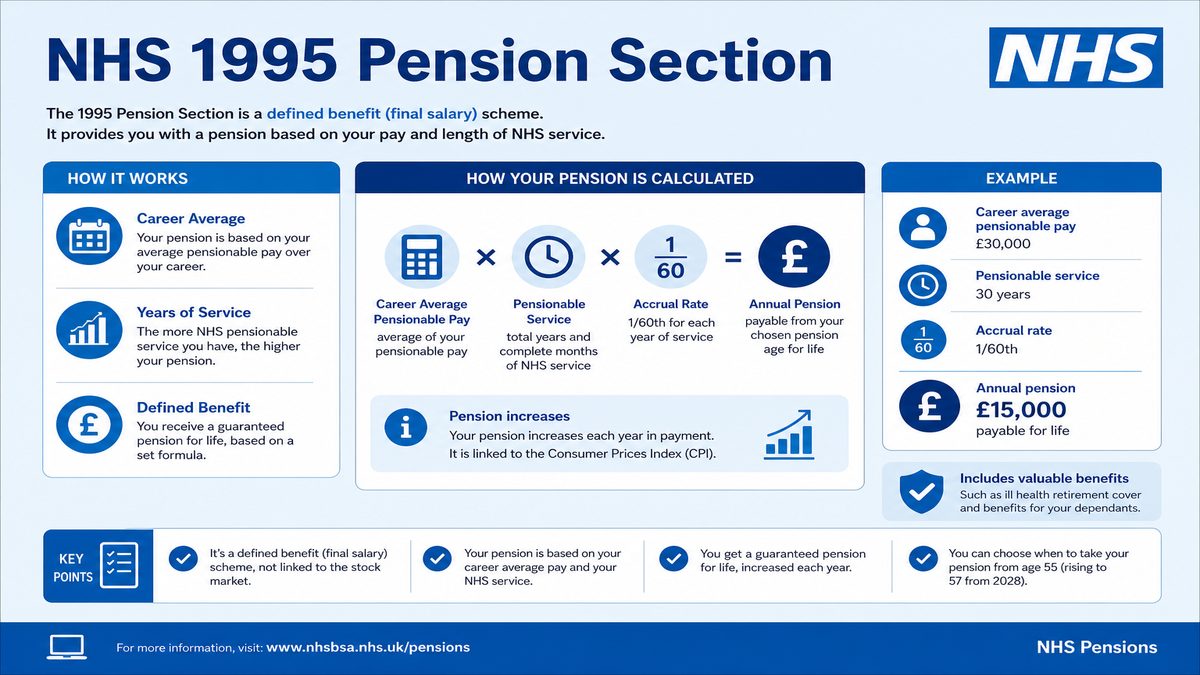
The NHS 1995 Section is a defined benefit final salary pension scheme. It covered NHS staff who joined before 1 April 2008. The 1995 Section closed to new accruals on 31 March 2022, but benefits accrued before that date remain preserved and payable under the original terms.
The NHS 1995 Pension Scheme structure rewards long-term service and late-career salary progression, offering a pension based on final salary rather than an average across the career.
Annual pension from the 1995 Section is calculated using the salary, service, and accrual rate. The salary is the average of the three consecutive years with the highest pensionable earnings, taken from the last ten years of service.
Written as a formula:
Annual Pension = Final Pensionable Pay × Years of Reckonable Service ÷ 80
In addition to the annual pension, the NHS 1995 Section provides an automatic tax-free lump sum, calculated as three times the annual pension:
Automatic Lump Sum = Annual Pension × 3
The automatic lump sum feature distinguishes the 1995 Section from the 2008 and 2015 sections, which do not offer an automatic lump sum.
Claire, Band 7 Registered Nurse, retiring at NPA 60
Step | Calculation | Result |
Annual pension | £48,000 × 25 ÷ 80 | £15,000/year |
Automatic lump sum | £15,000 × 3 | £45,000 |
Monthly pension | £15,000 ÷ 12 | £1,250/month |
At age 60, Claire receives £15,000 per year plus a £45,000 tax-free lump sum on day one of retirement. No commutation is required and no choices are needed on the lump sum unless she wants to convert further pension into additional cash.
For part-time workers, the 1995 Section adjusts service on a pro-rata basis. Service years are reduced proportionally based on hours worked compared to a full-time equivalent. A member working 50% of full-time hours for 20 years accrues 10 years of qualifying service.
The final pensionable pay used in the formula is based on the whole-time equivalent salary. Part-time staff are not disadvantaged on the salary side of the formula — only on the years of service.
Members with confirmed Special Class or Mental Health Officer (MHO) status in the 1995 Section have a Normal Pension Age of 55, not 60. This applies to specific clinical groups — including qualified mental health nurses and certain allied health professionals — who had direct and substantial contact with mentally disordered patients.
Special Class status is not transferable to the 2008 or 2015 sections and does not apply to service built up after 31 March 2008.
The 1995 Section has a maximum service cap of 40 years. Forty years of service gives 40/80ths = 50% of final salary as an annual pension. Members who reached 40 years of reckonable service before 31 March 2022 stopped building further 1995 Section benefits at that point.
The NHS 2008 Section is a defined benefit final salary pension scheme that replaced the 1995 Section for staff joining from 1 April 2008. It uses 1/60th final salary accrual with no automatic lump sum. Normal pension age is 65.
Annual Pension = Final Pensionable Pay × Years of Reckonable Service ÷ 60
The salary definition is identical to the 1995 Section: the average of the three consecutive years with the highest pensionable earnings in the last ten years before retirement.
There is no automatic lump sum. You can commute (exchange) part of your annual pension for a tax-free cash lump sum at an exchange rate of £12 of lump sum for every £1 of annual pension surrendered.
Break-even point: It takes approximately 12 years of retirement before the higher pension would have repaid the lump sum. If you expect to live well beyond 12 years in retirement, keeping the higher pension produces better total value — but taking cash at retirement gives immediate flexibility.
Mohammed, Band 6 Physiotherapist, retiring at NPA 65
Step | Calculation | Result |
Annual pension (no commutation) | £42,000 × 14 ÷ 60 | £9,800/year |
Monthly pension (no commutation) | £9,800 ÷ 12 | £817/month |
Optional lump sum (commute £2,000 pension) | £2,000 × 12 | £24,000 lump sum |
Annual pension after commutation | £9,800 − £2,000 | £7,800/year |
Monthly pension after commutation | £7,800 ÷ 12 | £650/month |
Mohammed's break-even point on taking the lump sum is approximately 12 years into retirement. If he lives beyond age 77, keeping the higher pension produces more total income than taking the £24,000 lump sum.
The 2008 Section builds pension 33% faster than the 1995 Section per year of service (1/60th vs 1/80th). The 1995 Section's automatic lump sum of 3× annual pension partially offsets this difference in total economic value.
The critical structural distinction is Normal Pension Age. The 1995 Section grants full unreduced benefits five years earlier than the 2008 Section (age 60 vs age 65). A member with identical service and salary in both sections would receive their 1995 benefits five years sooner — generating significantly more total lifetime pension income if they live to average life expectancy.
The 2015 Scheme covers all current active NHS members. Since 1 April 2022, all active members build up benefits in the 2015 Scheme for new service. It uses 1/54th career average revalued earnings (CARE) accrual. Normal pension age is your State Pension Age, or 65 if later.
Every year you are an active member, you earn a pension slice equal to your pensionable pay divided by 54. That slice is then revalued annually by CPI + 1.5% until you retire. At retirement, all your revalued slices are added together to give your total 2015 Scheme pension.
Pension Accrued Per Year = That Year's Pensionable Pay ÷ 54 Total 2015 Pension = Sum of all annual slices, each revalued by CPI + 1.5%
Priya, Band 5 Staff Nurse, planning to retire at State Pension Age 67
Step | Calculation | Result |
Annual pension accrual (per year) | £32,000 ÷ 54 | £593/year accrued |
Over 10 years (without revaluation) | £32,000 × 10 ÷ 54 | £5,926/year |
With CPI + 1.5% revaluation over 10 years (at estimated 2% CPI) | £5,926 × compounding 3.5% | ≈ £8,300/year at retirement |
Monthly pension | ≈ £8,300 ÷ 12 | ≈ £692/month |
Automatic lump sum | None | £0 |
The revaluation effect is significant. At CPI + 1.5% compounding over 10 years, Priya's pension grows materially in real terms. The longer the time between accrual and retirement, the more powerful the revaluation becomes.
The 2015 Scheme outperforms final salary rules when:
The 2015 Scheme underperforms final salary rules when your salary in the final years of your career is significantly higher than your career average — which is common for consultants, senior managers, and Band 8+ staff promoted late. For those members, the 1995 or 2008 final salary link captures the peak earnings and applies it to all years of service, producing a materially higher pension.
Different accrual rules and Normal Pension Ages apply to benefits built up at different times. Your total NHS pension at retirement is the sum of each section's calculation applied independently.
David, Band 8a Clinical Lead
Section | Formula | Annual Pension | Lump Sum |
1995 Section | £58,000 × 20 ÷ 80 | £14,500/year | £43,500 (automatic) |
2015 Scheme (at NPA 67, unreduced) | £55,000 × 5 ÷ 54 | £5,093/year (before revaluation) | £0 |
Combined total at respective NPAs | £19,593/year | £43,500 | |
Monthly income | £1,633/month |
David can draw his 1995 Section benefits at age 60 (his NPA for that section) and leave his 2015 benefits in the scheme until State Pension Age at 67 — drawing each section at its unreduced NPA and avoiding early retirement reductions on both.
If you joined the NHS… | Your scheme section(s) are… |
Before 1 April 2008 | 1995 Section (pre-2015 service) + 2015 Scheme (from April 2022) |
Between 1 April 2008 and 31 March 2015 | 2008 Section (pre-2015 service) + 2015 Scheme (from April 2022) |
From 1 April 2015 onwards | 2015 Scheme only |
Your confirmed section and accumulated pension figures appear on your NHSBSA Annual Benefit Statement (ABS). Access it at the NHSBSA Member Hub or via ESR self-service.
The McCloud case was about protections for older workers when the reformed public service pension schemes — including the 2015 NHS Scheme — were introduced. Those protections were found by the Court of Appeal to be unlawfully discriminatory against younger members.
The result is a remedy period from 1 April 2015 to 31 March 2022, during which eligible scheme members can choose whether their legacy (1995 or 2008) section or CARE (2015) scheme rules apply to their membership during that window.
NHS staff who were active in the scheme on 31 March 2012 and on 1 April 2015 are eligible for the remedy. If you were not in the NHS Pension Scheme on both of those dates, the McCloud remedy does not apply to you.
You do not make this choice now. Your remedy-period service has been temporarily rolled back into the 1995 or 2008 section. At retirement, NHSBSA will calculate both options and present you with a comparison via a Remediable Service Statement (RSS). You then choose which set of rules to apply to your remedy-period service.
Important: Do not make major retirement decisions based on an assumed McCloud outcome. Wait for your Remediable Service Statement from NHSBSA, which confirms both options and their values for your specific service record.
All three scheme sections use the same tiered employee contribution structure. From 1 April 2026, the NHS Pension Scheme uses six contribution tiers with rates running from 5.2% to 12.5%.
Tier | Pensionable Pay (2026/27) | Employee Rate |
1 | Up to £13,259 | 5.2% |
2 | £13,260 – £28,854 | 6.5% |
3 | £28,855 – £35,155 | 8.3% |
4 | £35,156 – £52,778 | 9.8% |
5 | £52,779 – £67,668 | 10.7% |
6 | £67,669 and above | 12.5% |
Employers contribute a flat rate of 23.7% of pensionable pay, making the NHS Pension Scheme one of the most generous occupational pension schemes in the UK. That employer contribution does not come out of your pay — it is an additional cost borne entirely by your NHS employer.
NHS pension contributions are deducted from gross pay before income tax is calculated — a net pay arrangement — so you receive automatic tax relief at your marginal rate. A 20% taxpayer paying 8.3% contributions sees a net cost of approximately 6.6%. A 40% taxpayer paying 12.5% sees a net cost of approximately 7.5%.
Not all NHS income is pensionable.
Pensionable pay includes:
Not pensionable:
If your basic salary is £32,073 but you receive £4,000 in HCAS, your pensionable pay is £36,073 — placing you in Tier 4 (9.8%) rather than Tier 3 (8.3%).
Unlike income tax (which is marginal), NHS pension contributions apply to your entire salary based on which tier you fall into. This creates cliff edges at tier boundaries.
If your pensionable pay is £28,854 (top of Tier 2), you pay 6.5% = £1,876/year. If it rises by just £1 to £28,855, you move to Tier 3 and pay 8.3% on your entire salary = £2,395/year. That is £519 more in pension contributions for £1 more in gross pay. This is the single most misunderstood feature of NHS pensions and catches thousands of staff every year.
The four most dangerous tier boundary points in 2026/27:
Boundary | Tier Change | Extra Annual Contribution Triggered |
£28,854 → £28,855 | Tier 2 (6.5%) → Tier 3 (8.3%) | £519/year |
£35,155 → £35,156 | Tier 3 (8.3%) → Tier 4 (9.8%) | £527/year |
£52,778 → £52,779 | Tier 4 (9.8%) → Tier 5 (10.7%) | £475/year |
£67,668 → £67,669 | Tier 5 (10.7%) → Tier 6 (12.5%) | £1,218/year |
The Department of Health and Social Care reviews these thresholds annually using the Consumer Price Index to adjust for inflation and maintain consistency in take-home pay at each tier level.
Since October 2022, contribution tier assessment for part-time staff changed. Before this reform, tiers were set on whole-time equivalent pay — meaning part-time workers often paid a higher percentage than their actual earnings warranted. Since the change, your tier is based on actual pensionable pay received. A member on 0.5 WTE is assessed against the tier thresholds using their 0.5 WTE earnings, not the full-time figure.
Every scheme section permits retirement from age 55. Retiring before your Normal Pension Age triggers an actuarial reduction to your benefits. The reduction grows the further from NPA you retire.
The 1995 Section applies separate reduction factors to the pension and to the automatic lump sum. The lump sum reduction is consistently lower than the pension reduction.
Approximate reductions (England & Wales):
Years Early | Pension Reduction | Lump Sum Reduction |
1 year early (retire at 59) | ≈ 5.1% | ≈ 1.7% |
2 years early (retire at 58) | ≈ 10.0% | ≈ 3.4% |
3 years early (retire at 57) | ≈ 14.6% | ≈ 5.0% |
4 years early (retire at 56) | ≈ 19.0% | ≈ 6.6% |
5 years early (retire at 55) | ≈ 23.1% | ≈ 8.2% |
Note: Exact reduction factors are published by NHSBSA and applied to your individual pension estimate. The figures above are indicative. For the precise reduction applicable to your service record, request a retirement benefits estimate directly from NHSBSA.
The 2008 Section has a 10-year window of potential early retirement (age 55 to NPA 65). Reductions per year are higher than the 1995 Section because of the larger gap between minimum retirement age and NPA.
Approximate reductions:
Years Early | Pension Reduction |
1 year early (retire at 64) | ≈ 5.0% |
3 years early (retire at 62) | ≈ 14.3% |
5 years early (retire at 60) | ≈ 22.8% |
10 years early (retire at 55) | ≈ 40.0% |
A 2008 Section member retiring at 55 retains only approximately 60% of their full NPA pension.
The 2015 Scheme carries the most severe early retirement penalties. With a State Pension Age of 67, retiring at 55 means drawing benefits 12 years early.
Approximate reductions:
Years Early | Pension Reduction |
2 years early (retire at 65) | ≈ 10.0% |
5 years early (retire at 62) | ≈ 23.4% |
7 years early (retire at 60) | ≈ 31.0% |
12 years early (retire at 55) | ≈ 47.0% |
A 2015 Scheme member who retires at 55 receives only approximately 53% of their full NPA pension. This is the primary reason many NHS staff with significant 2015 Scheme benefits choose to defer those benefits to State Pension Age while drawing their 1995 Section benefits at NPA 60.
The break-even age is the point at which total income from taking a reduced pension early equals total income from waiting for the unreduced pension. For most NHS members retiring 3–5 years early, break-even falls between age 70 and age 75. If your family history suggests longevity beyond 75, waiting for full unreduced benefits produces more total lifetime income in most scenarios.
ERRBO allows 2015 Scheme members to purchase protection against the early retirement reduction. By paying additional contributions now, you secure the right to retire up to 3 years before State Pension Age without actuarial reduction applied to your 2015 benefits. ERRBO is purchased in whole years. The cost depends on your age at purchase and the number of years of protection you buy. Contact NHSBSA for a personal ERRBO quotation.
The 1995 Section provides an automatic tax-free lump sum equal to 3× your annual pension. No commutation is required. You receive this automatically on the first day of retirement. You can additionally commute further annual pension into a larger lump sum, subject to the Lump Sum Allowance.
There is no automatic lump sum. You can commute part of your annual pension at a rate of £12 of lump sum for every £1 of annual pension surrendered.
There is no automatic lump sum. Commutation operates at the same 12:1 rate as the 2008 Section.
The Lump Sum Allowance is £268,275 for 2026/27. This is the maximum total tax-free lump sum you can receive across all pension schemes in your lifetime. Any tax-free lump sum amount above this limit is taxed at your marginal income tax rate.
For NHS members with long service or high salaries, the 1995 Section automatic lump sum alone can consume a substantial portion of the LSA. A member with a £30,000 annual 1995 Section pension receives an automatic lump sum of £90,000 — leaving £178,275 of remaining LSA allowance for further commutation or other pension schemes.
The Annual Allowance is the maximum amount by which your pension benefits can grow in a tax year without triggering a tax charge. For 2026/27, the standard Annual Allowance is £60,000.
For defined benefit schemes, Annual Allowance is not measured by contributions paid. It is measured by the growth in the value of your pension benefits, calculated as: (Closing Pension Value − Opening Pension Value) × 16, plus any lump sum increase.
Annual Allowance charges primarily affect high earners. The highest-risk groups are:
If your adjusted income exceeds £260,000, your Annual Allowance tapers. For every £2 of adjusted income over £260,000, your AA reduces by £1, down to a minimum floor of £10,000. Adjusted income includes salary, employer pension contributions, and all other income sources.
If your pension growth exceeds the Annual Allowance and you face a tax charge, you can elect for the NHS Pension Scheme to pay the charge from your future pension benefits. This is called Scheme Pays. It reduces your future pension by an actuarially equivalent amount but eliminates any immediate cash payment requirement. The deadline to submit a Scheme Pays election is 31 July in the tax year following the year the charge arose.
The Additional Pension facility allows 2015 Scheme members to purchase extra annual pension on top of standard accrual. You can buy up to £7,401 of additional annual pension for 2026/27. Payment can be made through regular monthly contributions deducted from pay or as a one-off lump sum.
The 1995 Section previously offered an Added Years facility to purchase extra reckonable service. This is closed to new contracts. Members who held existing Added Years contracts before closure can continue their arrangements to completion.
The NHS Shared Cost AVC operates through a salary sacrifice arrangement alongside the main NHS Pension Scheme. Contributions are deducted before income tax and National Insurance, producing a larger effective saving than standard voluntary contributions. The NHS Shared Cost AVC is provided through Prudential and allows investment in a range of funds. At retirement, the AVC fund can be taken as a tax-free lump sum (subject to the LSA) or used to purchase an annuity.
All three sections provide death-in-service benefits, but the survivor pension percentages differ materially.
Benefit | 1995 Section | 2008 Section | 2015 Scheme |
Death-in-Service Lump Sum | 2× pensionable pay | 2× pensionable pay | 2× pensionable pay |
Spouse / Civil Partner Survivor Pension | 50% of member's pension | 37.5% of member's pension | 33.75% of member's pension |
Nominated Partner Pension | ✅ Available | ✅ Available | ✅ Available |
Children's Pension | Payable up to age 23 (in full-time education) | Payable up to age 23 (in full-time education) | Payable up to age 23 (in full-time education) |
Death After Retirement | Survivor pension continues | Survivor pension continues | Survivor pension continues |
The 1995 Section provides the highest survivor pension at 50% of the member's annual pension. The 2015 Scheme provides the lowest at 33.75%. For a member receiving £20,000 per year, this is the difference between a survivor receiving £10,000 per year (1995 Section) and £6,750 per year (2015 Scheme) — a £3,250 annual difference paid for the survivor's lifetime.
Partial retirement (also called Retire and Return) allows NHS staff to take between 20% and 80% of their built-up pension while continuing to work — provided they reduce their pensionable earnings by at least 10%.
This is available from age 55. The portion of pension you do not draw stays in the scheme and continues to grow. Members can draw their 1995 or 2008 Section benefits at their Normal Pension Age while simultaneously continuing to build 2015 Scheme benefits — a particularly powerful planning option for staff in their late 50s and early 60s.
Partial retirement is especially valuable for:
The core scheme rules — accrual rates, Normal Pension Ages, and lump sum entitlements — are identical across all four UK nations. Contribution tier structures differ.
Scotland (Scottish Public Pensions Agency — SPPA): Scottish NHS staff pay contribution rates set by the Scottish Public Pensions Agency. The SPPA uses a different tier structure with more bands than England and Wales. If you work in Scotland, use the SPPA contribution table rather than the England & Wales rates above.
Northern Ireland (HSC Pension Service): The Northern Ireland HSC Pension Scheme mirrors England & Wales rules closely, but with slightly different tier thresholds and a top employee contribution rate of 12.7% (vs E&W's 12.5%). The employer contribution rate in Northern Ireland is 23.2%.
The 1995 Section uses 1/80th final salary accrual and pays an automatic lump sum of 3× pension with a Normal Pension Age of 60. The 2008 Section uses 1/60th final salary accrual with no automatic lump sum and a Normal Pension Age of 65. The 2015 Scheme uses 1/54th career average accrual, no automatic lump sum, CPI + 1.5% annual revaluation on active benefits, and a Normal Pension Age equal to State Pension Age (minimum 65).
There is no universally best scheme. Staff with significant late-career salary growth benefit more from 1995 or 2008 final salary rules. Staff with consistent salaries throughout their career often benefit more from the 2015 Scheme's higher 1/54th accrual rate and CPI + 1.5% revaluation. Use the calculator above to compare your personal figures with your exact salary and service data.
The 1995 Section accrues at 1/80th of final salary per year. The 2008 Section accrues at 1/60th of final salary per year. The 2015 Scheme accrues at 1/54th of each year's actual pensionable pay, with CPI + 1.5% revaluation applied annually.
Yes. The minimum pension age across all three sections is 55. Retiring before your Normal Pension Age triggers an actuarial reduction. The reduction grows the further from NPA you retire. Retiring 12 years early in the 2015 Scheme reduces your pension by approximately 47%.
If you joined the NHS before April 2015 and have continued working, you almost certainly hold benefits in at least two sections. Your Annual Benefit Statement from NHSBSA confirms the exact breakdown of benefits by section.
The McCloud remedy gives eligible NHS members a choice between legacy (1995/2008) and 2015 CARE scheme rules for pension service between 1 April 2015 and 31 March 2022. NHSBSA calculates both options at retirement and presents them in your Remediable Service Statement (RSS). You choose the option that produces the higher pension for your circumstances.
The standard Annual Allowance is £60,000 for 2026/27. If your adjusted income exceeds £260,000, your allowance tapers by £1 for every £2 over the threshold, down to a minimum of £10,000. If you breach the Annual Allowance, you can elect Scheme Pays to have the tax charge met from your future pension rather than as an immediate cash payment.
The Lump Sum Allowance (LSA) is £268,275 for 2026/27. Tax-free lump sums across all your pension schemes in your lifetime cannot exceed this figure. Any amount above £268,275 is taxed at your marginal income tax rate.
Your employer contributes 23.7% of your pensionable pay on top of your own contributions. This does not come out of your pay — it is an additional cost met entirely by your employer and is one of the most valuable features of NHS employment. Most private sector employers contribute between 3% and 8%.
Your accrued pension is preserved and will be paid at your Normal Pension Age. Deferred 2015 Scheme benefits are revalued annually by CPI. Deferred 1995 and 2008 Section benefits are also revalued by CPI while in deferral. If you have fewer than 2 years of qualifying membership, you can usually receive a refund of contributions.
The 2015 Scheme has no service cap — your pension grows for every year you contribute. The 1995 Section had a maximum of 40 years of service, producing a maximum of 40/80ths = 50% of final salary as an annual pension. The 2008 Section has no service cap.
Contributions are deducted from gross pay before income tax — a net pay arrangement — providing automatic tax relief at your marginal rate. A basic rate taxpayer paying £4,000 in annual contributions has a net cost of £3,200. A higher rate taxpayer paying £4,000 has a net cost of £2,400.
The survivor pension percentage is 50% of your annual pension from the 1995 Section, 37.5% from the 2008 Section, and 33.75% from the 2015 Scheme. All three sections pay an equivalent survivor pension to a qualifying civil partner or nominated partner.
Partial retirement allows you to draw between 20% and 80% of your built-up NHS pension while continuing to work, provided you reduce your pensionable earnings by at least 10%. It is available from age 55. The remaining pension stays in the scheme and continues to grow.
Log in to the NHSBSA Member Hub to view your Annual Benefit Statement. Your ABS shows accumulated pension in each section and a projection at Normal Pension Age. You can also request a retirement benefits estimate directly from NHSBSA for a more precise projection based on your full verified service record.
Your Situation | Best Scheme Rules Likely Produce Higher Benefits |
Late-career salary growth (e.g. recent promotion to Band 8+) | 1995 or 2008 — final salary captures the peak earnings |
Consistent salary throughout career (e.g. Band 5–6) | 2015 CARE — 1/54th rate + revaluation compounds |
Want to retire at 60 without reduction | 1995 Section — NPA is 60 |
Want the highest pension per year of service | 2015 Scheme — 1/54th is the highest accrual rate |
Want a tax-free lump sum without commutation | 1995 Section — 3× automatic lump sum |
Have a long deferred period before retirement | 2015 Scheme — CPI + 1.5% revaluation adds compounding value |
Concerned about Annual Allowance | Compare all sections — CARE growth and final salary growth are measured differently |
Service in the McCloud remedy period (2015–2022) | Need both options calculated — do not assume either way |
The only way to determine your personal best outcome is to input your actual service record and salary data into the calculator above. Every NHS member's situation is different.
This calculator and all content on this page provide estimates for planning and educational purposes only. Actual pension benefits are calculated by NHSBSA using your verified service records. The McCloud remedy involves complex actuarial calculations — for definitive remedy advice, contact NHSBSA directly or consult a regulated independent financial adviser with NHS pension expertise.
Pension income is taxable as earned income in retirement. Tax-free lump sums are tax-free up to the Lump Sum Allowance of £268,275 for 2026/27. This page does not constitute financial advice.
For your official pension estimate: NHSBSA Member Hub | nhsbsa.pensionsmember@nhsbsa.nhs.uk