 Take Home Pay
Take Home Pay
Take Home Pay
Instantly calculate your NHS pension growth (Pension Input Amount), check whether you exceed the Annual Allowance, model carry forward from previous years, and see your exact Annual Allowance tax charge — updated for the 2025/26 tax year.
Required input fields:
Field | Description |
Scheme section | 1995 / 2008 / 2015 CARE |
Opening pension (£/yr) | Value at 6 April, before CPI uplift |
Closing pension (£/yr) | Value at 5 April |
CPI uplift rate (%) | Auto-set to 1.7% for 2025/26 |
Opening lump sum (£) | 1995 Section members only |
Closing lump sum (£) | 1995 Section members only |
Carry forward — 2022/23 | Unused AA from that year |
Carry forward — 2023/24 | Unused AA from that year |
Carry forward — 2024/25 | Unused AA from that year |
Threshold income (£) | Total income minus personal pension contributions |
Adjusted income (£) | Total income plus all employer pension contributions |
Marginal tax rate | 20% / 40% / 45% |
Output fields: Pension Input Amount (PIA) | Available Annual Allowance (with carry forward) | Excess over AA | Annual Allowance Charge (£) | Tapered AA (if applicable) | Scheme Pays eligibility flag
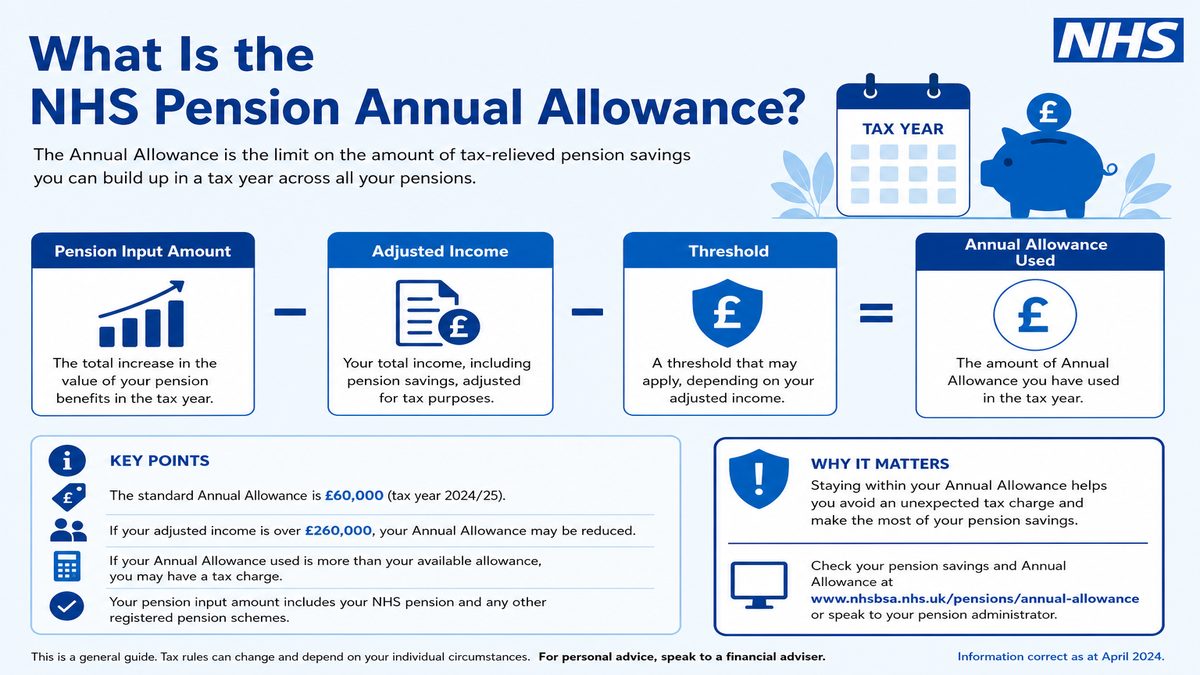
The Annual Allowance is the maximum amount of tax-free growth an individual's pension can grow by in one year. It is set by HMRC and applies across all registered pension schemes a person belongs to — including the NHS Pension Scheme.
For the 2025/26 tax year, the Annual Allowance is £60,000.
The NHS Pension Scheme is a Defined Benefit (DB) scheme. This means your pension growth for Annual Allowance purposes is not based on the cash contributions deducted from your payslip. Unlike defined contribution pensions, the NHS uses the Pension Input Amount (PIA). Your pension growth is also known as the Pension Input Amount — it is the capitalised increase in your benefits over the tax year. The NHS pension measures growth based on the increase in the value of your benefits from the start to the end of the tax year.
The majority of members should not be affected by the Annual Allowance, but there are a number of circumstances where members could see significant growth in their NHS Pension Scheme benefits that takes them over the Annual Allowance.
If you exceed the Annual Allowance, you may need to pay an Annual Allowance charge to HMRC.
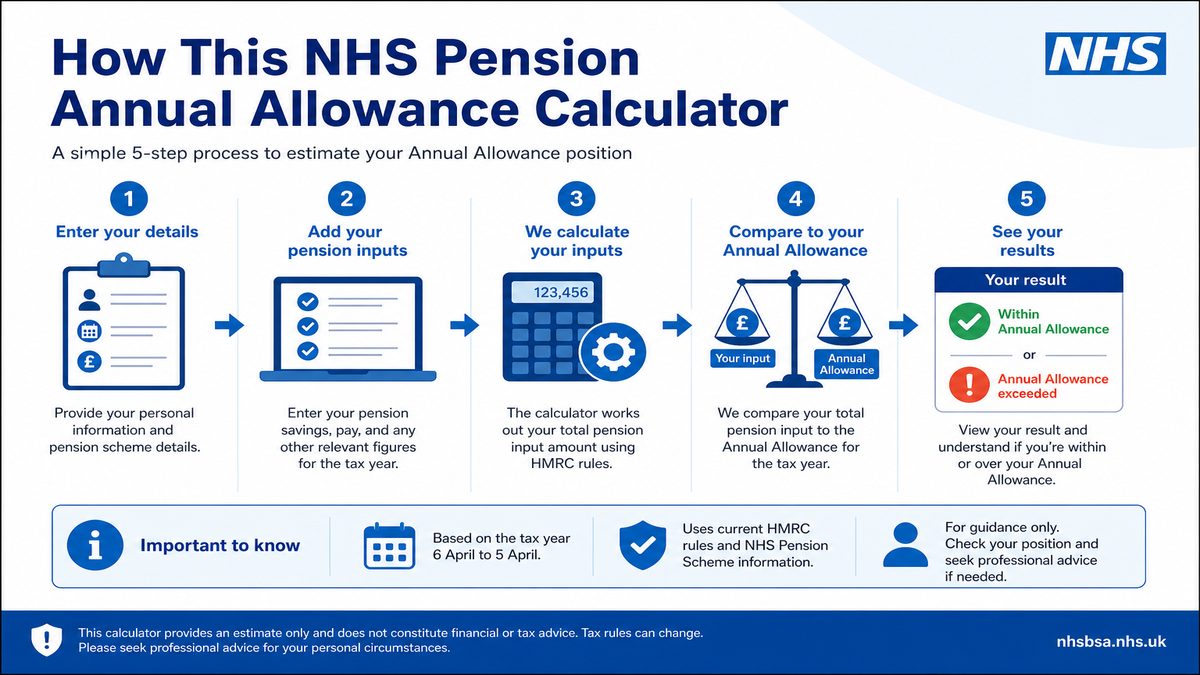
This calculator uses the HMRC-defined methodology for defined benefit schemes. The Pension Input Period (PIP) runs from 6 April to 5 April each tax year.
The opening value is the capital value of your NHS pension at the start of the tax year, adjusted for inflation.
Formula for the 1995 and 2008 Sections:
Opening Value = (Annual Pension at 6 April × 16 + Automatic Lump Sum) × (1 + CPI rate)
For the 2015 CARE Scheme:
Opening Value = Annual CARE Pension at 6 April × 16 × (1 + CPI rate)
The opening value is adjusted for inflation using September's CPI. HMRC increases this value using September CPI inflation from the previous year, because HMRC tries to avoid taxing you just because inflation has pushed pension values up.
The current CPI rate is 1.7% for the year 2025/26.
The closing value is the capital value of your NHS pension at the end of the Pension Input Period — 5 April 2026 for the 2025/26 tax year.
Formula for the 1995 Section (final salary + automatic lump sum):
Closing Value = (Annual Pension at 5 April × 16) + Automatic Lump Sum
Formula for the 2008 Section (final salary, no automatic lump sum):
Closing Value = Annual Pension at 5 April × 16
Formula for the 2015 CARE Scheme:
Closing Value = Annual CARE Pension at 5 April × 16
Formula:
PIA = Closing Value − Opening Value (CPI-adjusted)
Your Pension Input Amount = Closing Value − (Opening Value + Inflation Adjustments). This is the amount your pension savings have grown in real terms during the Pension Input Period.
Your available Annual Allowance = Standard or Tapered AA + any carry forward from the previous three tax years.
The table below gives the confirmed standard Annual Allowance for every tax year since 2010/11. This is essential for calculating carry forward.
Tax Year | Standard Annual Allowance | Key Event |
2025/26 | £60,000 | Current year |
2024/25 | £60,000 | — |
2023/24 | £60,000 | Increased by Spring Budget 2023 (from £40,000) |
2022/23 | £40,000 | — |
2021/22 | £40,000 | — |
2020/21 | £40,000 | — |
2019/20 | £40,000 | — |
2018/19 | £40,000 | — |
2017/18 | £40,000 | — |
2016/17 | £40,000 | — |
2015/16 | £80,000 (pre-alignment) / £0 (post-alignment sub-limit) | Transitional split Pension Input Period |
2014/15 | £40,000 | Reduced from £50,000 |
2013/14 | £50,000 | — |
2012/13 | £50,000 | — |
2011/12 | £50,000 | — |
2010/11 | £255,000 | Pre-reform era |
Tapered Annual Allowance threshold history:
Tax Years | Threshold Income Trigger | Adjusted Income Trigger | Minimum Floor |
2023/24–2025/26 | £200,000 | £260,000 | £10,000 |
2020/21–2022/23 | £200,000 | £240,000 | £4,000 |
2016/17–2019/20 | £110,000 | £150,000 | £10,000 |
Before 2016/17 | N/A — taper did not exist | — | — |
The Tapered Annual Allowance reduces the standard £60,000 limit for NHS staff with high incomes. It applies when both income tests are failed.
The taper applies where threshold income is over £200,000 and adjusted income exceeds £260,000 — in which case the Annual Allowance is reduced by £1 for every £2 of adjusted income above £260,000, down to a minimum of £10,000.
The two income definitions:
If your threshold income is £200,000 or below, you keep the full £60,000 allowance regardless of adjusted income. Both gateways must be exceeded for the taper to apply.
Adjusted Income | Annual Allowance |
£260,000 or less | £60,000 |
£280,000 | £50,000 |
£300,000 | £40,000 |
£320,000 | £30,000 |
£340,000 | £20,000 |
£360,000 or more | £10,000 |
Tapering reduces the allowance by £1 for every £2 of adjusted income above £260,000, down to a minimum of £10,000 for those with adjusted income above £360,000.
⚠️ NHS-specific warning: The NHS pension scheme will not necessarily know if you are subject to tapering — if you are subject to the taper, you should request a statement.
For relevant salary sacrifice arrangements made after 8 July 2015, HMRC says the reduction in employment income is added back when working out threshold income. So salary sacrifice may not reduce threshold income in the way you expect.
Carry forward allows you to use unused Annual Allowance from the three preceding tax years to offset a current-year breach before any charge applies.
You can still use unused Annual Allowance from the previous three tax years, provided you are eligible to do so.
Rules for carry forward:
Prior Year | Annual Allowance That Year | Max Carry Forward (if fully unused) |
2022/23 | £40,000 | £40,000 |
2023/24 | £60,000 | £60,000 |
2024/25 | £60,000 | £60,000 |
Total max carry forward | — | £160,000 |
Combined with the standard 2025/26 AA of £60,000, a member with three fully unused prior years could have a total available AA of £220,000 in 2025/26 before any charge arises.
Input | Value |
Pensionable pay 2025/26 | £38,000 |
Opening CARE pension (6 April 2025) | £6,200/yr |
CPI uplift (2025/26) | 1.7% |
Closing CARE pension (5 April 2026) | £6,900/yr |
Calculation:
✅ Result: PIA of £9,432 is well within the £60,000 Annual Allowance. No charge. No action required.
Input | Value |
Pensionable pay 2025/26 | £95,000 |
Opening CARE pension (6 April 2025) | £28,000/yr |
CPI uplift | 1.7% |
Closing CARE pension (5 April 2026) | £29,600/yr |
Calculation:
✅ Result: No breach. No carry forward needed.
This example illustrates why 1995 Section members face the highest risk of an Annual Allowance breach when they receive a pay award, because the entire pension is recalculated using the new final salary across all years of service.
Input | Value |
Years of pensionable service | 25 years |
Opening pension (best of last 3 years' pay = £90,000) | £28,125/yr |
Opening lump sum | £84,375 |
Closing pension (new final pay = £104,000) | £32,500/yr |
Closing lump sum | £97,500 |
CPI uplift 2025/26 | 1.7% |
Calculation:
❌ Breach = £74,043 − £60,000 = £14,043 excess
Option | Detail |
With £20,000 carry forward | Excess = £0, no charge |
Without carry forward at 40% tax rate | Charge = £14,043 × 40% = £5,617 |
Scheme Pays eligible? | Yes — charge > £2,000 AND NHS PIA > £60,000 |
Input | Value |
Adjusted income | £310,000 |
Threshold income | £215,000 |
Tapered AA | £60,000 − [(£310,000 − £260,000) ÷ 2] = £35,000 |
PIA from pension growth | £48,000 |
Carry forward available | £6,000 |
Total available AA | £35,000 + £6,000 = £41,000 |
Excess | £48,000 − £41,000 = £7,000 |
Marginal tax rate | 45% |
Annual Allowance Charge | £7,000 × 45% = £3,150 |
Scheme Pays is available as both thresholds (£2,000 charge, £10,000+ excess) are met.
GPs in the 1995 Section are assessed differently from Officer members. GP pensionable earnings are dynamised (revalued) using an uprating factor published each year by NHSBSA. If you are not sure which scheme category you are in, check your annual benefit statement. If there is a section entitled 'Practitioner Dynamising Sheet', you are in the practitioner category. If not, you are in the officer category.
Due to the certification process required to verify GP earnings and contributions, Annual Allowance statements for GPs are usually issued late. GPs must therefore estimate their Annual Allowance position in order to pay charges when due and apply for Scheme Pays before the 31 July deadline.
From 1 April 2022, all active accrual has been in the 2015 scheme, with legacy sections closed to further accrual.
AA capital value formula:
(Annual Pension × 16) + Automatic Lump Sum
The 1995 Section creates the largest AA risk for high earners. Because the pension is calculated using final salary rather than career average, a single pay award in the final years recalculates the entire benefit across all service years simultaneously — creating a disproportionate PIA spike.
AA capital value formula:
Annual Pension × 16
In the 2015 scheme, pension builds at 1/54th of your pensionable pay each year, revalued by CPI + 1.5%.
AA capital value formula:
Annual CARE Pension × 16
Since April 2022, all active NHS members build new pension in the 2015 scheme only. Legacy section benefits for service before April 2015 are preserved exactly as they were. If you were in the 1995 Section, you still have your 1/80th accrual for all pre-April 2015 service. Any service after April 2022 builds in the 2015 CARE scheme regardless of how long you have been in the NHS.
Most NHS members therefore have a split pension — legacy section benefits for pre-April 2015 service and CARE benefits for post-April 2022 service. Both are included in your total Pension Input Amount.
Employee contributions are deducted from your pensionable pay before income tax, giving automatic tax relief at your marginal rate. NHS pension contribution rates are tiered based on your total pensionable pay for the year. The rate applies to your whole salary, not just the portion within a band. For 2025/26, rates range from 5.2% for earnings up to £18,400 up to 12.5% for earnings above £109,750.
Your employer adds 14.38% on top of your salary regardless of which tier you are in.
Critical distinction: Employee contribution rates determine cash paid in — they do not determine your Pension Input Amount. Your PIA is calculated using the capital value formula, not from contribution amounts. A Band 6 nurse contributing £2,100 per year in cash contributions may have a PIA of £9,000–£12,000 depending on pensionable pay growth.
If your Pension Input Amount exceeds your available Annual Allowance (after carry forward), you have an Annual Allowance charge.
The charge is calculated at your marginal income tax rate — applied to the excess pension savings above your available Annual Allowance.
Formula:
Annual Allowance Charge = (PIA − Available AA including carry forward) × Marginal Tax Rate
Marginal Tax Rate | Income Band (2025/26 England, Wales, Northern Ireland) |
20% (basic rate) | £12,571 – £50,270 |
40% (higher rate) | £50,271 – £125,140 |
45% (additional rate) | Above £125,140 |
The excess pension savings are notionally added to your taxable income to determine which rate applies. If the excess straddles a tax band boundary, two different rates apply to the respective portions.
You have two options to pay:
Option 1 — Pay HMRC Directly: Declare the charge on your Self Assessment tax return and pay by 31 January following the end of the relevant tax year (e.g., by 31 January 2027 for a 2025/26 charge).
Option 2 — Scheme Pays: Ask the NHS Pension Scheme to pay the charge on your behalf. In return, your NHS pension benefits will be permanently reduced when they become payable.
Scheme Pays allows members to ask the NHS Pension Scheme to pay your Annual Allowance charge to HMRC. In return, your NHS pension benefits will be permanently reduced when they become payable, or if you leave and transfer out of the Scheme.
Mandatory Scheme Pays applies when both conditions are met simultaneously:
When paid through the Mandatory Scheme Pays facility, the NHS Pension Scheme is responsible for paying the member's tax charge to HMRC by their deadline.
The Voluntary Scheme Pays facility was extended from 2017/18 onwards. This is available if you have an Annual Allowance charge as a result of having an available Annual Allowance lower than the standard Annual Allowance. From 2017/18, you no longer have to have an Annual Allowance charge of more than £2,000 to use voluntary Scheme Pays.
You can ask the scheme to pay up to 100% of your Annual Allowance charge that relates to your NHS benefits, as long as they receive your election before the deadline.
To ask the NHS Pension Scheme to pay your Annual Allowance charge to HMRC, complete the Scheme Pays Election Notice (SPE2). You must only complete the current version of the election notice available on the NHSBSA website. The SPE2 must be completed for each tax year for which you have an Annual Allowance charge.
Tax Year | Scheme Pays Deadline |
2022/23 | 31 July 2024 (passed) |
2023/24 | 31 July 2025 (passed) |
2024/25 | 31 July 2026 |
2025/26 | 31 July 2027 |
⚠️ McCloud Remedy extension: For tax years 2023/24 and 2024/25 only, if members are unable to submit a mandatory Scheme Pays election due to the 2015 Remedy and delays in the provision of their Remediable Pension Savings Statement (RPSS), any late payment interest charges imposed by HMRC can be reclaimed through the NHS Cost Reimbursement Scheme.
You should complete and send your election earlier if one of the following events takes place before the deadline: you retire (the election should be completed before your NHS benefits become payable) or you reach age 75 (the election should be completed before your 75th birthday).
Electing for the scheme to pay the charge will result in a reduction to your pension at retirement (and to the lump sum for 1995 section members). The actuarial reduction that NHSBSA applies is calculated to be cost-neutral to the scheme. If you live longer than average, Scheme Pays costs you more in total than paying HMRC directly. Model this carefully before choosing.
A pension savings statement tells members whether they have exceeded the Annual Allowance limit in the NHS Pension Scheme.
NHSBSA aims to send a pension savings statement if the total pension growth across your NHS Pension Schemes is more than the Annual Allowance. The pension agencies issue statements at the beginning of October relating to the previous tax year.
You can also request an on-demand statement at any time — particularly useful if you have pension savings with another registered pension scheme alongside your NHS benefits.
You can request details of your service record and a breakdown of the calculations from the scheme administrator. These need to be checked, as they form the basis of the calculation of pension growth.
⚠️ GP-specific warning: Annual Allowance statements for GPs are usually issued late due to the certification process required to verify GP earnings and contributions. Do not wait for your statement before estimating your position and meeting the 31 July Scheme Pays deadline.
⚠️ Employer data warning: Members could be subject to fines and late payment penalties from HMRC if they do not receive their statement due to employer data errors. HMRC may impose fines of £300 per member plus £60 per day per member until the record is updated. Ensuring your employer submits accurate payroll data on time is therefore critical.
If you are affected by the Public Service Pension Remedy, sometimes known as the McCloud remedy, this may affect your Annual Allowance.
If you have NHS service in the period 1 April 2015 to 31 March 2022 — which applies to most active NHS members — McCloud applies to you. Your remedy-period service has been temporarily rolled back into the 1995 or 2008 section, and at retirement you will be offered a choice between legacy and reformed scheme benefits for that period.
Retrospective Annual Allowance recalculations for remedy-period years (2015/16 to 2021/22) may result in revised charges or refunds depending on which scheme option a member ultimately selects at retirement.
Due to the McCloud age discrimination remedy, the statements for 2022/23 had an extended deadline of 6 October 2024 for members whose service reverts to their legacy schemes.
Active member statements: As of spring 2026, NHSBSA cannot give a timeframe for when active members will receive their Remediable Service Statements. Members awaiting their RPSS should use the HMRC digital service tool — "Calculate your public service pension adjustment" — to understand their updated tax position.
The answer depends on your scheme, your pay level, and your service history.
Formula: Final Pay ÷ 80 × 20
Final Pensionable Pay | Annual Pension | Automatic Lump Sum (3×) |
£30,000 | £7,500 | £22,500 |
£40,000 | £10,000 | £30,000 |
£55,000 | £13,750 | £41,250 |
£70,000 | £17,500 | £52,500 |
£90,000 | £22,500 | £67,500 |
£110,000 | £27,500 | £82,500 |
Formula: Final Pay ÷ 60 × 20
Final Pensionable Pay | Annual Pension | Lump Sum |
£30,000 | £10,000 | Optional commutation |
£40,000 | £13,333 | Optional commutation |
£55,000 | £18,333 | Optional commutation |
£70,000 | £23,333 | Optional commutation |
£90,000 | £30,000 | Optional commutation |
The 2015 CARE pension after 20 years depends on your actual pay each year and the CPI + 1.5% revaluation applied annually.
Approximate 2015 CARE pension after 20 years at various pay levels:
Average Annual Pay | Approximate Annual Pension After 20 Years |
£30,000 | ~£11,100 |
£38,000 | ~£14,100 |
£50,000 | ~£18,500 |
£70,000 | ~£25,900 |
£90,000 | ~£33,300 |
These are estimates only. Request an official projection from NHSBSA for your personalised figure.
Mistake 1 — Comparing cash contributions to £60,000 Your NHS Pension Scheme contribution on your payslip is not your Pension Input Amount. PIA is calculated from the capital value formula. Your PIA will almost always be higher than your cash contributions.
Mistake 2 — Ignoring carry forward Many NHS staff with a breach in the current year have sufficient carry forward from previous years to eliminate the charge entirely. Always calculate carry forward before assuming any tax is owed.
Mistake 3 — Missing private or additional income in the taper calculation Doctors and GPs with private practice income, locum earnings outside NHS-contracted posts, or significant investment income may breach the taper threshold without realising it. All taxable income sources count toward threshold and adjusted income.
Mistake 4 — Assuming negative growth can be banked or carried forward You cannot carry forward a negative pension input amount. From tax year 2023/24, if your pension input amount in the 1995/2008 Scheme is negative, this can be offset against a positive amount in the 2015 Scheme in the same tax year. That is the limit — it cannot reduce carry forward capacity in future years.
Mistake 5 — Missing the Scheme Pays deadline The NHS Pension Scheme must receive your election by 31 July, following the January in which the Annual Allowance charge must be declared on your Self Assessment tax return. Missing this deadline means you must pay HMRC directly — regardless of the size of the charge.
Mistake 6 — Not checking for employer data errors You can request details of your service record and a breakdown of the calculations from the scheme administrator. These need to be checked, as they form the basis of the calculation of pension growth. Errors in your service record directly distort your PIA calculation.
Mistake 7 — Confusing the Annual Allowance with the Lifetime Allowance The Lifetime Allowance was abolished from 6 April 2024. The Annual Allowance (£60,000 in 2025/26) continues in full force and is a completely separate rule.
Mistake 8 — Not factoring in Additional Pension purchases Additional Pension purchased under NHS Pension Scheme rules increases your closing pension value, which increases your Pension Input Amount. Any Additional Pension contract payments during the 2025/26 tax year are included in the Annual Allowance assessment.
NHS Role | Risk Level | Primary Reason |
1995 Section members receiving a pay award | 🔴 High | Final salary amplification across all service years |
Senior consultants with adjusted income over £260,000 | 🔴 High | Tapered AA reduces available limit to as low as £10,000 |
GPs with significant pensionable earnings increase | 🔴 High | Dynamised earnings create large PIA spikes |
Band 8c / 8d / 9 AfC members | 🟡 Medium | PIA can approach £60,000 with pay progression |
2015 CARE Scheme members, Band 7 and below | 🟢 Low | PIA typically £8,000–£18,000, well within £60,000 |
Part-time NHS staff | 🟢 Very Low | Reduced pensionable pay, lower PIA |
The standard Annual Allowance for 2025/26 is £60,000. This is the same as 2024/25 and 2023/24. It was increased from £40,000 by the Spring Budget 2023.
Yes. The NHS Pension Scheme is a defined benefit scheme, so pension growth is measured using the capital value formula (pension × 16), not by tracking cash contributions. Your Pension Input Amount is compared to your available Annual Allowance each year.
The CPI rate applied to the opening pension value for 2025/26 is 1.7%, based on the September 2024 CPI figure.
Check your Annual Benefit Statement (ABS) or Total Reward Statement (TRS), available on the NHS Total Reward Statements website. Your scheme section is stated explicitly on those documents.
Yes. The Tapered Annual Allowance continues to apply in 2025/26. The thresholds are £200,000 threshold income and £260,000 adjusted income, with a minimum floor of £10,000. These thresholds are unchanged from 2023/24.
For every £2 your adjusted income goes over £260,000, your allowance is reduced by £1, until it reaches a minimum of £10,000. This minimum applies at adjusted income of £360,000 or above.
Yes, but the amount carried forward from a tapered year is limited to the tapered AA that applied in that year, not the standard £60,000. If your tapered AA was £30,000 and your PIA was £22,000 in that year, you carry forward £8,000 — not £38,000.
Reckonable pay is the pensionable pay figure used to calculate your NHS pension benefit. In the 1995 Section, it is the best of your last three years' whole-time equivalent pensionable pay at or before retirement. In the 2008 Section, it is the average of the best three consecutive years of pensionable pay in the last ten years. In the 2015 CARE Scheme, each year's accrual is based on that year's actual pensionable pay — reckonable pay as a concept does not apply in the same way.
Scheme Pays allows members to ask the NHS Pension Scheme to pay your Annual Allowance charge to HMRC on your behalf. In return, your NHS pension benefits are permanently reduced when they become payable, or if you leave and transfer out of the Scheme.
The Scheme Pays deadline for a 2025/26 Annual Allowance charge is 31 July 2027.
SPE2 is the Scheme Pays Election Notice. It is the form you complete to instruct the NHS Pension Scheme to pay your Annual Allowance charge to HMRC. A separate SPE2 must be completed for each tax year to which a charge relates. The current version is available on the NHSBSA website.
The answer depends on your scheme:
Use the calculator at the top of this page for a personalised projection.
The MPAA is a separate limit of £10,000 that applies to defined contribution (DC) pension contributions once you have flexibly accessed a DC pension pot. It does not apply to your NHS Defined Benefit pension growth. However, if you have a personal pension or AVC and you have triggered the MPAA by flexibly accessing it, your DC contributions become capped at £10,000 per year.
Yes. Additional Pension purchased under NHS Pension Scheme rules increases your closing pension value, which increases your Pension Input Amount. Any Additional Pension payments in the 2025/26 tax year are included in the Annual Allowance assessment.
Yes. You can request an on-demand pension savings statement from NHSBSA at any time, particularly if you do not expect your NHS pension growth to exceed the standard Annual Allowance or if you have pension savings with another registered pension scheme.
The NHS Employers Ready Reckoner is an official forward-looking tool designed to help staff understand the benefits they are building up in the scheme and their Annual Allowance liability. This calculator covers the same methodology, with the addition of carry forward modelling, Scheme Pays eligibility checking, and tapered Annual Allowance calculation in a single tool — covering all NHS staff including nurses, doctors, GPs, AHPs, and managers.
If your charge exceeds £2,000 and your NHS pension growth alone exceeds the standard £60,000 Annual Allowance, Mandatory Scheme Pays is available. You can ask the NHS Pension Scheme to pay up to 100% of the charge that relates to your NHS benefits, subject to the relevant SPE2 deadline.
Yes. If you are affected by the Public Service Pension Remedy, Annual Allowance figures for remedy-period years (1 April 2015 to 31 March 2022) are being recalculated by NHSBSA as Remediable Service Statements are issued. Use the HMRC digital service — "Calculate your public service pension adjustment" — to assess your updated tax position once you receive your RPSS.
Use these tools alongside the Annual Allowance Calculator for a complete picture of your NHS pay and pension position:
This calculator provides estimates for guidance only. It does not constitute financial, tax, or legal advice. The Annual Allowance and associated tax rules are set by HMRC and are your personal tax responsibility. NHS employers and NHSBSA cannot advise you on your personal tax liability.
All figures are based on publicly available HMRC rules, NHSBSA guidance, and NHS Employers Ready Reckoner methodology, current to the 2025/26 tax year. Tax rules change — always verify current thresholds with HMRC or a qualified independent financial adviser before making any financial decisions.
For official NHS pension benefit estimates and pension savings statements, contact NHSBSA directly via nhsbsa.nhs.uk.