 Take Home Pay
Take Home Pay
Take Home Pay
Use this calculator to find out exactly how much NHS mileage reimbursement you can claim. Enter your business miles, select your vehicle type, and get an instant result based on the current Agenda for Change Section 17 rates — updated for June and July 2026.
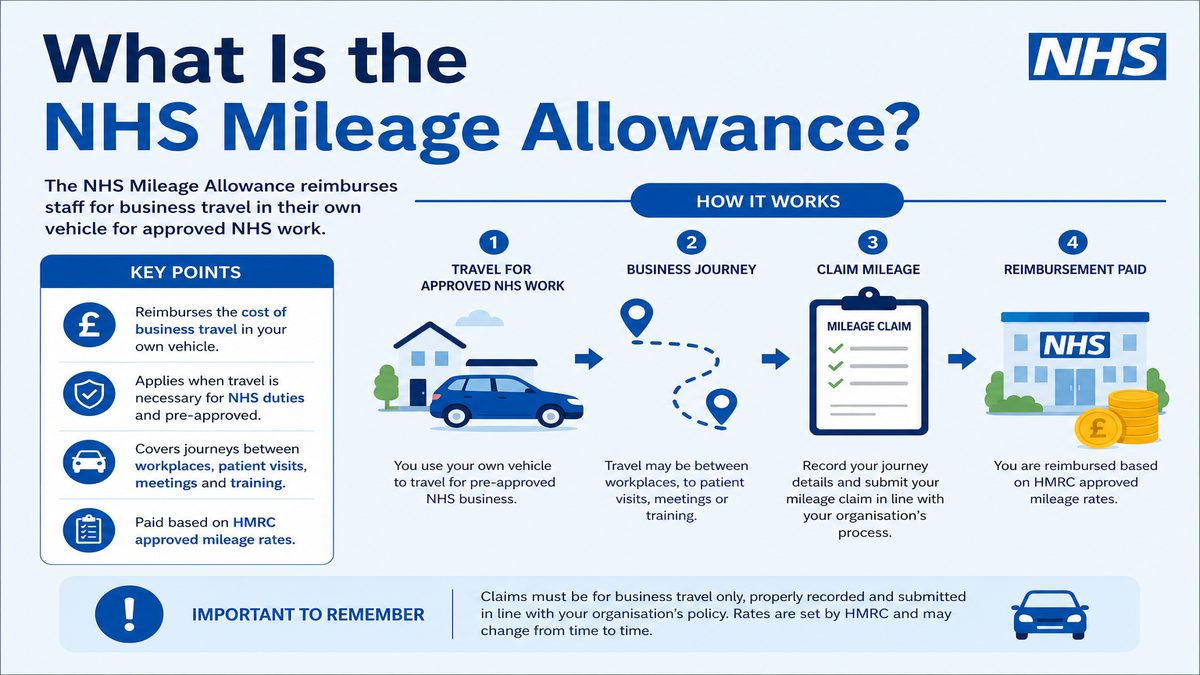
The NHS mileage allowance is a per-mile reimbursement paid to NHS staff who use their own privately owned vehicle for work-related travel. It is not a salary supplement or a bonus. It is a direct reimbursement for the running costs a staff member incurs when driving their personal vehicle on NHS business — covering fuel, insurance, tyre wear, servicing, and depreciation in a single flat rate.
1 Mileage for NHS staff is nationally agreed as part of NHS terms and conditions, often referred to as Agenda for Change. 4 NHS mileage rates are detailed in Section 17 of Agenda for Change. This section of the NHS Terms and Conditions of Service (TCS) Handbook sets every rule that governs how many pence per mile you are paid, what journeys qualify, and when the rate drops after a threshold. 2 These arrangements apply to all staff in England on AfC contracts covered by the NHS Terms and Conditions of Service Handbook, and whose employer operates under Section 17: reimbursement of travel costs.
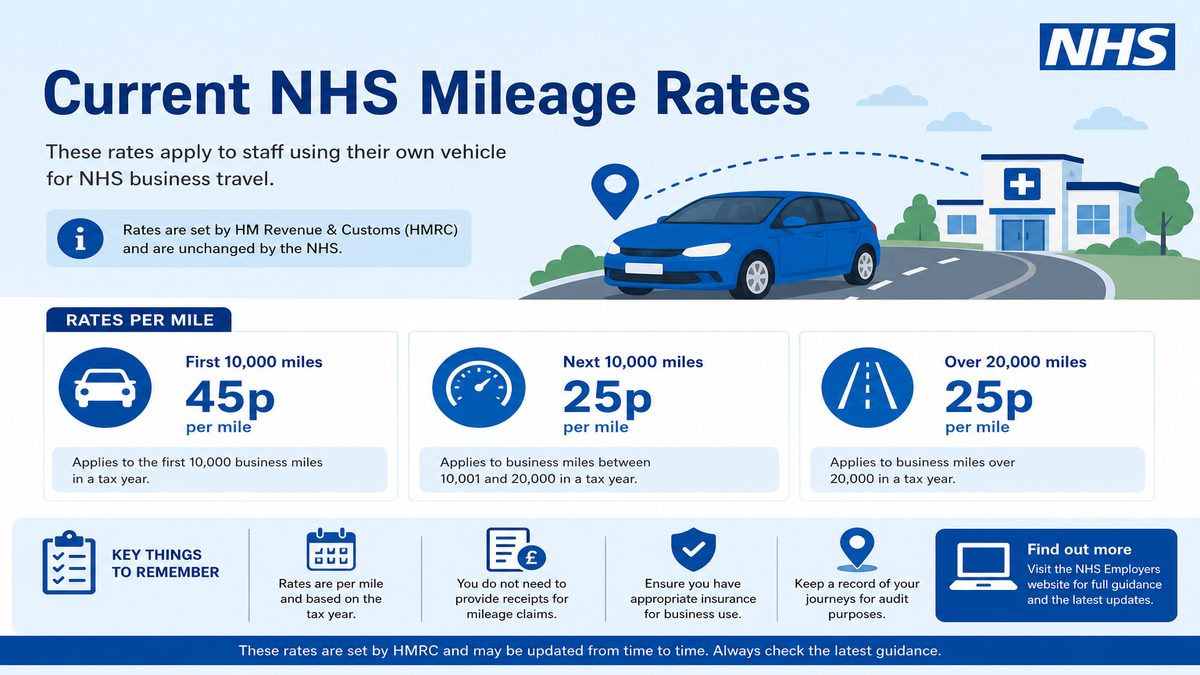
1 The nationally agreed NHS mileage allowance rates per mile from 1 June 2026 are: 59p for the first 3,500 miles for business purposes and 36p for each business mile after the threshold of 3,500 miles.
Vehicle | Rate 1 | Threshold | Rate 2 |
Car (all types) | 59p per mile | 3,500 miles | 36p per mile |
Motorcycle | Separate rate | — | Flat |
Bicycle | Separate rate | — | Flat |
1 From 1 July 2026 a new mileage threshold applies. The nationally agreed NHS mileage allowance rates per mile from 1 July 2026 are: 59p for the first 4,500 miles for business purposes and 36p for each business mile after the threshold of 4,500 miles.
Vehicle | Rate 1 | Threshold | Rate 2 |
Car (all types) | 59p per mile | 4,500 miles | 36p per mile |
2 From 1 July 2026, the mileage dropdown threshold — the point at which the reimbursement rate reduces for car users — will increase from 3,500 miles to 4,500 miles. The increase in the mileage threshold allowance means that the higher rate will apply for a greater number of miles each year.
9 Following the November 2025 review, rates decreased from 1 January 2026. The rates for staff on AfC terms and conditions were: 56p per mile for the first 3,500 business miles per year, and 21p per mile for every mile above 3,500.
Period | Rate 1 | Threshold | Rate 2 |
Before January 2026 | 59p | 3,500 miles | 24p |
1 January – 31 May 2026 | 56p | 3,500 miles | 21p |
1 June – 30 June 2026 | 59p | 3,500 miles | 36p |
From 1 July 2026 | 59p | 4,500 miles | 36p |
The HMRC Approved Mileage Allowance Payment (AMAP) rate is separate from the NHS AfC Section 17 rate. It is the tax-free ceiling HMRC sets for mileage reimbursement. Any amount your employer pays above this ceiling is taxable. Any amount paid below it means you can claim Mileage Allowance Relief.
13 On 21 May 2026 the Chancellor announced that the Approved Mileage Allowance Payment for cars and vans rises from 45p to 55p per mile for the first 10,000 business miles in a tax year. The change is backdated to 6 April 2026, so it applies to the whole 2026/27 tax year. This is the first increase in 15 years. 11 Motorcycles are reimbursed at 24p per mile and bicycles at 20p, with no mileage threshold on either.
Vehicle Type | First 10,000 Miles | Above 10,000 Miles |
Car / Van | 55p per mile | 25p per mile |
Motorcycle | 24p per mile | 24p per mile |
Bicycle | 20p per mile | 20p per mile |
Passenger supplement | +5p per mile | +5p per mile |
14 For employees using their own electric cars for business, the standard AMAP rate of 55p/25p still applies — there is no separate rate for personally owned EVs.
Most NHS staff receive the AfC rate of 59p per mile. HMRC permits 55p per mile tax-free. The 4p difference between these two figures is taxable income.
Here is how the tax calculation works on a monthly payslip:
If you are a basic-rate taxpayer (20%), the additional tax liability on that £20 is £4.00. If you are a higher-rate taxpayer (40%), it is £8.00. The mileage reimbursement itself remains a net benefit regardless of which tax band applies to you.
18 The AMAP rate already includes fuel, insurance, servicing, tyres, road tax, and wear and tear. If you claim the mileage rate, you cannot also claim any of those costs as separate expenses.
2 These arrangements apply to all staff in England on AfC contracts covered by the NHS Terms and Conditions of Service Handbook, and whose employer operates under Section 17: reimbursement of travel costs.
Eligible staff include:
2 Very senior managers are reimbursed in line with their local policies and contracts of employment. Staff within the remit of the Doctors' and Dentists' Review Body who are not employed on the 2016 training terms are excluded from Section 17 and follow separate arrangements.
The key rule is simple: qualifying mileage is travel you must make to perform your NHS duties, beyond your ordinary commute.
Claimable journeys:
Not claimable:
15 Business mileage includes travel to temporary workplaces, client visits, and trips between work locations. It does not include ordinary commuting between your home and your regular workplace.
If you and your line manager formally agree that your contractual base is your home, you may claim for all business miles from home. For home-based workers, every journey from home to a work location counts as business mileage, because there is no separate commute to deduct.
If you work as a bank nurse across multiple sites with no single permanent base, each site you travel to may qualify as a temporary workplace. In this scenario, travel from home to each site may be claimable. Check your trust's expenses policy for the specific definition of "temporary workplace" they apply.
The NHS uses an eligible miles system. Your employer deducts your normal home-to-base round-trip distance from your total daily business mileage. You are reimbursed only for the additional miles driven above your standard commute.
Example:
This prevents the mileage allowance from subsidising ordinary commuting while ensuring you are fully reimbursed for every extra mile driven on NHS business.
2 Similar to the previous mileage system, the dropdown threshold is where the reimbursement rate reduces after a certain number of miles travelled in a year.
From 1 July 2026, the threshold is 4,500 miles per year. Every mile above 4,500 drops to 36p.
Full-year calculation example (from 1 July 2026):
Miles Driven | Rate | Subtotal |
First 4,500 miles | 59p | £2,655.00 |
Miles 4,501 – 6,000 (1,500 miles) | 36p | £540.00 |
Total (6,000 miles) | £3,195.00 |
3 The new baseline rates apply to all car types. Engine size does not affect the rate. A 1.0-litre car and a 3.0-litre car both receive 59p per mile under Section 17.
The reserve rate applies to a specific group: NHS trainees and resident doctors who do not relocate when appointed to a new training post and instead travel a longer distance than expected.
The reserve rate from 1 June 2026 is 30 pence per mile. This is set at 50% of the standard Section 17 car rate (59p ÷ 2 = 29.5p, rounded to 30p).
The 17-mile rule works as follows:
Example: Home to training post = 25 miles. Claimable excess = 25 − 17 = 8 miles each way at 30p = £4.80 per day.
Resident doctors appointed to single-site training programmes are not eligible to claim excess mileage, as they are expected to live within a reasonable commute of the place of work.
2 In June 2024, the NHS Staff Council was given a mandate from the Department of Health and Social Care to renegotiate a new mechanism to calculate the reimbursement rates for NHS staff in England whose contract of employment directly links to Section 17 of the AfC NHS Terms and Conditions of Service Handbook.
The previous mechanism had relied on the AA motoring cost guides, which were last published in 2014. Since that point, any changes to reimbursement rates depended solely on fluctuations in fuel prices, leaving the system unresponsive to the full costs of vehicle ownership.
2 The Office for National Statistics (ONS) publishes data on aspects of the cost of motoring under the "operation of personal transport equipment" component of the Consumer Prices Index (CPI) in aggregate. The NHS Staff Council has used this data as an inflationary measure for the costs associated with business motoring. 5 On implementation, the mechanism calculates reimbursement rates as 59p for rate 1 and 36p for the drop-down rate for rate 2.
Change | Detail | Date |
New Section 17 rates live | 59p / 36p | 1 June 2026 |
Threshold increase | 3,500 → 4,500 miles | 1 July 2026 |
Mileage counter reset change | Changes from 1 July to 1 April | 1 April 2027 |
Review frequency | Every May and November | Ongoing |
Trigger threshold | Rates only change if the calculated shift is 5% or more | Ongoing |
6 If the review produces a change in the rates of reimbursement of less than five per cent, up or down, rates will not change. If the change in rates produced by the change in motoring costs is more than five per cent, rates will change on 1 July or 1 January. 5 Section 17 of the NHS Terms and Conditions of Service Handbook was updated on 1 June 2026.
4 There are a few NHS Trusts that have their own local mileage rates that were in place before the national agreement was reached. 3 Where local partnerships of employers and trade unions have agreed alternative arrangements to the provisions in Section 17 of the NHS TCS Handbook, it is not the intention that these new arrangements replace any local agreement.
This means some trusts may currently operate on HMRC AMAP rates (55p/25p) rather than the AfC rates (59p/36p). If you are unsure which rate your trust applies, check your payslip or ask your line manager or HR department directly.
NHS mileage arrangements differ across the four UK nations.
NHS Wales: 1The situation is different depending on where you live. Learn more about the situation in each of the UK devolved nations. NHS Wales operates under its own All Wales Mileage Protocol. Welsh NHS staff should contact their employer for the current applicable rates.
NHS Scotland: 1There has been a temporary increase to NHS Scotland national mileage rates in place in Scotland since April 2022. Scottish NHS staff should refer to NHS Scotland's specific arrangements.
Northern Ireland: Arrangements remain subject to ongoing devolved administration discussions. Northern Ireland NHS staff should verify current rates with their employer.
Log the following for each trip:
Deduct your normal home-to-base round-trip from your total daily mileage. The remaining miles are your eligible claimable miles for that day.
Most NHS trusts process mileage claims through ESR (Electronic Staff Record). Some trusts use local expenses portals or paper-based systems. Submit monthly to align with payroll cycles.
HMRC requires evidence to support mileage claims. A mileage log — physical or digital — that records each journey is sufficient. Keep records for at least six years from the end of the relevant tax year.
Your mileage reimbursement appears separately on your payslip. The taxable portion (the amount above the 55p AMAP rate) will be subject to income tax and National Insurance. This is calculated automatically by payroll.
Mileage Allowance Relief applies when your employer pays you below the HMRC AMAP rate. In that situation, you are entitled to claim tax relief on the shortfall.
14 Employees who receive less than the approved rate can claim Mileage Allowance Relief (MAR) from HMRC directly. 16 If an employer pays less than the approved mileage rate, the employee may be able to claim tax relief on the shortfall. For example, if an employer pays 35p per mile and the approved rate is 55p per mile, the employee may be able to claim tax relief on the 20p per mile difference.
For most NHS staff on AfC contracts, your trust pays 59p per mile — which is above the 55p AMAP rate. This means you do not need to claim MAR. Instead, the 4p difference is taxable, handled automatically through payroll.
If your trust pays AMAP rates (55p) instead of the full AfC rate, there is no taxable element and no MAR to claim — because you are paid exactly at the tax-free ceiling.
If your trust pays below 55p (e.g. a locally agreed lower rate), you can claim MAR on the difference via HMRC's online portal or your self-assessment tax return.
14 For employees using their own electric cars for business, the standard AMAP rate of 55p/25p still applies — there is no separate rate for personally owned EVs. This is one area where HMRC's rates are under some scrutiny, since the running costs of EVs are quite different from petrol or diesel vehicles. For now, though, the same rates apply.
For NHS AfC Section 17 purposes, the same 59p/36p rates apply to all car types regardless of fuel — petrol, diesel, hybrid, or full electric.
Section 17 mileage rates do not apply to lease cars or pool vehicles. Lease car arrangements within the NHS are governed by local policies and informed by HMRC Advisory Fuel Rates — not the AfC Section 17 schedule. 10Pool vehicles are owned by the employer. They are not allocated to an individual employee and are only available for business use. Provision of pooled vehicles is an important part of local travel policies. If you drive a lease car, speak to your fleet or HR department for the applicable rate.
1 The nationally agreed NHS mileage allowance rates per mile from 1 July 2026 are: 59p for the first 4,500 miles for business purposes and 36p for each business mile after the threshold of 4,500 miles.
11 The HMRC mileage rate for 2026/27 is 55p per mile for the first 10,000 business miles in a car or van, then 25p per mile after that.
12 The HMRC-approved mileage rate for cars and vans has been increased to 55p from 45p for the first 10,000 miles. 13 This is the first increase in 15 years.
The NHS AfC rate of 59p per mile exceeds the HMRC AMAP rate of 55p per mile. The 4p per mile excess is taxable. The remaining 55p is tax-free. Your trust's payroll system calculates and deducts this automatically.
No. 8Unless your home is your work base, you cannot claim costs like daily commuting to your place of work.
No. The Section 17 rate of 59p per mile applies to all car types regardless of engine size, fuel type, or age of vehicle. 3The new baseline rates apply to all car types.
There is no annual cap. The 4,500-mile threshold (from 1 July 2026) is the point at which your rate drops from 59p to 36p per mile. You continue to be reimbursed at 36p for every eligible mile beyond that threshold, with no upper limit.
1 From 1 April 2027, the mileage counter reset will change from 1 July to 1 April. Until then, the counter resets on 1 July each year.
5 The new mileage reimbursement mechanism will review rates twice a year. 3 The new mechanism will review inflation data every October and April each year, starting in October 2026.
You can claim an additional 5p per mile per passenger when carrying a fellow NHS employee on the same business journey. The 5p rate applies per passenger — if you carry two colleagues, you can claim an additional 10p per mile.
Yes. Motorcycles are eligible for NHS mileage reimbursement at a separate flat rate under Section 17. 11Motorcycles are reimbursed at 24p per mile and bicycles at 20p, with no mileage threshold on either.
No. NHS Scotland and NHS Wales operate under their own separate arrangements. 3These changes apply to staff employed on the NHS Terms and Conditions of Service in England. Devolved nations have their own rate agreements — verify directly with your employer.
The reserve rate from 1 June 2026 is 30p per mile. It applies to excess travel claims where a resident doctor travels more than 17 miles each way to a training post and has chosen not to relocate. Only miles above the 17-mile deductible are claimable at this rate.
Bank nurses can claim mileage for business journeys performed during their duties. If no single site is your permanent base, each site you travel to may be treated as a temporary workplace. Check with your trust's bank bureau for the specific claiming procedure, as bank staff may use a different submission process to substantiated employees.
8 The fleet of personal cars in use in the NHS is called the Grey Fleet. Every NHS staff member who drives their own car on NHS business is part of the Grey Fleet. The Section 17 mileage rates are the reimbursement mechanism for Grey Fleet travel.
No. 18The AMAP rate already includes fuel, insurance, servicing, tyres, road tax, and wear and tear. If you claim the mileage rate, you cannot also claim any of those costs as separate expenses. This applies equally to the NHS AfC Section 17 rate.
3 Some trusts may have agreed local variations or put in place HMRC AMAP rates while the broken mechanism was in place. Where local agreements or variations are in place, employers and trade unions will need to discuss implementation of the updated Section 17. If you believe your trust should be moving to the updated Section 17 rates, raise it with your trade union representative.