 Take Home Pay
Take Home Pay
Take Home Pay
This NHS McCloud Remedy Calculator estimates the pension impact of the Public Service Pensions Remedy on your NHS Pension Scheme membership for the remedy period: 1 April 2015 to 31 March 2022.
Enter your legacy scheme section (1995 or 2008), your pensionable pay, and your service during the remedy period. The calculator produces:
Accuracy notice: This tool provides estimates only. Your definitive McCloud figures will appear on your official Remediable Service Statement (RSS) issued by NHS Pensions (NHSBSA). Always verify your figures with NHSBSA or a Financial Conduct Authority (FCA) regulated financial adviser before making your remedy choice.
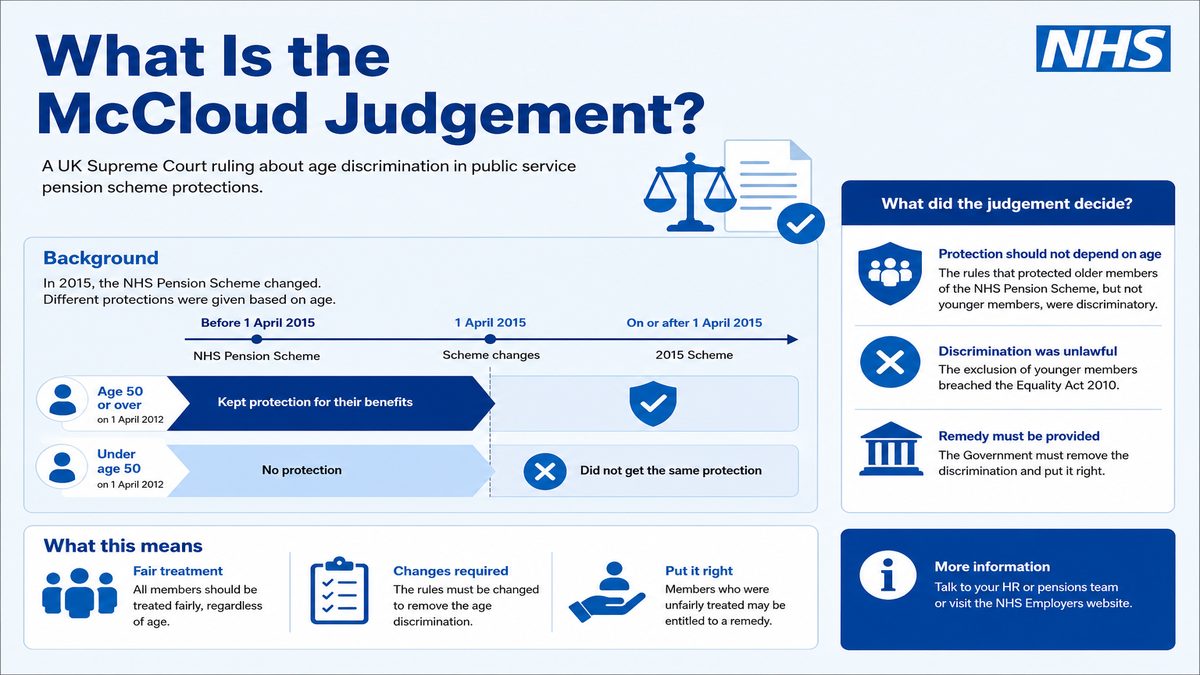
5 In December 2018, the Court of Appeal found transitional pension protections introduced in 2015 to be discriminatory against younger members. This became known as the McCloud judgement. 27 In 2015, the Government changed most public service pension schemes, including the NHS Pension Scheme. These changes did not apply to members who were close to retirement. The Court of Appeal later found that this was unfair to younger members. 5 The McCloud remedy removes the age discrimination that was judged to have arisen in public service pension schemes, including the NHS Pension Scheme. The discrimination resulted from allowing older members to remain in the 1995/2008 scheme when the 2015 scheme was introduced on 1 April 2015. 23 The judgement is named after one of the claimants, a member of the Judicial Pension Scheme. The companion case — known as Sargeant — was brought simultaneously by Firefighters. Both cases were heard together in the Court of Appeal. 24 This led to legal challenges, with judges bringing a case to an employment tribunal known as the McCloud case, and firefighters doing the same under the name Sargeant. The issue escalated through the courts until 15 July 2019, when the government accepted that the discrimination needed to be addressed.
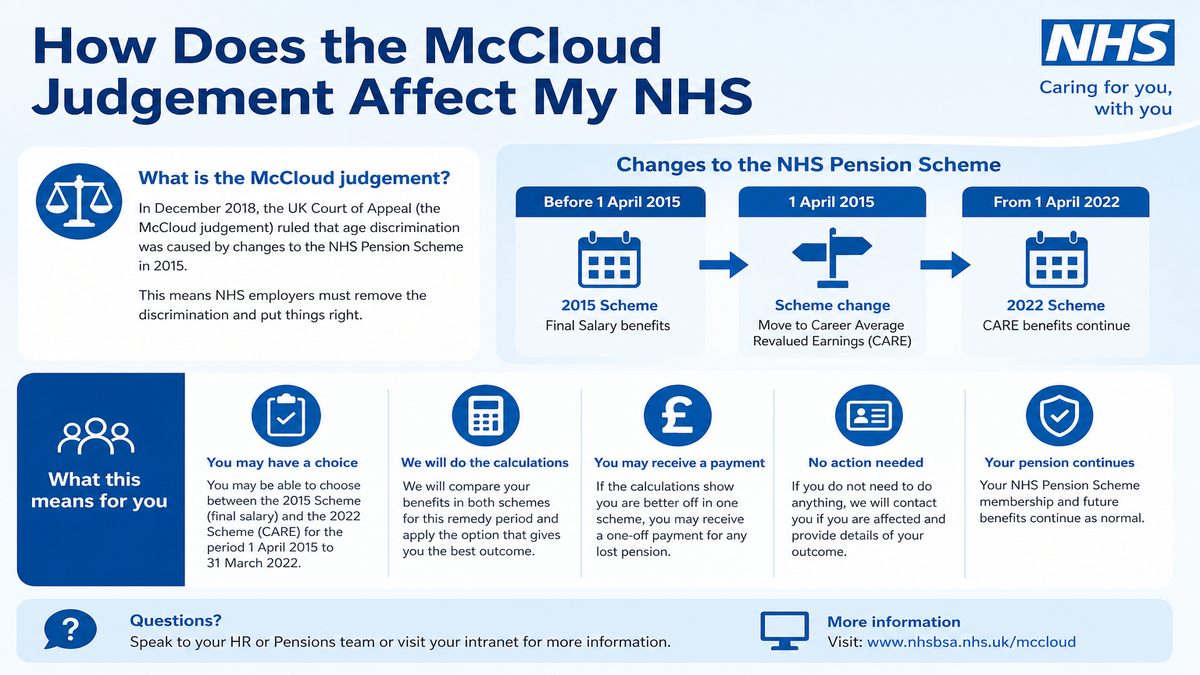
1 The Public Service Pensions Remedy (McCloud) addresses age discrimination identified in the 2015 public service pension scheme reforms, giving eligible members the choice between legacy and reformed scheme benefits for the remedy period (1 April 2015 to 31 March 2022). 27 The government is removing this age discrimination from public service pension schemes in two parts. Completed in 2022, all active members are now members of the 2015 Scheme. This makes sure all active pension scheme members are treated equally. The second part is to correct the discrimination that could have happened between 1 April 2015 and 31 March 2022.
The remedy operates in two stages:
17 From 1 October 2023, any pensionable service affected members have between 1 April 2015 and 31 March 2022 was placed in their legacy scheme — in the NHS, this is the 1995/2008 Scheme. 18 This is called rollback. 20 The first stage of the public service pensions remedy (also known as McCloud) is rollback. Rollback concerns how pensionable service accrued during the remedy period is treated. The remedy period was 1 April 2015 to 31 March 2022. 7 Your service for the remedy period has been automatically moved into your legacy scheme until you make your choice. This is called rollback.
7 If you are affected by the changes to public service pension schemes — sometimes known as 'McCloud' or the public service pensions remedy — you will be asked if you would like to receive legacy scheme or reform scheme pension benefits for your membership between 1 April 2015 and 31 March 2022. 5 All members affected by the discrimination will be offered a choice about their pension benefits for the period between 1 April 2015 and 31 March 2022 to address the unequal treatment that occurred during that time. 24 The McCloud remedy involves rolling back affected members' service to their legacy schemes and providing a choice at retirement between legacy and reformed scheme benefits for the remedy period.
The Deferred Choice Underpin (DCU) guarantees you will never be locked into the worse option. You choose at retirement which set of rules applies to your remedy period service, after reviewing your full RSS comparison figures.
5 Employees who joined the NHS Pension Scheme on or before 31 March 2012 and who were still members of the scheme on 1 April 2015 are eligible for the remedy, regardless of whether they previously received full, tapered or no protection. This includes current members of staff, those that have already retired or no longer work for the NHS and those that have passed away. 5 Staff that joined the scheme on or after 1 April 2012 are not affected.
You are affected by the McCloud remedy if all of the following conditions apply:
28 You had pensionable service during the remedy period (1 April 2015 to 31 March 2022); the pensionable service was in the legacy scheme or the 2015 scheme that would have been service in the legacy scheme but for the discrimination; and you were in pensionable service under a legacy public service pension scheme on or before 31 March 2012 and have not since had a disqualifying gap before starting any pensionable service during the remedy period.
Member Type | McCloud Affected? | What Happens |
Joined NHS Pension on or before 31 March 2012 — active on 1 April 2015 | ✅ Yes | Remedy period service rolled back; DCU choice offered at retirement |
Joined NHS Pension between 1 April 2012 and 31 March 2015 | ❌ No | Not in scope; entered 2015 Scheme as standard |
Fully protected member (within 10 years of NRA in April 2012) | ✅ Yes | Already in legacy scheme; DCU choice still offered |
Tapered protected member | ✅ Yes | Partial rollback to legacy scheme; DCU choice at retirement |
Deferred member (left NHS, not yet retired) | ✅ Yes | Rollback applied; RSS to be issued by March 2027 |
Already retired since 1 April 2015 | ✅ Yes | RSS and remedy choice being issued in priority order by December 2027 |
Opted-out member during remedy period | ✅ Potentially | Option to reinstate opted-out service in legacy scheme |
23 The McCloud Remedy requires that members of the NHS Pension Scheme for the tax years from April 2015 to April 2022 (7 years) are reassessed in terms of both pension growth (the increase in the value of your pension rights) and the tax liabilities that may have arisen as a result.
The remedy affects two areas of your NHS pension:
The three sections of the NHS Pension Scheme have entirely different benefit structures. Understanding these differences is essential to making an informed McCloud choice.
16 The 1995 Section normal pension age is 60, and the 2008 Section is 65. 16 The NHS 2015 Scheme normal pension age is your State Pension age, or age 65 if that is later. 16 The three NHS pension schemes accrue at 1/80th final salary, 1/60th final salary, and 1/54th CARE respectively.
Scheme Section | Accrual Type | Accrual Rate | Normal Retirement Age (NRA) | Automatic Lump Sum |
1995 Section | Final Salary | 1/80th per year | 60 | Yes — 3× annual pension |
2008 Section | Final Salary | 1/60th per year | 65 | No |
2015 Scheme | CARE (Career Average Revalued Earnings) | 1/54th per year | State Pension Age | No |
15 The NHS 1995 Pension Scheme calculates retirement benefits based on a member's final pensionable pay, which is the highest earning over the last three consecutive years within the final ten years of service. 15 Unlike the 2015 scheme, which is based on a Career Average Revalued Earnings (CARE) structure, the 1995 scheme links pensions directly to the final salary, making it particularly advantageous for staff who experience salary increases towards the end of their careers. 19 Unlike the 1995 section, there is no automatic lump sum in the 2008 or 2015 schemes, although a member can give up a proportion of pension to take a lump sum. 19 The 2015 section has a later normal age of retirement, although the growth (accrual rate) is slightly greater. This can result in higher pension growth (also referred to as pension input), which might mean the member exceeds the annual allowance threshold. This could trigger a tax charge.
Because your remedy period service (2015–2022) has been rolled back into your legacy 1995 or 2008 Section by default, the financial value of your pension for those 7 years is now calculated under those legacy rules — not the 2015 CARE rules — until you make your DCU choice at retirement.
5 Members will need a Remedial Pension Savings Statement (RPSS) from NHS Pensions before they can check their pension tax position with HMRC. Employers should remind staff that they must take action when they receive their RPSS. 25 Your Pension Annual Allowance position for years within the remedy period may now be different — and that can trigger one of two outcomes: you might be due a tax refund if you overpaid tax because your pension growth was previously overstated under the old rules. 25 If the revised figures mean you exceeded your Pension Annual Allowance in a tax year, you will usually need to tell HMRC within the timeframe set out on your RPSS. 5 Many members may find there is little or no change to their pension tax position. However, all members who receive an RPSS need to check their pension tax position with HMRC. An online tool from HMRC is in place to help members check if their tax position has changed and guides them through claiming refunds or paying additional charges. 13 Where Annual Allowance charges are affected by rollback, members can correct these via the HMRC Digital Service.
This is one of the most searched questions about the McCloud remedy. The direct answer is: McCloud does not automatically change your retirement age, but it directly affects how much pension you receive if you retire at 60.
19 In the 1995 section, the NRA is 60; in the 2008 section, it is 65; and in the 2015 section, the NRA is the same as your State Pension age.
The McCloud remedy rolled your 2015 scheme remedy period benefits (2015–2022) back into your legacy 1995 or 2008 Section. This matters for retirement at 60 in the following way:
For 1995 Section members: Any remedy period service now sitting in the 1995 Section carries an NRA of 60. If you choose legacy benefits at retirement, those 7 years of service are accessible at age 60 without an early retirement actuarial reduction — because 60 is the NRA for that service under the 1995 Section rules.
For 2008 Section members: The NRA is 65. Choosing legacy (2008 Section) benefits for remedy period service and retiring at 60 will trigger an early retirement reduction, as 60 is below the 2008 Section NRA.
For any member choosing reformed (2015) scheme benefits for remedy period: The NRA is State Pension Age (currently 67). Retiring at 60 on 2015 Scheme remedy period benefits triggers a significant actuarial reduction.
19 There are some earlier NRAs for special classes of primary care staff — principally nurses, physios, midwives and health visitors who were members of the pension scheme before 6 March 1995. Mental Health Officers and Special Class members may hold an NRA of 55 where qualifying conditions are met.
Practical impact at age 60: A 1995 Section member who built 7 years of 2015 CARE benefits between 2015 and 2022 would previously have faced early retirement reductions on those 7 years at age 60. After rollback into the 1995 Section and selecting legacy benefits, those 7 years carry NRA 60 — no reduction applies on those years at age 60.
Use the calculator above to model your estimated pension value at different retirement ages under both the legacy and reformed options.
16 Long-serving NHS staff are likely to have three pots of pension governed by three different sets of rules. Each pot has its own normal pension age, its own accrual calculation, and its own lump sum rules. They can in some cases be drawn at different times.
For most 1995 Section members, the legacy option for the remedy period will be the higher value. The 1995 Section's final salary link means that pay progression after 2015 increases the value of ALL 1995 Section service, including remedy period years, because they are calculated on your final (highest) pensionable pay.
The 2015 CARE scheme can outperform the legacy scheme for remedy period benefits in specific circumstances:
The Deferred Choice Underpin guarantees you will never be forced into the option that produces a lower pension. You compare both figures from your RSS at retirement and then choose.
14 Two different statements are outstanding to McCloud members — one called the Remediable Service Statement (RSS), which provides vital information about pension benefits and the choices available to the individual, and the other called the Remedial Pension Savings Statement (RPSS), which is needed by higher-earning members to calculate where tax charges apply. 5 The RSS will show two sets of figures showing the value of pension benefits to date with membership for the remedy period (1 April 2015 – 31 March 2022) in the 1995/2008 scheme, or in the 2015 scheme. 10 NHS Pensions has started sending RSS (choice letters) to NHS Pension Scheme members who have claimed benefits from any part of the Scheme and are affected by the public service pensions remedy. These letters explain that members have a choice of 1995/2008 Scheme (whichever Scheme they were in before moving to the 2015 Scheme), or 2015 Scheme pension benefits for membership between 1 April 2015 and 31 March 2022.
5 An RPSS is sent to members affected by the McCloud remedy. It helps members check their annual allowance position after the remedy period was rolled back to the 1995/2008 scheme. NHS Pensions will send an RPSS to all members who exceeded the annual allowance in any tax year between 2015/16 to 2021/22. 13 When you have your RPSS, you will be able to input the information into the HMRC Digital Service to see if you have over or underpaid an annual allowance charge for any of the remedy period tax years or whether you have to pay a charge for tax year 2022–23.
Action steps when your RSS/RPSS arrives:
13 The Cost Claim Back Scheme allows members directly affected by the remedy to apply to claim back some types of direct financial losses incurred as a result of the discrimination or the application of the remedy. 13 The deadline for compensation is up to 12 months after receiving your Remedial Pension Savings Statement (RPSS). 5 Many members may wish to use an independent financial adviser for help with this process, and members may be able to claim back some of the associated costs through the NHS Cost Claim Back Scheme.
6 It was announced on Thursday 21 May 2026, in a Written Ministerial Statement to Parliament, that revised forecasted deadlines for the Public Service Pensions Remedy (also known as McCloud) have now been set. 6 These deadlines are the latest dates by which NHSBSA expects Remedy Service Statements (RSS) to be sent to McCloud-affected members where benefits are already in payment. Statements will be sent in phases within those deadlines, with many expected to be sent earlier. NHSBSA will share updates as often as possible to help members understand which timeline applies to their individual circumstances.
4 Subject to the dependencies outlined, the NHSBSA's plans currently forecast that: Retired members whose remedy period (1 April 2015 to 31 March 2022) benefits are still affected by the discrimination identified by the McCloud judgment — in that some or all of the accrual for that period is 2015 scheme accrual — should receive their remedy choice by the end of December 2027; Retired members whose remedy period benefits are no longer affected by this discrimination — in that all of their accrual for the period is 1995 to 2008 scheme accrual — should receive their remedy choice by the end of June 2030; All active and deferred members who are due a remedial pension saving statement should have received this by the end of March 2027. 1 It is important to note that the majority of members will receive their remedy choice and RPSS before these dates.
1 To date, 10,462 remediable service statements (RSS) have been issued to retired members most likely to be facing financial detriment, with 5,368 decisions already enacted. In addition, 121,824 RPSS have been issued. 14 Out of the 1.1 million members affected by McCloud, 450,000 have already retired, but priority for delivery of the RSS or 'choice letter' is for the 49,000 members who are likely to receive higher benefits following their McCloud choice, to prevent them facing financial detriment. 1 The complexity of the NHS Pension Scheme — the largest of all public sector schemes, supporting 3.86 million members — means this has been a substantial undertaking.
14 The issuing of both statements has been delayed a number of times because of technical complexities as well as the volume of processing work. 4 The NHS Business Services Authority has now developed and aligned its plans for the delivery of the McCloud remedy. An independent review, led by Lisa Tennant, has considered those plans and the NHSBSA's capacity, capability and functions to deliver the remedy. 13 The mandatory scheme pays deadline for remedy period tax years 2019/20 – 2021/22 and tax year 2022/23 has been extended. The extension dates are: 6 July 2025 for those who were active and deferred members on 30 September 2023, and 6 July 2027 for those who were pensioner members on 30 September 2023.
For most active (currently working) NHS members: 18Depending when you retire, you will be asked to make this decision either when you claim your NHS pension benefits, or at a later time. You do not need to take action now.
Step 1 — Select your legacy scheme section
Identify whether you were in the 1995 Section or the 2008 Section of the NHS Pension Scheme immediately before being moved (or due to be moved) into the 2015 Scheme. 19Which part of the NHS Pensions Scheme you are in depends on when you joined and whether you have had a break from the scheme. Some 1995 members may have also exercised a pension choice exercise to move their 1995 benefits to the 2008 Section. If you exercised this option, you are a 2008 Section member.
Check your scheme section on the NHS Pensions member portal at mynhspension.nhsbsa.nhs.uk. 16Your Total Reward Statement (TRS) or annual benefit statement shows your accumulated benefits by section, including any McCloud remedy estimate.
Step 2 — Enter your remedy period service
Enter the whole years and months of pensionable service you worked between 1 April 2015 and 31 March 2022. The maximum remedy period is 7 years (84 months). Part-time workers: enter your WTE (whole-time equivalent) fraction alongside actual years served.
Step 3 — Enter your pensionable pay
Step 4 — Select your target retirement age
Enter the age at which you plan to retire. This determines whether early retirement actuarial reductions apply to either option. Selecting age 60 is particularly important for 1995 Section members — it will show whether any reduction applies to the legacy or reformed option.
Step 5 — Read your two estimates
Your results show:
15 The NHS 1995 Pension Scheme is a final salary defined benefit pension scheme administered by the NHS Business Services Authority (NHSBSA). 15 The NHS 1995 Pension Scheme closed to new accrual on 31 March 2022. The closure was part of the McCloud remedy addressing age discrimination issues identified in the 2015 scheme changes.
5 All active members of the NHS Pension Scheme are now in the 2015 scheme. All active members of the NHS Pension Scheme joined the 2015 scheme from 1 April 2022, to ensure equal treatment from 1 April 2022 onwards.
27 In 2015, the Government changed most public service pension schemes, including the NHS Pension Scheme. These changes did not apply to members who were close to retirement. The Court of Appeal later found that this was unfair to younger members. The government is removing this age discrimination from public service pension schemes in two parts.
In simple terms: older workers were allowed to stay in their better, final salary pension scheme. Younger workers were not given the same choice. The courts ruled this broke age discrimination law. The fix — the McCloud remedy — gives younger workers a retrospective choice between the old and new pension rules for the 7-year period when the discrimination occurred.
5 Employees who joined the NHS Pension Scheme on or before 31 March 2012 and who were still members of the scheme on 1 April 2015 are eligible for the remedy, regardless of whether they previously received full, tapered or no protection. This includes current members of staff, those that have already retired or no longer work for the NHS and those that have passed away.
For most 1995 Section members choosing legacy benefits at retirement, the remedy will produce a higher pension for the remedy period, because final salary (1/80th on highest pay) typically outperforms CARE (1/54th on averaged pay) for members whose pay grew over time.
The McCloud judgement is the 2018 court ruling that identified the age discrimination. The McCloud remedy is the Government's legislative response — enacted through the Public Service Pensions and Judicial Offices Act 2022 — which corrects that discrimination through rollback and the Deferred Choice Underpin. The two terms refer to different things but are used interchangeably in everyday language.
1 The Public Service Pensions Remedy (McCloud) addresses age discrimination identified in the 2015 public service pension scheme reforms, giving eligible members the choice between legacy and reformed scheme benefits for the remedy period (1 April 2015 to 31 March 2022). 7 If you are affected by the changes to public service pension schemes — sometimes known as 'McCloud' or the public service pensions remedy — you will be asked if you would like to receive legacy scheme or reform scheme pension benefits for your membership between 1 April 2015 and 31 March 2022. This is called the remedy period.
The McCloud judgement affects your pension in up to two ways:
The 2015 remedy refers to correcting the discrimination that arose when the NHS Pension Scheme reformed in 2015. 5The discrimination resulted from allowing older members to remain in the 1995/2008 scheme when the 2015 scheme was introduced on 1 April 2015. All active members of the NHS Pension Scheme joined the 2015 scheme from 1 April 2022, to ensure equal treatment from 1 April 2022 onwards.
5 Retired members whose remedy period benefits are still affected by the discrimination identified by the McCloud judgement (in that some or all of the accrual for that period is 2015 scheme accrual) should receive their remedy choice by the end of December 2027. 5 Retired members whose remedy period benefits are no longer affected by this discrimination (in that all of their accrual for the period is 1995/2008 accrual) should receive their remedy choice by the end of June 2030. All active members (who are paying into the scheme) and deferred members (who previously contributed to the scheme but have since left NHS employment and have not yet taken any pension) should have received their RSS by the end of March 2027.
5 The RSS will show two sets of figures showing the value of pension benefits to date with membership for the remedy period (1 April 2015 – 31 March 2022) in the 1995/2008 scheme, or in the 2015 scheme. 8 NHS Pensions is currently sending RSS to NHS Pension Scheme members who have claimed pension benefits from any section of the Scheme and are affected by the Public Service Pensions Remedy, starting with the members most affected.
5 An RPSS is sent to members affected by the McCloud remedy. It helps members check their annual allowance position after the remedy period was rolled back to the 1995/2008 scheme. 23 Once you receive your RPSS, you may need to take action. If it shows that you have exceeded your Annual Allowance in any relevant year, you will likely be required to submit disclosures to HMRC via their online digital service. 5 Many members may find there is little or no change to their pension tax position. However, all members who receive an RPSS need to check their pension tax position with HMRC.
The most recent development is the Written Ministerial Statement of 21 May 2026, which set revised forecasted deadlines for RSS delivery. 4The NHS Business Services Authority has now developed and aligned its plans for the delivery of the McCloud remedy. An independent review, led by Lisa Tennant, has considered those plans and the NHSBSA's capacity, capability and functions to deliver the remedy. 4Lisa Tennant is now preparing a final report, which the Minister intends to publish in due course.
The NHSBSA confirmed: 110,462 remediable service statements (RSS) have been issued to retired members most likely to be facing financial detriment, with 5,368 decisions already enacted. In addition, 121,824 RPSS have been issued.
Yes. 15The NHS 1995 Pension Scheme continues to offer retirement options, death benefits, and the McCloud choice, allowing eligible members to elect back into legacy protections.
1995 Section members who were moved into the 2015 Scheme from 1 April 2015 — or due to be moved — have had their remedy period service (2015–2022) rolled back into the 1995 Section as the default position. At retirement, they choose whether those 7 years are calculated under 1995 Section rules (1/80th final salary, NRA 60, automatic lump sum) or 2015 CARE rules (1/54th average, NRA State Pension Age).
The McCloud remedy applies to all major UK public sector pension schemes. For civil servants:
Civil servants should contact MyCSP (civil.service.pensions@mycsp.co.uk) directly for their individual RSS.
The McCloud remedy applies to the Teachers' Pension Scheme with the same remedy period (1 April 2015 – 31 March 2022) and the same DCU mechanism. The legacy section for teachers is the Final Salary Scheme (1/80th, NRA 60); the reformed section is the Career Average scheme. Teachers should contact Teachers' Pensions directly at teacherspensions.co.uk for their individual statement status and timeline.
13 The Cost Claim Back Scheme allows members directly affected by the remedy to apply to claim back some types of direct financial losses incurred as a result of the discrimination or the application of the remedy. 13 Members affected by the Public Service Pensions Remedy (PSPR) will have a choice of 1995/2008 Scheme or 2015 Scheme pension benefits for their membership during the remedy period. Affected members with membership in the 2015 Scheme during the remedy period have had this membership rolled back into the 1995/2008 Scheme.
The remedy itself is a pension benefit correction, not a direct cash compensation payment. However:
For most 1995 Section members: choosing legacy benefits for the remedy period will produce a higher pension than the 2015 CARE option. This is because final salary accrual (1/80th of your highest pensionable pay in the last 10 years) is calculated on your career-end pay, which benefits from any pay progression, incremental advancement, Clinical Excellence Awards, or Clinical Leadership Awards received after 2015.
For 2008 Section members: the outcome is more nuanced and depends on individual salary trajectory and planned retirement age. 24The remedy involves rolling back affected members' service to their legacy schemes and providing a choice at retirement between legacy and reformed scheme benefits for the remedy period. This process is complex and can impact both your pension benefits and tax liabilities.
Use the calculator on this page to model your individual estimated outcome.
The NHS pension reform timeline that led to the McCloud remedy:
Date | Event |
2008 | 2008 Section introduced; new NHS joiners enter 2008 Section |
1 April 2012 | Final date to join legacy schemes as a new member |
1 April 2015 | 2015 CARE Scheme introduced; members moved in based on protection status |
December 2018 | Court of Appeal McCloud and Sargeant judgement |
15 July 2019 | Government accepts discrimination must be remedied |
10 February 2022 | Public Service Pensions and Judicial Offices Act 2022 receives Royal Assent |
1 April 2022 | All active members transferred to 2015 Scheme; legacy schemes close to new accrual |
1 October 2023 | Rollback enacted; remedy period service moved to legacy schemes |
October 2024 onwards | RPSS statements begin issuing in phases |
21 May 2026 | Written Ministerial Statement sets revised RSS deadlines |
December 2027 | Deadline for RSS to retired members whose benefits are still affected |
March 2027 | Deadline for RPSS to active and deferred members |
June 2030 | Deadline for RSS to retired members whose benefits are no longer affected |