 Take Home Pay
Take Home Pay
Take Home Pay
Use this NHS salary sacrifice car calculator to find out exactly how much a lease car will cost you after tax savings, National Insurance savings, and Benefit-in-Kind (BIK) tax for the 2026/27 tax year. Enter your Agenda for Change salary, the monthly lease amount, your car type, and its P11D value. The calculator returns your adjusted take-home pay, total savings, NHS pension impact, and your true net monthly cost — in seconds.
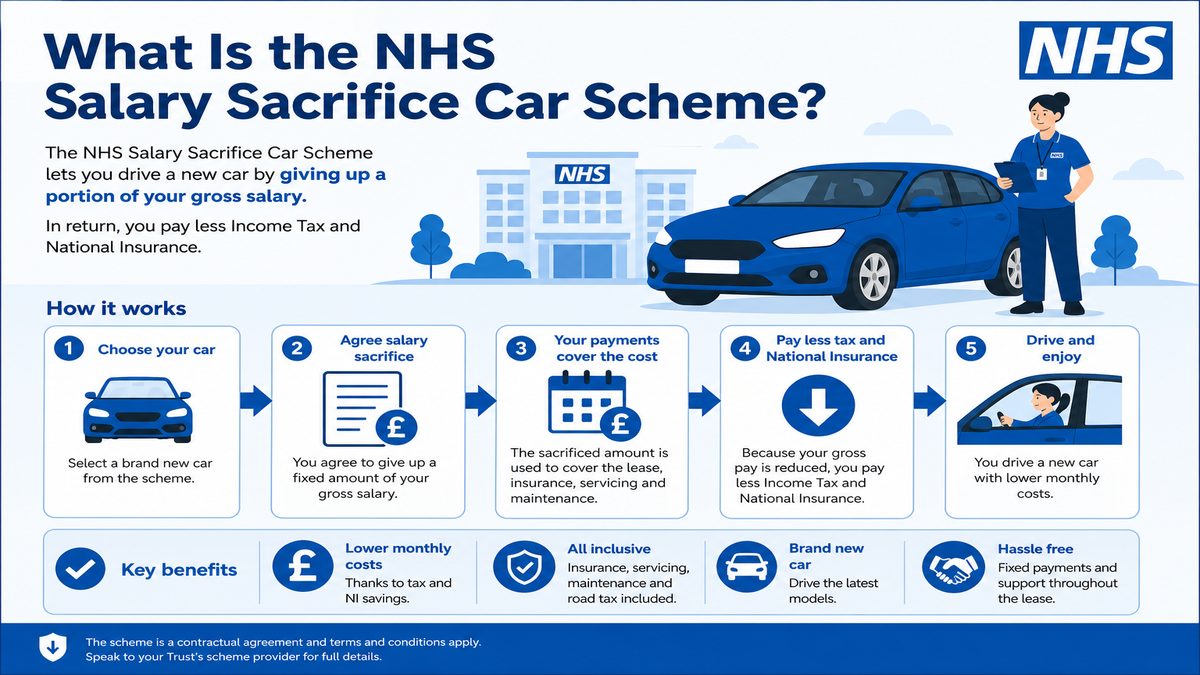
The NHS salary sacrifice car scheme is a contractual arrangement between you and your NHS Trust. You agree to reduce your gross salary by a fixed monthly amount. In return, your Trust provides a fully maintained lease car of equivalent value as a non-cash benefit.
The financial logic is direct. Income Tax and National Insurance Contributions (NICs) are calculated on your new, lower gross pay. You never pay tax on the amount sacrificed. A personal car lease funded from your net pay gives you no such relief — you fund it entirely from income that has already been taxed. Salary sacrifice breaks that cycle.
9 Fully electric cars are not tax-free under salary sacrifice — they attract a BIK rate of 4% in 2026/27, rising by 1 percentage point per year — but employees still pay significantly less than they would on a petrol or diesel equivalent.
The scheme is available only through your employing Trust. Not every NHS Trust participates. Your HR or payroll team confirms eligibility, scheme rules, and the approved provider for your organisation.
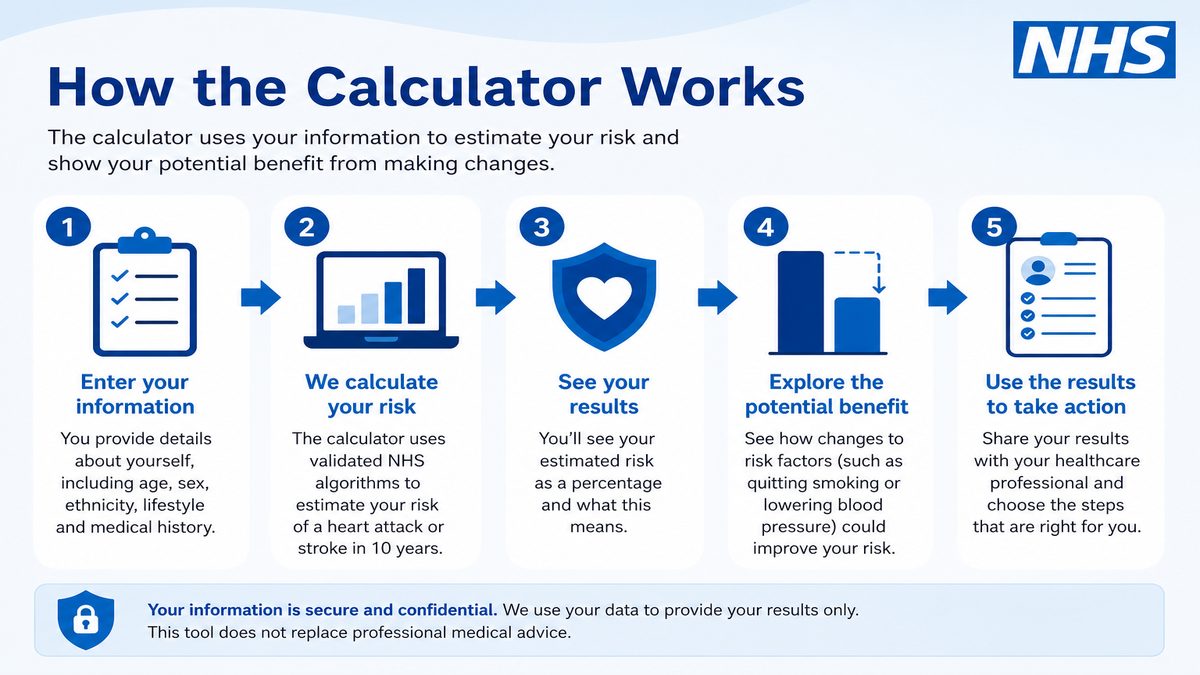
The calculator requires four inputs.
Input 1 — Annual gross salary. Use your basic Agenda for Change (AfC) salary. 5Basic salary and High Cost Area Supplements (HCAS) are pensionable pay; overtime payments, expense reimbursements, one-off non-consolidated payments, and car allowances are not. If your Trust treats HCAS as pensionable, include it in your gross figure to calculate the correct pension tier.
Input 2 — Monthly lease cost. This is the pre-tax gross sacrifice amount quoted by your Trust's scheme provider. Do not use a net or post-tax figure from a personal lease comparison site. The two figures are structurally different.
Input 3 — Car emission type. Select fully electric (0 g/km CO₂), plug-in hybrid (PHEV), or petrol/diesel. The calculator applies the correct HMRC BIK rate for your selection.
Input 4 — P11D value. 10The P11D company car value is the vehicle's list price, including VAT and delivery charges, excluding registration and tax. Your scheme provider's written quote includes this figure. 13If you negotiate a discount on the car but the manufacturer's list price is higher, HMRC uses the official list price — not what you paid.
The calculator outputs:
Every car delivered through salary sacrifice is classified by HMRC as a company car. You pay Benefit-in-Kind tax on the car's taxable value. 8BIK tax is what employees pay when they receive a company car for personal use, and the amount depends on three things: the car's P11D value, its CO₂ emissions, and the employee's income tax rate.
8 The government sets BIK rates to encourage cleaner vehicles, which is why electric cars enjoy lower rates than petrol, diesel, or even hybrid alternatives.
10 The BIK tax for electric cars remains substantially lower than for petrol/diesel vehicles, with EV BIK rates at just 4% for 2026/27, increasing by 1% the following year, then by 2% annually to 9% in 2029/30 — significantly below the maximum rate for conventional vehicles.
Tax Year | Electric Car BIK Rate |
2025/26 | 3% |
2026/27 | 4% |
2027/28 | 5% |
2028/29 | 7% |
2029/30 | 9% |
Source: HMRC confirmed multi-year schedule.
10 Petrol and diesel cars (51g/km CO₂ and above) attract BIK rates between 17% and 37% in 2026/27, climbing by 1 percentage point each year to a 39% cap in 2029/30 — almost ten times the pure-EV rate. 13 For a petrol car with 51–54 g/km CO₂, the BIK rate is 17% in 2026/27. For a diesel emitting 130 g/km, it sits at around 31%.
8 Plug-in hybrid vehicles benefit from significantly lower BIK rates compared to petrol and diesel cars. For 2026/27, PHEVs with 1–50 g/km CO₂ emissions attract BIK rates of 6–19% depending on their electric range. 9 From 6 April 2028, BIK rates for plug-in hybrids will reset to align with internal combustion vehicles, removing the current favourable electric-range bands. If you are considering a PHEV on a 3 or 4-year lease starting in 2026, model the 2028/29 BIK jump into your total cost before committing.
15 The BIK tax charge is calculated as the car's P11D value multiplied by the applicable BIK rate, then multiplied by your income tax rate.
Formula: P11D value × BIK percentage × your marginal Income Tax rate = annual BIK tax
Electric car example (basic rate taxpayer): £35,000 P11D × 4% BIK × 20% tax = £280 per year = £23.33 per month
Electric car example (higher rate taxpayer): £35,000 P11D × 4% BIK × 40% tax = £560 per year = £46.67 per month
Petrol car example at 130 g/km (basic rate taxpayer): £35,000 P11D × 31% BIK × 20% tax = £2,170 per year = £180.83 per month
The electric car costs £157.50 per month less in BIK tax than the petrol equivalent — at the same list price and in the same tax year. This differential is the primary reason the scheme delivers strongest value on zero-emission vehicles.
OpRA stands for Optional Remuneration Arrangements. Under HMRC's OpRA rules, salary sacrifice benefits are normally taxed at the higher of the amount sacrificed or the BIK value. This protects HMRC from arrangements where the sacrifice amount is large but the BIK value is small.
Electric cars are exempt from this rule. 9HMRC has special valuation rules (OpRA) that may override the standard P11D BIK calculation — but for zero-emission vehicles, the standard BIK applies. This exemption means the 4% BIK rate applies in full, regardless of how much you sacrifice per month.
Profile: Band 5 nurse, England, 2026/27. Gross annual salary: £32,934. Monthly lease cost: £350. Car: fully electric, P11D value £35,000.
Step 1 — Annual sacrifice: £350 × 12 = £4,200
Step 2 — New taxable salary: £32,934 − £4,200 = £28,734
Step 3 — Income Tax saving (basic rate, 20%): £4,200 × 20% = £840 per year / £70 per month
Step 4 — National Insurance saving (8% employee main rate, 2026/27): £4,200 × 8% = £336 per year / £28 per month
Step 5 — BIK tax charge: £35,000 × 4% × 20% = £280 per year / £23.33 per month
Step 6 — Net monthly cost of car: £350 − £70 − £28 + £23.33 = £275.33 per month
This nurse receives a brand-new electric car with insurance, servicing, road tax, tyres, and breakdown cover for a true net cost of £275.33 per month. The gross lease is £350. The saving is £74.67 per month — a 21.3% reduction versus paying the full lease from net pay.
Step 7 — Pension tier impact: 1As of 1 April 2026, the contribution rates are: 5.2% for earnings up to £13,259; 6.5% for £13,260 to £28,854; 8.3% for £28,855 to £35,155; 9.8% for £35,156 to £52,778; 10.7% for £52,779 to £67,668; and 12.5% for £67,669 and above.
Original salary £32,934 = Tier 3 at 8.3%. Pension contribution: £32,934 × 8.3% = £2,733.52 per year. Post-sacrifice salary £28,734 = Tier 2 at 6.5%. Pension contribution: £28,734 × 6.5% = £1,867.71 per year.
The nurse pays £865.81 less in pension contributions per year. This saves money immediately — but permanently reduces the CARE pension credit banked for this year. That trade-off is covered in full in the pension section below.
Profile: Band 6 paramedic, England, 2026/27. Gross annual salary: £39,959. Monthly lease cost: £420. Car: fully electric, P11D value £40,000.
Step 1 — Annual sacrifice: £420 × 12 = £5,040
Step 2 — New taxable salary: £39,959 − £5,040 = £34,919
Step 3 — Income Tax saving (basic rate, 20%): £5,040 × 20% = £1,008 per year / £84 per month
Step 4 — National Insurance saving (8%): £5,040 × 8% = £403.20 per year / £33.60 per month
Step 5 — BIK tax charge: £40,000 × 4% × 20% = £320 per year / £26.67 per month
Step 6 — Net monthly cost: £420 − £84 − £33.60 + £26.67 = £309.07 per month
Gross saving versus paying the lease from take-home pay: £110.93 per month, a 26.4% reduction.
Profile: Band 7 specialist, England, 2026/27. Gross annual salary: £48,270. Monthly lease cost: £500. Car: fully electric, P11D value £45,000. Higher rate taxpayer status: this salary crosses the £50,270 threshold only marginally — for simplicity, this example applies the 20% basic rate for most of the sacrifice, with the note that any portion of income above £50,270 is taxed at 40%.
Step 1 — Annual sacrifice: £500 × 12 = £6,000
Step 2 — New taxable salary: £48,270 − £6,000 = £42,270
Step 3 — Income Tax saving (20% basic rate on £6,000): £6,000 × 20% = £1,200 per year / £100 per month
Step 4 — National Insurance saving (8%): £6,000 × 8% = £480 per year / £40 per month
Step 5 — BIK tax charge: £45,000 × 4% × 20% = £360 per year / £30 per month
Step 6 — Net monthly cost: £500 − £100 − £40 + £30 = £390 per month
The saving is £110 per month. For staff on Band 8a and above (£56,388+) who are confirmed 40% taxpayers, the tax saving on the same sacrifice doubles, reducing the net cost further.
For NHS staff paying 40% Income Tax, salary sacrifice delivers proportionally larger savings. The same sacrifice amount produces double the tax relief.
Metric | 20% Taxpayer (Band 5/6) | 40% Taxpayer (Band 8a+) |
Monthly sacrifice | £500 | £500 |
Annual income tax saving | £1,200 | £2,400 |
Monthly income tax saving | £100 | £200 |
NI saving (8% / 2%) | £40 | £10 (above UEL) |
BIK on £45,000 EV (4%) | £30/month (20%) | £60/month (40%) |
Net monthly cost | £390 | £350 |
UEL = Upper Earnings Limit (£50,270 for 2026/27). Earnings above the UEL attract 2% NICs, not 8%.
10 A 40% taxpayer would pay just £47 monthly BIK for a Tesla Model Y compared to £458 for a similarly priced BMW 3 Series — a saving of over £400 per month. This comparison assumes similar P11D values. The exact figure varies by model.
The question most NHS staff ask is: should I choose an electric car or can I still save on petrol or diesel? The calculator answers this precisely. The data is unambiguous.
At a £40,000 P11D value for a basic rate taxpayer in 2026/27:
Metric | Fully Electric | Petrol (130 g/km) | Diesel (130 g/km) |
BIK rate 2026/27 | 4% | ~31% | ~31% (+4% diesel surcharge if non-RDE2) |
Annual BIK taxable value | £1,600 | £12,400 | £12,400 |
Annual BIK tax (20%) | £320 | £2,480 | £2,480 |
Monthly BIK tax (20%) | £26.67 | £206.67 | £206.67 |
Annual tax + NI savings on £4,800 sacrifice | £1,344 | £1,344 | £1,344 |
Net annual cost of car (£400/month lease) | £3,776 | £5,936 | £5,936 |
Net monthly cost | £314.67 | £494.67 | £494.67 |
The petrol car costs £180 per month more than the electric car at the same list price and lease amount. The BIK tax on the petrol car nearly cancels out the entire salary sacrifice benefit.
12 If you are signing multi-year leases on plug-in hybrids now, model the 2028/29 BIK increase into the total cost. PHEVs lose their electric-range-based BIK bands from April 2028 and revert to standard ICE rates.
This is the single most important section on this page. It is the area most NHS staff underestimate before entering a scheme.
The NHS Pension Scheme (2015 Section) operates on a Career Average Revalued Earnings (CARE) basis. Each year of service, 1/54th of your pensionable pay is added to your pension account as a pension credit. That credit is revalued annually by CPI + 1.5% until you draw your pension.
When salary sacrifice reduces your pensionable pay, the 1/54th banked for that year is calculated on the lower figure. This is a permanent reduction in your pension accrual for that specific year. It cannot be reversed once the tax year closes.
1 NHS pension contribution rates for 2026/27 are structured into six tier thresholds. As of 1 April 2026, the rates are: 5.2% for earnings up to £13,259; 6.5% for £13,260 to £28,854; 8.3% for £28,855 to £35,155; 9.8% for £35,156 to £52,778; 10.7% for £52,779 to £67,668; and 12.5% for £67,669 and above.
Tier | Pensionable Pay Range (2026/27) | Employee Contribution Rate |
1 | Up to £13,259 | 5.2% |
2 | £13,260 – £28,854 | 6.5% |
3 | £28,855 – £35,155 | 8.3% |
4 | £35,156 – £52,778 | 9.8% |
5 | £52,779 – £67,668 | 10.7% |
6 | £67,669 and above | 12.5% |
Source: 6NHS Employers — member contribution rates for 2026/27 increased in line with the CPI indexation rate of 3.8%.
3 Thresholds for 2026/27 were uplifted by 3.8% (September 2025 CPI), above the 3.3% AfC pay award — meaning most members did not drift into a higher contribution band despite receiving a pay rise. 6 The employer contribution rate is 23.7% of members' pensionable pay — a key benefit that helps make the NHS Pension Scheme one of the most comprehensive and generous schemes in the UK.
A Band 5 nurse with a salary of £32,934 enters a 3-year lease at £350 per month. Pensionable pay drops to £28,734.
Without sacrifice: 1/54 × £32,934 = £609.89 per year of pension credit banked. With sacrifice: 1/54 × £28,734 = £532.11 per year of pension credit banked.
Annual reduction in pension credit: £77.78 per year of retirement income. Over 3 years of the lease: £233.34 per year less in retirement income, permanently.
That figure is revalued upward by CPI + 1.5% each year between now and retirement. If the nurse is 30 years from retirement, the real-terms impact compounds significantly. The calculator flags this figure alongside every result.
Risk 1 — CARE accrual reduction. As shown above, your annual pension credit is calculated on your lower post-sacrifice pay. This is permanent.
Risk 2 — Tier cliff-edge savings. If your sacrifice drops you from Tier 3 (8.3%) to Tier 2 (6.5%), you pay less in pension contributions today. That is a cash benefit. But you also accrue less pension and your employer contributes 23.7% of a smaller number.
Risk 3 — Death-in-service lump sum. The NHS pension death-in-service lump sum is calculated on pensionable pay. A lower pensionable pay means a lower lump sum paid to your dependants.
Risk 4 — Ill-health retirement benefits. Ill-health retirement income is based on pensionable pay and pensionable service accrued. A lower pensionable pay means lower ill-health retirement income if you need it.
Risk 5 — Statutory Maternity Pay (SMP). SMP is calculated on average weekly earnings during a qualifying period (weeks 17–25 of pregnancy). If salary sacrifice is active during that period, your average weekly earnings — and therefore your SMP — will be lower. This is a significant financial consideration for NHS staff planning a family.
Action: Ask your Trust HR department whether pension protection (maintaining pensionable pay at the pre-sacrifice level) is available. Some Trusts offer this. It is not universal and is not guaranteed. Confirm in writing before signing the scheme agreement.
NHS salary sacrifice car schemes are not available to all NHS staff automatically. Every Trust operates its own scheme with its own eligibility rules. The common criteria across most providers are:
Employment status. You must be a permanent NHS employee. Fixed-term contract staff may be eligible if the contract extends beyond the lease end date.
Remaining contract length. Your remaining contract must be at least as long as the lease term (typically 24 to 48 months). A 3-year lease requires at least 36 months remaining on your contract.
Salary floor. Your gross salary must remain above the National Minimum Wage after the sacrifice deduction is applied throughout the lease term. 6A two-step approach reduces the likelihood of moving into a higher contribution tier as a direct result of a national pay award and experiencing an overall reduction in take-home pay. The National Minimum Wage rate for workers aged 21 and over is £12.21 per hour from April 2025, subject to annual review.
Driving licence. A valid UK driving licence held in your name for the full lease term.
Probation period. Most Trusts exclude employees still within their probationary period. Check your Trust's specific policy.
Trust participation. Only NHS Trusts that have contracted with a salary sacrifice car scheme provider can offer this benefit. Your HR team confirms whether your Trust participates and which provider manages the scheme.
NHS salary sacrifice car schemes bundle all major running costs into a single monthly payment. This is not comparable to a personal lease, which is just the vehicle rental.
Typically Included | Typically Not Included |
Vehicle lease | Fuel or electricity costs |
Fully comprehensive motor insurance (usually 5 named drivers) | Congestion charges / ULEZ fees |
Scheduled servicing and maintenance | Parking fines |
Road Tax (VED) | Excess mileage charges |
Breakdown and recovery cover | Damage beyond fair wear and tear at return |
Tyre replacement (fair wear and tear) | |
Gap insurance (many providers) |
Confirm exactly what is included in your provider's quote before comparing it to any personal lease or other car ownership cost.
The provider available to you depends entirely on which company your Trust has contracted with. You cannot choose a provider independently. The leading NHS salary sacrifice car scheme providers operating in 2026 are:
NHS Fleet Solutions — The largest national salary sacrifice car scheme for NHS and public sector organisations. Directly embedded with the NHS supply chain framework.
Tusker — Operates the SalarySacrifice4Cars (SS4C) platform used by a large number of NHS Foundation Trusts across England.
Fleet Evolution — Provides bespoke schemes to NHS organisations of any size, with a strong focus on electric vehicles and public sector compliance.
Knowles Associates — Active in specific NHS Foundation Trust agreements, including University Hospitals Birmingham NHS Foundation Trust.
Octopus EV — Specialises in fully electric vehicle salary sacrifice for NHS and wider public sector employers, with home charger installation bundled in select packages.
Contact your Trust HR department first to identify the approved provider before requesting any quotes.
Step 1. Enter your annual gross salary in the salary field. Use your basic Agenda for Change pay, including HCAS if applicable. Do not include overtime.
Step 2. Enter the monthly gross sacrifice amount from your scheme provider's quote. This is the pre-tax figure — not your net cost.
Step 3. Select your car type: fully electric, plug-in hybrid, or petrol/diesel. This determines which BIK rate HMRC applies.
Step 4. Enter the P11D value. This appears on your provider's quote. It is the official list price including factory options and delivery, excluding first registration fee and VED.
Step 5. Click Calculate. Review all outputs: monthly take-home change, tax saving, NI saving, BIK charge, net cost, pension tier before and after, and CARE accrual impact.
Step 6. Adjust your inputs to model different cars, lease amounts, or salary levels. Use the results to compare an electric car versus a petrol equivalent before choosing.
Your saving depends on three variables: your marginal tax rate, the car's BIK rate, and the monthly lease cost. A basic rate taxpayer sacrificing £400 per month saves 20% in Income Tax (£80) plus 8% in NICs (£32) = £112 per month in combined savings, offset by the BIK tax charge. For an electric car at 4% BIK on a £35,000 P11D, the BIK charge is £23.33 per month for a basic rate taxpayer. Net saving: £88.67 per month, making the true cost £311.33 instead of £400.
Yes. Salary sacrifice reduces your pensionable pay. Your NHS Pension (CARE) annual accrual, your employer's 23.7% contribution, and your pension tier are all calculated on the lower figure. Ask your Trust whether pension protection arrangements are in place before signing. 6Members should be aware that there is no detrimental impact to scheme benefits they will receive in retirement only where their Trust has implemented explicit pension protection — this is not automatic.
Early termination of the lease triggers charges. Most scheme providers include early termination insurance for redundancy scenarios, but voluntary resignation and transfer to a non-participating employer are treated differently. Read the early termination terms in your scheme agreement before signing. Some providers cap charges; others pass the full residual liability to the employee.
Yes, but it is rarely financially beneficial. 10Petrol and diesel cars with CO₂ above 51 g/km attract BIK rates between 17% and 37% in 2026/27. On a £35,000 petrol car emitting 130 g/km, the annual BIK tax for a basic rate taxpayer is £2,170 — nearly eight times the £280 charge on an electric car at the same price. The BIK tax on a petrol car can eliminate and exceed all salary sacrifice savings.
10 The P11D company car value is the vehicle's list price, including VAT and charges of delivery, excluding registration and tax. Your scheme provider includes it in every quote. It is set by the manufacturer and does not change based on any discount you negotiate.
Yes. 9Fully electric company cars are not tax-free — they are charged at 4% BIK in 2026/27, rising by 1 percentage point per year, as confirmed in HMRC's guidance on tax on company cars. Electric company cars still generate a BIK charge collected via PAYE, just at a lower rate than petrol and diesel vehicles.
A salary sacrifice reduces your contractual gross pay. Many mortgage lenders use the post-sacrifice figure as your gross income. This reduces the amount you can borrow. Before applying for a mortgage, provide your lender with both your pre- and post-sacrifice contract figures and ask whether the lender will assess your application on the pre-sacrifice salary. Some lenders will; others will not.
Eligibility depends on your Trust's rules and the lease cost. The key legal limit is that salary sacrifice cannot reduce your effective hourly rate below the National Minimum Wage (£12.21 per hour for workers aged 21+ from April 2025). Most providers set a practical minimum annual salary of £30,000 for scheme access.
No. The car is leased by your NHS Trust or the scheme provider on behalf of the Trust. You are the primary driver. The Trust is the registered keeper. At the end of the lease, the car returns to the provider. You have no ownership rights and no residual value interest.
The car is returned to the scheme provider. Your gross salary reverts to its pre-sacrifice level immediately. If the scheme is still available and you are still eligible, you can enter a new arrangement for a new vehicle. You are not obligated to continue.
Most NHS salary sacrifice car schemes include fully comprehensive insurance that covers the primary driver plus named additional drivers, typically up to 5 named individuals. Confirm the exact terms with your provider before adding drivers.
No — the employee does not pay Class 1A NICs. 11Employers pay Class 1A National Insurance at 15% on the BIK value from April 2025. This is paid by your Trust, not deducted from your pay. You pay Income Tax only on the BIK value, through a revised PAYE tax code.
CARE stands for Career Average Revalued Earnings. It is the model used by the NHS Pension Scheme (2015 Section). Each year, 1/54th of your pensionable pay is banked permanently as pension credit and revalued by CPI + 1.5% until you retire. A salary sacrifice reduces the 1/54th banked for that year. Over a 3-year lease, this produces a compounding reduction in retirement income that cannot be recovered.
3 Thresholds for 2026/27 were uplifted by 3.8% (September 2025 CPI), above the 3.3% AfC pay award. Most members did not drift into a higher contribution band despite receiving a pay rise. Contributions are based on your actual pensionable pay, not whole-time-equivalent — part-timers pay the rate that fits what they actually earn.
Yes. Your employer also saves Class 1 NICs on the sacrificed amount because the sacrificed portion is not subject to employer National Insurance. This is one reason Trusts support the scheme — it reduces their payroll costs. Some providers pass part of this employer NIC saving back to the employee as a further discount on the lease.
Yes. Enter your actual annual pensionable pay, not your whole-time equivalent. 3Contributions are based on your actual pensionable pay, not whole-time-equivalent. Part-timers pay the rate that fits what they actually earn. Ensure the sacrificed amount does not drop your effective hourly rate below the National Minimum Wage.