 Take Home Pay
Take Home Pay
Take Home Pay
Find out exactly how much your NHS redundancy payment will be reduced — whether due to partial retirement, a previous redundancy, a MARS severance payment, or returning to NHS employment within the restriction period.
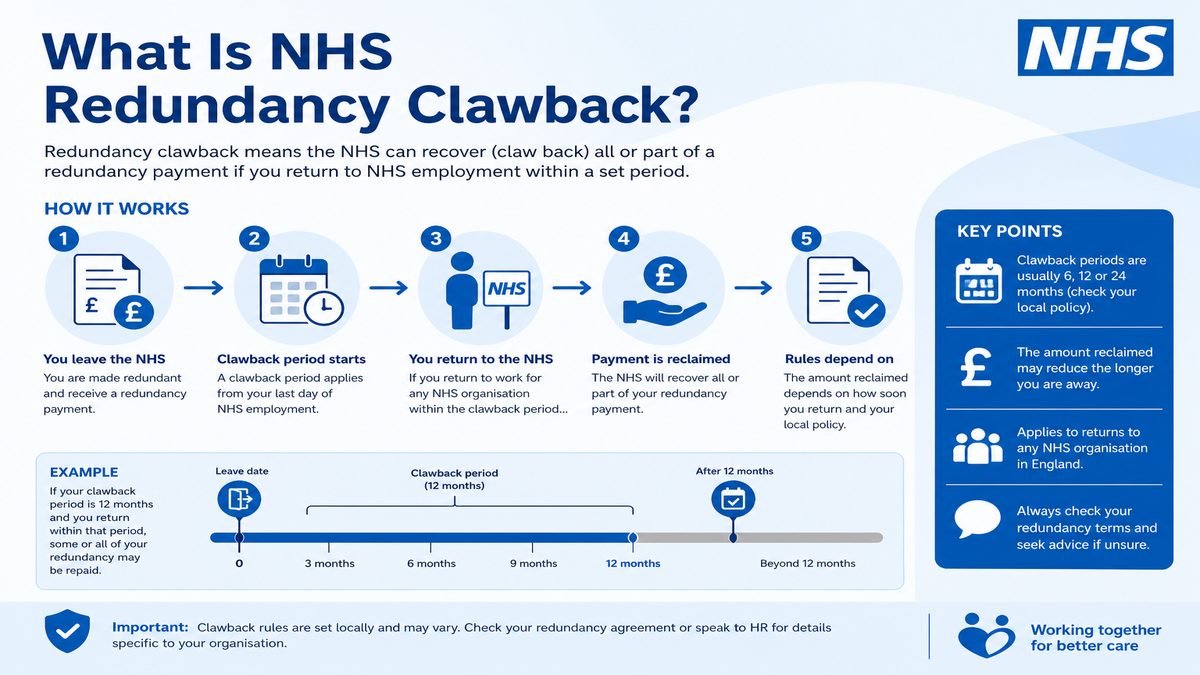
NHS redundancy clawback is a contractual mechanism that reduces — or recovers — your redundancy payment when one of three conditions applies. 7Contractual redundancy terms are set out in the Agenda for Change NHS Terms and Conditions of Service Handbook under Section 16, more specifically Paragraph 16.6, for NHS staff who are on Agenda for Change contracts in England or those whose terms refer dynamically to Agenda for Change.
Clawback operates across three distinct scenarios, each with its own calculation rules:
Scenario 1 — Partial Retirement Clawback: Service years used to draw pension benefits are deducted from your reckonable service before your redundancy lump sum is calculated.
Scenario 2 — Previous Redundancy / Loss of Office Clawback: Service years already compensated by a prior redundancy payment or loss of office payment cannot be counted again.
Scenario 3 — Re-Joining Clawback: Returning to NHS employment within the restriction period after receiving your redundancy payment triggers repayment of some or all of that lump sum.
Understanding which scenario applies to your situation — and by how much it reduces your payment — is the exact purpose of this calculator.
Every clawback calculation begins with the same core formula:
Reckonable Service After Clawback = Total Continuous NHS Service (complete years) MINUS years of service used to calculate partial retirement pension benefits MINUS years of service covered by a previous redundancy or loss of office payment MINUS years of service covered by a MARS severance payment
Redundancy Payment After Clawback = Reckonable Service After Clawback (maximum 24 years) × Monthly Pay
Where Monthly Pay =
9 A month's pay, subject to a total annual earnings floor of £23,000 and cap of £80,000, is either an amount equal to 1/12th of the annual salary at the date of termination or 4.35 times a week's pay, whichever is more beneficial to the employee. 3 NHS redundancy terms under Section 16 of the AfC handbook provide 1 month's actual pay per year of reckonable service, up to a maximum of 24 years. No weekly pay cap applies (unlike statutory redundancy). Service beyond 24 complete years does not increase your entitlement further. 2 From April 2026, the statutory weekly cap is £751. (This statutory cap applies only if you are calculating statutory redundancy as a fallback comparison — not NHS contractual pay.)
Key salary rules:
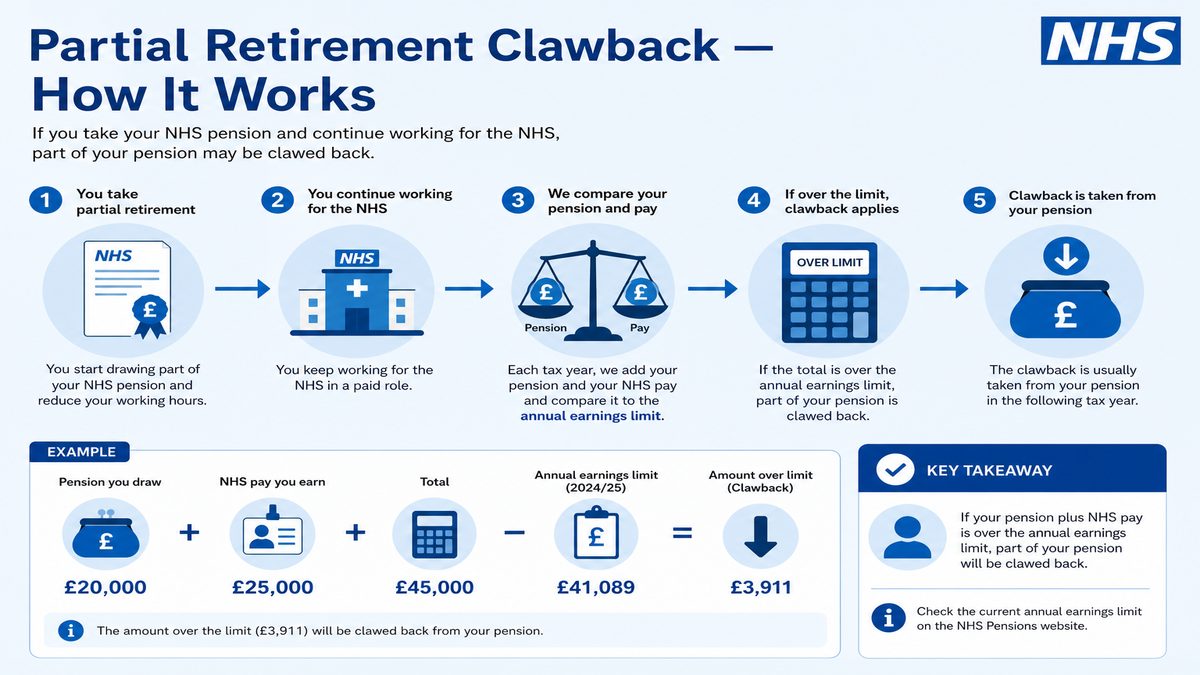
Partial retirement clawback is the most financially significant clawback type affecting NHS staff in 2026. 6If you are a member of the NHS Pension Scheme and have partially retired, your contractual redundancy payment will only be based on NHS reckonable service, as set out in Section 16 of the NHS Terms and Conditions of Service Handbook.
2 Service already used to calculate pension benefits cannot count as reckonable service for redundancy pay under Paragraph 16.6 of the NHS TCS Handbook.
This means if you drew pension benefits on 20 years of service through partial retirement, and your total NHS service at redundancy is 25 years, your reckonable service for redundancy purposes is 5 years — not 25.
Step 1: Confirm total continuous NHS service in complete years at your redundancy date.
Step 2: Confirm how many years of service were used to calculate your partial retirement pension benefits. This figure appears on your pension award letter from NHS Business Services Authority (NHSBSA).
Step 3: Subtract Step 2 from Step 1.
Step 4: Apply the salary floor or cap if relevant.
Step 5: Multiply the result (capped at 24 years) by your monthly pay figure.
The scenario: A Band 7 Senior Nurse, annual FTE salary £46,148, took partial retirement in 2020 and drew pension benefits on 18 years of NHS service. She continued working. Her redundancy date is September 2026. Total NHS service at redundancy = 23 years.
Calculation Factor | Value |
Total NHS service | 23 years |
Service used for partial retirement pension | 18 years |
Reckonable service after clawback | 5 years |
Monthly pay (£46,148 ÷ 12) | £3,845.67 |
Redundancy WITHOUT clawback (23 × £3,845.67) | £88,450.41 |
Redundancy AFTER clawback (5 × £3,845.67) | £19,228.33 |
Clawback reduction | £69,222.08 |
4 For some NHS employees, particularly those with decades of experience, this clawback provision can reduce redundancy payments by a substantial amount. 12 MiP has raised concerns about the impact of the scheme on staff who have used flexible retirement options, such as partial retirement and retire-and-return. Under the national scheme, these staff would lose their reckonable service when calculating redundancy payments — something MiP has called "grossly unfair" and called on the government to address.
2 Under Paragraph 16.6, service already taken into account for a previous redundancy or loss of office payment cannot be counted again.
This rule applies regardless of how much time has passed since the previous payment, providing your continuous NHS service was not broken by more than 12 months before re-joining. The service already compensated is permanently excluded. Only the new service accumulated since re-joining counts toward your next redundancy entitlement.
The scenario: A Band 5 NHS administrator received a redundancy payment in 2018 covering 12 years of NHS service. She re-joined the NHS in 2019 after a 4-month gap. She is now being made redundant again in 2026. Current annual salary: £36,483.
Calculation Factor | Value |
Previous service (paid out 2018) | 12 years |
New continuous service since 2019 | 7 years |
Reckonable service after clawback | 7 years |
Monthly pay (£36,483 ÷ 12) | £3,040.25 |
Redundancy AFTER clawback | £21,281.75 |
What redundancy would have been without clawback (19 yrs) | £57,764.75 |
Clawback reduction | £36,483.00 |
The 12-year period is permanently excluded. No time limit removes the deduction — it applies for the duration of her NHS career.
A Mutually Agreed Resignation Scheme (MARS) is not a redundancy. 10Mutually agreed resignation is not a redundancy or a voluntary redundancy, which would currently be covered by AfC Section 16.
4 MARS is a voluntary resignation under Section 20 of the NHS TCS Handbook, not a redundancy under Section 16.
MARS clawback applies in two ways:
Way 1 — Service exclusion from future redundancy: 4If you previously took a MARS payment, that service is permanently excluded from your reckonable service. If you took partial retirement, the service you drew pension benefits on is also excluded.
Way 2 — MARS is typically less generous than redundancy: 2Whether you are facing compulsory redundancy, considering voluntary redundancy, or exploring a MARS offer, understanding your financial entitlement is essential. MARS payments are almost universally lower than Section 16 redundancy entitlements, and the service years used for MARS are permanently lost for any future redundancy calculation.
Before accepting a MARS offer, confirm three things in writing with your HR department:
10 Severance payments should not be made where the circumstances entitle an employee to a contractual redundancy payment or redundancy benefits under the NHS Pension Scheme Regulations.
If your employer is offering MARS while a redundancy situation exists, this may not be lawful. Contact your union representative immediately.
Returning to NHS employment after receiving a redundancy lump sum triggers repayment — this is the third form of clawback. The rules differ significantly between standard AfC Section 16 terms and the 2025/26 national VR model scheme.
2 Re-joining the NHS within 6 months of your redundancy date may require you to repay all or part of your redundancy payment. Consider waiting at least 6 months before re-joining.
The national scheme introduced materially stricter clawback terms than standard AfC. 16For the first time, every staff member taking VR — including the most junior — would be compelled to repay some or all of their redundancy package if they return to an NHS organisation, government department, or arm's-length body within a set period. The six-month clawback for lower-paid staff and twelve-month window for senior managers and higher payouts is unprecedented in its breadth. In previous schemes, clawback was reserved for large settlements, typically above £100,000.
12 MiP chief executive Jon Restell said: "The clawback terms, apparently a Treasury red line, are the toughest ever sought, and many members are unclear what 're-employment in the public sector' means in practice."
13 NHS England and several Integrated Care Boards quietly adjusted their policy in late 2025, relaxing the rules regarding the "clawback" of redundancy payments. Staff who leave under the VR scheme no longer have to repay their redundancy money if they subsequently take a job in the wider government sector, outside of health. 14 Under the new policy, individuals who leave NHS England or an ICB through the voluntary scheme will retain their full redundancy payment even if they subsequently take up roles in central government, local government, arm's-length bodies, or other public institutions outside the health sector.
This relaxation does NOT cover re-joining the NHS itself. Taking a role with another NHS Trust, an ICB, an NHS arm's-length body, or NHS England itself still triggers the full clawback repayment obligation.
The following table shows the general pro-rata repayment principle. Your specific scheme documentation governs the exact repayment formula — always confirm with your employer in writing.
Gap Before Re-joining | Repayment Obligation (Standard AfC) | Repayment Obligation (Model Scheme — Junior) | Repayment Obligation (Model Scheme — Senior / £100k+) |
0–1 months | Up to 100% | Up to 100% | Up to 100% |
1–2 months | Partial pro-rata | Partial pro-rata | Partial pro-rata |
2–3 months | Partial pro-rata | Partial pro-rata | Partial pro-rata |
3–4 months | Partial pro-rata | Partial pro-rata | Partial pro-rata |
4–5 months | Partial pro-rata | Partial pro-rata | Partial pro-rata |
5–6 months | Partial pro-rata | Partial pro-rata | Partial pro-rata |
6+ months | £0 repayment | £0 repayment | Partial pro-rata |
12+ months | £0 repayment | £0 repayment | £0 repayment |
Wider government roles (non-health) — £0 repayment at any gap under the late-2025 relaxation (national VR scheme staff only).
4 The NHS redundancy calculator for 2026/27 covers all pay bands, part-time pro-rata, the salary floor and cap, over-55 pension options, and the clawback rules that are currently affecting thousands of NHS England and ICB staff.
The staff groups most exposed to clawback in 2026 are:
Partially retired staff — Any NHS employee who drew pension benefits while continuing to work faces a reckonable service reset. The longer their pre-retirement service, the larger the reduction.
Returning NHS employees — Anyone who received a redundancy payment in a previous NHS role and re-joined. Only service accumulated after re-joining counts toward the new redundancy.
MARS recipients — Staff who previously accepted a MARS severance payment. Those years are permanently excluded from future redundancy calculations.
Senior managers and executives — Those with payments above £100,000 face a 12-month clawback restriction period rather than 6 months.
ICB corporate staff — 14Integrated care boards, many of which are required to reduce running costs by up to thirty percent, have initiated workforce changes that are placing thousands of administrative and leadership roles at risk.
NHS England staff — 15The national VR scheme has been issued to staff across NHS England, ICBs, and commissioning support units, ahead of large-scale structural changes and cost reductions.
The redundancy payment and the NHS pension are separate entitlements. A clawback deduction on your redundancy payment does NOT reduce your NHS pension. Your pension entitlement is governed by NHS Pension Scheme Regulations — not by Section 16 of the AfC Handbook.
However, the two interact in two important ways:
Interaction 1 — Partial Retirement Creates Clawback: Drawing pension benefits early through partial retirement directly reduces your reckonable service for redundancy purposes. The more years you drew pension on, the lower your redundancy payment.
Interaction 2 — Over-55 Compulsory Redundancy Pension Access: 4The critical difference is the pension — compulsory redundancy over 55 can trigger early unreduced pension access; voluntary redundancy generally cannot.
This creates a meaningful financial difference between compulsory and voluntary redundancy for NHS staff aged 55 or over. Staff in this position should obtain a pension estimate from NHSBSA before deciding whether to apply for voluntary redundancy.
The Retire-and-Return Position: 4This clawback provision has been described as particularly strict in recent NHS England reorganisations. NHS England quietly adjusted its policy in late 2025 to relax clawback rules for staff moving to wider government roles outside of health. For staff who have retired and returned to the NHS, this policy shift may create a re-joining pathway that does not trigger repayment — providing the role is outside the NHS health sector.
6 If you have received an offer of voluntary redundancy from one of the affected NHS organisations, you will be offered a settlement agreement.
A settlement agreement is a legally binding contract. Once signed, you waive the right to bring most employment law claims against your employer in relation to your employment and its termination.
12 The model scheme does not allow for payment in lieu of notice (PILON) and prevents staff from negotiating their own exit dates.
Settlement agreements in the context of NHS redundancy clawback contain four clauses you must review before signing:
6 Before you sign, you should seek formal legal advice and ensure you have the final copy of the settlement agreement and all relevant information.
Your NHS employer is legally required to contribute toward independent legal advice on the settlement agreement. This contribution is typically £500 + VAT but verify the exact figure in your offer letter.
Tax is calculated on the post-clawback figure. The pre-clawback amount is irrelevant for tax purposes — only what you actually receive is assessed.
The £30,000 Tax-Free Threshold: The first £30,000 of a genuine redundancy payment is exempt from Income Tax under Section 403 of the Income Tax (Earnings and Pensions) Act 2003 (ITEPA 2003). This threshold has not changed.
Above £30,000: Any amount above £30,000 is taxed as employment income at your marginal Income Tax rate — 20%, 40%, or 45% depending on your total income for that tax year.
National Insurance: No National Insurance contributions (NICs) are payable on a genuine redundancy payment — statutory or contractual. This applies to both employee and employer NICs.
Tax Timing Risk:
16 For many staff, the VR payment will fall into the same tax year as their final salary, triggering a significant spike in their tax bill. Several ICB employees say this alone is enough to rule them out.
If your redundancy payment and your final salary payments both fall in the same tax year, the combination may push you into a higher Income Tax band, increasing the tax payable on the excess above £30,000.
Example Tax Calculation After Clawback:
Factor | Value |
Redundancy after clawback | £45,000 |
Tax-free amount (ITEPA 2003) | £30,000 |
Taxable amount | £15,000 |
Marginal rate (40% band) | 40% |
Tax payable on redundancy | £6,000 |
Net redundancy received | £39,000 |
8 To qualify for NHS contractual redundancy pay, you must have at least 2 years (104 weeks) of continuous service, been made redundant (your role is no longer required), and not unreasonably refused suitable alternative employment.
This 2-year qualifying threshold applies to your reckonable service AFTER clawback deductions. If clawback reduces your reckonable service below 2 complete years, you lose the entitlement to NHS contractual redundancy pay entirely and fall back to statutory minimum — which is calculated using the capped weekly rate, not monthly actual pay.
9 Suitable alternative employment is a concept of the Employment Rights Act 1996 and an important part of a robust redundancy process. It is an employer's responsibility to seek suitable alternative employment for staff before making redundancies.
If your Trust offers you a suitable alternative role and you unreasonably refuse it, you lose your entitlement to redundancy pay entirely — not just a clawback reduction. The full payment is forfeited.
9 Whether a job is "suitable" will depend on a number of key factors including how similar the work is to the employee's current job. The question of suitable alternative employment should be determined on a case-by-case basis.
Factors used to determine suitability include:
If you believe a role being offered is not genuinely suitable, you have the right to challenge this determination. Contact your union representative or employment solicitor before refusing any offer in writing.
9 Service with a GP practice does not automatically count for an NHS redundancy payment as it is not NHS service which has to be with an NHS employer. However, employers do have the discretion to recognise service outside the NHS.
12 NHS trade unions, including MiP, have refused to endorse NHS England's national voluntary redundancy scheme, describing some aspects of the scheme as "grossly unfair" and warning of "potentially serious" tax implications. Unions were consulted on the terms of the VR scheme but say many concerns about the scheme were ignored, and that it offers worse terms than comparable public sector VR programmes. 4 Unions including MiP, RCN, UNISON, and Unite have refused to endorse the national voluntary redundancy model scheme. Concerns include the clawback provisions described as the toughest ever sought, the treatment of partially retired staff who lose reckonable service, the absence of PILON, and the use of settlement agreements. 6 Along with other trade unions, the RCN has raised concerns and commented on the voluntary redundancy "model scheme" at a national level. Trade unions have not agreed to the scheme over concerns the redundancy terms differ from those set out in the NHS Terms and Conditions of Service Handbook.
The RCN position in their own words: 6"We've opposed this 'model scheme' where it differs from the NHS Terms and Conditions of Service Handbook, particularly the clawback provisions and settlement agreements. These changes come at a time of major NHS restructuring during which the RCN will remain committed to safeguarding nursing roles and standards."
These are the most financially damaging errors NHS staff make when assessing their clawback position:
Mistake 1 — Using total service instead of reckonable service.
1 If you have taken partial retirement, Paragraph 16.6 clawback can significantly reduce your reckonable service because service already used for pension benefits cannot be counted again for redundancy pay. Always start with reckonable service — never total service.
Mistake 2 — Accepting MARS when a genuine redundancy situation exists.
10 Severance payments should not be made where the circumstances entitle an employee to a contractual redundancy payment or redundancy benefits under the NHS Pension Scheme Regulations. If your employer offers MARS while your role is genuinely redundant, accepting MARS may forfeit a significantly larger Section 16 entitlement.
Mistake 3 — Re-joining NHS at month 5 instead of waiting for month 6. One month's difference can mean repaying the entire redundancy lump sum. 2Re-joining the NHS within 6 months of your redundancy date may require you to repay all or part of your redundancy payment. Consider waiting at least 6 months before re-joining.
Mistake 4 — Assuming the wider government relaxation removes all clawback.
13 Staff who leave under the VR scheme no longer have to repay their redundancy money if they subsequently take a job in the wider government sector, outside of health. This exemption is specifically for non-health government roles only. Re-joining any NHS employer still triggers full clawback.
Mistake 5 — Signing a settlement agreement before obtaining legal advice.
6 Before you sign, you should seek formal legal advice and ensure you have the final copy of the settlement agreement and all relevant information. Once signed, a settlement agreement is legally binding and cannot be challenged.
Mistake 6 — 1Confusing statutory with contractual redundancy pay.
2 NHS AfC contractual terms are usually far more generous. Ensure you know which scheme applies — statutory is the minimum, not the standard for AfC staff in England.
Mistake 7 — Not confirming reckonable service in writing. Verbal estimates from HR are not contractually binding. Request written confirmation of your reckonable service, the clawback deduction applied, and the resulting payment figure before submitting your application.
Mistake 8 — Ignoring the part-time pro-rata adjustment.
1 Forgetting part-time adjustments to salary floors and the overall payment is a consistent error. Part-time staff have their monthly pay pro-rated based on contracted hours ÷ 37.5 after the salary floor or cap is applied to the FTE figure.
NHS redundancy clawback is a contractual provision under Paragraph 16.6 of the NHS Terms and Conditions of Service Handbook. It operates in two ways. First, it reduces your redundancy payment by excluding service years already used for pension benefits (partial retirement), a previous redundancy, a loss of office payment, or a MARS severance. Second, a separate repayment clawback requires you to repay all or part of your redundancy lump sum if you re-join the NHS within the restriction period — typically 6 months under standard AfC terms, or 12 months for senior staff under the 2025/26 national VR model scheme.
2 Service already used to calculate pension benefits cannot count as reckonable service for redundancy pay under Paragraph 16.6 of the NHS TCS Handbook. Every year of service you used to draw partial retirement pension benefits is deducted from your total service before your redundancy is calculated. If you drew pension on 20 years of service and have 25 years of total service at redundancy, only 5 years count. Your redundancy is calculated on 5 years, not 25.
1 Under NHS Agenda for Change terms in England, redundancy pay is one month's pay for each complete year of reckonable service, up to a maximum of 24 years. Clawback deductions are applied first, and then the 24-year cap is applied to what remains. If clawback reduces your service below 2 complete years, you lose entitlement to contractual redundancy pay entirely.
Under standard AfC Section 16 terms: 6 months. Under the national VR model scheme for junior staff: 6 months. Under the national VR model scheme for senior staff or payments above £100,000: 12 months. 16The six-month clawback for lower-paid staff and twelve-month window for senior managers and higher payouts is unprecedented in its breadth. In previous schemes, clawback was reserved for large settlements, typically above £100,000.
11 Staff taking voluntary redundancy under the national NHS scheme will no longer face payment clawbacks if they get a job in government outside of health. This exemption applies to NHS England and ICB staff under the national VR scheme only. It covers roles in central government, local government, and arm's-length bodies outside the health sector. It does NOT cover re-joining any NHS employer.
No. 4MARS is a voluntary resignation under Section 20 of the NHS TCS Handbook, not a redundancy under Section 16. 10Mutually agreed resignation is not a redundancy or a voluntary redundancy, which would currently be covered by AfC Section 16. MARS payments are typically lower than Section 16 redundancy, and the service years used for MARS are permanently excluded from any future redundancy calculation.
3 NHS redundancy terms under Section 16 of the AfC handbook provide 1 month's actual pay per year of reckonable service, up to a maximum of 24 years. 9 A month's pay is subject to a total annual earnings cap of £80,000. Therefore the maximum NHS contractual redundancy payment is 24 × (£80,000 ÷ 12) = **£160,000 gross before tax**. Clawback deductions reduce this figure based on individual service history.
The first £30,000 is tax-free under ITEPA 2003, Section 403. Any amount above £30,000 is taxed as employment income at your marginal rate. No National Insurance contributions are payable on any amount of a genuine redundancy payment. Tax is calculated on the amount you actually receive after clawback — not on the pre-clawback figure.
Yes. 4If you are facing NHS England or ICB voluntary redundancy in 2026, take independent legal advice before signing any settlement agreement — your employer is required to cover those costs. Your union can also challenge whether a MARS offer is lawful if a genuine redundancy situation exists, and can negotiate exit dates and terms.
Yes. 2Service covered by previous payments cannot be counted again under Paragraphs 16.6 and 20.18 of the NHS TCS Handbook. The years covered by your MARS payment are permanently excluded from any future NHS redundancy calculation, in the same way as years used for a previous redundancy payout.
9 Suitable alternative employment is a concept of the Employment Rights Act 1996 and an important part of a robust redundancy process. If your employer makes a formal offer of a suitable alternative role and you unreasonably refuse it, you forfeit your entire redundancy entitlement — not just a clawback reduction. The full payment is lost. Whether a refusal is "unreasonable" depends on the specific role, terms, location, and your personal circumstances. Always take union advice before refusing any formal offer.
No. 12NHS trade unions, including MiP, have refused to endorse NHS England's national voluntary redundancy scheme, describing some aspects of the scheme as "grossly unfair" and warning of "potentially serious" tax implications. 15The terms have not been approved by unions, despite being circulated to the workforce.
9 A month's pay is subject to a total annual earnings floor of £23,000. Staff whose FTE salary falls below £23,000 per year have their monthly pay calculated using £23,000 as the base figure. This floor increases the redundancy payment for lower-paid staff above what their actual salary would produce.
9 Service with a GP practice does not automatically count for an NHS redundancy payment as it is not NHS service which has to be with an NHS employer. However, employers do have the discretion to recognise service outside the NHS. If you have GP practice service, request written confirmation from your current NHS employer about whether that service will be recognised before submitting your redundancy application.