 Take Home Pay
Take Home Pay
Take Home Pay
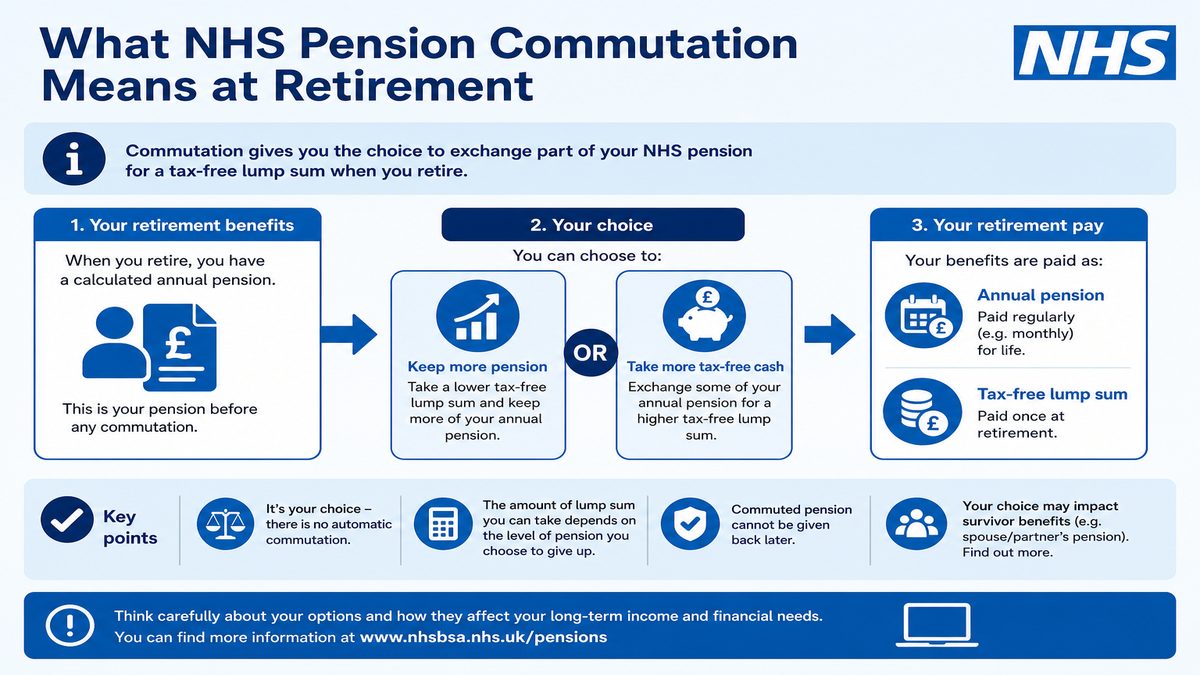
NHS pension commutation is the process of exchanging (commuting) part of your annual pension for a larger one-off retirement lump sum. In the NHS Pension Scheme, the standard exchange rate for optional commutation is fixed in regulations: you receive £12 of lump sum for every £1 of annual pension you give up. That rate applies across the 1995 Section, the 2008 Section and the 2015 Scheme for ordinary retirement commutation, as confirmed by NHS Business Services Authority guidance and Government Actuary’s Department factor notes.
Commutation sits alongside—not instead of—your basic pension calculation. Your accrued pension is worked out first under the rules of each section or scheme you belong to. You then decide how much of that pension (if any) to exchange for cash, subject to scheme and HMRC limits. The calculator above is designed to help you model residual pension and lump sum outcomes before you make an irrevocable election on your claim form. For authoritative scheme rules and claim processes, always cross-check with NHSBSA Member Hub and the relevant members’ guides.
Understanding commutation matters because the cash decision permanently reduces your lifetime pension income. A larger lump sum can clear a mortgage, fund a home move, or create an emergency buffer, but it also lowers the indexed pension that supports day-to-day living for the rest of retirement. The right answer depends on tax allowances, other savings, longevity expectations, dependants’ benefits, and whether you already receive an automatic lump sum under the 1995 Section.
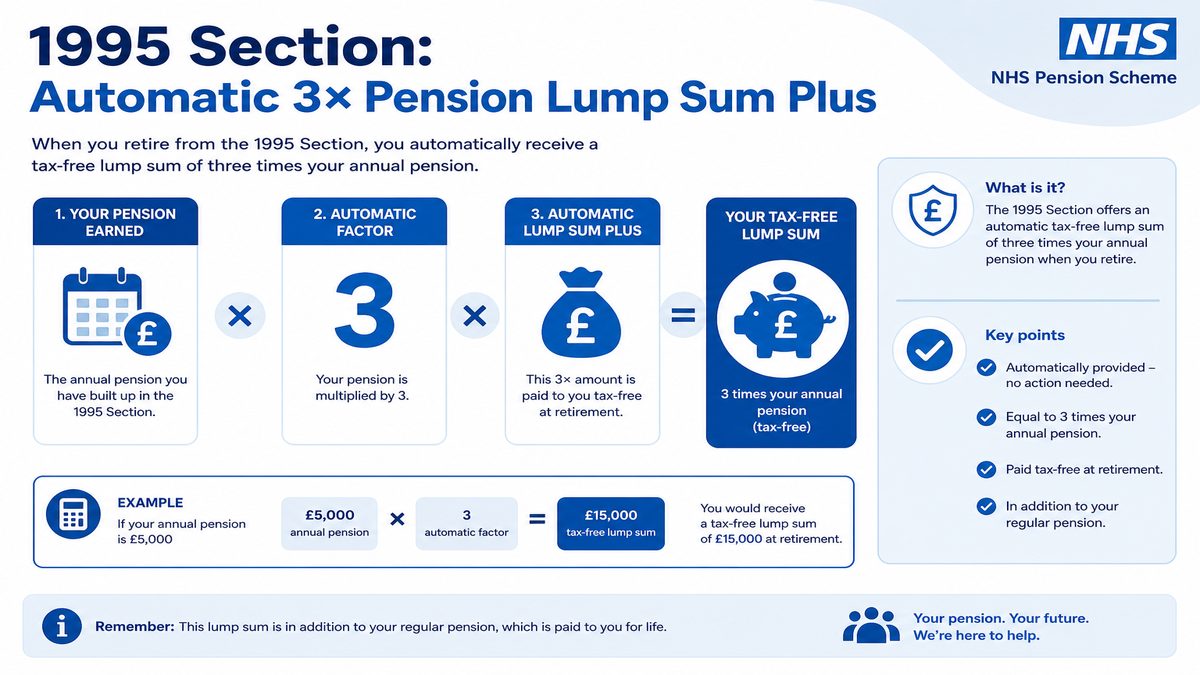
Members retiring from the 1995 Section normally receive an automatic retirement lump sum equal to three times their annual pension, in addition to the pension itself. That automatic cash is a structural feature of 1995 benefits and does not require you to give up extra pension beyond the design of the section. Many members still ask whether they can take more cash than the automatic 3× amount. The answer is yes in many cases—but only if you were actively contributing to the NHS Pension Scheme on or after 1 April 2008, and only up to the scheme’s maximum lump sum rules.
Optional further commutation in the 1995 Section works at the same £12 for £1 rate. Each extra £12 of lump sum requires you to surrender £1 of annual pension. Because you already have an automatic lump sum, any further cash you take is additional to 3× pension and further reduces the residual pension paid for life. NHSBSA explains that the maximum lump sum is generally limited to around 25% of the capital value of your benefits, and that for 1995 Section pensions the practical maximum total lump sum often works out at approximately 5.36 times the pre-commutation annual pension.
Think of 1995 retirement cash in two layers:
Your capital value for the maximum test is assessed after commutation, typically by multiplying the reduced annual pension by 20 and adding the total retirement lump sum. That is why “multiply pension by about 5.36” is a useful planning shorthand for 1995 members, not a substitute for an NHSBSA estimate. Full detail appears in the NHSBSA 1995/2008 Members’ Guide.
The 2008 Section and the 2015 Scheme do not pay an automatic 3× pension lump sum. Instead, any retirement lump sum is created by commuting pension at £12 of cash for each £1 of annual pension given up. If you take no commutation, you receive the full calculated pension and no scheme retirement lump sum from that section or scheme (subject to any special rules such as serious ill-health options).
Maximum cash is again constrained by the roughly 25% of capital value rule. NHSBSA’s practical planning factors are approximately:
Those multipliers are planning approximations derived from the interaction of the £12:£1 commutation rate and the capital-value test. Exact figures on your award letter may differ after actuarial reductions, Scheme Pays debits, concurrent membership decisions, or other adjustments. Confirm figures using official estimates from NHSBSA: Can I commute part of my pension?.
In 1995, part of the lump sum arrives automatically. The capital-value maths therefore allows a higher multiple of pension as total cash before hitting the 25% ceiling relative to the starting pension. In 2008 and 2015, all cash is purchased by surrendering pension, so the maximum cash expressed as a multiple of the starting pension is lower—around 4.28× rather than around 5.36×. Both routes still use the same £12 for £1 exchange rate for the pension you actually commute.
| Feature | 1995 Section | 2008 Section | 2015 Scheme |
|---|---|---|---|
| Automatic lump sum | Yes — normally 3 × pension | No | No |
| Optional commutation rate | £12 lump / £1 pension | £12 lump / £1 pension | £12 lump / £1 pension |
| Typical max lump sum factor (planning) | ~5.36 × pension | ~4.28 × pension | ~4.28 × pension |
| Capital value test | ~25% of capital value | ~25% of capital value | ~25% of capital value |
| Active membership on/after 1 Apr 2008 needed for optional commute? | Yes (for further cash beyond automatic) | Yes (to take a lump sum by commute) | Subject to scheme claim rules; confirm with NHSBSA |
HMRC and scheme rules limit how much of your pension package can be taken as an authorised lump sum. In NHS Pensions practice, the maximum retirement lump sum is usually expressed as 25% of the capital value of your benefits. Capital value is commonly illustrated as:
Capital value ≈ (reduced annual pension × 20) + total retirement lump sum
Because the lump sum and residual pension move together when you commute, there is a maximum cash point beyond which further commutation would breach the limit. That is the origin of the 5.36 and 4.28 planning factors published for members. If you have other pensions already crystallised, your available room under the Lump Sum Allowance (LSA) may also constrain how much of an NHS lump sum can be paid tax-free.
The standard Lump Sum Allowance is £268,275 for most people without protections, and it applies across all your registered pension arrangements, not just the NHS scheme. Amounts above available LSA may be taxable. Treat LSA as a high-level tax constraint in planning; obtain personalised tax advice if your combined lump sums approach or exceed the allowance. Overview guidance is available from GOV.UK: Tax on pension lump sums and NHSBSA member materials.
The examples below are illustrative only. They use round numbers and ignore early-retirement reductions, inflation uplifts between estimate and payment, Scheme Pays, and concurrent scheme interactions. Always rely on your official NHSBSA estimate for claim decisions.
Assume a 1995 Section annual pension of £20,000 before optional further commutation.
This member receives the classic 1995 package: pension plus 3× cash. Many members stop here if they do not need extra liquidity or wish to preserve maximum indexed income.
Using the same £20,000 starting pension, approximate maximum total lump sum ≈ 5.36 × £20,000 = £107,200.
Compared with Example A, the member gains roughly £47,200 more cash but permanently loses about £3,933 of annual pension (before future increases). Over a long retirement, that income reduction can exceed the extra cash unless the lump sum is invested or used to clear high-cost debt.
Assume a 2015 Scheme annual pension of £18,000 and the member elects maximum cash ≈ 4.28 × £18,000 = £77,040.
If the same member instead takes a moderate lump sum of £36,000:
Moderate commutation preserves more lifetime income while still funding a meaningful cash buffer—often a practical middle path for members who are neither “cash maximisers” nor “pension maximisers”.
For a £18,000 2008 Section pension, maximum planning cash is also around 4.28 × £18,000 = £77,040, with residual pension around £11,580 if the maximum is taken. The arithmetic mirrors the 2015 example because both arrangements lack the 1995 automatic 3× cash layer.
| Scenario | Starting pension | Lump sum (approx.) | Residual pension (approx.) |
|---|---|---|---|
| 1995 — automatic only | £20,000 | £60,000 | £20,000 |
| 1995 — near max further commute | £20,000 | £107,200 | £16,067 |
| 2015 — moderate commute | £18,000 | £36,000 | £15,000 |
| 2015 — near maximum | £18,000 | £77,040 | £11,580 |
Most authorised pension commencement lump sums within available allowances are paid tax-free. Since the Lifetime Allowance was abolished, the focus for lump-sum tax planning shifted to the Lump Sum Allowance and related allowances. For many NHS retirees, the practical question is simply: “Will my NHS lump sum, plus any other pension lump sums, stay within my available LSA?”
Key high-level points for NHS staff:
Use GOV.UK materials and, where figures are material, regulated financial advice. Scheme administrators can show NHS figures; they cannot design your whole-of-wealth tax strategy. See also GOV.UK guidance on the lump sum allowance alongside NHSBSA estimates.
Commutation is a personal finance decision, not a clinical or payroll default. Members often commute more when they have a clear, time-sensitive use for capital: clearing an expensive mortgage, bridging a house purchase, funding essential adaptations, or creating a short-term income bridge before other pensions start. Extra cash can also help if you have limited other liquid savings and want a contingency fund that is not locked in pension income.
Reasons to commute less (or not at all beyond any automatic 1995 cash) include wanting maximum inflation-linked income for life, having sufficient cash already outside pensions, expecting long longevity with limited other guaranteed income, or planning to leave a stronger ongoing income base for a partner who may rely on your household budget. Remember that commuting the member’s pension does not normally reduce the calculated survivor’s pension in the same way for standard commutation—survivor pensions are generally based on the member’s pension before that optional commutation—but household cash-flow still falls when the member’s own pension falls. Confirm dependants’ rules for your section in official guides.
Doctors and consultants should also consider interaction with other pension arrangements and tax positions discussed in professional guidance from the BMA pensions pages. Agenda for Change staff can use the same framework with NHSBSA estimates and, where needed, independent advice.
The McCloud remedy addresses age discrimination in public service pension reforms. Many members have legacy (1995/2008) and reformed (2015) service, with remedy choices that can change which benefits are payable for the remedy period. Because commutation elections can differ by scheme membership in some claim scenarios, McCloud-affected members should read their remedy correspondence carefully before locking in lump-sum choices.
In broad terms: where you have separate 1995 or 2008 membership and 2015 membership, you may be able to make separate commutation decisions for each, subject to NHSBSA rules (ill-health claims can be treated differently). Where membership has been combined or specific claim pathways apply, the lump-sum decision may need to be consistent. Treat McCloud as a reason to request an up-to-date official estimate rather than relying on pre-remedy illustrations. Start with NHSBSA McCloud remedy information and your personal statement.
Ill-health retirement has distinct benefit tiers and, in serious ill-health cases, options that can differ from ordinary retirement commutation. NHSBSA and GAD guidance note that serious ill-health situations can allow exchange of pension for lump sum using the £12:£1 framework, subject to specific modifications. Ill-health claims can also constrain how separately you may elect commutation across scheme memberships.
If you are exploring ill-health retirement:
Member FAQs and claim routes are maintained on the NHSBSA knowledge base.
The calculator on this page is an educational modelling tool. Conceptually, it takes your estimated annual pension by section or scheme, applies the £12 for £1 exchange rate, respects approximate maximum factors (~5.36 for 1995 total cash planning; ~4.28 for 2008/2015), and shows residual pension after your chosen lump sum. It is not an official NHSBSA award, does not apply every actuarial reduction automatically, and does not replace regulated advice.
Use it to:
Before submitting a claim, reconcile calculator outputs with your official estimate and the claim form instructions from NHSBSA.
It means giving up part of your annual pension in exchange for a larger retirement lump sum. In the NHS Pension Scheme, optional commutation normally pays £12 of lump sum for each £1 of annual pension surrendered, subject to scheme and HMRC limits.
Yes. The 1995 Section normally pays an automatic retirement lump sum of three times the annual pension. Eligible members who were actively contributing on or after 1 April 2008 may also commute further pension for additional cash up to the maximum rules.
Those arrangements were designed without a built-in 3× cash layer. Any retirement lump sum is created by commuting pension at £12 for £1, unless a special route (such as certain serious ill-health options) applies.
They are planning approximations for the maximum lump sum relative to annual pension after applying the capital-value (around 25%) limit with the £12:£1 rate. About 5.36× is commonly used for 1995 total cash planning; about 4.28× for 2008 and 2015. Your official estimate is definitive.
Authorised lump sums within your available Lump Sum Allowance are generally tax-free, but LSA is shared across all pensions and the standard allowance is £268,275 for many people. Scheme maximum and tax-free maximum are not always the same. Check GOV.UK lump-sum tax guidance.
Commutation elections made as part of claiming benefits are treated as permanent for practical planning purposes. Do not experiment with maximum cash unless you are comfortable with the lower residual pension for life. Confirm irrevocability wording on your claim paperwork.
For standard optional commutation, survivor pensions are generally based on the member’s pension before that commutation, so the calculated survivor pension is typically not reduced by the member’s optional cash choice in the same way. Always verify the rule for your section in NHSBSA guides, especially for ill-health or special cases.
Remedy membership can change which benefits are paid for the remedy period and how separately you may elect commutation across schemes. Use your latest McCloud correspondence and a fresh NHSBSA estimate before deciding.
Possibly, but ill-health tiers and serious ill-health options follow specific rules. Do not apply ordinary-retirement worked examples blindly. Ask NHSBSA which lump-sum options apply to your tier and claim type.
Request a retirement estimate and follow claim instructions via NHSBSA. Use this page’s calculator only as a planning aid before you review official paperwork.
NHS pension commutation is the trade between lifetime indexed income and immediate cash at a regulated £12 for £1 rate. 1995 members usually start with an automatic 3× pension lump sum and may add further cash up to roughly 5.36× pension in total. 2008 and 2015 members create cash entirely by commutation, typically up to around 4.28× pension. Maximums reflect the capital-value framework near 25%, and tax-free treatment also depends on your wider Lump Sum Allowance position.
Model residual pension carefully, read NHSBSA guides, account briefly for McCloud if relevant, and treat ill-health routes as a separate rule set. The calculator above helps you visualise trade-offs; NHSBSA figures and, where appropriate, regulated advice should drive the final election.