 Take Home Pay
Take Home Pay
Take Home Pay
If you or a family member received substandard NHS care that caused physical harm, psychological injury, or financial loss, you may be entitled to compensation. This NHS medical negligence claim calculator generates an indicative payout estimate based on the same framework used by specialist solicitors and courts across England and Wales. Enter your injury type, severity level, and any verified financial losses to receive your estimate in under two minutes.
Step 1 — Select the category that best describes your injury (surgical error, misdiagnosis, birth injury, medication error, delayed treatment, failure of consent, or other).
Step 2 — Select the severity level of harm you suffered (minor / moderate / severe / catastrophic).
Step 3 — Enter any verified financial losses: lost past earnings, future lost earnings, private medical costs, home or vehicle adaptations, and travel expenses to appointments.
Your result displays two figures: your estimated general damages range and your estimated total claim value (general damages + special damages combined).
All general damages figures are generated using the Judicial College Guidelines 18th Edition (April 2026).
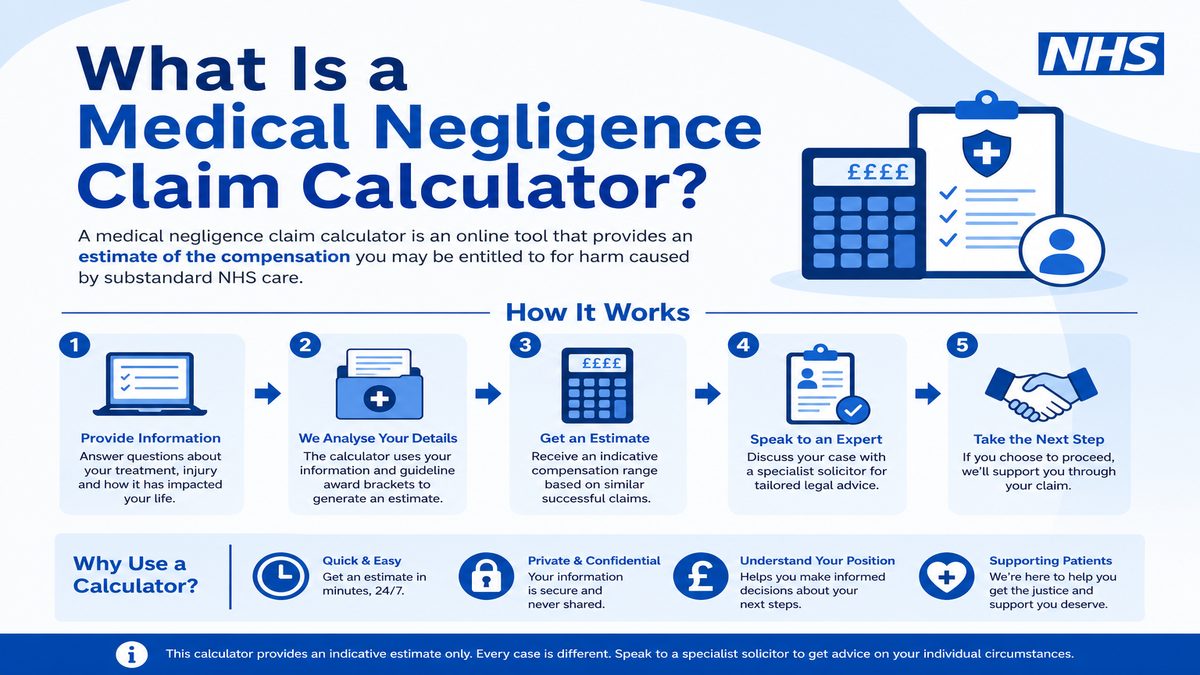
A medical negligence claim calculator estimates the likely compensation range for harm caused by substandard medical treatment. The calculator splits your potential claim into two legally distinct components — general damages and special damages — and applies published valuation guidelines to each component.
10 The Judicial College Guidelines are used by courts, insurers, and lawyers to help assess the appropriate compensation levels for pain, suffering, and loss of amenity. The calculator on this page applies those same guidelines to your inputs. The result is an indicative starting range, not a guaranteed award. Every claim is fact-specific, and a specialist medical negligence solicitor will refine this estimate once your medical records and expert reports are reviewed.
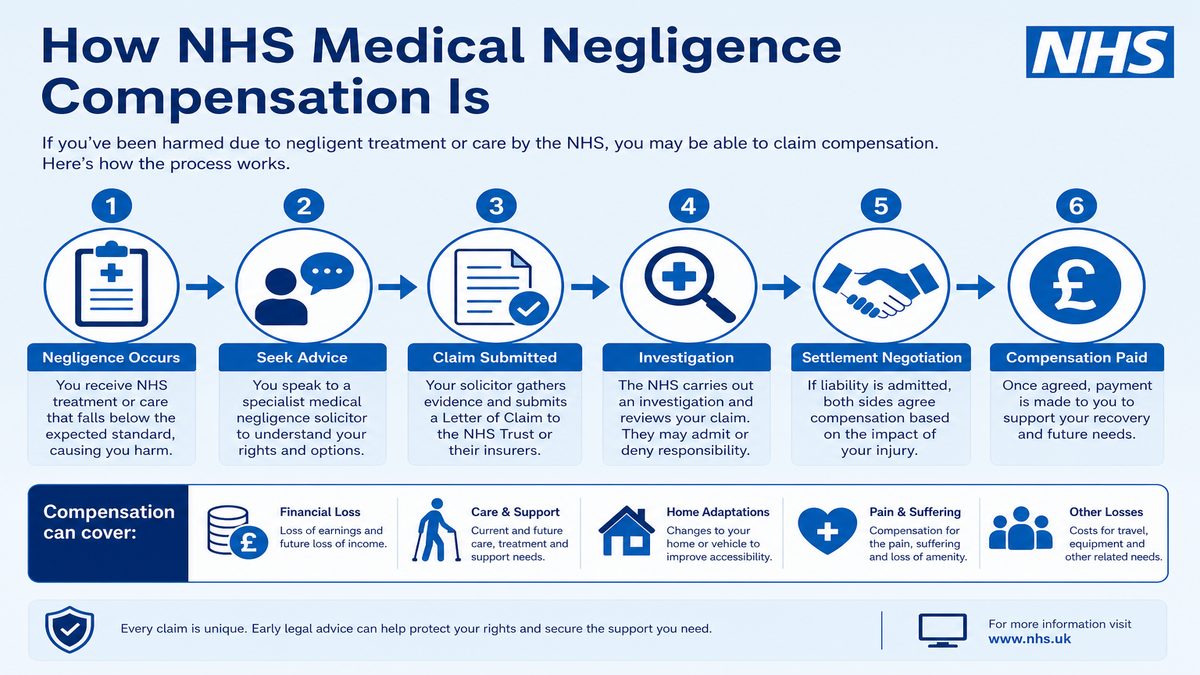
Every clinical negligence claim in England and Wales is valued under two heads of loss. Understanding both heads is essential before you use the calculator, because the calculator applies both simultaneously.
General damages compensate you for the physical and psychological impact of the negligence itself. Courts and solicitors use a defined legal phrase for this: pain, suffering, and loss of amenity (PSLA). 10The Judicial College Guidelines provide monetary brackets for each category of injury and are applicable to England and Wales.
9 The 18th Edition of the Judicial College Guidelines, published 9 April 2026, sets new indicative brackets and commentary used across courts, claimants' lawyers, and defendants when valuing general damages for pain, suffering, and loss of amenity. 9 The editors applied an uplift to the published brackets to reflect inflation since the previous edition — that uplift is approximately 8.2%, based on changes in the Retail Prices Index (RPI). 15 The Judicial College Guidelines figures do not have the status of being legally binding, but rather provide guidance to those involved in such claims. Actual awards can fall above or below a bracket depending on the specific medical evidence, prognosis, and judicial discretion.
Special damages cover every quantifiable financial loss caused by the negligence. Unlike general damages, special damages are calculated from evidence — payslips, invoices, receipts, bank statements, and care cost assessments. There is no bracket or cap on special damages; they are limited only by what can be proven.
Special damages typically include the following:
In high-value catastrophic injury cases, special damages — particularly future care costs and future lost earnings — represent the largest portion of the total award, often exceeding general damages by a ratio of 10:1 or more.
The following brackets are derived from the Judicial College Guidelines framework. 9The 18th Edition, published April 2026, raised general damages by approximately 8.2% across most categories and added new provisions including miscarriage claims. Figures below reflect the 18th Edition uplifted brackets.
Injury Type | Severity | Approximate Compensation Range |
Minor psychological injury / wrong diagnosis stress | Minor | Up to £7,800 |
Dental injury — loss of front tooth | Minor | Up to £3,780 |
Failed sterilisation / unwanted pregnancy | Minor–Moderate | Up to £9,750 |
Wrist fracture — complete recovery | Minor | £4,660 – £13,650 |
Wrist fracture — permanent significant disability | Severe | £31,090 – £58,350 |
Thumb loss (dominant hand) | Moderate–Severe | £33,700 – £52,020 |
Loss of one kidney | Significant | Up to £42,750 |
Below-knee amputation | Severe | £102,450 – £127,900 |
Above-knee amputation | Severe | £127,900 – £178,400 |
Severe brain damage | Catastrophic | £383,000+ |
Quadriplegia / tetraplegia | Catastrophic | £428,590 – £533,430 |
Obstetric cerebral palsy | Catastrophic | Case-specific (PPO + lump sum) |
Source: Judicial College Guidelines 18th Edition (April 2026). All figures are indicative general damages ranges only — special damages (financial losses) are calculated separately and added to these figures.
13 If two people suffer similar injuries in different parts of the country, they should broadly receive similar levels of compensation — without guidelines, there could be wide variations, leading to unfairness.
4 NHS Resolution states that a total of £3.09 billion was paid against all NHS clinical negligence schemes in 2024/25, with £2.29 billion representing compensation paid directly to claimants. 1 NHS Resolution received 14,428 new clinical negligence claims and reported incidents in 2024/25. 4 This was a near 10% rise over 2023/24 figures. 5 A record 83% of clinical claims were resolved without the need for legal proceedings in 2024/25. 7 £1.3 billion of the total clinical negligence payments in 2024/25 related to maternity alone. 4 Obstetrics (birth injury) claims accounted for a substantial 52.5% of the value of claims received in 2024/25. 4 For comparison, the next largest specialty, emergency medicine, represented just 7.1%. 1 The estimated annual cost of harm for incidents in 2024/25 for the main clinical scheme, the Clinical Negligence Scheme for Trusts (CNST), was £4.6 billion. 1 NHS Resolution's provision for future liabilities as of 31 March 2025 was £60.3 billion.
Payout range summary by injury severity:
Severity Band | Typical Payout Range |
Minor injuries | £3,000 – £20,000 |
Moderate injuries | £20,000 – £100,000 |
Severe / life-changing injuries | £100,000 – £1,000,000 |
Catastrophic injuries (e.g. cerebral palsy with PPO) | £1,000,000 – £20,000,000+ |
Birth injuries — particularly those resulting in cerebral palsy, hypoxic-ischaemic encephalopathy (HIE), or Erb's palsy — represent the highest-value tier of NHS compensation. 3A relatively small number of catastrophic injuries, particularly those involving maternity care and severe neurological damage, account for a substantial proportion of total compensation paid each year.
These awards are large because they must cover the entirety of the affected child's life:
6 Periodical Payment Orders (PPOs) provide lifelong financial compensation for people who live with severe or permanent injury, often following a birth injury or catastrophic surgical error. Rather than paying a single lump sum, the court orders annual payments for the life of the claimant. These payments are indexed to an appropriate inflation measure — typically ASHE 6115 for care costs — which protects the claimant from underfunding over a 50+ year period.
To bring a successful medical negligence claim, you must establish three legal elements simultaneously. A claim that satisfies two out of three still fails.
A legal duty of care exists automatically in every patient–clinician relationship within the NHS. The moment an NHS doctor, nurse, midwife, surgeon, pharmacist, or allied health professional begins treating you, they owe you a duty of care. This element is rarely disputed in NHS claims.
Your treatment must have fallen below the standard expected of a reasonably competent practitioner in that specialty. The legal benchmark is the Bolam test, established in Bolam v Friern Hospital Management Committee [1957]: a clinician is not negligent if they acted in accordance with a practice accepted as proper by a responsible body of medical opinion in that specialty.
The Bolitho refinement (Bolitho v City and Hackney Health Authority [1997] UKHL 46) adds a critical qualification: that body of medical opinion must be capable of withstanding logical analysis. A court will not accept peer opinion that is not logically defensible, even if held by a genuine body of practitioners.
Informed Consent is a separate and increasingly significant basis for claims. Following Montgomery v Lanarkshire Health Board [2015] UKSC 11, a clinician must disclose all material risks of a proposed treatment — risks that a reasonable patient in that person's position would want to know. Failure to obtain proper informed consent and proceeding with a procedure that causes harm can constitute negligence even if the procedure itself was performed technically correctly.
It is not enough to show that your care was substandard. You must prove that the breach of duty caused your harm. The standard legal test is the "but for" test: but for the defendant's negligent act or omission, would the harm have occurred?
The standard of proof in civil clinical negligence claims is the balance of probabilities: the harm must be more likely than not (greater than 50% probability) to have been caused by the breach. This contrasts with the criminal standard of proof beyond reasonable doubt.
In complex medical causation cases — particularly delayed diagnosis of cancer or infection — an independent medical expert must provide a report establishing that the delay materially affected outcome.
The Limitation Act 1980 governs the time limit for all personal injury claims in England and Wales. Missing this deadline extinguishes your right to claim.
Claimant Circumstance | Time Limit |
Standard adult claim | 3 years from the date of negligence |
"Date of knowledge" rule | 3 years from the date you first knew (or could reasonably have known) the harm was caused by treatment |
Child claimant | 3 years from their 18th birthday — claim must be issued before age 21 |
Claimant without mental capacity | Time limit suspended for the entire duration of incapacity |
Death of the patient | 3 years from the date of death or the date of knowledge of dependants — under Fatal Accidents Act 1976 and Law Reform (Miscellaneous Provisions) Act 1934 |
The "date of knowledge" rule is critical. Many patients experience harm and only discover — sometimes years later — that their injury was caused by substandard treatment rather than a known complication or unavoidable outcome. The 3-year clock starts from the date you first had reason to connect your injury to the treatment you received, not necessarily the date of the treatment itself.
Do not delay in seeking legal advice. Simple claims with admitted liability settle in 12–18 months. Complex disputes over liability take 3–5 years. Catastrophic injury cases requiring full prognosis establishment take 5 years or more. Starting early gives your solicitor the maximum time to gather evidence, instruct experts, and negotiate effectively.
Your solicitor will gather the majority of evidence on your behalf, but understanding what is required helps you prepare and assess the strength of your case.
Medical evidence:
Financial evidence:
Procedural evidence:
Instruct a specialist medical negligence solicitor. Most operate on a Conditional Fee Agreement (CFA), commonly called No Win No Fee. You pay nothing upfront and nothing if the claim fails. At the initial consultation, the solicitor assesses whether your case has reasonable prospects of success — the standard required before a CFA is granted.
Your solicitor formally requests your complete NHS medical records from every relevant Trust, GP practice, and hospital. NHS bodies are required to respond within 30 days. Complex cases involving multiple providers can take 40–50 days to compile all records.
A medical expert in the relevant specialty reviews your records and produces two reports: a breach of duty report (did care fall below the required standard?) and a causation report (did that substandard care cause your specific harm?). Without a supportive expert report, a claim cannot proceed.
Your solicitor sends a formal Letter of Claim to the NHS Trust responsible for your care. The letter must set out: the precise nature of the alleged breach of duty; the clinician(s) involved and the date(s) of the negligent act; the nature and extent of harm caused; and the heads of loss being claimed.
2 NHS Resolution resolved a record 83% of clinical claims in 2024/25 without the need for legal proceedings. NHS Resolution manages the defence on behalf of NHS Trusts and has **4 months** to investigate and respond to the Letter of Claim under the Pre-Action Protocol for the Resolution of Clinical Disputes.
If liability is admitted, quantum (the value of the claim) is negotiated between solicitors. Most cases settle at this stage. If liability is disputed, court proceedings are issued. If it is too early to determine the full extent of injury, your solicitor may apply for an interim payment — a payment on account of the final compensation — to cover immediate costs such as care and treatment.
The vast majority of NHS negligence claims settle before reaching a full trial. 2Over 11,000 people saw their claims resolved with mediation, negotiation, and other non-adversarial processes without the need for court involvement in 2024/25 alone.
All NHS negligence compensation is funded and managed by NHS Resolution — an arm's-length body of the Department of Health and Social Care. 6In 2024/25, £3.1 billion was paid out by NHS Resolution in compensation, legal costs, and associated expenses to compensate patients harmed by avoidable medical errors.
Your claim is legally directed against the NHS Trust, not against an individual doctor or nurse. Making a claim:
2 By working collaboratively to resolve claims for compensation against the NHS, NHS Resolution keeps patients, their families, and healthcare staff out of court, while sharing what it learns back with the NHS to prevent the same things happening again.
In claims involving large future loss elements, the Personal Injury Discount Rate (PIDR) determines how future financial losses are converted into a present-value lump sum. 10The PIDR is applied when assessing lump-sum awards for future financial losses to claimants who sustained significant personal injuries.
The PIDR changed to +0.5% in January 2025 (from -0.25% previously). The positive rate means a larger discount is applied to future loss calculations compared to the previous negative rate. In simple terms, future losses — particularly future care costs and future lost earnings in catastrophic injury cases — are valued slightly lower under the +0.5% rate than under the previous -0.25% rate.
This factor is most significant in:
For minor and moderate claims with no significant future loss component, the PIDR has no material effect on total compensation.
The majority of medical negligence solicitors in England and Wales fund claims through a Conditional Fee Agreement (CFA), commonly called No Win No Fee. This funding model means:
After-the-Event (ATE) Insurance: Your solicitor will typically arrange ATE insurance on your behalf. ATE covers your liability for the opponent's legal costs if you lose. The premium is deferred — it is only paid in the event of a successful outcome, and is typically recovered from the defendant or deducted from the settlement.
Legal Aid: Legal Aid remains available for clinical negligence cases involving children who suffer neurological damage at birth causing severe disability. Contact the Legal Aid Agency or a specialist firm with a Legal Aid contract for eligibility assessment.
An NHS medical negligence claim can arise from any act or omission by an NHS healthcare professional that falls below the standard of a reasonably competent practitioner and causes harm. The most common categories are:
Surgical Errors Wrong-site surgery, retained foreign objects post-operation, anaesthesia errors, nerve damage during a procedure, failure to perform a required intraoperative check.
Misdiagnosis and Delayed Diagnosis Failure to diagnose or delayed diagnosis of cancer, stroke, meningitis, appendicitis, pulmonary embolism, sepsis, or ectopic pregnancy. Delayed diagnosis claims require expert evidence that earlier diagnosis would have materially altered the outcome.
Medication Errors Prescription of the wrong drug, wrong dose, failure to check for contraindications, failure to monitor for known side effects, dispensing errors at hospital pharmacy level.
Birth Injuries Cerebral palsy caused by oxygen deprivation (hypoxic-ischaemic encephalopathy / HIE), Erb's palsy from excessive traction during delivery, shoulder dystocia mismanagement, failure to perform a timely caesarean section. 3The most striking finding from recent NHS Resolution reports is the dominant role played by maternity-related negligence — approximately £1.3 billion of clinical negligence payments during 2024/25 related to maternity claims alone.
Failure to Obtain Informed Consent Following Montgomery v Lanarkshire Health Board [2015] UKSC 11, every clinician must disclose all material risks — risks a reasonable patient in that position would want to know — before a procedure. Failure to warn of a significant risk that subsequently materialises can ground a claim even where the procedure was technically performed correctly.
Delayed Treatment Failure to refer urgently, failure to order appropriate investigations, failure to act on abnormal test results, cancellation of surgery without clinical justification, unreasonable delays in outpatient waiting times causing deterioration.
GP Negligence Failure to refer for specialist investigation, failure to diagnose, failure to follow up on abnormal test results, prescribing errors in primary care.
Anaesthesia Negligence Awareness under anaesthesia, failure to assess airway properly, administering incorrect anaesthetic doses, failure to monitor vital signs.
Yes. The legal principles — duty of care, breach, and causation — apply equally whether care was delivered by the NHS or a private provider. The difference is the defendant and insurer:
The same Judicial College Guidelines apply to valuing general damages regardless of whether the negligence occurred in an NHS or private setting.
If a claimant's own actions contributed to their harm — for example, failing to follow post-operative instructions, failing to disclose a pre-existing condition, or discontinuing prescribed medication without medical advice — a court may reduce the total award proportionally. This is called contributory negligence.
Contributory negligence findings in clinical negligence cases are uncommon. Courts apply this principle cautiously given that patients are typically vulnerable and dependent on professional guidance. However, in cases where the claimant's conduct was materially causative of the harm, a reduction of 10–50% of the total award is possible.
If negligent NHS treatment caused or contributed to a patient's death, two separate legal claims are available:
Under the Law Reform (Miscellaneous Provisions) Act 1934: The deceased's estate can bring a claim for losses the patient suffered from the date of negligence to the date of death — including pain and suffering experienced by the patient, lost earnings up to the date of death, and out-of-pocket expenses.
Under the Fatal Accidents Act 1976: Qualifying dependants — spouses, civil partners, children, parents — can claim for financial dependency (the income they would have received from the deceased) and for a bereavement award. The statutory bereavement award is currently £15,120 for qualifying relationships under the Fatal Accidents Act 1976 (as amended).
Personal injury compensation — including all NHS medical negligence awards — is exempt from Income Tax and Capital Gains Tax in the United Kingdom. HMRC does not treat compensation for personal injury as income or as a capital gain.
However, two tax considerations apply in high-value cases:
Seek independent financial advice for any award exceeding £100,000.
There is no single average figure that meaningfully reflects the range of claims. 4NHS Resolution states that £3.09 billion was paid against all clinical negligence schemes in 2024/25, with £2.29 billion representing direct compensation to claimants. Divided across 14,428 claims, this produces a mathematical average of approximately £158,000 — but this figure is heavily skewed by a small number of catastrophic birth injury cases worth millions each. Minor claims settle for £3,000–£20,000. The only reliable estimate for your specific claim comes from a specialist solicitor who reviews your medical records and expert reports.
The calculator applies the Judicial College Guidelines 18th Edition (April 2026) to your selected injury type and severity to generate a general damages range. It then adds any financial losses you input (lost earnings, care costs, medical expenses, travel costs) to produce a total indicative claim value. 15The value of a claim is different for each individual claim, and advice will vary depending upon the nature of the injury and the needs and circumstances of the individual.
The Limitation Act 1980 sets a 3-year limitation period for personal injury claims. For clinical negligence, the clock starts on the date of negligence or — critically — the date of knowledge: the date you first knew, or could reasonably have known, that your injury was caused by the treatment you received. Children have until their 21st birthday to issue a claim. Claimants without mental capacity are not time-limited while that incapacity continues.
Duty of care is the legal obligation owed by every NHS healthcare professional to every patient to act in that patient's best interests and to provide treatment that meets the standard of a reasonably competent practitioner in that specialty. In NHS clinical negligence claims, the existence of a duty of care is almost never disputed — it arises automatically from the patient–clinician relationship. The contested elements in most claims are breach of duty and causation.
The Bolam test, established in Bolam v Friern Hospital Management Committee [1957] 1 WLR 582, sets the standard for medical negligence. A clinician is not negligent if they acted in accordance with a practice accepted as proper by a responsible body of medical opinion in that specialty at the time of treatment. The Bolitho refinement ([1997] UKHL 46) requires that the responsible body of medical opinion must be logically defensible — it cannot be accepted uncritically by a court.
Making a medical negligence claim does not affect your entitlement to NHS treatment, your position on any NHS waiting list, or the quality of care you receive from any NHS provider. Compensation is paid by NHS Resolution — a central government body — not from Trust operational budgets or frontline services. It is unlawful for any NHS body to discriminate against a patient on the grounds that they have brought or are bringing a legal claim.
NHS Resolution is an arm's-length body of the Department of Health and Social Care, established under the NHS (Residual Liabilities) Act 1996. It manages and funds all clinical negligence claims against NHS Trusts and GP practices in England through two main indemnity schemes: the Clinical Negligence Scheme for Trusts (CNST) and the Clinical Negligence Scheme for General Practice (CNSGP). 2NHS Resolution resolved a record 83% of clinical claims in 2024/25 without the need for legal proceedings.
Timescales vary significantly by complexity:
Claim Type | Typical Duration |
Simple claim — liability admitted early | 12–18 months |
Moderate claim — liability disputed | 2–3 years |
Complex claim — multi-party, expert disagreement | 3–5 years |
Catastrophic injury (birth injury, brain injury) | 5–10 years |
Catastrophic cases take longer because full prognosis must be established before quantum can be agreed — courts and parties need certainty about the claimant's lifetime needs before agreeing a final figure.
8 Surgical errors caused the highest damages among primary causes, with failure or delayed treatment and decision-making errors also accounting for substantial compensation totals. Birth injuries — particularly those resulting in cerebral palsy — consistently produce the largest individual awards because they involve a lifetime of care, support, and lost earnings calculated over 60+ years.
Yes. Psychological injury — including clinical depression, PTSD, and anxiety disorders — caused by NHS negligence is compensable. The Judicial College Guidelines set specific brackets for psychiatric and psychological damage. A minor psychological injury caused by misdiagnosis or an unnecessary procedure falls into a bracket up to approximately £7,800 (18th Edition). Severe, permanent psychiatric injury caused by, for example, a negligent obstetric outcome falls into the highest bracket, which can exceed £100,000 in general damages alone.
A Periodical Payment Order is a court-ordered structured compensation arrangement used in high-value NHS negligence cases involving permanent catastrophic injury. 6PPOs provide lifelong financial compensation for people who live with severe or permanent injury, often following a birth injury or catastrophic surgical error. Instead of a single lump sum, the defendant (NHS Resolution) pays defined annual sums for the life of the claimant. PPOs are indexed to protect against inflation — care cost payments are typically indexed to ASHE 6115 (the earnings index for care workers), meaning the payments rise in line with the actual cost of professional care over the claimant's lifetime.
General damages compensate for pain, suffering, and loss of amenity (PSLA) — the physical and psychological harm caused by the negligence. General damages are assessed by reference to Judicial College Guidelines brackets and expert medical evidence on prognosis. Special damages compensate for all quantifiable financial losses caused by the negligence — lost earnings, care costs, medical expenses, and adaptations. Special damages are calculated from documentary evidence and are not capped.