 Take Home Pay
Take Home Pay
Take Home Pay
Use this free NHS London Weighting calculator to find your exact High Cost Area Supplement (HCAS) for 2026/27. Select your Agenda for Change pay band, choose your zone — Inner London, Outer London, or Fringe — and see your gross supplement, new total salary, and estimated monthly take-home uplift after income tax, National Insurance, and NHS Pension deductions. All figures use the confirmed 2026/27 rates effective from 1 April 2026.
How to use this calculator:
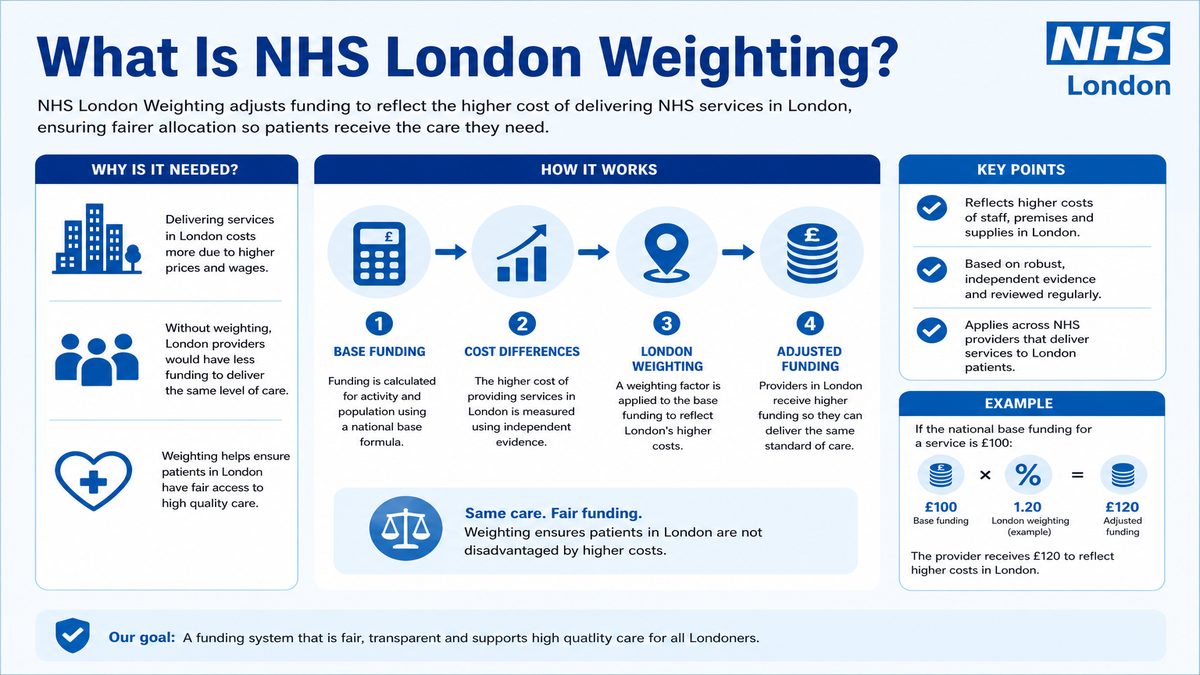
4 NHS London Weighting, formally known as the High Cost Area Supplement (HCAS), is a financial supplement for NHS staff on Agenda for Change contracts working in designated high-cost areas in and around London. It aims to offset the increased cost of living in London, which includes higher expenses for housing, transportation, and general living. 4 HCAS applies to staff employed on Agenda for Change contracts and is a separate pensionable payment added to the basic salary. It is not a discretionary bonus, and it is not a benefit paid by the government directly to NHS workers. It is a contractual supplement built into the NHS Terms and Conditions of Service Handbook and paid by your employing NHS Trust as part of your salary. 4 HCAS is divided into three geographic levels — Inner London, Outer London, and Fringe — with each zone having different payment rates applied as a percentage of the basic salary.
The supplement has roots going back to 1920, when the London Pay Board first created additional payments for public sector employees working in London. In the NHS, it now operates exclusively under the Agenda for Change (AfC) framework and is applied nationally and consistently across every qualifying Trust.
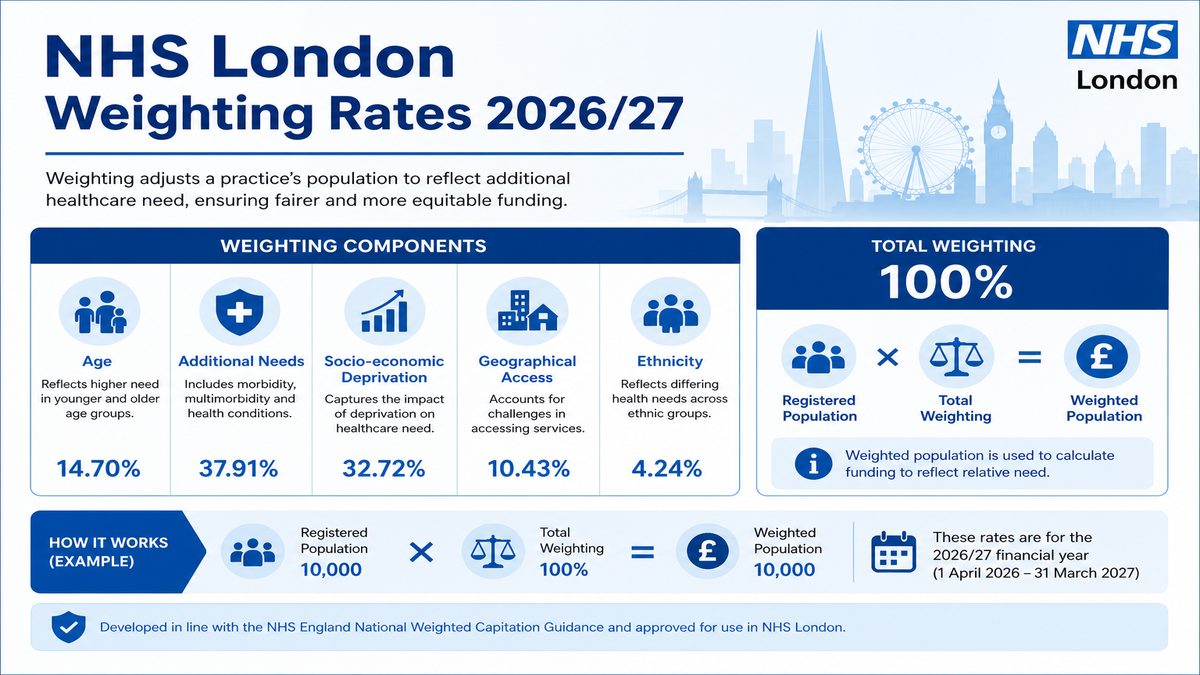
2 NHS London Weighting (HCAS) for 2026/27 increased by 3.3% in line with the pay award. 15 The NHS Pay Review Body recommended 3.3% in its 39th report in early 2026, which the UK Government accepted in full. NHS Employers published the implementing circular in February 2026, with the uplift applied to all pay points from 1 April 2026. 3 In 2026/27, Inner London is 20% of basic pay, subject to a £5,794 minimum and £8,746 maximum. Outer London is 15%, with a £4,870 minimum and £6,137 maximum. Fringe is 5%, with a £1,346 minimum and £2,270 maximum.
HCAS Zone | Rate (% of Basic Salary) | Minimum Per Year | Maximum Per Year |
Inner London | 20% | £5,794 | £8,746 |
Outer London | 15% | £4,870 | £6,137 |
Fringe | 5% | £1,346 | £2,270 |
Source: NHS Employers pay circular 2026/27, effective 1 April 2026.
1 The supplement is calculated as a percentage of your basic salary, but is subject to a minimum and maximum cap. If the percentage calculation falls below the minimum, you receive the minimum. If it exceeds the maximum, you receive the maximum. 1 For most staff in Bands 2–6, the percentage calculation falls within the range. Higher bands tend to hit the maximum cap.
The HCAS calculation follows three steps, applied in this exact order every time.
Step 1 — Apply the percentage. Multiply your basic salary by the zone rate: 20% for Inner London, 15% for Outer London, or 5% for Fringe.
Step 2 — Apply the floor and ceiling. 7If the percentage of your salary falls below the minimum, you are topped up to it. If it exceeds the maximum, you are capped at it. Lower earners often receive more than the headline percentage, and higher earners receive less.
Step 3 — Add to basic pay. The final HCAS figure is added to your Agenda for Change basic salary to produce your new gross pay.
13 The 2026/27 NHS Employers pay scale sets Band 5 entry at £32,073.
11 In practice, a Band 5 nurse at the entry step (£32,073) working in Inner London receives 20% on top, subject to the minimum and maximum — taking the total to £38,488 a year (Source: NHS Employers, 2026/27 HCAS inner table).
13 The 2026/27 pay scale shows Band 7 reaching £56,515 at the top point. Band 8a entry sits above this.
NHS London Weighting is both taxable and pensionable. 3The take-home increase is lower than the gross allowance after pension, tax, NI and any student-loan deduction.
3 The same gross HCAS does not create the same net result at every band. The reason is pension contribution tiers. 12 Pension contributions are based on actual annual pensionable pay, not simply on the Agenda for Change band. This means two staff members in the same band can pay different contribution rates if they sit in different salary ranges.
Here is the critical interaction most NHS London Weighting calculators ignore. Your basic salary might place you in one pension contribution tier. When your HCAS is added to your pensionable pay total, you may cross the boundary into a higher tier. When that happens, the higher percentage applies to your entire salary — not just the London Weighting portion. That is why a Band 7 nurse at the top of the band can end up with a smaller net HCAS uplift than a Band 6 nurse at the top of theirs.
5 Your net gain after tax and NI will be approximately 55–70% of the gross supplement shown. The precise figure depends on your total pensionable pay, tax code, whether you have a student loan, and your pension contribution tier.
Pay Band | Gross Annual HCAS | Approx. Monthly Net Uplift |
Band 2 | £5,794 (floor) | ~£340–360 |
Band 3 | £5,794 (floor) | ~£340–365 |
Band 4 | £5,794 (floor) | ~£340–370 |
Band 5 (entry) | £6,415 | ~£370–400 |
Band 6 (entry) | ~£7,992 | ~£420–460 |
Band 7 (entry) | £8,746 (cap) | ~£455–490 |
Band 8a (entry) | £8,746 (cap) | ~£440–480 |
Band 8b (entry) | £8,746 (cap) | ~£430–470 |
Note: Band 8a and 8b net uplift can be lower than Band 7 despite receiving the same gross HCAS, because the supplement may push pensionable earnings across a contribution tier boundary. Use the calculator above for your exact figure.
The table below shows gross annual HCAS at the entry pay point of each band for all three zones.
Pay Band | Basic Salary (Entry) | Inner London HCAS | Outer London HCAS | Fringe HCAS |
Band 2 | £25,272 | £5,794 (floor) | £4,870 (floor) | £1,346 (floor) |
Band 3 | £26,385 | £5,794 (floor) | £4,870 (floor) | £1,346 (floor) |
Band 4 | £28,392 | £5,794 (floor) | £4,870 (floor) | £1,420 |
Band 5 | £32,073 | £6,415 | £4,870 (floor) | £1,604 |
Band 6 | £39,959 | £7,992 | £5,994 | £1,998 |
Band 7 | £49,387 | £8,746 (cap) | £6,137 (cap) | £2,270 (cap) |
Band 8a | £53,755 | £8,746 (cap) | £6,137 (cap) | £2,270 (cap) |
Band 8b | £62,215 | £8,746 (cap) | £6,137 (cap) | £2,270 (cap) |
Band 8c | £73,664 | £8,746 (cap) | £6,137 (cap) | £2,270 (cap) |
Band 8d | £86,970 | £8,746 (cap) | £6,137 (cap) | £2,270 (cap) |
Band 9 | £105,385 | £8,746 (cap) | £6,137 (cap) | £2,270 (cap) |
Band 7 and above always hit the Inner London cap. Band 6 and above always hit the Fringe cap. Use the calculator for your exact pay point.
4 NHS London Weighting applies to three geographic zones with varying percentage rates: Inner London at 20%, Outer London at 15%, and Fringe areas at 5%.
Factor | Inner London | Outer London | Fringe |
Percentage rate | 20% | 15% | 5% |
2026/27 minimum | £5,794/year | £4,870/year | £1,346/year |
2026/27 maximum | £8,746/year | £6,137/year | £2,270/year |
Monthly gross max | £729/month | £511/month | £189/month |
1 For a Band 5 nurse on £32,073, Inner London means £6,415/year versus Outer London's £4,811/year — a difference of £1,604 per year or about £134 per month.
4 NHS London Weighting is determined by three geographic zones: Inner London, Outer London, and Fringe areas. The HCAS zones are based on historic Primary Care Trust (PCT) designations, reflecting the varying cost of living across the capital and its outskirts.
2 Inner London includes: Camden, City of London, Hackney, Hammersmith and Fulham, Haringey, Islington, Kensington and Chelsea, Lambeth, Lewisham, Newham, Southwark, Tower Hamlets, Wandsworth, Westminster, and Greenwich. 6 Hospitals located here include major teaching centres like Guy's and St Thomas', University College London Hospitals, and King's College Hospital. The cost of living and commuting into these central locations is the highest in the country. Accordingly, the financial supplement provided here is the largest. Staff working in the Inner London zone receive an uplift of 20% on top of their basic salary.
5 Boroughs typically included in the Outer London HCAS zone include: Barking and Dagenham, Barnet, Bexley, Brent, Bromley, Croydon, Ealing, Enfield, Greenwich, Harrow, Havering, Haringey, Hillingdon, Hounslow, Kingston upon Thames, Merton, Newham, Redbridge, Richmond upon Thames, Sutton, and Waltham Forest. 6 Moving further out from the centre but still firmly within the Greater London boundaries brings us to the Outer London zone. This covers areas like Barking, Havering, Redbridge, Hillingdon, and Kingston upon Thames.
1 The Fringe zone covers areas just outside the M25, including parts of Hertfordshire, Essex, Surrey, and Kent. 17 Over time, the Fringe expanded to include some areas in the "London fringe" covering parts of Surrey, Kent, Essex, Hertfordshire, and Buckinghamshire, where workers still faced higher costs due to proximity to the capital.
NHS Trusts in the Fringe zone include East and North Hertfordshire NHS Trust, Surrey and Sussex Healthcare NHS Trust, Frimley Health NHS Foundation Trust, Dartford and Gravesham NHS Trust, and Princess Alexandra Hospital NHS Trust.
17 Teachers in a school might be paid Inner London Weighting, while support staff in the exact same building receive Outer London Weighting because they are employed under different pay structures. This happens in boroughs like Haringey, Greenwich, and Newham. In the NHS, your HCAS zone is determined by your employing Trust's designation, not the local authority boundary. If you are unsure of your Trust's zone, your payslip or employment contract states the applicable HCAS level.
7 HCAS applies to staff on Agenda for Change (AfC) contracts working in a qualifying high cost area. 11 If you work for the NHS in England, your salary is almost certainly set by Agenda for Change (AfC). It covers more than a million staff — nurses, healthcare assistants, paramedics, physiotherapists, pharmacists, administrators, cleaners, scientists and managers — everyone except doctors, dentists and very senior managers. 8 All NHS Agenda for Change staff who work at a site located within a designated HCAS zone receive London Weighting. This includes nurses, allied health professionals, healthcare assistants, and administrative staff. Medical and dental staff have separate arrangements.
The following roles receive HCAS automatically if their workplace is in a qualifying zone:
Resident doctors, specialty doctors, SAS doctors, and consultants are employed on separate terms — the 2016 Resident Doctor Contract or the Consultant Contract. These contracts carry their own London zone supplements with different percentages, minimum values, and maximum caps. If you are a doctor, check the BMA rate card for your specific contract type and zone.
Very Senior Managers (VSM) on locally determined contracts negotiate any London supplement through their individual employment agreement. Bank-only workers receive HCAS on qualifying shifts only if their bank contract specifies it.
7 HCAS is treated as part of your pensionable pay, so your NHS pension contributions are calculated on your basic salary plus the supplement. 1 Yes, HCAS is fully pensionable. It is added to your basic salary for pension purposes, which increases both your pension contributions and the pension you are building up. Over a long career, the additional pension accrual from HCAS can be worth thousands of pounds per year in retirement income.
Under the NHS Pension Scheme 2015 (CARE — Career Average Revalued Earnings) section, your pension accrues at 1/54th of your pensionable earnings each year. A Band 5 nurse receiving £6,415 annual HCAS builds an additional £118.79 of annual pension for every year worked in an Inner London HCAS zone. Over a 30-year NHS career in London, that compounds to roughly £3,564 of extra annual pension income at retirement before revaluation indexing is applied.
HCAS also means your lump sum death in service benefit is calculated on a higher total pensionable pay figure. This is a genuine and often overlooked financial benefit of working in an HCAS zone.
4 NHS London Weighting is a pensionable and taxable component of the salary, calculated as a percentage of the basic salary, and is subject to minimum and maximum annual thresholds. 7 It is fully taxable and subject to National Insurance, like the rest of your earnings. Your employer deducts income tax through PAYE, Class 1 National Insurance contributions, and your NHS Pension contribution from your total pensionable pay — which includes HCAS — on every monthly payslip.
HCAS is not a tax-free allowance. It is not similar to a mileage reimbursement or subsistence payment. It is earnings. The gross figure that appears on your payslip will always be reduced by PAYE tax (20% if you are a basic rate taxpayer, 40% if your total income exceeds £50,270 for 2026/27), National Insurance at the applicable rate, and your NHS Pension contribution tier percentage.
1 Yes, but it is pro-rated based on your contracted hours. If you work 60% of full-time hours, you receive 60% of the HCAS supplement. The minimum and maximum amounts are also pro-rated accordingly.
The calculator on this page handles pro-rata HCAS automatically when you enter your FTE percentage.
8 Your HCAS zone is determined by the postcode of your workplace, not your home address. If you work at a hospital in inner London but live in Kent, you receive the inner London rate. 6 It is important to understand that the supplement is tied to your physical base of work, not where you personally live. 2 If you work under a home-based contract and your home address falls within an HCAS zone, you are entitled to HCAS at the appropriate level for your postcode. This is increasingly relevant as hybrid and community-based NHS roles expand. If you later move home outside an HCAS zone, your employer should review your supplement entitlement. Similarly, if you move into an HCAS zone, you may become eligible to receive the supplement.
If you are on a workplace-based contract but temporarily working from home by informal arrangement, your HCAS zone remains determined by your contracted workplace postcode — not your home postcode — until your contract is formally amended.
For formally designated home-based NHS contracts, the rule is clear: the HCAS zone is determined by your home postcode. For all other contracts, it is determined by your workplace site postcode. An informal work-from-home arrangement does not change your contractual HCAS entitlement.
If your Trust converts your role to a permanent home-based contract, your HR department must formally review which HCAS zone — if any — applies to your home postcode. Some community NHS workers who moved to home-based contracts during 2020–2023 found their HCAS zone reclassified when contracts were formally updated.
HCAS is part of your full pensionable pay. During NHS Occupational Maternity Pay (OMP), the pay reference period that determines your pay is based on your average weekly earnings — which includes HCAS. During the full-pay period of maternity leave, you receive your basic salary plus HCAS. During the half-pay period, the calculation is based on your OMP reference earnings, which also include HCAS.
Statutory Maternity Pay (SMP) is calculated on your average weekly earnings for the eight weeks before the 15th week before your expected due date. Because HCAS is included in those weekly earnings, it increases the SMP reference figure — meaning NHS London Weighting directly increases your SMP entitlement compared to an equivalent NHS worker outside London.
Yes. Because HCAS is added to your gross pensionable pay, it increases your total income figure. Student loan repayments are calculated on income above the repayment threshold. For Plan 2 loans in 2026/27, the threshold is £27,295 per year. Any HCAS that takes your total income above that threshold will generate additional student loan deductions. This further reduces your net take-home uplift from HCAS. The calculator on this page accounts for student loan repayments when you select your loan plan.
8 The supplement is paid automatically as part of your salary. You do not need to apply for it. If your workplace is in a designated zone, the HCAS is added to your basic pay on every payslip.
HCAS appears as a separate line item on your ESR (Electronic Staff Record) payslip. It is labelled distinctly from your basic salary, your unsocial hours enhancements, and any other payments. If your payslip does not show a separate HCAS line and your workplace is in a qualifying zone, raise this with your payroll department in writing immediately — it is a contractual entitlement, not a discretionary payment.
2 HCAS is uplifted each year as part of the Agenda for Change pay award process. If the 2027/28 award is, for example, 3%, HCAS rates will increase by the same percentage — subject to the minimum and maximum thresholds also being adjusted.
The minimum and maximum cash amounts for each zone are not simply the old rates multiplied by the percentage. They are recalculated by NHS Employers and published in the annual pay circular. Over a 10-year period, both the floor and ceiling amounts have grown, meaning lower-banded staff and higher-banded staff both receive progressively more — subject to the new cap.
It depends entirely on the advertising Trust. Some NHS Trusts quote the basic Agenda for Change salary with a note that HCAS is paid additionally. Others quote the combined figure (basic + HCAS) in the headline salary. Still others list a salary range that reflects different pay points including HCAS at various points.
The phrase "inclusive of London Weighting" on a job advert means the salary quoted already contains the HCAS. To find the underlying Agenda for Change basic salary, subtract the applicable HCAS from the quoted figure. "Plus London Weighting" or "exclusive of London Weighting" means the quoted figure is the basic AfC salary and HCAS will be paid additionally.
Always check your contract before signing — it must specify your HCAS zone and the annual supplement amount.
HCAS and unsocial hours enhancements interact in a way that consistently benefits London-based NHS workers above the headline supplement figure.
Under Agenda for Change, night shift enhancements are calculated at 30% above your basic hourly rate. Weekend enhancements are 30% above basic hourly rate on Saturdays and Sunday is enhanced at time-and-a-third. Public holiday enhancements are double time. Your basic hourly rate is derived from your basic salary — and your basic salary for this purpose includes HCAS.
This means a Band 5 nurse working a night shift in Inner London earns a night enhancement calculated on £38,488 (basic + HCAS) rather than £32,073 (basic only). The 30% night enhancement alone generates an additional ~£1.93 per hour in Inner London compared to a non-London equivalent. Over a typical rota of six night shifts per month, that compounds to roughly £277 extra per month before tax — entirely additional to the headline HCAS supplement.
For NHS employers under Agenda for Change: yes. 4HCAS rates are detailed in the NHS Terms and Conditions Handbook, maintaining consistency across the NHS workforce. This handbook is contractually binding. A Trust whose site falls within a designated HCAS zone has no discretion — it must pay the supplement.
17 For private sector employers, London Weighting is entirely discretionary. They can choose to offer it, set their own rates, or not provide it at all. 17 In the public sector, however, most government departments, the NHS, local authorities, and educational institutions have established London Weighting structures as part of their pay frameworks.
17 There is no single, standard rate for London Weighting across employers. Amounts vary significantly depending on your employer, sector, and location within Greater London.
Sector | London Supplement Type | Typical Annual Amount |
NHS (Agenda for Change) | HCAS — percentage of salary | £1,346 – £8,746 |
Civil Service | Flat-rate London allowance | ~£3,000 – £4,000 |
Teaching (STPCD) | Inner/Outer London pay spine uplift | ~£1,738 – £2,007 |
Metropolitan Police | London Allowance (flat rate) | ~£2,841 |
Local Government (NJC) | Varies by council | No national standard |
NHS HCAS is the most progressive structure among UK public sector London supplements: lower earners receive proportionally more relative to their salary (protected by the floor), and the percentage structure means mid-range earners receive a genuine cost-of-living uplift rather than a token flat rate.
This is the question most NHS London Weighting guides avoid answering honestly. 8Average monthly rent for a one-bedroom flat in inner London is approximately £1,800, compared to around £750 in a city like Manchester or Birmingham. That is a £1,050/month premium — or £12,600/year — above the Manchester average.
For a Band 5 nurse receiving £6,415 gross Inner London HCAS, the monthly net uplift after tax, NI, and pension is approximately £370–400. The London rent premium of ~£1,050/month exceeds the net HCAS by roughly £650–680 per month. HCAS closes part of the gap but does not eliminate it.
2 For years, NHS staff and unions have argued that HCAS is outdated and unfair. The supplement is based on PCT boundaries from 2005 — over 20 years ago — and does not reflect current housing costs or commute patterns across England. Critics point out that cities including Birmingham, Manchester, Bristol, and Leeds now have housing costs that rival Outer London fringe areas, yet NHS staff there receive no supplement. 2 The 2026/27 NHS Pay Review Body report acknowledged growing interest in expanding HCAS, but stopped short of recommending changes. Any reform is expected to be part of the wider Agenda for Change structural discussions happening throughout 2026.
For staff who share accommodation, live in Outer London or Fringe zones, or commute from outside the M25, the financial equation is more balanced. For a single nurse renting alone in Zone 1–2, HCAS is a meaningful but insufficient offset.
If your workplace is in an HCAS zone and no supplement appears on your payslip, follow these steps in order.
2 Your contract should specify the HCAS level. You can also check the NHS Employers pay circular for 2026/27 to verify your expected figure.
First, check your employment contract. It must state your HCAS zone. Second, contact your payroll department in writing — email with a clear subject line referencing HCAS and your payslip date. Third, if payroll does not resolve it within two pay cycles, escalate to your line manager and HR business partner. Fourth, contact your union representative — UNISON, the Royal College of Nursing (RCN), Unite, or GMB. HCAS non-payment is a contractual breach and unions can formally pursue it. Fifth, if the matter is unresolved, raise a formal grievance under your Trust's grievance procedure.
Arrears for HCAS non-payment are typically backdated to the date the entitlement began — meaning delays in raising the issue do not forfeit your right to the unpaid supplement.
This is one of the most frequently asked questions from overseas NHS recruits. HCAS is included in your gross total pay for NHS payroll purposes — it appears on your payslip and is subject to UK income tax. However, for Home Office Skilled Worker Visa purposes, the picture is more nuanced.
The Skilled Worker Visa salary threshold is assessed against your basic gross salary for the role. HCAS is classified as an allowance rather than a consolidated basic salary. This means that in some visa salary threshold calculations, HCAS may not count toward the minimum salary requirement for your Standard Occupational Classification (SOC) code.
If you are applying for a Skilled Worker Visa for an NHS role, applying for a visa extension, or moving from Student Visa to Skilled Worker Visa, verify with your Trust's HR team exactly how your total pay (basic + HCAS) is reported to the Home Office. Do not assume HCAS contributes to the visa salary floor without confirmation.
HCAS is part of your gross annual salary for mortgage affordability calculations. Because it is a guaranteed contractual supplement — not variable pay like overtime or bank shifts — most major mortgage lenders treat it as part of your regular income when assessing affordability.
To demonstrate HCAS income to a mortgage lender, provide your three most recent payslips showing the HCAS line item, your most recent P60 showing total earnings (which will include HCAS), and your NHS employment contract confirming the HCAS zone and entitlement.
Some specialist NHS mortgage brokers understand the AfC pay structure and can optimise your application by correctly presenting HCAS as pensionable guaranteed income. Standard high-street mortgage advisors may be less familiar with NHS payslip structures.
The NHS HCAS map divides the Greater London region and surrounding counties into three concentric zones:
7 Inner London covers central boroughs (20%), Outer London the surrounding boroughs (15%), and Fringe a ring of nearby counties such as parts of Hertfordshire, Essex, Kent and Surrey (5%). 7 Your zone depends on where your employing trust or site is located. 7 Your contract or payslip states which zone applies.
3 Inner London HCAS has a minimum of £5,794 and a maximum of £8,746 per year. Outer London has a minimum of £4,870 and a maximum of £6,137. Fringe has a minimum of £1,346 and a maximum of £2,270. Divided by 12, Inner London HCAS ranges from £483 to £729 per month gross. Outer London ranges from £406 to £511. Fringe ranges from £112 to £189. Use the calculator above for your exact band and pay point.
4 NHS London Weighting applies to three geographic zones with varying percentage rates: Inner London at 20%, Outer London at 15%, and Fringe areas at 5%. All percentages are subject to minimum and maximum annual cash amounts.
4 HCAS rates are detailed in the NHS Terms and Conditions Handbook, maintaining consistency across the NHS workforce. For Trusts in designated zones, it is a contractual obligation — not discretionary.
16 Yes. High Cost Area Supplements are treated as pensionable pay. This means your NHS pension contributions will be calculated based on your basic salary plus your HCAS payment.
2 Inner London staff receive 20% of basic salary, with a minimum of £5,794 and a maximum of £8,746 for 2026/27.
3 Outer London HCAS is 15% of basic pay, subject to a £4,870 minimum and £6,137 maximum in 2026/27.
It means the salary figure already contains the HCAS supplement. The basic Agenda for Change salary is lower than the advertised figure by the HCAS amount. Always confirm which is stated before accepting a job offer.
HCAS applies to bank shifts worked at sites within a qualifying HCAS zone, provided your bank contract specifies it. Check your bank terms directly with your bank bureau or employing Trust.
7 HCAS applies to staff on Agenda for Change contracts working in a qualifying high cost area. This includes nurses, midwives, healthcare assistants, allied health professionals, paramedics, pharmacists, and administrative staff. Doctors, dentists, and very senior managers have separate arrangements.
8 Your HCAS zone is determined by the postcode of your workplace, not your home address. The only exception is formally designated home-based contracts, where your home postcode determines the zone.
2 If you work under a home-based contract and your home address falls within an HCAS zone, you are entitled to HCAS at the appropriate level for your postcode. Informal working-from-home arrangements do not change your contractual zone.
For any period when NHS furlough schemes were in place, HCAS was included in the pay reference calculation because it is part of standard contractual pay. Furlough calculations were based on usual gross pay, and HCAS is part of usual gross pay.
Yes. Croydon is within the Outer London HCAS zone. NHS staff at Croydon Health Services NHS Trust receive the Outer London rate of 15% of basic salary, subject to the £4,870 minimum and £6,137 maximum for 2026/27.
5 Waltham Forest is included in the Outer London HCAS zone. NHS staff there receive 15% HCAS.
2 HCAS is uplifted each year as part of the Agenda for Change pay award process. The 2027/28 rate will be confirmed following the NHS Pay Review Body's next annual report and the government's response. Both the percentage rates and the floor/ceiling cash amounts are reviewed annually.
A Band 5 nurse at the 2026/27 entry pay point of £32,073 receives £6,415 Inner London HCAS, giving a total gross salary of £38,488. At Outer London, the same nurse receives the floor of £4,870, giving a total of £36,943. At Fringe, the supplement is £1,604, giving £33,677 total.
A Band 6 nurse at the entry pay point of £39,959 receives £7,992 Inner London HCAS (total: £47,951), £5,994 Outer London HCAS (total: £45,953), or £1,998 Fringe HCAS (total: £41,957).
A Band 7 at entry (£49,387) receives £8,746 Inner London HCAS (the cap applies — 20% of £49,387 = £9,877, which exceeds the £8,746 maximum). Total gross salary: £58,133. Outer London: £6,137 cap applies. Fringe: £2,270 cap applies.
All Band 8a pay points generate an HCAS percentage above the Inner London maximum of £8,746. All Band 8a staff in Inner London receive exactly £8,746. All Band 8a staff in Outer London receive exactly £6,137. All Band 8a staff in Fringe receive exactly £2,270.
1 Yes, it is pro-rated based on contracted hours. If you work 60% of full-time hours, you receive 60% of the HCAS supplement. The pro-rated floor and ceiling apply accordingly.
The 2026/27 London Weighting allowance (HCAS) ranges from £1,346 (Fringe minimum) to £8,746 (Inner London maximum) for full-time Agenda for Change staff. 2NHS London Weighting for 2026/27 increased by 3.3% in line with the pay award, effective 1 April 2026.