 Take Home Pay
Take Home Pay
Take Home Pay
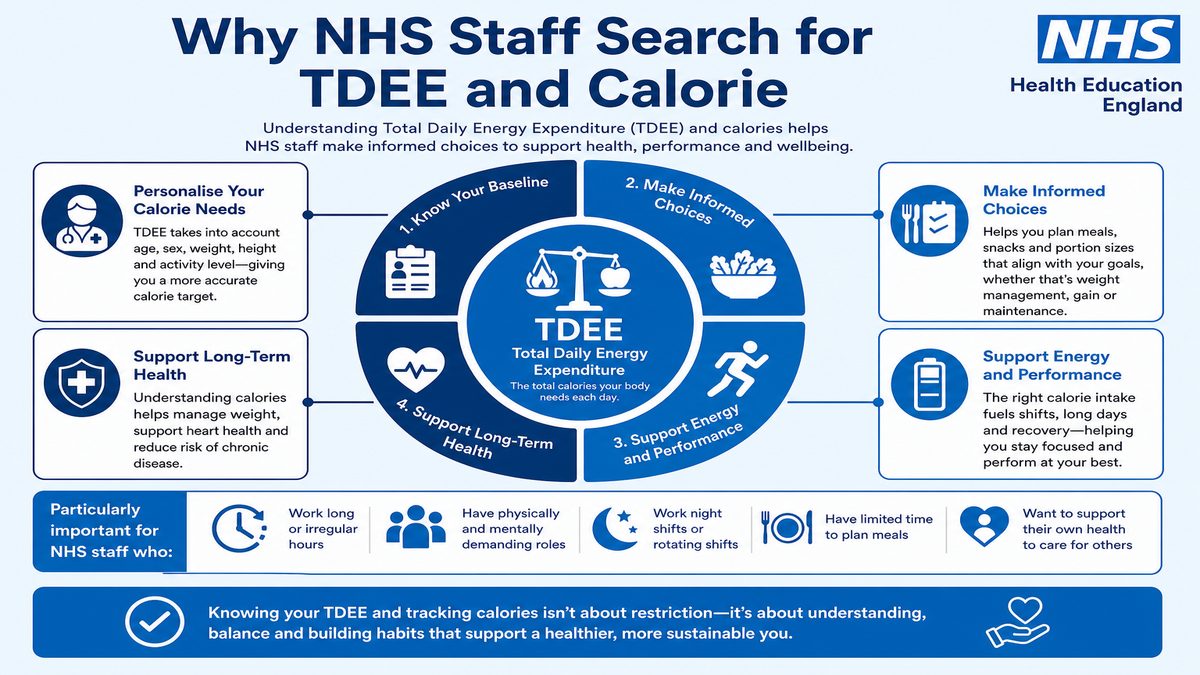
NHS nurses, midwives, allied health professionals (AHPs), healthcare assistants, doctors and support staff increasingly search for total daily energy expenditure (TDEE) and calorie-deficit guidance because shift work, irregular meal timing and high physical demand make “generic” diet advice feel unrealistic. A desk-based 2,000-calorie slogan does not reflect a 12-hour acute ward, a night in ED, community walking visits, or theatre lists with long standing periods. Estimating TDEE gives a personalised starting point for weight management, performance and recovery without pretending one number fits every roster.
This page explains how a practical TDEE estimate is built from basal metabolic rate (BMR), activity multipliers and NHS-relevant lifestyle factors. It also covers calorie deficits for fat loss, surpluses for gaining weight or supporting training, protein targets, BMI categories, sleep disruption and appetite, and when to seek a clinical dietitian. The on-page calculator applies these concepts interactively. This content is general wellbeing information, not medical advice, diagnosis or treatment. If you have a medical condition, disordered eating history, are pregnant, breastfeeding, or underweight, speak to a qualified clinician before changing your diet.
Official lifestyle guidance from the NHS remains the baseline for population health messaging—see NHS Live Well: healthy weight and NHS Better Health. Use the calculator as an educational tool alongside those resources, not as a substitute for personal clinical care.
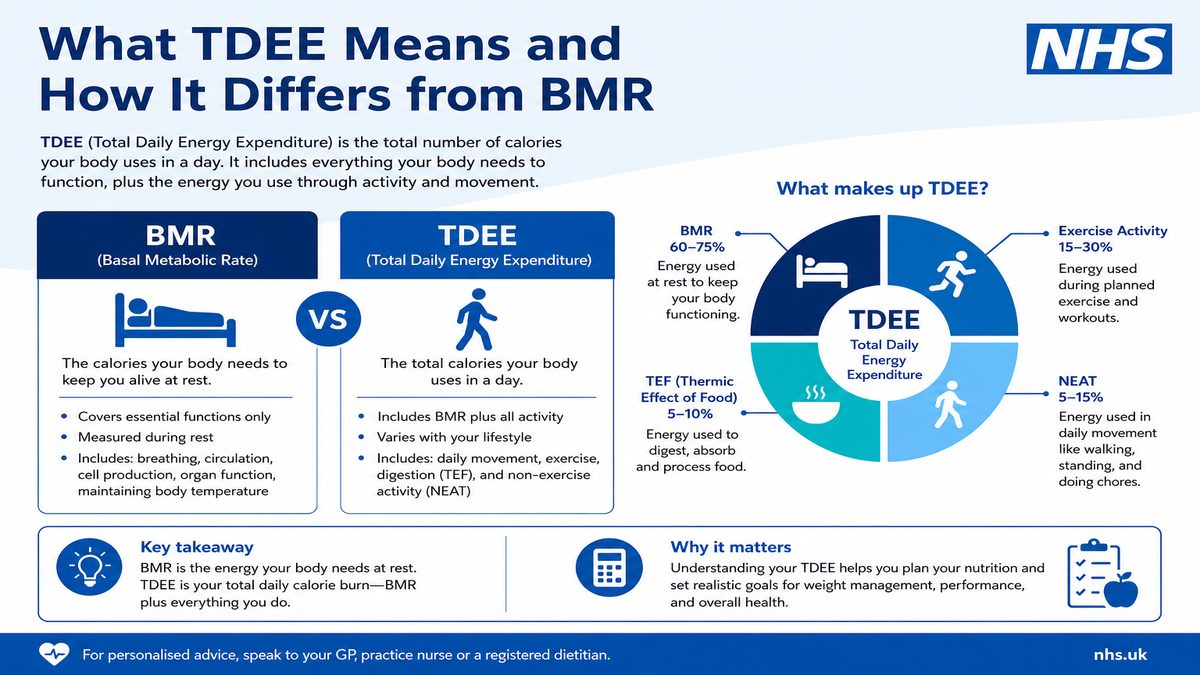
Basal metabolic rate (BMR) is an estimate of the calories your body would burn at complete rest to maintain essential functions such as breathing, circulation and cellular metabolism. Total daily energy expenditure (TDEE) is BMR plus the energy cost of daily movement, occupational activity, exercise and the thermic effect of food. In plain terms: BMR is the engine idling; TDEE is the full day including your shifts, commute, training and fidgeting.
For weight stability over time, average energy intake needs to roughly match average TDEE. Sustained intake below TDEE tends to produce fat loss (and some lean-mass loss if protein and resistance work are inadequate). Sustained intake above TDEE tends to produce weight gain. The size and consistency of the gap matter more than any single “perfect” calorie day—especially on rotating NHS rotas where appetite and opportunity to eat swing widely between long days, nights and rest days.
Equations are population averages. Two Band 5 nurses of identical height, weight, age and sex can differ in muscle mass, thyroid status, medications, sleep debt and non-exercise activity. Treat calculator outputs as a starting range (±10% is a sensible mental band) and adjust based on 2–4 weeks of average weight trend, energy, mood and work performance—not on overnight scale noise.
Many modern calculators, including educational tools used by health-interested adults, estimate BMR with the Mifflin–St Jeor equation. It is widely regarded as a robust practical formula for adults compared with older alternatives in many validation contexts, though no equation is perfect for every individual.
In kilocalories per day, Mifflin–St Jeor is commonly stated as:
Example: a 34-year-old woman, 68 kg, 165 cm:
That BMR is not yet a daily target. It must be multiplied by an activity factor to approximate TDEE before you choose a deficit or surplus.
Classic Harris–Benedict–style activity multipliers are still used as rough TDEE scalers:
| Activity description | Typical multiplier | NHS-oriented illustration |
|---|---|---|
| Sedentary | × 1.2 | Mostly desk/admin day, little walking, no training |
| Lightly active | × 1.375 | Light ward walking or 1–3 easy training sessions/week |
| Moderately active | × 1.55 | Typical acute ward/community day with regular on-feet time |
| Very active | × 1.725 | Long 12-hour clinical shifts, frequent stairs/manual handling, plus training |
| Extra active | × 1.9 | Very high physical workload most days (use cautiously; often overestimates) |
Continuing the earlier example (BMR ≈ 1,380 kcal):
NHS staff often mis-classify activity. A “quiet” admin day is not the same as a medical assessment unit late shift. Conversely, labelling every working day as “extra active” can inflate TDEE and stall fat-loss progress. When unsure, start one category lower than your optimistic guess, then raise intake if weight falls faster than planned or energy collapses on shift.
Shift patterns change both energy burn and appetite regulation. Twelve-hour shifts increase time on feet, reduce structured meal windows and can push staff toward convenient ultra-processed snacks from hospital shops or vending machines. Night duty disrupts circadian cues that normally coordinate hunger hormones, insulin sensitivity and sleep pressure. The result is familiar: low appetite at “breakfast” after nights, intense cravings before trying to sleep in daylight, and irregular protein distribution across 24 hours.
Energy demand on nights is not automatically higher than days for every role—some night shifts are less physically intense—but sleep loss itself can increase perceived hunger and preference for energy-dense foods. That means calorie control on nights is often harder even when TDEE is similar. Practical tactics matter as much as the number:
NHS organisational wellbeing pages and national healthy-lifestyle campaigns reinforce sleep, movement and balanced eating as linked behaviours—not isolated calorie maths. See NHS guidance on sleep and tiredness alongside weight resources.
A 12.5-hour duty with commuting can mean 14+ hours away from home kitchen control. That extends the eating window and raises the chance of duplicate meals (“I already ate at work, then again when I got home”). TDEE may be higher on those days, but unplanned intake often rises even more. Many staff do better with a weekly average calorie target plus higher-flexibility rest days, rather than rigid identical targets every calendar day.
A calorie deficit means consuming less energy than your estimated TDEE on average. Two common planning deficits are:
Using the moderate TDEE example of ≈ 2,140 kcal:
| Goal | Daily target (approx.) | Expected pace (very approximate) |
|---|---|---|
| Maintenance | 2,140 kcal | Weight stable over weeks |
| Mild deficit (−250) | 1,890 kcal | Gradual fat loss; better adherence for many shift workers |
| Standard deficit (−500) | 1,640 kcal | Faster loss if adherence holds; watch energy on long shifts |
Aggressive deficits below about 1,200 kcal/day for many adults are generally inappropriate without clinical supervision and can harm training quality, immune resilience and concentration—outcomes NHS staff cannot safely gamble with. If hunger, dizziness, cold intolerance or binge–restrict cycles appear, widen the deficit, raise protein, improve sleep opportunity, or seek professional support.
For population advice on losing weight safely, NHS pages such as NHS: start losing weight emphasise sustainable habits over crash approaches.
Not every NHS staff member wants to lose weight. Recovery from illness, athletic goals, or being underweight may call for a surplus—eating above TDEE. A modest surplus of about +200 to +300 kcal/day supports gradual gain with less excess fat than large surpluses. Pair surplus calories with progressive resistance training and adequate protein so more of the gain is lean tissue.
Underweight staff, or anyone with a suspected eating disorder, should not self-prescribe aggressive surplus or deficit plans from a web calculator. Use NHS clinical pathways and dietetic referral where indicated. Start with NHS advice for underweight adults if BMI is low or weight loss is unintentional.
Protein helps preserve lean mass in a deficit and supports recovery from physically demanding work. A practical target used in many sports-nutrition contexts for adults aiming to lose fat or train hard is around 1.6 g of protein per kilogram of body weight per day, adjusted for clinical constraints (for example, some kidney conditions require tailored medical advice).
For a 68 kg clinician: 1.6 × 68 ≈ 110 g protein/day. Distributed across meals, that might look like 30–40 g at each of three eating occasions plus a smaller snack—more realistic than one huge protein hit at 20:00 after a late finish.
Remaining calories can come from carbohydrate and fat according to preference, culture and shift timing. Many nurses feel better with more carbohydrate before or during physically heavy duties and a calmer, protein-forward meal before daytime sleep after nights. There is no single “NHS macro ratio,” and extreme low-carb approaches can be hard to sustain around unpredictable breaks.
Body mass index (BMI) is weight in kilograms divided by height in metres squared. NHS adult categories are commonly summarised as:
| BMI (kg/m²) | Category (general adult guidance) |
|---|---|
| Below 18.5 | Underweight |
| 18.5–24.9 | Healthy weight range (general population framing) |
| 25–29.9 | Overweight |
| 30 and above | Obesity (with further clinical subclasses in care pathways) |
BMI does not directly measure body fat, fitness, or cardiometabolic risk. Muscular staff can show a higher BMI without excess fat; others can have a “normal” BMI with poor diet quality and low fitness. Ethnicity-specific risk thresholds are also used in UK clinical practice for some groups when assessing type 2 diabetes risk. Use BMI as one screening lens, then consider waist circumference, blood pressure, lipids, glucose, family history and how you feel at work. Official explainer: NHS BMI calculator and categories.
Sleep restriction alters leptin and ghrelin signalling, increases reward-driven eating and reduces inhibitory control—exactly when a ward fridge pastry is easiest. Night workers may also experience social jet lag: trying to live on a day schedule on days off while working opposite hours on duty. That oscillation makes consistent calorie adherence harder than the TDEE equation suggests.
Supportive strategies for NHS rotas:
If insomnia, possible sleep apnoea, or mental health symptoms are prominent, calorie fine-tuning is secondary—seek appropriate NHS clinical support. Lifestyle sleep advice is summarised on NHS: how to get to sleep.
Sustainable change beats perfect tracking. NHS staff who succeed long term usually build systems that survive late finishes:
Occupational health, staff physiotherapy and trust wellbeing offers can complement personal habits. National campaigns via NHS Better Health provide structured quitting, activity and weight-support entry points.
See a GP or ask about dietetic referral if you have unexplained weight change, BMI in underweight or obesity ranges with complications, diabetes, gastrointestinal disease, food insecurity coupled with medical need, pregnancy nutrition concerns, or a history of eating disorders. Calculators cannot triage clinical risk.
Seek urgent help if calorie control thoughts become compulsive, if you are purging, if work performance is collapsing around food restriction, or if colleagues/family express concern about rapid weight loss. NHS mental health and eating-disorder pathways exist for a reason; lifestyle articles are not treatment.
For general healthy-eating foundations aligned with UK guidance, see NHS Eat Well. Government dietary reference frameworks are also summarised via GOV.UK Eatwell Guide.
The calculator on this page is an educational estimator. Conceptually it:
It does not measure your metabolic rate directly, does not know your roster next month, and does not adjust automatically for illness, pregnancy, lactation, or medications that affect weight. Re-run estimates when body weight changes materially, and prioritise how you feel on shift over chasing a static number.
This page and calculator provide general information for NHS staff wellbeing education only. They are not medical advice, not a personalised nutrition prescription, and not a substitute for assessment by a GP, registered dietitian or other qualified professional. Do not start a low-calorie diet if you are under 18, pregnant, breastfeeding, underweight, recovering from disordered eating, or living with a condition that requires therapeutic nutrition—unless a clinician has agreed the plan. If you feel unwell while changing intake, stop and seek clinical advice.
TDEE is the estimated number of calories you burn in a full day, including rest metabolism and activity. Matching intake to TDEE tends to maintain weight; eating below it tends to produce loss over time; eating above it tends to produce gain.
It is a solid population equation for many adults, but shift workers should treat the result as a starting estimate. Validate against your average weight trend over several weeks and adjust.
Not necessarily. Many people do better with a weekly average: slightly higher intake on the most demanding duties if hunger and performance require it, and steadier intake on rest days—while keeping the weekly mean near the goal.
It can be appropriate for some healthy adults, but others need a milder −250 approach to protect concentration and mood. If you feel faint, irritable or binge-prone, the deficit is too aggressive for your current context.
Around 1.6 g per kg body weight per day is a widely used practical target for adults in a fat-loss or training phase, unless a clinician advises otherwise for medical reasons.
No. BMI is a screening tool. Combine it with waist measures, blood results, fitness, family history and clinical judgement. See the NHS BMI guidance.
Sleep disruption affects appetite hormones and decision fatigue. Pre-packed meals, protein-forward snacks and protecting daytime sleep often help more than willpower alone.
Yes, if protein is adequate, progressive resistance training fits the roster, and calories are at maintenance or a small surplus. Progress will be slower during brutal rota blocks—plan deloads around nights.
If weight change is unintentional, if BMI is very high or very low with symptoms, if you have chronic disease needing therapeutic diets, or if eating behaviours feel out of control. Ask your GP about dietetic or specialist referral.
Start with NHS healthy weight, NHS Better Health, and the GOV.UK Eatwell Guide.
Estimate BMR with Mifflin–St Jeor, scale to TDEE with an honest activity factor, then choose maintenance, a mild (−250) or standard (−500) deficit, or a modest surplus based on your goal. Anchor protein near 1.6 g/kg, respect BMI as context rather than destiny, and design habits that survive nights and 12-hour duties. Recalculate when your weight or role intensity changes, and escalate to clinical care when numbers are not the real problem.
Use the calculator above to generate a personalised starting range, then let two to four weeks of real roster life—and official NHS lifestyle guidance—decide your next adjustment.