 Take Home Pay
Take Home Pay
Take Home Pay
Find out exactly how much mortgage you can afford on your NHS salary. This calculator uses your Agenda for Change pay band, your NHS Pension Scheme contribution tier, and the income multiple that applies to your role — so the result reflects what a lender actually sees, not just your gross pay.
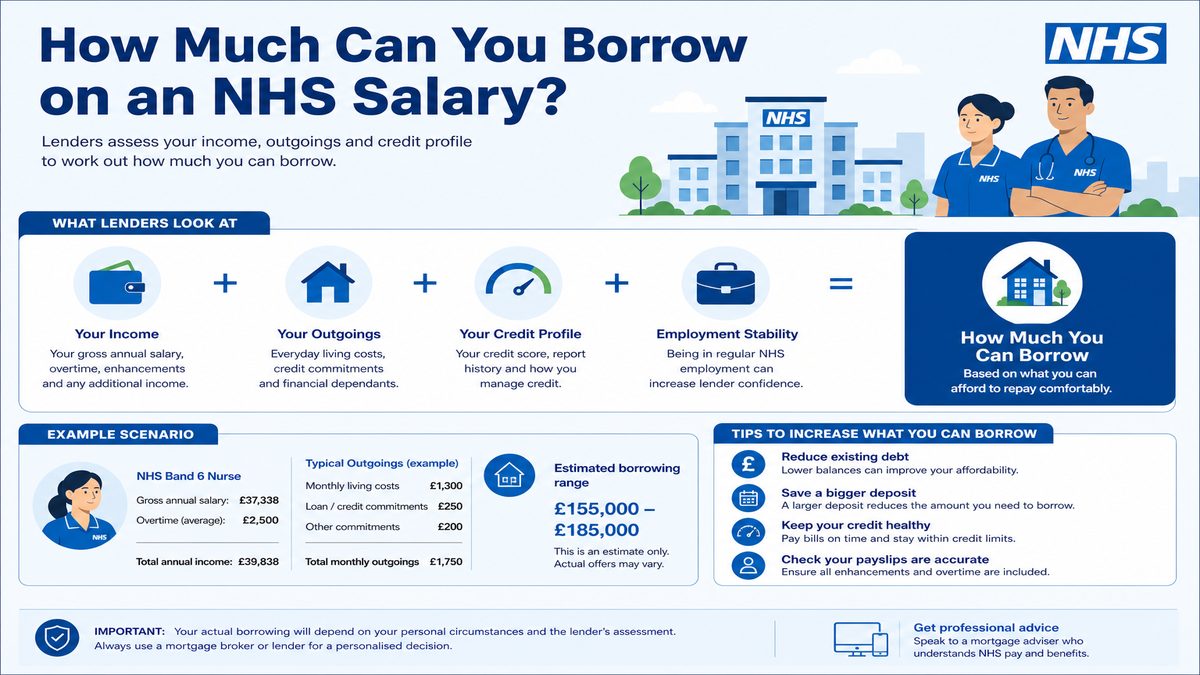
19 Most lenders are willing to lend an applicant around 4.5 times their salary for a mortgage, but NHS staff can sometimes be eligible for higher lending schemes that let you borrow up to 5.5 or 6.5 times their salary.
The reason NHS staff access higher borrowing is straightforward. 19The key difference between NHS staff and other applicants is that lenders consider job security and future income potential when assessing affordability — not just current income. This is particularly helpful if you are at the start of your career and have the potential to progress to more senior or better paid roles in the future.
This calculator gives you three borrowing figures side by side:
Add your deposit to any of these figures to see your total property budget instantly.
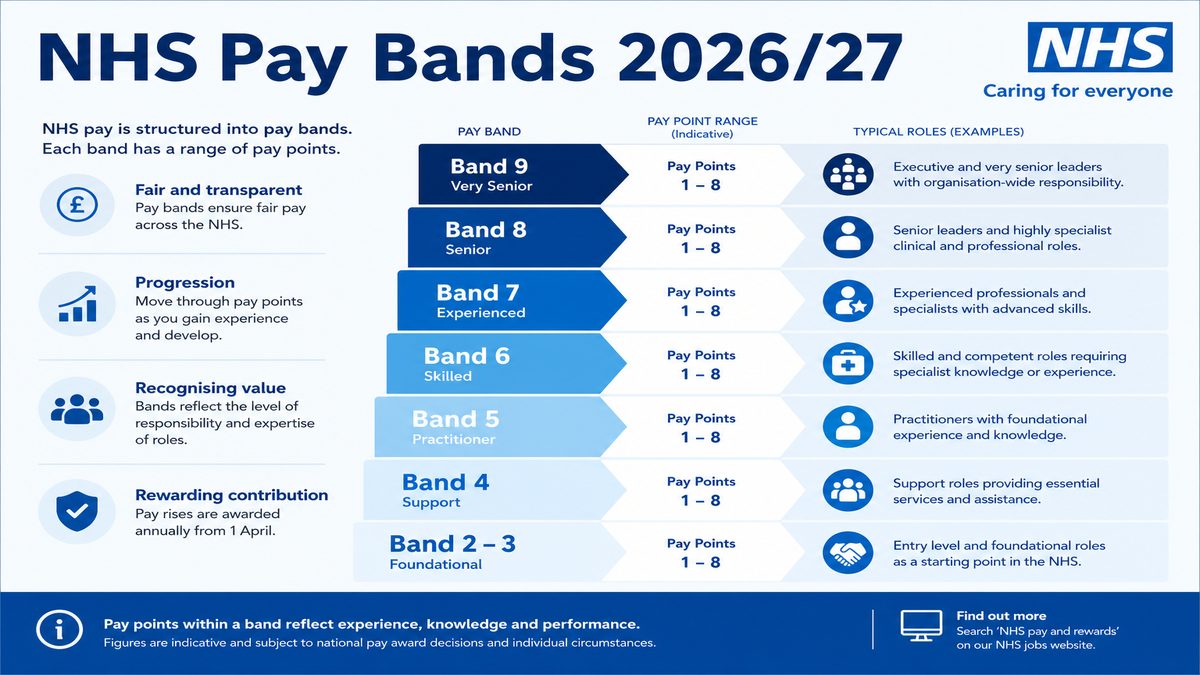
2 The NHS uses Agenda for Change (AfC) to set pay for most staff. This system divides roles into nine pay bands, with Band 2 being entry-level and Band 9 covering senior executives. Each band has pay step points. You start at the entry point and move up through steps based on years of service. This is called pay progression. 26 NHS pay in England is determined by the Agenda for Change framework, which covers all directly employed NHS staff except doctors, dentists, and very senior managers. The system was introduced in 2004 to create a single, transparent pay structure across the health service. 3 The current pay scales for 2026/27 include a 3.3% pay rise, with salary ranges for each band from Band 2 through Band 9. 1 The 2026/27 figures reflect the 3.3% award applied from April 2026 and are the latest officially published scales.
The table below shows the current 2026/27 England Agenda for Change salary ranges for every band, the correct NHS Pension contribution tier, and what you can borrow at both the standard 4.5× and enhanced 5.5× income multiples. All salary figures are sourced from NHS Employers (nhsemployers.org).
Band | Entry Salary | Top of Band | Pension Rate | Borrow at 4.5× | Borrow at 5.5× |
Band 2 | £25,272 | £25,272 | 6.5% | £113,724 | £139,000 |
Band 3 | £24,916 | £26,446 | 6.5% | £112,122 | £137,039 |
Band 4 | £27,485 | £29,551 | 6.5% | £123,683 | £151,168 |
Band 5 | £32,073 | £39,043 | 8.3% | £144,329 | £176,402 |
Band 6 | £39,205 | £47,084 | 9.8% | £176,423 | £215,628 |
Band 7 | £47,810 | £54,825 | 9.8% | £215,145 | £263,011 |
Band 8a | £56,388 | £65,269 | 10.7% | £253,746 | £310,135 |
Band 8b | £65,664 | £75,990 | 10.7% | £295,488 | £361,152 |
Band 8c | £78,192 | £90,387 | 12.5% | £351,864 | £430,280 |
Band 8d | £93,735 | £108,075 | 12.5% | £421,808 | £515,765 |
Band 9 | £109,475 | £129,783 | 12.5% | £492,638 | £602,330 |
Salary data: NHS Employers 2026/27 pay scales, effective 1 April 2026 (nhsemployers.org). Pension rates: NHSBSA / NHS Pay Calculator 2026/27. Borrowing figures are estimates based on gross salary before pension deduction. Lender offers depend on full affordability assessment.
Before using the calculator, confirm which band applies to your role.
29 Band 2 staff include healthcare assistants, receptionists, phlebotomists, administrative staff, domestic staff, and catering staff. 29 Band 3 staff include clinical support workers, therapy assistants, pharmacy assistants, administrative workers, and clerical staff. 29 Band 4 staff include nursing associates, associate practitioners, pharmacy technicians, bed managers, and senior clerical staff. 29 Band 5 staff include nurses, newly qualified midwives, paramedics, physiotherapists, occupational therapists, and speech therapists. 29 Band 6 staff include junior sisters, charge nurses, midwives, paramedics, newly qualified pharmacists, and biomedical scientists. 29 Band 7 staff include ward sisters, charge nurses, senior physiotherapists, occupational therapists, pharmacists, and senior midwives. 29 Band 8a staff include matrons, advanced clinical practitioners, service managers, and specialty leads. 24 Bands 6 and 7 cover specialist and senior clinical roles, team leaders, and ward managers. Bands 8a to 8d and Band 9 are reserved for very senior managers, consultants, and directors.
14 All NHS Pension Scheme members pay a percentage of their pensionable pay to the scheme each month. This is called a contribution rate.
Mortgage lenders assess your net disposable income — the money left after income tax, National Insurance, and pension deductions. The NHS Pension contribution is the variable most NHS staff overlook when estimating their borrowing power, and it is the one that differs most significantly between bands.
9 As of 1 April 2026, the contribution rates are: 5.2% for earnings up to £13,259; 6.5% for £13,260 to £28,854; 8.3% for £28,855 to £35,155; 9.8% for £35,156 to £52,778; 10.7% for £52,779 to £67,668; and 12.5% for earnings of £67,669 and above. 14 The Department of Health and Social Care has confirmed that salary ranges are automatically reviewed each year on 1 April. These reviews are based on the percentage increase in the Consumer Price Index (CPI), except for the lowest tier. 11 Your contribution comes out of your salary before income tax is calculated, so you get tax relief automatically without needing to claim. 9 Employers contribute a flat rate of 23.7% of pensionable pay, making the NHS Pension Scheme one of the most generous in the UK. This employer contribution does not come out of your pay, but it is a significant part of your total employment package that lenders recognise when assessing NHS income stability.
A practical example: A Band 5 nurse at the entry point of £32,073 pays 8.3% pension (£2,662 per year). A Band 6 specialist nurse at £39,205 pays 9.8% pension (£3,842 per year). The higher rate at Band 6 partially offsets the salary increase in terms of net disposable income. This calculator applies the correct tier automatically so you see your real borrowing position.
The standard income multiple of 4.5 times gross annual salary applies to all NHS staff using mainstream lenders without professional mortgage criteria. This is the most widely available option and the baseline figure this calculator shows.
Example: Band 5 nurse at £32,073 × 4.5 = £144,329 maximum borrowing.
17 Where most lenders cap borrowing at around 4 to 4.5 times income, specialist lenders working with NHS employees may stretch to 5, 5.5, or even 6 times income for certain professions. 17 This is particularly valuable for doctors, dentists, and senior clinicians, but nurses, paramedics, and other clinical staff also benefit from lenders who understand bank shifts, locum income, and unsocial hours enhancements.
Example: Band 6 midwife at £39,205 × 5.5 = £215,628 maximum borrowing — compared to only £176,423 at 4.5×. The difference is £39,205 in borrowing capacity from the same salary.
19 You can potentially borrow 5.5× to 6.5× your salary through professional mortgages, compared to the standard 4.5×. 19 Lenders often consider future income potential and job security rather than just current salary. 16 What does exist is a number of mortgage lenders — both high street banks and specialist providers — offering preferential terms, enhanced income multiples, and more flexible underwriting criteria for NHS staff as part of what is called a professional mortgage.
17 There is no single official NHS mortgage scheme operating in 2026. However, many UK mortgage lenders recognise the stability and reliability of National Health Service employment and offer enhanced terms to NHS workers. These benefits typically come in the form of higher income multiples, flexible treatment of overtime and shift pay, and a more sympathetic view of complex NHS income structures. 17 Most mortgage products marketed to NHS professionals are standard residential mortgages with key worker or professional borrower enhancements rather than separate NHS-branded loans. 23 What matters most is not whether something is labelled or advertised as an NHS mortgage — it is most important to understand whether your chosen lender recognises how your income actually works and assesses it accordingly.
23 Across the NHS, income is often made up of several different income streams. Examples include earnings from additional overtime, night shifts, bank work, or other additional roles. 23 Each of these income enhancements adds to your total income on paper. However, each lender has their own criteria and can view these enhancements very differently. Some lenders may include additional forms of income in full, while others may only take a limited percentage, and some may not consider them at all. It is this difference in how income is interpreted that can have a significant impact on how much you are able to borrow.
The following table shows how different types of NHS variable income are typically treated by UK mortgage lenders in 2026:
Income Type | Typical Lender Treatment |
Agenda for Change base salary | Accepted at 100% by all lenders |
Unsocial hours enhancement | Accepted by most lenders — 3 to 6 months of payslips required |
Bank / agency shifts | Averaged over 6 to 12 months; specialist lenders more flexible |
Contracted overtime | Accepted by most lenders at 50%–100% |
Non-contracted overtime | Averaged; fewer lenders accept in full |
On-call allowance | Accepted if regular and shown on payslips |
High Cost Area Supplement (HCAS) | Treated as guaranteed income by most lenders |
Locum income (self-employed) | Requires 1–2 years of accounts; specialist lenders only |
3 The High Cost Area Supplement (HCAS) is an additional pensionable payment for Agenda for Change staff working in or around London. HCAS is calculated as a percentage of basic salary across three geographic zones: Inner London at 20%, Outer London at 15%, and the Fringe area at 5%. 6 The Inner London HCAS is 20% of basic salary, subject to a minimum payment of £5,794 and a maximum payment of £8,746. 6 The Fringe zone HCAS is 5% of basic salary, subject to a minimum payment of £1,346 and a maximum payment of £2,270.
Because HCAS is pensionable and paid as part of your regular monthly salary, most lenders treat it as guaranteed income. This increases your qualifying income figure and therefore your maximum borrowing.
Example: A Band 5 nurse in Inner London at £32,073 base + £6,415 Inner London HCAS (20%) = £38,488 qualifying income. At 4.5× = £173,196 borrowing compared to £144,329 outside London. The HCAS supplement adds £28,867 in borrowing capacity.
The calculator combines your maximum borrowing with your deposit to show your total property budget and your LTV ratio.
20 If you are purchasing a property with an NHS mortgage or other key worker scheme, you may only need to put down a 5% deposit. This can be extremely helpful for first-time buyers who have only a small amount saved.
The LTV ratio determines which mortgage products you can access and what interest rate you will pay:
Your Deposit | LTV Ratio | Product Access |
5% | 95% | Limited product range; higher interest rates |
10% | 90% | Significantly wider product range |
15% | 85% | Access to most competitive products |
20% | 80% | Optimal rate tier for most lenders |
25% or more | 75% or below | Best available rates across all lenders |
Example — Band 6 specialist nurse: Entry salary £39,205 × 4.5 = £176,423 borrowing. With £20,000 deposit, total property budget = £196,423. LTV = 89.8%, placing this buyer in the 10% deposit product tier.
The calculator gives you an estimate. A lender's affordability assessment goes further and checks several additional factors.
23 Lenders are looking for a stable income, evidence of a sensible financial foundation, and the confidence that repayments can be maintained over time.
The key factors a lender checks for NHS staff:
Income verification: 21You will need to provide supporting evidence with your application, including three months of payslips or a copy of a contract if you are a new starter.
Existing commitments: Student loan repayments, car finance, credit cards, and childcare costs all reduce your net disposable income. Plan 1 student loans deduct 9% on earnings above £22,015. Plan 2 deducts 9% above £27,295.
Pension deduction impact: 24NHS pay band salaries are gross figures before any deductions. Your take-home pay will be lower after income tax, National Insurance, and NHS Pension contributions are deducted. Pension contribution rates range from 5.2% to 12.5% depending on your salary.
Credit history: 23In reality it will always come down to your personal financial circumstances, including your income, deposit, credit history, and how all of that is assessed by a lender.
Stress testing: Lenders test whether you could maintain repayments if interest rates were to increase after you take out the mortgage. This is a regulatory requirement across all UK residential mortgage lending.
All figures use the 2026/27 entry-point salary (England), the standard 4.5× income multiple, and assume a £15,000 deposit. Professional mortgage borrowing uses 5.5×. All salary data sourced from NHS Employers (nhsemployers.org). Pension tiers sourced from NHSBSA (nhsbsa.nhs.uk).
Band | Entry Salary | Pension Rate | Max Borrow (4.5×) | Max Borrow (5.5×) | + £15k Deposit (4.5×) |
Band 2 | £25,272 | 6.5% | £113,724 | £139,000 | £128,724 |
Band 3 | £24,916 | 6.5% | £112,122 | £137,039 | £127,122 |
Band 4 | £27,485 | 6.5% | £123,683 | £151,168 | £138,683 |
Band 5 | £32,073 | 8.3% | £144,329 | £176,402 | £159,329 |
Band 6 | £39,205 | 9.8% | £176,423 | £215,628 | £191,423 |
Band 7 | £47,810 | 9.8% | £215,145 | £263,011 | £230,145 |
Band 8a | £56,388 | 10.7% | £253,746 | £310,135 | £268,746 |
Band 8b | £65,664 | 10.7% | £295,488 | £361,152 | £310,488 |
Band 8c | £78,192 | 12.5% | £351,864 | £430,280 | £366,864 |
Band 8d | £93,735 | 12.5% | £421,808 | £515,765 | £436,808 |
Band 9 | £109,475 | 12.5% | £492,638 | £602,330 | £507,638 |
18 NHS workers do not automatically receive special mortgage rates, but some lenders do recognise NHS employees as key workers and may offer enhanced income multiples and more flexible affordability assessments. 18 These benefits usually only apply to the NHS applicant, not both parties. The non-NHS applicant's income is typically assessed at the standard 4.5× multiple.
Example joint application: Band 5 nurse at £32,073 (professional multiple 5.5×) + non-clinical partner at £28,000 (standard 4.5×):
The calculator supports joint inputs. Enter both salaries and select the correct multiple for each applicant.
19 Options for NHS staff include professional mortgages, 5× income mortgages, and various guarantor mortgage or Shared Ownership schemes. 16 Beyond lender-specific criteria, several government-backed schemes can help make homeownership more accessible, particularly for first-time buyers. The First Homes scheme offers eligible first-time buyers a discount of 30% to 50% off certain new-build properties. Local councils can set their own eligibility conditions, and many councils explicitly prioritise key workers, including NHS staff, for First Homes properties. 21 Government schemes for NHS professionals to consider include Shared Ownership and the First Homes Scheme.
Note: The original NHS Key Worker Mortgage Scheme no longer operates. 22The NHS Key Worker Mortgage Scheme covered specific roles within the NHS. However, that scheme has ended, and new options are now available for all NHS employees, including both clinical and non-clinical staff.
28 On the 2026/27 England pay scale, a newly qualified Band 5 nurse earns £32,073 a year gross. At the standard 4.5× income multiple, this produces a maximum borrowing of **£144,329**. With a professional mortgage at 5.5×, the maximum increases to **£176,402**. At the top of Band 5 (£39,043), the figures rise to £175,694 at 4.5× and £214,737 at 5.5×. Add your deposit to either figure for your total property budget.
19 NHS workers are viewed as low-risk, often qualifying for lower interest rates and smaller deposits. 20 Professional career paths in the NHS are seen as more secure and likely to enjoy structured salary increases, so mortgage lenders see borrowers in key worker roles as less risky. This translates into higher income multiples and more flexible treatment of variable income, not a separate product.
Yes, directly. 9NHS Pension contribution rates are structured as tiered deductions from employees' pensionable pay. These rates are determined by the tier system, which categorises contributions based on actual annual pensionable pay. As of 1 April 2026, the contribution rates are organised into six tiers, with rates ranging from 5.2% to 12.5%. The tier system assigns each employee to a specific contribution rate based on their pensionable pay, impacting take-home pay by reducing it in proportion to the percentage of their tier. Lenders assess affordability on your net income, so the higher your pension contribution tier, the lower your disposable income — and the lower your stress-tested maximum borrowing.
23 Income from additional overtime, night shifts, and bank work adds to total income on paper. However, each lender has their own criteria and can view these enhancements very differently. Some lenders include additional forms of income in full, while others take a limited percentage, and some do not consider them at all. The difference between the most and least flexible lender on NHS variable income can run to tens of thousands of pounds in borrowing capacity. This is the strongest argument for using a mortgage broker who works with NHS applicants regularly.
20 If you are purchasing a property with an NHS mortgage or key worker scheme, you may only need to put down a 5% deposit. However, a 5% deposit places you at a 95% LTV, which carries higher interest rates and a narrower product range. A 10–15% deposit unlocks significantly better rates and is the recommended minimum for most NHS applicants who can achieve it.
22 A newly qualified doctor, for instance, typically faces an affordability assessment. Lenders are reassured by the transparency of NHS and public sector income arrangements, which are available on government websites. They can see that a doctor's basic starting salary is likely to increase and that long-term affordability should only improve. The same reasoning applies to nurses, allied health professionals, and other clinical staff on fixed-term contracts. Specialist lenders understand that fixed-term NHS contracts structurally renew and treat employment history as a stronger signal than contract type.
28 For a Band 5 newly qualified nurse in England, the headline figure rose from £31,049 to £32,073 — an increase of £1,024. For a Band 6 specialist nurse, it went from £38,682 to £39,959 — an increase of £1,277. At the standard 4.5× multiple, a £1,024 pay rise adds **£4,608** to your maximum borrowing. A £1,277 rise adds **£5,747**. The 3.3% award effective April 2026 therefore increases borrowing capacity meaningfully across every band.
25 England, Wales, Scotland, and Northern Ireland negotiate NHS pay separately, so the pay scales differ between the four nations. 4 Welsh NHS salaries include an additional 1.5% Welsh Government premium on all Agenda for Change points. There is no London weighting in Wales. 9 NHS Pension contribution rates in Scotland differ from those in England and Wales. The Scottish Public Pensions Agency (SPPA) administers the scheme in Scotland, setting tier thresholds independently. The calculator defaults to England rates. Select your nation for the correct figures.
25 On the 2026/27 England pay scale, the lowest Agenda for Change salary is Band 2 at around £25,272, and the highest is the top of Band 9 at around £129,783. A Band 9 director at £129,783 × 6.5 (maximum professional multiple) = **£844,090 maximum borrowing** before deposit. In practice, a lender's stress test and individual affordability assessment determines the actual offer.
A Mortgage in Principle (also called a Decision in Principle or Agreement in Principle) is a written confirmation from a lender stating how much they would provisionally lend you based on a soft credit check and income declaration. It is not a binding mortgage offer. It shows estate agents and sellers that you are a serious buyer with verified affordability. This calculator gives you the data to request a Mortgage in Principle with confidence before approaching any lender.
The calculator output shows your estimated maximum borrowing at three income multiples, your monthly repayment at current average rates, and your total property budget. Take these figures to a mortgage broker or lender as a starting point. 18Using a mortgage broker, especially one experienced with NHS mortgages, can streamline the process and ensure the right lender is selected.