 Take Home Pay
Take Home Pay
Take Home Pay
Calculate your exact NHS part-time salary, monthly take-home pay, pension deduction, annual leave entitlement, and bank holiday allowance — updated to the confirmed 2026/27 Agenda for Change pay scales for England, Scotland, Wales, and Northern Ireland.
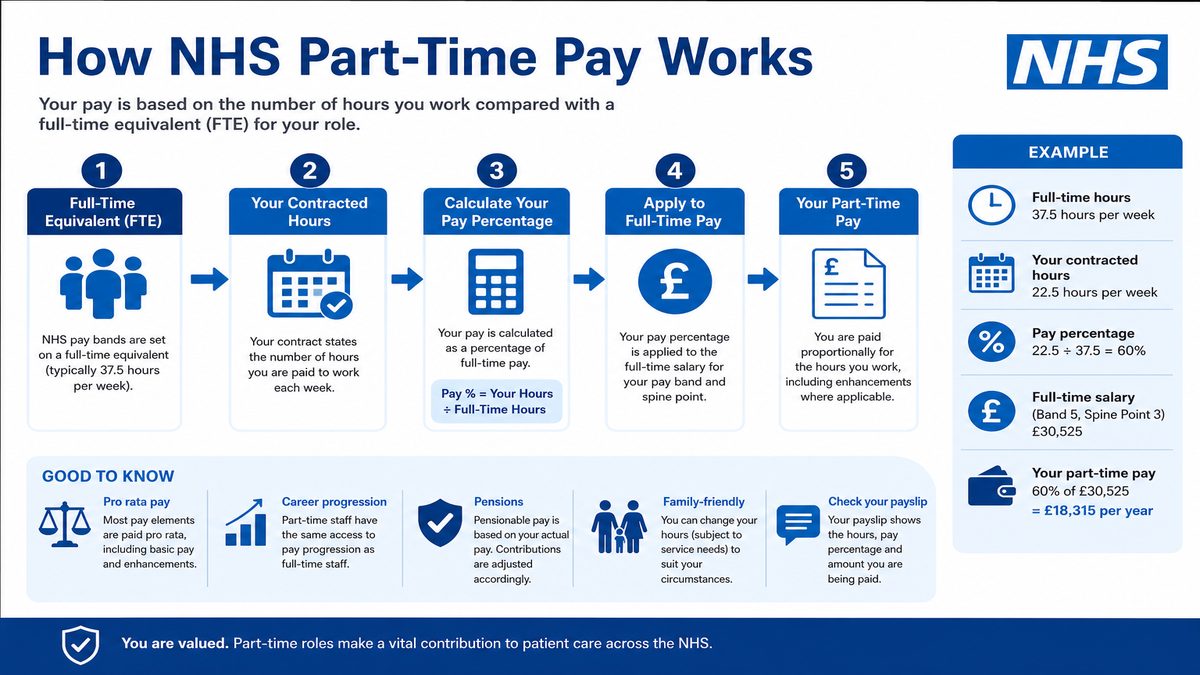
1 NHS Agenda for Change is a framework that standardises pay for most NHS staff across the UK, excluding doctors, dentists, and very senior managers. Every salary figure published under this system is a full-time equivalent (FTE) amount. 1 Hourly rates are calculated by dividing the annual salary by 52.143 weeks and then by 37.5 hours per week.
If you work part-time, your pay is pro-rated against the standard 37.5-hour full-time week. The formula is straightforward:
Part-Time Annual Salary = Full-Time Annual Salary × (Your Contracted Hours ÷ 37.5)
The result of that division is your WTE (whole-time equivalent). A nurse contracted for 22.5 hours per week has a WTE of 0.6, meaning she earns 60% of the full-time salary for her band and pay point. A healthcare assistant on 30 hours per week has a WTE of 0.8, earning 80% of the published figure.
This calculation applies identically across Band 2 through Band 9. There are no exceptions based on seniority, role type, or employer trust. 1The current pay scales for 2026/27 include a 3.3% pay rise across all bands. 5NHS Scotland applied a 3.75% pay award under its own national agreement, so Scottish salary rates differ from the other UK nations.
Contracted Hours/Week | WTE | % of Full-Time Salary |
15.0 | 0.40 | 40% |
18.75 | 0.50 | 50% |
22.5 | 0.60 | 60% |
26.25 | 0.70 | 70% |
30.0 | 0.80 | 80% |
33.75 | 0.90 | 90% |
If you work for NHS Scotland, there is a critical difference. 22From 1 April 2026 the full-time working week for Agenda for Change staff working in NHS Scotland will be 36 hours. 25Every NHS Scotland employee on an AfC contract will move from a standard 37.5-hour working week to a 36-hour standard working week — with no reduction in annual salary. This means a Scottish part-timer's WTE is calculated as contracted hours ÷ 36, not ÷ 37.5. A 22.5-hour contract in Scotland gives a WTE of 0.625 (not 0.6), producing a higher pro-rata salary than the same contract in England.
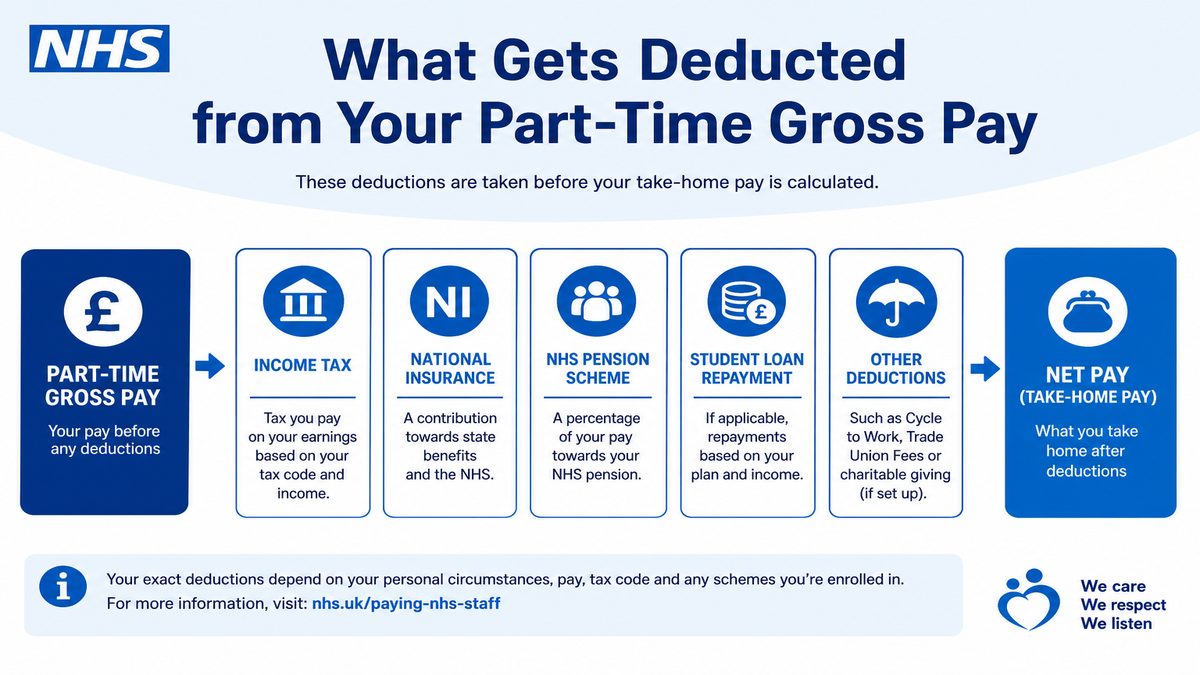
Your gross pro-rata salary is the starting number. Three mandatory deductions reduce it to the amount that reaches your bank account each month.
7 The NHS Pension Scheme uses a tiered structure to determine employee contribution rates. This system is based on actual annual pensionable pay, with contributions set in proportion to earnings. The current tier system consists of six levels. 7 As of 1 April 2026, the contribution rates are: 5.2% for earnings up to £13,259; 6.5% for £13,260 to £28,854; 8.3% for £28,855 to £35,155; 9.8% for £35,156 to £52,778; 10.7% for £52,779 to £67,668; and 12.5% for earnings of £67,669 and above.
The word "actual" is the key detail for part-time staff. 9If you work part-time, your contribution is based on your actual pensionable pay — the amount you actually earn. 12The government moved to a system where tiers are based on actual earnings rather than whole-time equivalent salary. This means if you work part-time, you only pay based on what you actually earn, which is a significant win for many staff.
A Band 5 nurse on 22.5 hours per week earns approximately £19,244 gross (0.6 × £32,073). Her pension tier is based on £19,244 — placing her in Tier 2 at 6.5%. If the tier were still based on her full-time equivalent salary of £32,073, she would fall into Tier 3 at 8.3%. The actual-pay rule saves her roughly £346 per year.
13 Your employer contributes 23.7% of your pensionable pay on top of your own contribution. 13 Your pension contributions are taken before tax, so the actual cost to you is lower than the headline rate.
The UK personal allowance for 2026/27 is £12,570. You pay 0% on the first £12,570 of your annual income. Because part-time earnings are lower, a smaller portion crosses into taxable territory. At very low contracted hours, your entire salary may sit below the personal allowance.
A Band 2 healthcare assistant on 15 hours per week earns approximately £10,109 gross (0.4 × £25,272). That is below the £12,570 threshold, resulting in zero income tax.
Class 1 employee National Insurance applies to earnings above the primary threshold. Even if your annual income is below the personal allowance for tax, NI may still apply on a pay-period basis, depending on whether your trust processes payroll weekly or monthly. The calculator above applies the correct NI thresholds automatically.
The table below uses 1Band 2 entry-level salaries starting at £25,272 per year and the confirmed 2026/27 pay points for England. Take-home figures assume tax code 1257L, no student loan, no HCAS, and no unsocial hours enhancements.
Band | FTE Entry Salary | 0.6 WTE Gross | Pension Tier | Pension Rate | Est. Monthly Take-Home |
Band 2 | £25,272 | £15,163 | Tier 2 | 6.5% | ~£1,153 |
Band 3 | £25,883 | £15,530 | Tier 2 | 6.5% | ~£1,178 |
Band 4 | £28,180 | £16,908 | Tier 2 | 6.5% | ~£1,271 |
Band 5 | £32,073 | £19,244 | Tier 2 | 6.5% | ~£1,424 |
Band 6 | £37,338 | £22,403 | Tier 2 | 6.5% | ~£1,621 |
Band 7 | £46,148 | £27,689 | Tier 2 | 6.5% | ~£1,920 |
Band 8a | £55,877 | £33,526 | Tier 3 | 8.3% | ~£2,170 |
These are estimates for illustration. Use the calculator above with your exact pay point, tax code, and student loan status for a precise result.
15 Under Agenda for Change, your annual leave entitlement increases with length of service. 21 Full-time staff receive 27 days plus 8 bank holidays, increasing to 29 days after 5 years and 33 days after 10 years. 15 Part-time staff receive the same entitlement pro-rated to their contracted hours. The formula is:
Part-Time Leave (hours) = (Your Weekly Hours ÷ 37.5) × Full-Time Entitlement in Hours
15 Part-time leave is calculated as: (your weekly hours ÷ 37.5) × full-time entitlement in hours. For example, 22.5 hours/week with 27 days entitlement = 16.2 days (121.5 hours). 16 Unlike many private-sector employers who quote entitlements in days, the NHS calculates leave in hours. This is essential for fairness across different shift patterns.
Service Length | FT Days (+ 8 BH) | 0.6 WTE Days | 0.6 WTE Hours |
0–4 years | 27 + 8 = 35 | 21.0 | 157.5 |
5–9 years | 29 + 8 = 37 | 22.2 | 166.5 |
10+ years | 33 + 8 = 41 | 24.6 | 184.5 |
14 If you calculate pro-rata leave for Scottish part-time staff, you must use 36 as the baseline — not 37.5. 14 Using the wrong number gives a lower, incorrect result.
17 Bank holidays are in addition to your basic annual leave entitlement. 17 Part-time workers receive a proportional bank holiday allowance based on their working pattern.
Full-time staff receive 8 bank holidays per year, totalling 60 hours (8 × 7.5). A 0.6 WTE worker receives 0.6 × 60 = 36 hours of bank holiday entitlement. If you work on a bank holiday, those hours are credited back to your allowance. If the bank holiday falls on your non-working day, the hours are deducted from your pro-rata bank holiday pot.
19 In some annual leave years, there may not be 8 general public holidays in the twelve-month period as sometimes Easter will fall in March and in effect there will be two Easter holidays in the twelve-month period. For 2026/27, this is relevant: 14 Easter 2027 falls early, placing Good Friday (26 March 2027) and Easter Monday (29 March 2027) inside this leave year.
Yes — but the pension accrual itself is also pro-rated. 8The 2015 Scheme accrues at 1/54 of your pensionable pay each year. 8For 2026/27 that revaluation rate is 5.3%. Each year of part-time work builds 1/54th of your actual part-time pensionable earnings into your retirement pot. Five years at 0.5 WTE builds the same pension value as 2.5 years at full-time.
This does not affect your qualifying service for retirement age purposes. A year of part-time service counts as a full year of membership in the scheme.
No. Unsocial hours enhancements are applied per hour worked, not per contracted week. Whether you work 15 hours or 37.5 hours, the same percentage enhancement applies to each qualifying hour. A Band 5 nurse working a Sunday shift receives a 60% enhancement on every hour of that shift — identical to a full-time colleague.
This is one of the most misunderstood areas of NHS part-time pay. The enhancement percentage does not change based on your WTE. Only your base salary is pro-rated. Enhancements sit on top.
Yes, for two reasons. First, 25Scottish AfC staff receive a 3.75% consolidated pay rise in 2026/27, compared to 3.3% for England and Wales. Second, Scotland applies its own income tax bands with different rates above certain thresholds (the Scottish starter, intermediate, and higher rates diverge from the rest of the UK).
A Band 6 nurse in Scotland on 22.5 hours per week earns a higher gross salary than her English counterpart on the same band and hours — and the net difference depends on which Scottish income tax band her earnings fall into.
HMRC's standard income tax estimator does not account for NHS-specific pension tiers. A generic calculator will either ignore pension entirely or apply an incorrect flat rate. This calculator is built specifically for NHS payroll logic. It uses:
Enter your band, pay point, contracted hours, and nation. The calculator returns your pro-rata gross salary, pension deduction, tax, NI, and monthly take-home pay in one result.
Disclaimer: This calculator provides estimates based on the national Agenda for Change framework and publicly available HMRC tax rates for 2026/27. Actual payslip figures may vary due to local trust policies, salary sacrifice schemes, student loan repayments, High Cost Area Supplements (London weighting), or additional allowances. For official pay scales, refer to NHS Employers. For pension tier thresholds, refer to NHS Business Services Authority.