 Take Home Pay
Take Home Pay
Take Home Pay
Calculate your NHS paternity pay in under 60 seconds. This free calculator covers all three pay tiers available to NHS employees: Occupational Paternity Pay (full basic pay) under NHS Agenda for Change Section 15, Statutory Paternity Pay at the confirmed 2026/27 HMRC rate, and zero-pay unpaid paternity leave — now a day-one right under the Employment Rights Act 2025. Enter your NHS Band, pay point, region, and length of continuous NHS service to receive your exact gross and net paternity pay figures — after Income Tax, National Insurance, and NHS Pension deductions — for the 2026/27 tax year (6 April 2026 to 5 April 2027).
Inputs the calculator uses:
Outputs the calculator produces:
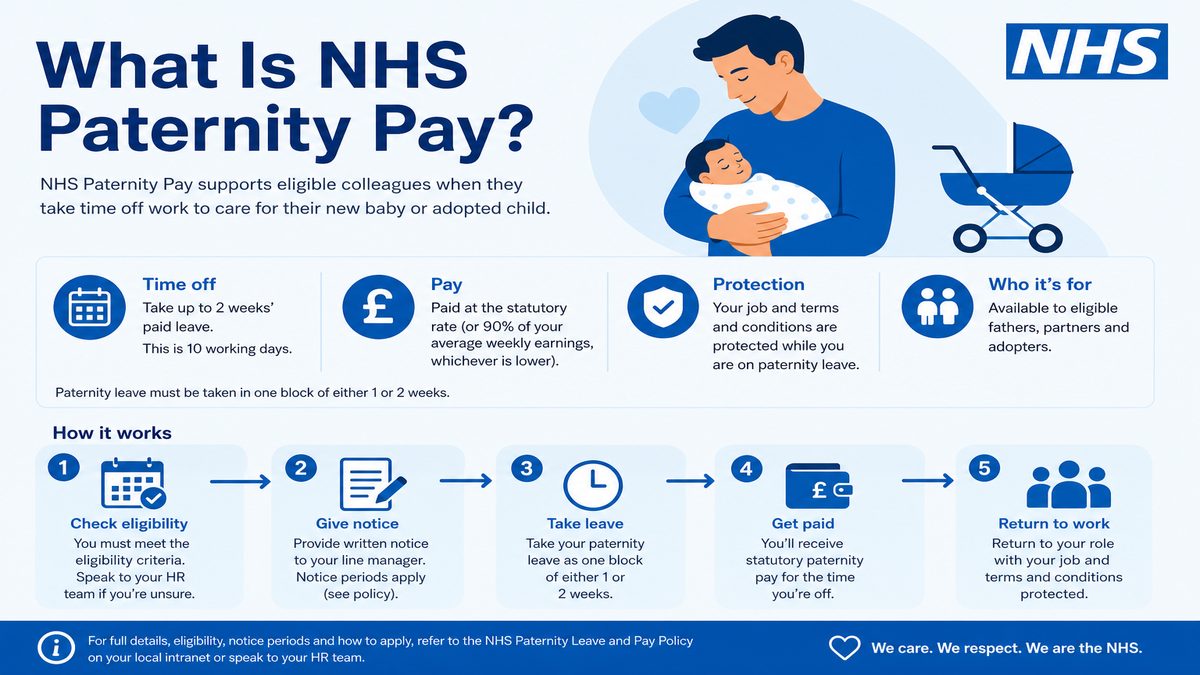
NHS paternity pay is the money paid to an NHS employee during their statutory paternity leave. It operates across three distinct tiers, and which tier you land on depends entirely on your length of continuous NHS service.
Tier 1 — Occupational Paternity Pay (OPP): 15You must have 12 months' continuous NHS service (with one or more NHS employers) at the beginning of the week — the Sunday — when the baby is due or the matching week if adopting. If you meet this threshold, you receive 2 weeks' full pay. Full pay means your normal basic weekly salary under your Agenda for Change band and pay point — not reduced to the statutory minimum. 8The Agenda for Change framework sets out provisions including maternity and paternity leave provisions under Section 15 of the NHS Terms and Conditions of Service Handbook.
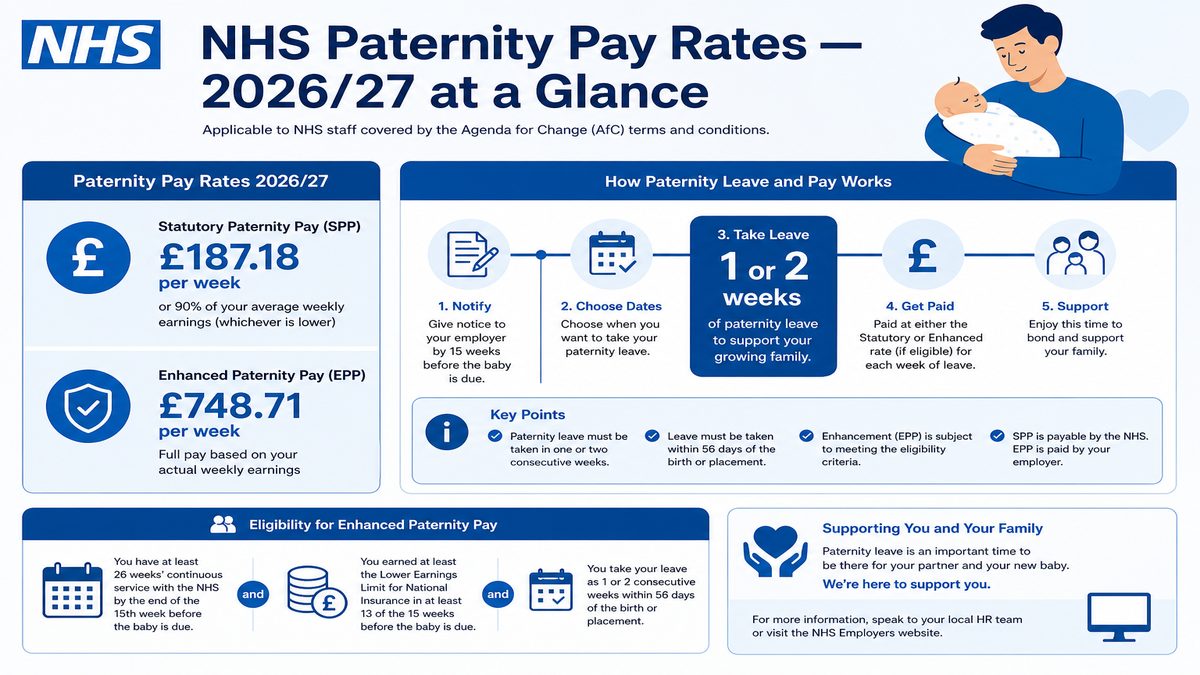
Tier 2 — Statutory Paternity Pay (SPP): 2From 6 April 2026, Statutory Paternity Pay is paid at £194.32 per week, or 90% of your average weekly earnings — whichever is lower. 2That is an increase from £187.18 in 2025/26. 1Statutory Paternity Pay is the minimum amount employers must pay eligible employees during paternity leave. If you qualify for OPP, your NHS Trust pays the difference between the statutory rate and your full salary — the two figures do not stack on top of each other.
Tier 3 — Unpaid Paternity Leave: 2For births and placements on or after 6 April 2026, the right to take paternity leave becomes a day-one employment right — you no longer need 26 weeks' continuous service to be entitled to the leave itself. 2However, Statutory Paternity Pay still requires 26 weeks of continuous service with your employer by the relevant qualifying week. So a new starter can take the leave from day one but may not yet qualify for the statutory pay.
Pay Tier | Service Required | Weekly Rate (Gross) | Duration |
Occupational Paternity Pay (OPP) | 12 months' continuous NHS service | Your full basic weekly salary (AfC band rate) | Up to 2 weeks |
Statutory Paternity Pay (SPP) | 26 weeks' continuous employment + AWE ≥ £129/week | £194.32 or 90% of AWE (lower figure applies) | Up to 2 weeks |
Unpaid Paternity Leave | Day-one right from 6 April 2026 — no service minimum | £0.00 | Up to 2 weeks |
4 From 6 April 2026, statutory maternity pay, paternity pay, adoption pay, shared parental pay, and parental bereavement pay rose from £187.18 to £194.32 per week.
You qualify for Occupational Paternity Pay if you meet every one of these four conditions:
You qualify for Statutory Paternity Pay if you meet all of the following:
16 The Employment Rights Act 2025 made Paternity Leave a "day one" right for all employees, subject to them providing their employer with the correct notice. This means that employees were eligible without needing to have worked for their employer for any particular time frame. 16 The 26-week qualifying period for Paternity Pay was unchanged. You must still satisfy the relationship test (father, spouse, civil partner, or partner of the mother) and confirm you intend to care for the child. 10 The requirements and entitlements are the same for same-sex couples.
For OPP: Divide your AfC annual basic salary by 52.143 to get your gross weekly pay. Part-time staff use their contracted hours pro-rata against the 37.5-hour standard week. 11Standard full-time hours under Agenda for Change are 37.5 hours per week. Note: 11NHS Scotland is moving to a 36-hour working week from April 2026, following their separate pay deal, so Scottish staff divide by 36 instead.
For SPP: Your employer calculates your Average Weekly Earnings (AWE) over the 8-week reference period ending with the qualifying week (the 15th week before the EWC). 2The statutory rate acts as a cap: if 90% of your average weekly earnings is below £194.32, you receive the lower 90% figure.
Paternity pay is processed through PAYE. Your tax code determines how much personal allowance you receive. The standard personal allowance for 2026/27 is £12,570 per year (£1,047.50 per month). Earnings above £12,570 are taxed at 20% (basic rate) up to £50,270, then 40% (higher rate) up to £125,140, then 45% (additional rate) above £125,140. Scottish NHS staff with an S prefix tax code pay Scottish Income Tax rates, which differ from the rest of the UK.
1 SPP is treated as earnings for tax and NI purposes: your employer processes it through payroll in the usual way — it appears on your payslip with deductions applied. For 2026/27, Class 1 employee NI is charged at 8% on weekly earnings between £242 and £967, then at 2% above £967.
If you remain in the 2015 NHS Pension Scheme during paternity leave, your employee contribution is deducted from your paternity pay. Contribution tiers for 2026/27 range from 5.2% (pensionable pay up to £13,259) to 13.5% (pensionable pay above £111,377), with Band 5 nurses at £31,469 falling into the 7.1% tier. Your employer continues to make its 23.7% employer contribution throughout your paid paternity leave.
If you are on a student loan repayment plan, deductions apply to paternity pay in the same way they apply to your normal salary. Plan 2 deductions apply above £27,295 per year (£524.90/week). Plan 1 threshold is £24,990 per year (£480.58/week).
Item | Figure |
Band | 5, Pay Point 2 |
AfC Annual Salary 2026/27 | £31,469 |
Continuous NHS service | 3 years |
Eligibility | Occupational Paternity Pay — full basic pay |
Gross weekly pay | £31,469 ÷ 52.143 = £603.51 |
Income tax (20% above weekly personal allowance of ~£241.73) | ~£72.36 |
Class 1 NI (8% on £603.51 − £242 threshold) | ~£28.92 |
NHS Pension (7.1% tier) | ~£42.85 |
Net weekly paternity pay | ~£459.38 |
Total net pay — 2 weeks | ~£918.76 |
This is an illustrative estimate based on tax code 1257L, no student loan, no salary sacrifice. Your exact figure depends on your individual payroll setup. Always confirm with your Trust payroll department.
Item | Figure |
Band | 3, Pay Point 1 |
AfC Annual Salary 2026/27 | £24,625 |
Continuous NHS service with current Trust | 8 months (32 weeks — qualifies for SPP) |
Continuous NHS service total | 8 months (below 12 months — does not qualify for OPP) |
Eligibility | Statutory Paternity Pay only |
Average weekly earnings | £24,625 ÷ 52.143 = £472.28 |
90% of AWE | £425.05 — above £194.32, so SPP rate applies |
Gross SPP weekly | £194.32 |
Income tax (20%) | ~£0.00 (below weekly personal allowance of £241.73) |
Class 1 NI | ~£0.00 (below £242/week NI threshold) |
NHS Pension (5.2% on £194.32) | ~£10.10 |
Net weekly paternity pay | ~£184.22 |
Total net pay — 2 weeks | ~£368.44 |
Item | Figure |
Band | 2, Pay Point 1 |
Continuous employment with Trust | 4 months (below 26 weeks — no SPP qualification) |
Eligibility | Unpaid paternity leave (day-one right) |
Gross weekly paternity pay | £0.00 |
Net weekly paternity pay | £0.00 |
This employee has the legal right to take 2 weeks of paternity leave under the Employment Rights Act 2025. The leave itself is protected from day one. The pay requires 26 weeks with the employer — which this employee has not yet reached.
NHS paternity leave lasts up to 2 weeks. 10You get the same amount of leave if your partner has a multiple birth, such as twins. 6From April 2024, you have also been able to take the two weeks as separate one-week blocks, at any point within the first 52 weeks after the birth. Leave cannot start before the birth. 10Leave cannot start before the birth.
18 The notice period for paternity leave has been temporarily reduced from 15 weeks to 28 days. This temporary reduction applies for births in the transitional period while the new day-one system beds in. For NHS staff, the practical process is:
Expected Week of Childbirth (EWC): 9The EWC normally starts from the Sunday before the expected date of birth. For example, if your due date is Wednesday 15 July 2026, your EWC runs from Sunday 12 July to Saturday 18 July 2026.
The Qualifying Week: 9The qualifying week is the 15th week before your EWC — the critical assessment point for eligibility and average weekly earnings calculation.
Leave window: You can start paternity leave on the day of birth, or any day within 52 weeks of the birth or adoption placement.
1 SPP is treated as earnings for tax and NI purposes. Universal Credit treats paternity pay — both OPP and SPP — as earned income. HMRC reports your paternity pay to the Department for Work and Pensions via Real Time Information (RTI), and your Universal Credit award adjusts automatically.
The Universal Credit taper rate for 2026/27 is 55%. For every £1 of net earnings, your UC reduces by 55p.
SPP example: 2 weeks of SPP at £194.32/week = £388.64 gross. After allowing for the UC work allowance (if applicable), and applying the 55% taper to net earnings, your UC for that assessment period reduces by approximately £179–£214 depending on your household composition and work allowance tier.
OPP example: A Band 5 nurse receiving ~£459 net per week receives approximately £918 net over 2 weeks. The UC taper reduces the award by approximately £505 over that assessment period — significantly more than during SPP-only.
Unpaid leave: If you take the day-one right with no pay, your UC is not affected by paternity pay (there is none). Your normal work allowance and taper calculations apply to any other household income.
If you receive UC, always update your UC journal to record your expected paternity leave dates and pay before the leave begins, so that DWP applies the correct assessment.
HMRC does not pay you paternity pay directly. HMRC's role is limited to three specific functions:
HMRC forms for paternity leave:
If your Trust disputes your SPP eligibility: Contact the HMRC Statutory Payments Disputes Team on 0300 322 9422 and request a formal HMRC decision. HMRC will investigate and rule within 14 days.
Feature | Paternity Leave | Maternity Leave |
Maximum leave duration | 2 weeks | 52 weeks |
Paid leave duration | Up to 2 weeks | Up to 39 weeks (SMP) |
Day-one right from 6 April 2026 | Yes — leave from day one | No — SMP still needs 26 weeks' service |
NHS Occupational Pay | 2 weeks full pay (12 months' NHS service) | 8 weeks full pay + 18 weeks half pay + 13 weeks SMP (12 months' NHS service, intent to return) |
Statutory rate | £194.32/week or 90% AWE (lower) | First 6 weeks: 90% AWE (uncapped). Weeks 7–39: £194.32 or 90% AWE (lower) |
Can be split into blocks? | Yes — two 1-week blocks within 52 weeks | No — continuous block only |
Keeping In Touch (KIT) days | Not applicable (leave too short) | Up to 10 KIT days during maternity leave |
Service to qualify for leave | Day one (from 6 April 2026) | 26 weeks to the qualifying week |
5 Statutory Maternity Pay provides up to 39 weeks of paid leave, with the first 6 weeks paid at 90% of Average Weekly Earnings and the remaining 33 weeks at £194.32 or 90% of AWE, whichever is lower.
2 If you want more paid time off than the two weeks of SPP allow, Shared Parental Leave lets eligible couples split up to 50 weeks of leave and up to 37 weeks of pay between them. 6 Shared Parental Pay is paid at the same £194.32/week rate.
You can take paternity leave and then shared parental leave in either order. 24The restriction on taking paternity leave after shared parental leave has been removed, giving parents more flexibility as to how leave is shared in the year following birth or adoption.
For NHS staff under AfC terms: Occupational Shared Parental Pay may be available if you meet your Trust's local policy criteria. Check Section 15 of the NHS Terms and Conditions Handbook and your Trust's SPL policy for enhanced rates above the statutory minimum.
To activate SPL, the mother or primary adopter must formally curtail their maternity leave using a Curtailment Notice. Both parents must then give separate SPL booking notices to their respective employers at least 8 weeks before the first SPL period begins.
1 If your baby is admitted to neonatal care, you may be entitled to Neonatal Care Leave and Pay on top of paternity leave. This is separate from and in addition to your standard paternity entitlement.
Neonatal Care Leave and Pay applies where a baby born on or after 6 April 2026 requires neonatal care within their first 28 days and receives that care for at least 7 continuous days. Parents receive up to 12 weeks of additional leave and pay on top of their existing maternity or paternity leave entitlement, paid at the same standard statutory rate of £194.32/week. The leave window extends up to 68 weeks from the date of birth.
This entitlement is particularly significant for NHS employees working in neonatal units or paediatric settings — your own child may qualify for this additional leave even while you work in a clinical area that cares for neonatal patients.
25 From 6 April 2026, a new right to Bereaved Partner's Paternity Leave supports employees who lose the mother or primary adopter of their child within the first year of their child's life or adoption. This is a day-one right, meaning employees are eligible from their first day of employment. 25 Employees may be eligible for up to 52 weeks of leave, depending on when the bereavement occurs. There is no statutory pay requirement — paid leave is at employer discretion. 20 While not part of the changes under the ERA 2025, the Bereaved Partner's Paternity Leave Regulations 2026 took effect on 6 April 2026 as part of wider reforms to family leave rights. For NHS employees in England and Wales, check your Trust's bereavement and compassionate leave policy and Section 23 of the AfC Handbook for any contractual enhancements above the statutory baseline.
Statutory Paternity Pay applies to adoption in the same way as birth, with two modifications:
The leave must begin on or after the date of placement — not before. The 52-week leave window runs from the date of placement.
Step 1 — Tell your line manager early. Inform them verbally as soon as the pregnancy is confirmed. This is not a formal notice — it is good practice that protects your relationship with your team.
Step 2 — Submit formal written notice 28 days before your leave start date. Under the temporary transitional arrangements in place from 6 April 2026, the standard 15-week notice period has been reduced to 28 days. 18The notice period for paternity leave has been temporarily reduced from 15 weeks to 28 days.
Step 3 — Complete your Trust's paternity leave form or HMRC SC3/SC4. Specify: your baby's expected due date (or adoption match date), whether you want 1 week or 2 weeks, and your intended leave start date.
Step 4 — Your HR/workforce team confirms your eligibility. They will check your continuous NHS service record against ESR (Electronic Staff Record) to confirm whether you receive OPP or SPP.
Step 5 — Change your start date if needed. You can amend your leave start date by giving 28 days' written notice of the new date to your employer before it begins.
Step 6 — Confirm the birth date. After the birth, notify your employer of the actual date. This is required for payroll to process the correct pay period.
It depends on your length of continuous NHS service. If you have 12 months' continuous NHS service on Agenda for Change terms, you receive 2 weeks at your full basic pay. 2Statutory Paternity Pay from 6 April 2026 is £194.32 per week, or 90% of your average weekly earnings — whichever is lower. Your actual net take-home after Income Tax, National Insurance, and NHS Pension deductions will be lower than the gross figure — use the calculator above for your specific net amount.
15 You must have 12 months' continuous NHS service (with one or more employers) at the beginning of the week when the baby is due. If you meet this threshold and are on Agenda for Change terms, you receive 2 weeks' full pay. If you have less than 12 months' NHS service, you receive SPP at £194.32/week gross (or less if 90% of your AWE is lower). If you have less than 26 weeks' service with your current Trust, you receive no pay at all during your leave.
19 The Employment Rights Act 2025 creates day-one rights to paternity leave and unpaid parental leave from 6 April 2026. 19 Whilst there is a day-one entitlement to paternity leave, employees still need 26 weeks' service to qualify for paternity pay — mirroring the maternity pay situation.
3 Leave can be taken in two separate 1-week blocks within 52 weeks of birth. You do not have to take both weeks consecutively. Give your employer 28 days' notice of each block separately.
You have 52 weeks from the date of birth or adoption placement to use your paternity leave. After 52 weeks, the entitlement lapses.
Yes. 6SMP, SPP, and ShPP are all taxable. OPP is also taxable as it is paid as normal salary through PAYE. Both Income Tax and Class 1 National Insurance apply. NHS Pension contributions are also deducted from OPP and from SPP.
If your AWE is below £129/week, you do not qualify for Statutory Paternity Pay. You are entitled to unpaid paternity leave (the day-one right from 6 April 2026) but will receive £0 in paternity pay. You may be able to claim Universal Credit to supplement household income during this period.
No. Annual leave continues to accrue at your full AfC rate during paternity leave. You cannot be asked to take annual leave at the same time as paternity leave. Any annual leave that accrues during paternity leave carries forward or is paid out in accordance with your Trust's annual leave policy.
24 The restriction on taking paternity leave after shared parental leave has been removed, giving parents more flexibility as to how leave is shared in the year following birth or adoption. You can now take paternity leave and SPL in either order within the 52-week window.
Your NHS Pension membership continues during paid paternity leave. Your employer makes the full 23.7% employer contribution. Your employee contribution is deducted from your paternity pay. The period of paid leave counts as pensionable service in the 2015 CARE Scheme and contributes to your career average pension accrual.
NHS bank staff on zero-hours contracts need to demonstrate average weekly earnings at or above £129/week across the 8-week reference period and must have been working with the same Trust for 26 weeks by the qualifying week. Bank assignments that were irregular or low-hours may not produce an AWE above the Lower Earnings Limit, meaning these staff may qualify for unpaid leave only. Agency workers are governed separately by the Agency Workers Regulations 2010. After 12 weeks in the same role with the same hirer, agency workers gain the right to the same basic pay as comparable permanent staff — which may affect their AWE calculation for SPP purposes. 10Agency workers are not entitled to paid time off for antenatal care until they have completed at least 12 weeks' continuous employment with the same employer.
15 Where an employee's baby is born alive prematurely, the employee is entitled to the same amount of paternity leave and pay as if the baby had been born at full-term. Your qualifying week is still calculated based on the original expected due date. If the early birth falls before the 15th week before your original due date, your Trust's payroll team will calculate your entitlement manually using HMRC guidance.
15 Where an employee's baby is stillborn after week 24 of pregnancy, the employee is entitled to the same amount of paternity leave and pay. 10 If a stillbirth or miscarriage occurs after the 24th week of pregnancy, your rights to leave and Statutory Paternity Pay are not affected. Speak to your Trust's HR department immediately — many Trusts also offer additional compassionate leave on top of the statutory entitlement in these circumstances.
Paternity leave is a specific entitlement of up to 2 weeks, linked to a birth or adoption event, and paid if you meet the service thresholds above. Unpaid parental leave is a separate entitlement — up to 18 weeks per child (capped at 4 weeks per year), unpaid, usable at any time until the child turns 18. 24From 6 April 2026, both paternity leave and unpaid parental leave became day-one rights.
"Government paternity pay" refers to Statutory Paternity Pay — the minimum paternity pay set and regulated by the UK Government through HMRC. 2Statutory Paternity Pay gives eligible new fathers and partners paid time off when a child is born or adopted. Your employer pays it through payroll and reclaims the majority of the cost from HMRC. The government does not pay you directly. The confirmed government paternity pay rate for 2026/27 is £194.32 per week.
No. Statutory Paternity Pay is an employer-paid statutory benefit. Self-employed people do not have an employer to pay it, and there is no equivalent of Maternity Allowance for paternity. If you are self-employed and your partner is the birth mother, she may claim Maternity Allowance. You may be eligible for Universal Credit to support household income while you take time off.
2 For pay, you or your employer's payroll generally need form SC3 for a birth or SC4 for adoption, confirming your entitlement. Your NHS Trust may substitute its own internal form in place of SC3/SC4 — check with your HR department before submitting.
Paternity leave is treated as a period of authorised leave from your NHS employer. Your contract of employment continues. For immigration purposes, you remain employed. Contact UK Visas and Immigration or your Trust's HR team if you are on a sponsored work visa and have specific questions about the impact of unpaid leave periods.