 Take Home Pay
Take Home Pay
Take Home Pay
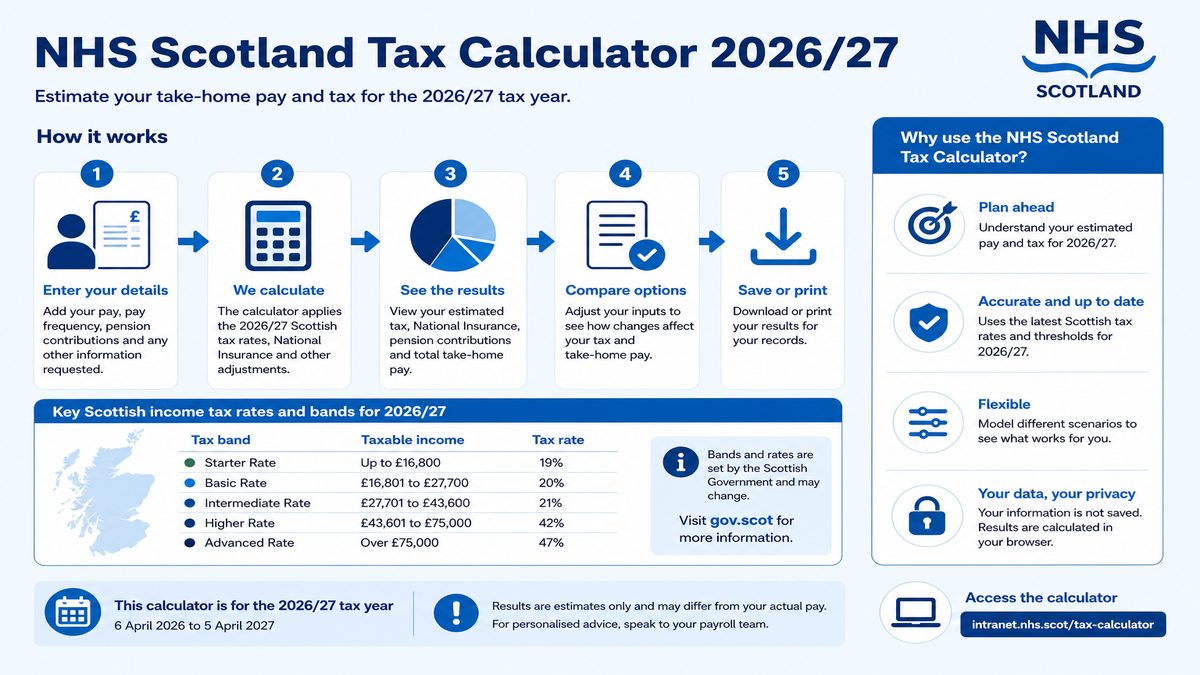
If you live in Scotland and work for NHS Scotland on Agenda for Change (AfC) terms, your gross band salary is only half the take-home story. Scottish Income Tax uses six rate bands — Starter, Basic, Intermediate, Higher, Advanced and Top — which diverge from the rest of the UK (rUK) structure used in England, Wales and Northern Ireland. National Insurance still follows UK-wide Class 1 rules. Student loan Plan 4 (the Scottish plan) uses a higher repayment threshold than English Plan 2. Pension contributions for most NHS Scotland staff go through the Scottish Public Pensions Agency (SPPA) arrangements rather than NHSBSA England.
This page explains the 2026/27 Scottish Income Tax bands, when you are a Scottish taxpayer, how the same AfC gross produces different net pay in Scotland versus England, and how Plan 4 and SPPA deductions sit alongside PAYE. Use the calculator above to model your band, pay point, hours and loan plan. Figures are estimates for planning — your ESR / ePayroll payslip and HMRC tax code remain definitive.
Authoritative band tables are published by the Scottish Government and mirrored on GOV.UK. Start with the Scottish Income Tax 2026 to 2027 technical factsheet, the GOV.UK Scottish Income Tax rates page, and Scottish Budget materials on gov.scot ready reckoners.
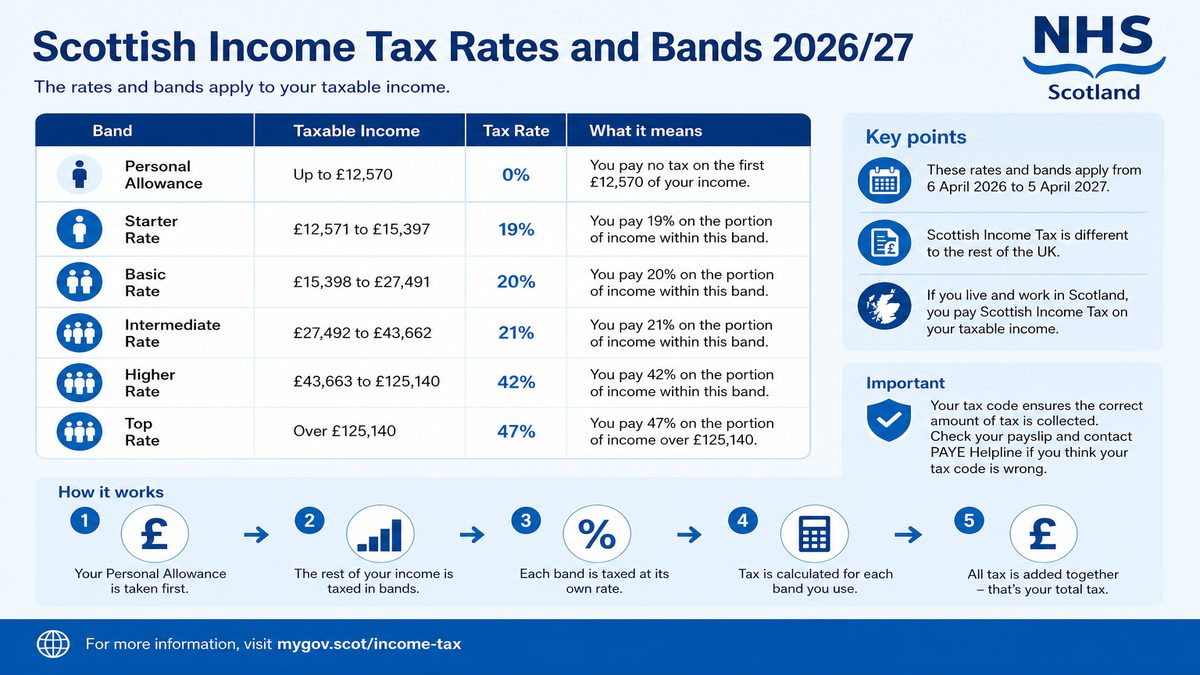
Scottish Income Tax applies to non-savings, non-dividend (NSND) income of Scottish taxpayers — primarily your NHS salary and most taxable employment income. Savings and dividend income remain reserved to the UK Parliament and use UK rates. The Personal Allowance is also a UK reserved matter: for 2026/27 it remains £12,570 for those entitled to the full allowance.
For 2026/27 the Scottish Parliament widened the Starter and Basic band limits (thresholds for paying Basic and Intermediate rates rose by about 7.4% versus 2025/26), while Higher, Advanced and Top thresholds stayed frozen in cash terms. Rates themselves remain: 19%, 20%, 21%, 42%, 45% and 48%.
| Band | Taxable income (with £12,570 PA) | Rate |
|---|---|---|
| Personal Allowance | Up to £12,570 | 0% |
| Starter | £12,571 to £16,537 | 19% |
| Basic | £16,538 to £29,526 | 20% |
| Intermediate | £29,527 to £43,662 | 21% |
| Higher | £43,663 to £75,000 | 42% |
| Advanced | £75,001 to £125,140 | 45% |
| Top | Over £125,140 | 48% |
Source: GOV.UK — Income Tax in Scotland: current rates and the gov.scot technical factsheet. You do not receive a Personal Allowance if your income exceeds £125,140 after taper.
Regardless of Scottish or rUK residence, the UK Personal Allowance is reduced by £1 for every £2 of adjusted net income above £100,000. The allowance is zero once adjusted net income reaches £125,140. Between those points the effective marginal rate is higher than the headline band rate because you lose Personal Allowance while also paying Higher / Advanced Scottish rates. NHS Pension contributions (net-pay arrangement) reduce adjusted net income, which can preserve some or all of the Personal Allowance for staff whose gross pay sits just over £100,000. Always model pensionable pay before assuming you have crossed the taper.
England, Wales and Northern Ireland use a simpler structure for NSND income: Basic 20%, Higher 40% and Additional 45%, with the Higher Rate Threshold historically aligned to a taxable band that reaches a £50,270 higher-rate starting point for standard Personal Allowance taxpayers (subject to freezes announced by the UK Government). Scotland inserts Starter (19%) and Intermediate (21%) bands below the Higher threshold, then charges Higher at 42% (not 40%), Advanced at 45%, and Top at 48% (not 45%).
Scottish Income Tax follows your tax residence, not solely where your hospital sits. In broad terms you are a Scottish taxpayer for a tax year if you are a UK resident and your main place of residence is in Scotland for at least as much of the year as in any other part of the UK — or if you live in Scotland for more days than elsewhere. Cross-border commuting (for example living in Berwick-upon-Tweed and working in Edinburgh, or living in Carlisle and rotating into Dumfries) needs careful HMRC residence analysis.
Your tax code usually carries an “S” prefix when Scottish rates apply (for example S1257L). If you move nation mid-year, notify HMRC and payroll promptly. Working for NHS Scotland while remaining an English taxpayer — or the reverse — is possible in edge cases; do not assume your employer’s location alone sets your tax nation.
HMRC guidance on Scottish taxpayer status is summarised via GOV.UK Scottish Income Tax. If your code looks wrong after a house move, raise a ticket with payroll and check your Personal Tax Account.
Class 1 employee National Insurance contributions are reserved to the UK Government. NHS Scotland staff pay the same NI percentages and earnings thresholds as colleagues in England on the same gross pay (subject to identical category letters and direction status). Scottish Income Tax does not replace NI, and you cannot “opt” into English tax rates while remaining a Scottish taxpayer.
When comparing Scotland vs England take-home on the same AfC gross:
For NI rates and thresholds see GOV.UK National Insurance rates.
Colleagues often ask: “If I earned the England Band 5 / 6 / 7 figure but paid Scottish tax, what happens?” That hypothetical isolates the tax system. In real life, NHS Scotland AfC cash rates are set separately and are frequently higher than England at many points — so real-world Scottish take-home reflects both higher (or different) gross and different tax. The calculator lets you hold gross constant to see the tax effect alone, then switch to Scottish band tables for a full picture.
Take an England-aligned Band 5 entry gross of £32,073. After Personal Allowance, most of this salary sits across Scottish Starter, Basic and Intermediate bands (19–21%). An English taxpayer on the same gross pays mainly 20% basic rate. The net Income Tax difference at Band 5 entry is usually modest — sometimes favouring the Scottish taxpayer slightly because of the 19% Starter slice and 2026/27 threshold changes — once pension relief is applied. Moving to Band 5 top (£39,043) still largely sits below the Scottish Higher threshold of £43,663, so Intermediate 21% applies to the upper slice while rUK remains in basic rate until the rUK higher threshold. Differences remain measurable but are typically hundreds of pounds a year rather than thousands at pure Band 5 basic pay without enhancements.
Band 6 England-aligned points (£39,959 / £42,170 / £48,117) straddle the Scottish Higher threshold. Entry and intermediate points sit mostly in Intermediate territory; top of Band 6 (£48,117) pushes a meaningful slice into Scottish Higher at 42%. An English taxpayer on £48,117 is only just into (or near) higher-rate territory depending on pension relief and taxable pay. Scottish Higher at 42% therefore starts earlier and bites harder on Band 6 tops and on staff with regular unsocial-hours enhancements that lift taxable pay over £43,663. This is the band range where many charge nurses and specialist practitioners first notice a clear Scotland-vs-England tax gap on equal gross.
Band 7 England-aligned salaries (£49,387 / £51,932 / £56,515) sit firmly in Scottish Higher rate territory for a large share of taxable income. Compared with rUK 40% Higher rate, Scotland’s 42% Higher rate increases Income Tax on every pound in that band. Advanced rate (45%) begins at £75,001 — relevant for Band 8b upwards and for Band 8a with significant enhancements. Top rate 48% above £125,140 affects a small minority of AfC staff (typically Band 9 tops and combined earnings). For Band 7, the practical message is: same gross, higher Scottish Income Tax than England once Higher band exposure is material; model pension relief carefully because net-pay contributions reduce taxable pay and can shrink the Higher slice.
| Illustrative England-aligned gross | Tax system focus | What usually differs vs England |
|---|---|---|
| Band 5 £32,073–£39,043 | Starter / Basic / Intermediate | Small net tax gap; Starter 19% can help lower earners |
| Band 6 £39,959–£48,117 | Intermediate into Higher 42% | Gap widens as income crosses £43,663 |
| Band 7 £49,387–£56,515 | Substantial Higher 42% | Clearer Scottish tax cost vs rUK 40% |
| £75,001+ | Advanced 45% | Further divergence; taper risk near £100k |
These are conceptual guides, not payslip forecasts. Plug your exact gross, pension tier and loan plan into the calculator for monthly figures.
Most Scottish-domiciled graduates who borrowed through the Student Awards Agency for Scotland repay under Plan 4. For 2026/27 the Plan 4 repayment threshold is £33,795 a year (£2,816.25 a month / £649.90 a week). You repay 9% of income above the threshold. Plan 4’s threshold is higher than Plan 2 (£29,385) and Plan 5 (£25,000), so many Band 5 staff repay less — or nothing — compared with English Plan 2/5 colleagues on the same salary.
Official thresholds are listed on GOV.UK — Repaying your student loan and in the 2026 to 2027 Student and Postgraduate Loan deduction tables. Moving to Scotland for work does not automatically convert an English Plan 2 loan into Plan 4 — plan type follows the loan you hold.
NHS Scotland pension membership for most AfC staff is administered via the Scottish Public Pensions Agency (SPPA). Like the NHS Pension Scheme in England and Wales, modern CARE benefits build pension based on career-average revalued earnings, with tiered employee contribution rates linked to pensionable pay. Contributions are typically deducted under a net-pay arrangement, reducing taxable pay and therefore Scottish Income Tax and (indirectly) helping with Personal Allowance taper modelling.
Do not assume England NHSBSA contribution tier tables match SPPA tiers pound-for-pound every year. When estimating take-home, select Scotland / SPPA options in the calculator and verify the percentage on your payslip after each April change. Opting out increases take-home only after accounting for lost tax relief and permanently reduced pension — seek regulated advice before leaving the scheme.
General scheme information is available via pensions.gov.scot (SPPA).
Scottish Income Tax policy for each year is set through the Scottish Budget and a Scottish Rate Resolution before the tax year starts. For 2026/27, policy widened lower-band thresholds while freezing Higher, Advanced and Top thresholds, consistent with UK-wide Personal Allowance freezes. The Scottish Fiscal Commission forecasts Income Tax receipts used in Budget planning; ready reckoners on gov.scot show the revenue impact of alternative rate or threshold choices.
NHS Scotland AfC pay awards are negotiated separately from Income Tax policy. A pay rise increases gross; Scottish tax bands determine how much of that rise reaches your bank account. When unions announce a percentage uplift, always re-run take-home with the new gross and current Scottish bands — especially if the uplift pushes you across £43,663 or £75,000.
Budget and tax publications: Scottish Income Tax technical factsheet and Scottish Budget 2026-27 tax ready reckoners — Income Tax.
Many NHS Scotland rotas push taxable pay above basic AfC salary. Night duty, weekend enhancements and overtime are usually taxable and often pensionable. A Band 6 practitioner whose basic pay sits just under £43,663 can cross into Scottish Higher rate (42%) once regular enhancements are included. That is why two colleagues on the “same band point” can see different effective tax rates: the one on long days and nights may already be paying 42% on a slice of earnings while the Monday–Friday colleague remains in Intermediate 21%.
When you use the calculator, add a realistic annual enhancement estimate if you work nights or weekends every week. For one-off overtime spikes, remember PAYE may deduct Higher-rate tax in the high month even if your annual income later falls back — HMRC usually corrects across the year via your tax code or a P800 calculation. Keep enhancement totals from your end-of-year payslip summary when checking whether you truly crossed Higher, Advanced or taper thresholds.
Offers that quote “Band 7 £49,387” using England tables are not automatically comparable with NHS Scotland Band 7 cash rates, and neither figure is take-home. Before accepting a move between England and Scotland, build three scenarios: (1) England gross + rUK tax + NHSBSA pension + your actual loan plan; (2) Scotland gross from the Scottish AfC circular + Scottish tax + SPPA + Plan 4 if applicable; (3) equal-gross tax-only comparison if you want to understand policy differences. Housing costs, mileage, remote/hybrid patterns and HCAS (England only) often dwarf the Income Tax gap — but the tax gap is still real for Higher-rate earners.
If you move home from England to Scotland mid-year, expect a tax-code change to an S-prefix and a possible in-year reconciliation. Do not wait until Self Assessment season if your code still shows English rates months after you settled north of the border.
With a £12,570 Personal Allowance: Starter 19% to £16,537; Basic 20% to £29,526; Intermediate 21% to £43,662; Higher 42% to £75,000; Advanced 45% to £125,140; Top 48% above £125,140. See GOV.UK.
No. Employee Class 1 NICs use UK rates and thresholds whether you work in Glasgow or Manchester. Income Tax is what differs for Scottish taxpayers.
Often because Scottish Higher rate (42%) begins at £43,663 — earlier and at a higher rate than rUK Higher (40%). Enhancements can push you over the threshold even if basic pay is just below it. Compare full payslips including pension and student loan before assuming tax alone explains the gap.
Plan 4 is the Scottish undergraduate repayment plan. For 2026/27 you repay 9% of income above £33,795. Details: GOV.UK student loan repayments.
Status depends on UK residence and where your main home / day count sits for the tax year — not only your Board’s address. Check HMRC guidance and update payroll if you move. A wrong tax code can misapply Scottish or rUK rates for months.
Yes. The £12,570 Personal Allowance is set by the UK Government and applies to Scottish taxpayers, including the taper above £100,000. Scotland sets NSND rates and bands, not the Personal Allowance itself.
Decide whether you are comparing (a) equal gross to isolate tax, or (b) real AfC tables for each nation plus correct tax, NI, pension and loan. Method (b) is what relocation decisions need. Use the calculator above for both scenarios.
Use the gov.scot technical factsheet, Budget ready reckoners on gov.scot, and the rates table on GOV.UK.
Almost never on basic Band 5 pay alone. Advanced starts at £75,001 and Top above £125,140. They matter for senior AfC bands, consultants on different contracts, or combined earnings across jobs — not typical Band 5 basic salaries.
Only when you intentionally want an equal-gross comparison. For real take-home planning, use NHS Scotland AfC pay points for your Board circular, Scottish Income Tax, SPPA contributions and the correct student loan plan. Mixing England gross with Scottish tax (or the reverse) produces misleading nets.
Starter and Basic upper limits rose (Starter now to £16,537; Basic to £29,526), lifting the Intermediate entry point. Higher (£75,000), Advanced (£125,140) and Top thresholds remained frozen. Rates stayed at 19%, 20%, 21%, 42%, 45% and 48%. Confirm the enacted figures on gov.scot.
This guide is informational only and is not tax, financial or employment advice. Confirm figures with HMRC, SPPA and your NHS Board payroll.