 Take Home Pay
Take Home Pay
Take Home Pay
Calculate your exact student loan repayments based on your NHS salary for the 2026/27 tax year. This free NHS student loan calculator shows your monthly and annual deductions for Plan 1, Plan 2, Plan 4 (Scotland), Plan 5, and Postgraduate loans. It automatically factors in your Agenda for Change basic pay, High Cost Area Supplement (HCAS), overtime, and unsocial hours to reveal the true impact on take-home pay.
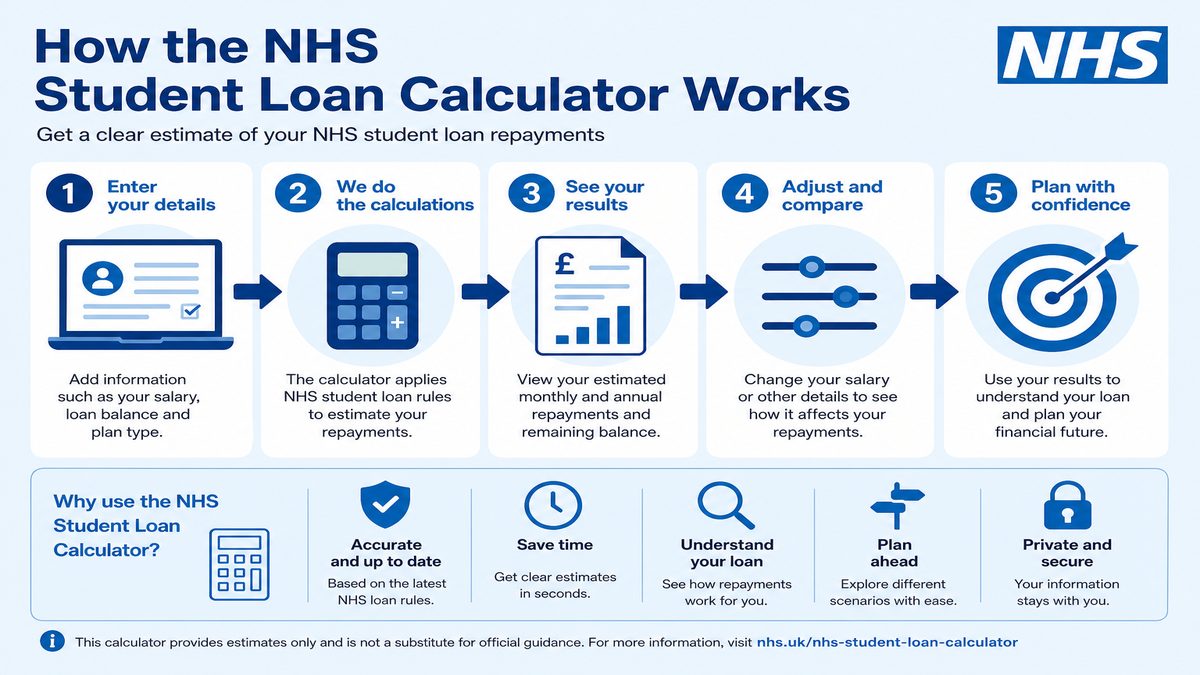
Enter your NHS pay band and step point or a custom gross salary. Select your undergraduate loan plan and whether you also have a Postgraduate Loan. Add any regular overtime or unsocial hours payments to see how these affect deductions.
The calculator applies official 2026/27 student loan thresholds directly to your total gross earnings. It then displays:
All calculations update instantly as you adjust inputs.
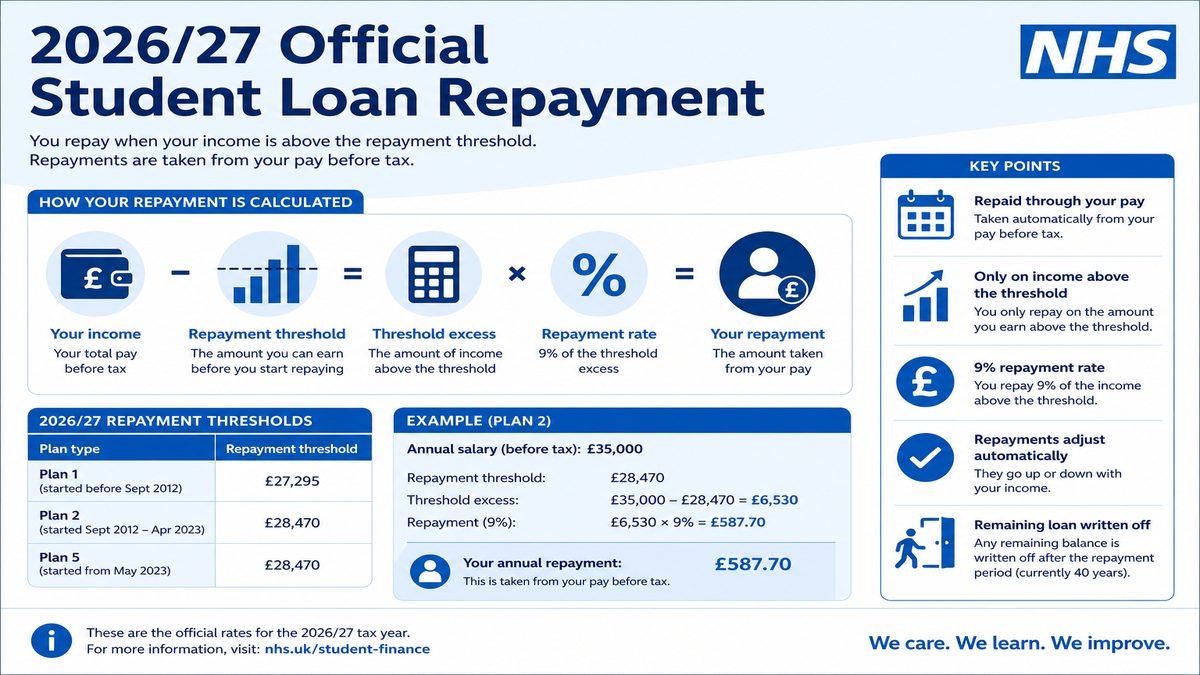
These thresholds apply from April 2026 to March 2027. You only repay on earnings above the relevant threshold.
Loan Plan | Annual Threshold | Monthly Threshold | Repayment Rate | Who It Applies To |
Plan 1 | £26,900 | £2,241 | 9% | England/Wales before Sept 2012; Northern Ireland |
Plan 2 | £29,385 | £2,448 | 9% | England/Wales Sept 2012 – July 2023 |
Plan 4 (Scotland) | £33,795 | £2,816 | 9% | Scottish students (any start date) |
Plan 5 | £25,000 | £2,083 | 9% | England, started Aug 2023 onwards |
Postgraduate Loan | £21,000 | £1,750 | 6% | Master's or Doctoral loans (England/Wales) |
Student loan repayments are calculated on your gross salary before pension contributions. This differs from income tax, where NHS pension contributions reduce your taxable pay.
Your plan depends on when and where you studied. Check your payslip (it lists the deduction type) or log into your Student Loans Company account.
You can be on more than one plan. An undergraduate loan (Plan 1–5) and a Postgraduate Loan are deducted simultaneously.
NHS trusts deduct student loans automatically through PAYE. No direct debit or manual payment is required.
The formula is simple:
(Gross earnings in the pay period − monthly threshold) × repayment rate
Gross earnings include:
NHS pension contributions do not reduce your student loan repayment. Pension contributions lower your income tax but the student loan calculation uses full gross pay. Salary sacrifice schemes (cycle to work, lease cars) reduce gross pay and therefore lower your student loan deduction.
Plan 2 only
Income above threshold: £39,043 − £29,385 = £9,658
Annual repayment: £9,658 × 9% = £869.22
Monthly repayment: £72.44
Plan 2 + Postgraduate Loan
Undergraduate (Plan 2): £72.44
Postgraduate (6% above £21,000): (£39,043 − £21,000) × 6% = £1,082.58 annual (£90.22 monthly)
Total monthly student loan deduction: £162.66
NHS Band & Step | Gross Annual | Plan 1 Monthly | Plan 2 Monthly | Plan 4 Monthly | Plan 5 Monthly | Plan 2 + PG Monthly |
Band 5 Step 1 (£32,073) | £32,073 | £38.80 | £20.16 | £0.00 | £53.05 | £110.38 |
Band 5 Step 3 (£39,043) | £39,043 | £91.29 | £72.44 | £39.43 | £105.39 | £162.66 |
Band 6 Step 2 (£42,170) | £42,170 | £115.15 | £96.30 | £63.29 | £129.25 | £186.52 |
Band 7 Step 1 (£49,387) | £49,387 | £180.78 | £161.93 | £128.92 | £194.88 | £252.15 |
Band 8a Step 1 (£57,528) | £57,528 | £230.75 | £211.90 | £178.89 | £244.85 | £302.12 |
All figures exclude overtime and unsocial hours. Add your regular additional payments in the calculator for precise results.
Student loan repayments increase whenever your gross pay rises in a pay period. Working nights, weekends, or extra bank shifts directly increases the deduction for that month.
Example: An additional £4,000 per year in unsocial hours on a Band 5 Plan 2 salary adds £30 per month to your student loan repayment.
NHS pension contributions are deducted from gross pay before tax and National Insurance. They do not affect student loan calculations.
A Band 7 employee paying 9.3% pension on £49,387 gross pays:
The pension saves tax but the full £49,387 is still used for the student loan calculation.
Salary sacrifice arrangements reduce your gross pay before student loan calculations. These schemes genuinely lower both your tax and student loan repayment.
Common NHS salary sacrifice options include:
During maternity leave your repayments adjust automatically:
Your loan balance is cancelled automatically at the end of the repayment term. You do not need to apply.
Interest continues to accrue until the loan is written off or fully repaid.
Voluntary overpayments only make financial sense if:
For most NHS staff on Plan 2 or Plan 5, the loan is written off before full repayment. In these cases, making extra payments simply increases the total you hand over without reducing the final balance owed at write-off.
Use the calculator to model your exact salary trajectory before deciding.
The calculator uses the same engine as our main NHS take-home pay tool to ensure consistency across all deductions.
Yes. All thresholds, repayment rates, Agenda for Change pay scales, tax allowances, and National Insurance rates reflect the official 2026/27 tax year.
Check the deduction description on your payslip or log into your Student Loans Company account. Plan 1, Plan 2, Plan 4, Plan 5, or Postgraduate Loan will be clearly indicated.
No. Student loan repayments are calculated on your full gross salary before pension deductions. Pension contributions only reduce your income tax.
Yes. All additional taxable earnings increase your gross pay and therefore increase your student loan deduction for that pay period.
Yes. Both are deducted simultaneously. The undergraduate plan uses 9% above its threshold. The Postgraduate Loan uses 6% above £21,000.
Repayments stop automatically when your pay falls below the monthly threshold. During unpaid maternity leave, no deductions are taken.
Yes. Plan 2 loans are written off after 30 years, Plan 5 after 40 years, and Plan 1 after 25 years (or age 65). Most NHS staff on lower-to-mid bands will not repay the full balance.
Student loan repayments are calculated on gross earnings. They are deducted alongside tax and National Insurance through PAYE.
Yes. If you overpaid because your income was below the threshold or due to an error, contact the Student Loans Company. Refunds are usually processed quickly.
On a Plan 2 loan, moving from £39,043 (Band 5 top) to £42,170 (Band 6) increases your monthly student loan deduction by approximately £23.86.
Yes. When you select a pay band and step, the gross salary already incorporates the standard London or fringe HCAS rates where applicable. You can override with a custom salary.
Student loan is deducted from each job separately based on that job’s gross pay. If your combined earnings exceed the threshold but each individual job is below it, you may need to make a payment via Self Assessment.
Only if you expect to repay the full amount before the write-off date. For most NHS staff the loan is written off, so voluntary payments increase the total amount you repay with no reduction in the final balance.
Yes. It uses Agenda for Change bands and works for any NHS employee paid on the standard pay scales.
Karen Beckett, ChFCIPP
Head of Payroll & Benefits at Dorset HealthCare University NHS Foundation Trust and NHS Pension Board Member. Chartered Fellow of the Chartered Institute of Payroll Professionals with over 40 years’ experience in NHS payroll, pensions and benefits.