 Take Home Pay
Take Home Pay
Take Home Pay
✅ Updated for 2026/27 Tax Year | ✅ Based on Official HMRC Flat Rate Figures | ✅ Free — No Sign-Up Required | ✅ Backdate Up to 4 Tax Years | ✅ Result in Seconds
If you work for the NHS and wash your own uniform at home, HMRC owes you money. 2If you bear the cost of cleaning your work uniform yourself, you may be eligible to claim HMRC flat rate expenses — also called the Uniform Tax Rebate. For most NHS roles, this is set at £125 per year, providing a tax saving of £25 at basic rate. This calculator shows you the exact figure — based on your NHS role, your tax rate, and the number of years you have not yet claimed — in under ten seconds. Enter your details above and see your result instantly.
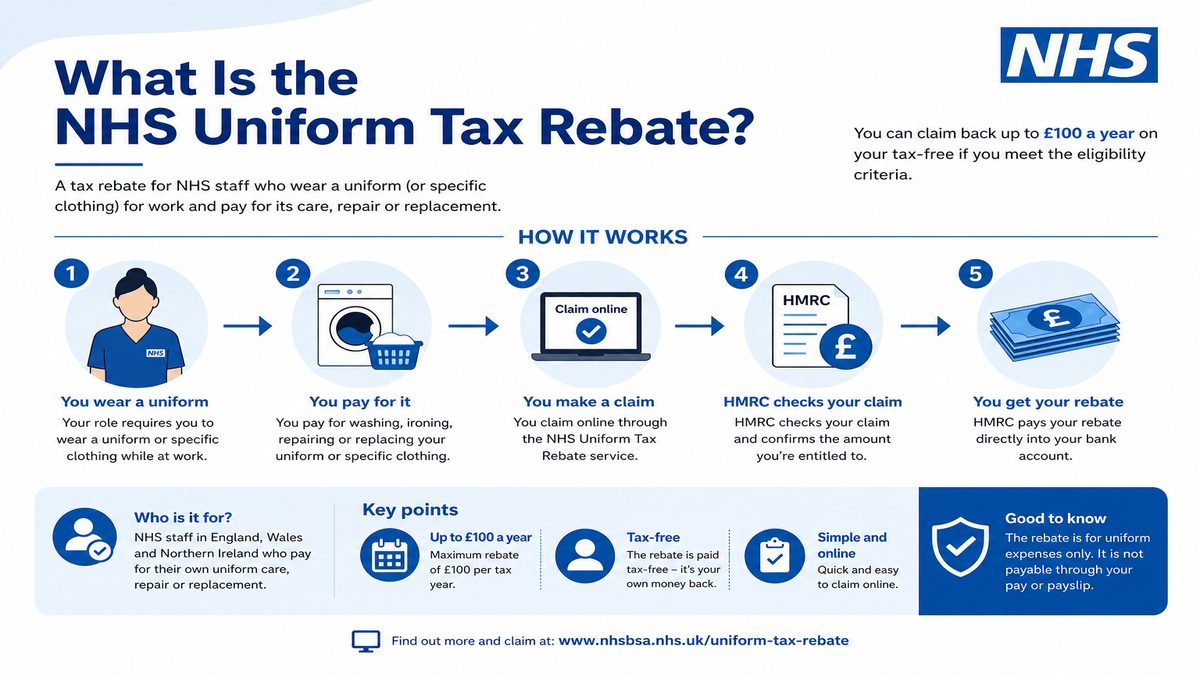
1 If you've been paying to wash, repair, or replace your work uniform, you could claim a tax refund through the HMRC uniform allowance. The uniform tax rebate is not a government grant or a separate payment system — it is a reduction in your taxable income that results in either a lump-sum refund for past years or an automatic reduction in your monthly PAYE tax deductions going forward. 6 HMRC flat rate expenses are fixed allowances that employees in specific occupations can deduct from their taxable income — no receipts required. They exist because certain jobs consistently require workers to spend money on uniforms, tools, or specialist clothing that employers do not fully reimburse.
For NHS staff, this means you do not need to count washing cycles, track detergent costs, or retain any proof of home laundry expenditure. HMRC pre-agrees the annual deduction for your occupational category and applies it the moment your claim is approved.
The flat rate expenses system operates under Section 367 ITEPA 2003 and is detailed in HMRC Employment Income Manual EIM32712.
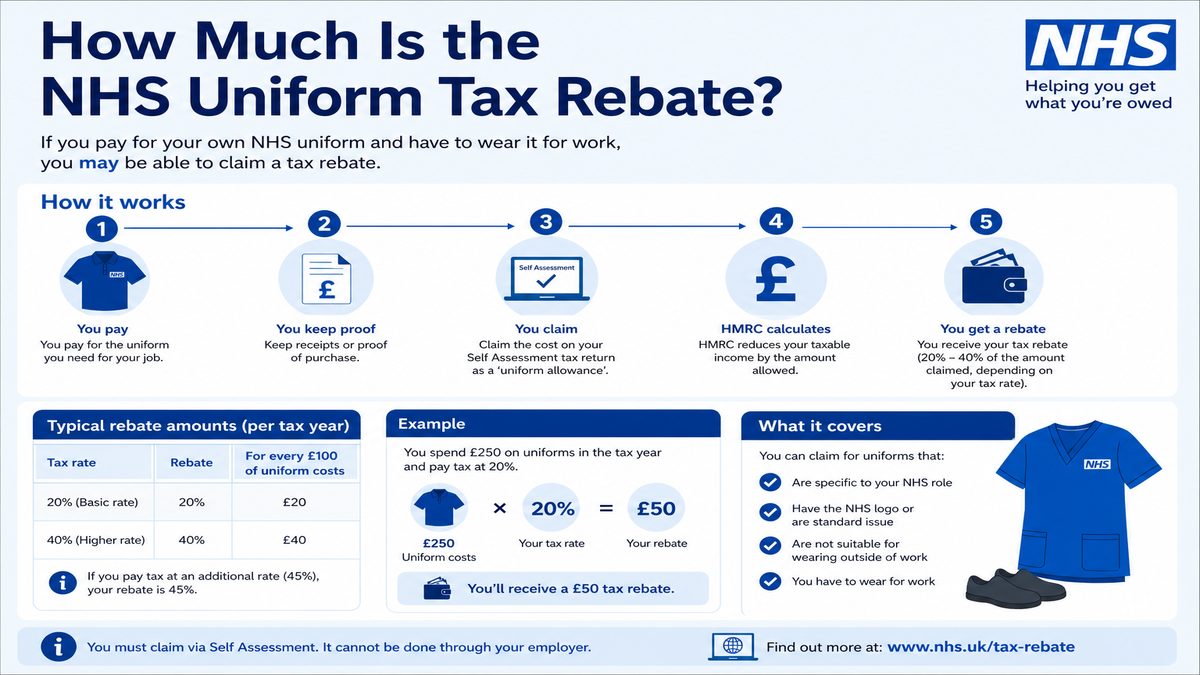
6 In 2026/27, the standard uniform maintenance allowance is £60 per year, but many trades receive significantly more. For NHS staff, the allowance is higher because HMRC recognises that clinical uniforms require frequent, intensive washing that exceeds everyday laundry costs. 5 The NHS uniform tax rebate is one of the most commonly claimed in the UK. The flat rate for nursing roles is £125 per year. Ambulance staff can claim £185 per year.
The cash you receive is calculated by multiplying the flat rate allowance by your income tax rate. 1The exact amount you receive depends on your tax rate. Basic-rate taxpayers get 20% of their industry's qualified deductions as a rebate, whilst higher-rate taxpayers get 40%.
NHS Flat Rate Allowance and Annual Rebate — 2026/27
NHS Role | HMRC Flat Rate | Basic Rate (20%) Rebate/Year | Higher Rate (40%) Rebate/Year |
Nurse / Midwife | £125 | £25.00 | £50.00 |
Healthcare Assistant | £125 | £25.00 | £50.00 |
Physiotherapist | £125 | £25.00 | £50.00 |
Ambulance Staff | £185 | £37.00 | £74.00 |
Other NHS (unlisted role) | £60 | £12.00 | £24.00 |
4 A healthcare worker with a £185 flat-rate allowance on basic rate receives £37 per year. If you backdate 4 years, that becomes £148.
A Band 5 nurse on basic rate who has never claimed receives £25 × 4 years = £100 as a lump sum, plus their tax code adjusted permanently to save £25 every single year going forward — for no further admin.
1 If you pay to wash, repair or replace a mandatory and recognisable work uniform without reimbursement from your employer, you can get a portion of your tax back. Not everyone is eligible; relief only applies to employees on PAYE.
All four conditions below must be true for your claim to succeed:
Condition 1 — You wear a recognisable NHS uniform Your clothing must identify you as an NHS worker. Scrubs with a trust logo, clinical tunics, healthcare tabards, and ambulance service uniforms all qualify. Ordinary clothes worn to work — even if required by your employer — do not count.
Condition 2 — Your employer requires you to wear it The uniform must be compulsory, not optional. A voluntary dress code does not qualify.
Condition 3 — You wash it yourself at your own expense You personally cover the cost of laundering. If your NHS trust provides free on-site laundry facilities and you use them, no claim is possible.
Condition 4 — You paid income tax in the years you are claiming for
7 Even if you meet the rules, you need to make sure you have paid enough tax to get tax relief. In tax years from 2021/22 to 2026/27, most people pay tax on their income over £12,570 (the personal allowance).
Who Cannot Claim:
1 Relief only applies to employees on PAYE. Personal protective equipment (PPE), regular clothing and self-employed expenses usually don't qualify.
If your employer reimburses your laundry costs — even partially — you can only claim the difference between your actual cost and the reimbursement, not the full flat rate. If you earn below the personal allowance of £12,570, you have no tax liability and therefore nothing to reclaim.
7 You have four years from the end of the tax year to make a claim; so, to claim tax relief for expenses which you incurred in tax year 2026/27, HMRC must receive your claim by 5 April 2031. 7 As we are currently in tax year 2026/27, you can make a claim for expenses in all years going back to tax year 2022/23.
Once a tax year falls outside the 4-year window, that refund is gone permanently. After 5 April 2027, you can no longer claim for 2021/22 — that year closes forever.
Backdating Window — Current as of 2026/27
Tax Year | Can You Still Claim? | Claim Deadline |
2022/23 | ✅ Yes | 5 April 2027 |
2023/24 | ✅ Yes | 5 April 2028 |
2024/25 | ✅ Yes | 5 April 2029 |
2025/26 | ✅ Yes | 5 April 2030 |
2026/27 (current year) | ✅ Yes (ongoing) | 5 April 2031 |
2021/22 | ❌ Expired | Window closed |
Every April, one claimable year disappears. If you have not yet claimed, submit before 5 April 2027 to protect your 2022/23 refund.
5 Each year is reviewed on its own. Submitting all years together can increase your total uniform tax rebate. Do not submit one year at a time — claim all four in a single submission to receive the maximum lump sum in the fastest timeframe.
Claiming your uniform tax rebate directly from HMRC is free. You do not need an accountant. You do not need a claims management company. 4Claiming directly from HMRC is free — no agent fees required.
Step 1 — Confirm you meet all four eligibility conditions listed above
If your trust provides and pays for laundry, stop here — no valid claim exists. If you wash your own uniform at your own cost, proceed.
Step 2 — Choose your claim method
7 You can either submit form P87 to HMRC by post or use HMRC's online iForm.
For flat rate uniform expenses specifically, the online route remains available. 8Taxpayers have to submit form P87 by post, together with the appropriate supporting evidence. The exception is for claims relating to uniforms, work clothing and tools ('flat rate expenses'). This means NHS uniform washing claims are among the most straightforward to submit — and can still be completed digitally.
Step 3 — Complete Form P87
10 The HMRC P87 form allows employees to claim tax relief on job-related expenses such as uniforms, mileage, travel, tools, and professional fees. 11 You can use a P87 form to claim tax relief if you're an employee of a business and the total value of expenses you're claiming for is less than £2,500 for the tax year.
You will need the following information before starting:
Step 4 — Submit your claim
Log into your Government Gateway account at gov.uk, navigate to "Claim tax relief for job expenses," select "Uniform, work clothing and tools," enter your NHS role, and submit. For postal claims, send your completed P87 to: HMRC, Pay As You Earn, BX9 1AS.
7 If using the postal form, you should try to save a copy of the submitted form. Make sure you send it in good time to reach HMRC by 5 April. You might wish to ask the Post Office for proof of postage and keep this in case HMRC say they haven't received your form.
Step 5 — Receive your refund
Backdated refunds are paid as a lump sum directly into your bank account. The ongoing allowance for the current and future tax years is applied to your tax code — your payslip will automatically show less tax deducted each month, with no further action required from you.
4 These allowances cover the cost of washing, repairing, and replacing your work clothing and equipment. You do not need to keep receipts when claiming the flat-rate amount — the figure is fixed for each occupation.
This is the defining advantage of the flat rate system over claiming actual costs. HMRC pre-authorises the annual deduction for your occupational category and accepts your claim on the basis of your job role alone. No laundry logs. No receipts. No detergent invoices. No calculation of water or electricity costs.
6 If your actual costs are higher than the flat rate, you can claim the actual amount instead — but you need documentation. HMRC may verify actual cost claims, so documentation is important.
For the overwhelming majority of NHS workers, the flat rate is both the simpler and the more advantageous option. The actual annual cost of home-washing clinical uniforms — when divided across weeks and calculated per cycle — rarely exceeds £125, making a receipted actual-expense claim both more complex and no more rewarding.
When HMRC approves your uniform tax relief, they modify your PAYE tax code. Your standard tax code for 2026/27 is 1257L if you receive the full personal allowance of £12,570.
Once your flat rate expense is applied, HMRC adds the allowance to your effective personal allowance within your tax code. For a nurse claiming £125 FRE, your adjusted allowance becomes £12,695 (£12,570 + £125). This means your employer deducts slightly less tax from every payslip — automatically, without any additional steps from you.
6 The relief is worth 20% of the flat rate if you are a basic-rate taxpayer. For a basic-rate nurse, that translates to £25 less tax paid per year — applied invisibly through payroll. For a higher-rate nurse, it is £50 per year.
Important: You must notify HMRC if your circumstances change. If you move to an employer outside a qualifying occupation, your trust begins providing laundry facilities, or you cease wearing a uniform, you must update HMRC. Failure to do so results in HMRC clawing back the relief through a future tax code adjustment.
6 Flat rate expenses are pre-agreed deductions set by HMRC for particular job types. Rather than requiring employees to itemise and prove every expense, HMRC publishes a fixed amount per occupation that reflects average costs.
These deductions reduce your taxable income. You pay less income tax as a result. The flat rate system exists because HMRC and trade unions or professional bodies negotiate a realistic average figure for each occupation, removing the administrative burden from both employees and HMRC of tracking real expenditure across millions of workers.
4 HMRC sets flat-rate expense allowances that range from £60 per year (retail, general occupations) up to £1,022 per year (airline pilots).
HMRC Flat Rate Allowances by Occupation — 2026/27 (Selected)
Occupation | Annual Flat Rate Allowance |
Nurses / Midwives / Healthcare Assistants | £125 |
Ambulance Staff | £185 |
Police Officers | £140 |
Mechanics / Motor Vehicle Technicians | £120 |
Firefighters | £80 |
Cabin Crew | £720 |
Airline Pilots | £1,022 |
Construction — Joiner / Carpenter | £140 |
General / Retail (unlisted roles) | £60 |
Source: HMRC EIM32712 / Section 367 ITEPA 2003
6 For most employees, the flat rate is simpler and the difference is small — but for employees with significant uniform, equipment, or tool costs, actual costs may be worthwhile.
Self-employed individuals are not eligible for the PAYE flat rate uniform rebate. 1Relief only applies to employees on PAYE.
If you work NHS bank shifts through an umbrella company that operates PAYE, you qualify in the same way as a substantive employee — provided the umbrella company deducts income tax through PAYE and you wash your own uniform. Confirm your payslip shows a PAYE tax code before submitting.
If you are genuinely self-employed and file a Self Assessment return (SA100), you can claim actual uniform and laundry costs as a business expense. Unlike the flat rate PAYE system, this requires you to retain records and have a reasonable basis for the figures you claim. Speak to a tax adviser or use HMRC's Self Assessment guidance at gov.uk.
The uniform flat rate expense is one of several tax reliefs available to NHS workers. Claiming all of them together on the same P87 form maximises your total refund.
Professional Registration Fees
If your professional body membership is required for your job and your employer does not pay it, you can claim the full annual cost. Examples for NHS staff include:
Professional Body | Annual Fee | Claimable? |
Nursing and Midwifery Council (NMC) | £125 | ✅ Yes |
General Medical Council (GMC) | £433 | ✅ Yes |
Health and Care Professions Council (HCPC) | £82.31 | ✅ Yes |
Royal College of Nursing (RCN) Membership | Actual fee paid | ✅ Yes |
NHS Mileage Relief
If you travel between NHS sites or to patients' homes in your own vehicle and your employer does not reimburse you at the full HMRC rate, you can claim the difference. The HMRC approved mileage rate is 45p per mile for the first 10,000 miles in a tax year.
Working From Home Relief — Important 2026 Update
13 From the tax year 6 April 2026 to 5 April 2027, you will not be able to claim tax relief for working from home. You can still claim for the 4 previous tax years. NHS clinical staff working on-site are unaffected by this change, but any NHS administrative staff who previously claimed home-working relief should note the abolition for 2026/27 onward.
The processing time depends on your submission method and HMRC's current workload.
Online claim (Government Gateway): Most straightforward flat rate uniform claims are processed within a few weeks of online submission. HMRC processes online submissions faster than postal forms, and bank transfers are issued after processing is complete.
Postal P87 claim: 3Paper P87 is still accepted but slower. Postal claims can take 8–12 weeks, particularly during the peak January–April filing period.
Phone claim: 13You can contact HMRC by phone if you've already claimed the same expense type in a previous year and your total expenses are £2,500 or less. This applies to renewals, not first-time claims.
Backdated refunds are paid as a single lump sum into your bank account. If HMRC does not hold your bank details, they issue a cheque to your registered address. Ongoing annual savings are applied through your PAYE tax code — your monthly payslip will reflect lower tax deductions automatically.
Martin Lewis of MoneySavingExpert has consistently identified the uniform tax rebate as one of the most frequently overlooked free-money claims available to UK workers. His core advice is direct: claim from HMRC yourself for free — never pay a third-party company a percentage fee to do something you can complete in under 15 minutes online.
5 Claims companies can simplify the process, but they take a cut. This is often 25% to 40% of your rebate. On a backdated 4-year NHS nurse claim worth £100, that means paying up to £40 for a service that costs you nothing to do directly through gov.uk.
The direct HMRC claim portal is: gov.uk/tax-relief-for-employees
There are no eligibility checks, no hidden fees, and no requirement to use a representative. HMRC processes claims submitted directly by employees the same way it processes those submitted by agents — at no cost to you.
Factor | Flat Rate Claim | Actual Expenses Claim |
Receipts required | No | Yes |
Calculation required | None — HMRC pre-sets the figure | You must calculate actual costs |
Amount claimable | £125 or £185 (NHS roles) | Whatever you genuinely spent |
Audit / scrutiny risk | Very low | Higher — HMRC may verify |
Admin time | Minimal | Significant |
When to use it | Almost always for NHS staff | Only if actual costs significantly exceed the flat rate |
6 If your actual costs are higher than the flat rate, you can claim the actual amount instead — but you need documentation. HMRC may verify actual cost claims, so documentation is important. For most employees, the flat rate is simpler and the difference is small.
In practice, the cost of home-laundering clinical scrubs or a nurse's tunic across a full year — calculated per wash cycle using average UK electricity, water, and detergent costs — falls well below £125 for most households. The flat rate is the correct choice for the vast majority of NHS workers.
Step 1 — Select your NHS role Choose your clinical role from the dropdown. The calculator automatically fills in the correct HMRC flat rate allowance for your occupation: £125 for nurses, midwives, physiotherapists, and healthcare assistants; £185 for ambulance staff; £60 for other NHS roles not listed with a higher rate.
Step 2 — Select your income tax rate Choose Basic Rate (20%) if your annual taxable income falls between £12,571 and £50,270. Choose Higher Rate (40%) if your income exceeds £50,270. Most Band 2–6 NHS staff pay basic rate. Band 7 and above may be higher-rate taxpayers depending on total income including unsocial hours payments and overtime.
Step 3 — Select the number of years to backdate Move the slider to 1, 2, 3, or 4 years. The calculator multiplies your annual saving by the years selected and produces your estimated lump-sum figure.
Step 4 — Answer the employer laundry question If your trust provides free laundry facilities and you use them, select Yes. The calculator will confirm that no valid claim exists in your circumstances. If you wash your own uniform at home, select No to proceed.
Step 5 — Read your result The output shows your annual tax saving, your estimated backdated lump sum, and your projected ongoing annual saving through your tax code. Use the result to decide whether to proceed with a free direct HMRC claim.
Result Field | What It Means |
Annual Flat Rate Allowance | The HMRC pre-agreed deduction for your occupation — this is not the cash refund, it is the reduction to your taxable income |
Annual Tax Saved | The actual cash you get back per year (flat rate × your tax rate percentage) |
Total Backdated Rebate | Your estimated lump-sum payment covering all unclaimed years, paid directly to your bank account |
Ongoing Annual Saving | The permanent annual reduction in your tax bill, applied through your PAYE code going forward |
Disclaimer: This calculator produces an estimate based on official HMRC flat rate expense allowances for 2026/27. Your actual refund may differ if you have already claimed in some years, hold a non-standard tax code, or have other employment expense claims active. Confirm your exact position through your HMRC Personal Tax Account at gov.uk.
The uniform tax rebate is an HMRC flat-rate allowance that covers the cost of laundering and maintaining a work uniform your employer requires you to wear. It reduces your taxable income and produces either a backdated lump-sum refund or an ongoing reduction to your PAYE tax code. 7If you make a valid claim for tax relief, you will not receive the full amount of the expense back from HMRC — you will only receive tax relief on the expense, which is calculated based on the rate of tax that you pay.
2 If you bear the cost of cleaning your work uniform yourself, you may be eligible to claim HMRC flat rate expenses. For most NHS roles, this is set at £125 per year, providing a tax saving of £25 at basic rate. Ambulance staff receive a flat rate of £185 per year, equating to £37 at basic rate or £74 at higher rate. 7 If you want to claim the standard allowance of £60 per year for washing your uniform at home and you pay tax at a rate of 20%, you will receive tax relief of £12.
The amount you can claim depends on your occupation and your tax rate. 4HMRC sets flat-rate expense allowances that range from £60 per year (retail, general occupations) up to £1,022 per year (airline pilots). As a basic rate (20%) taxpayer, you receive 20% of the flat-rate allowance. A higher rate (40%) taxpayer receives 40%. For NHS nurses, the flat rate is £125: that gives £25 at basic rate or £50 at higher rate per year.
No. If your employer provides and pays for laundry, you have no personal cost to claim. The relief covers only costs you bear yourself. If your trust offers laundry facilities but you choose not to use them and wash your own uniform at home instead, seek personal tax advice — your eligibility in this specific scenario depends on whether HMRC considers the employer provision adequate.
4 You do not need to keep receipts when claiming the flat-rate amount — the figure is fixed for each occupation. This is the primary advantage of the flat rate over actual-cost claims. HMRC accepts your occupational role as the sole basis for the deduction.
10 The HMRC P87 form allows employees to claim tax relief on job-related expenses such as uniforms, mileage, travel, tools, and professional fees. 11 You can use a P87 form to claim tax relief if you're an employee of a business and the total value of expenses you're claiming for is less than £2,500 for the tax year. For flat rate uniform claims, you can submit this online through your Government Gateway account.
The uniform tax code is your modified PAYE code after HMRC applies your flat rate expense relief. The standard 2026/27 code for a full personal allowance is 1257L. Once your £125 nurse's allowance is added, your effective allowance becomes £12,695, and your employer automatically deducts less tax from every payslip — with no further admin from you. 6If you wear a uniform or use tools for work and have not claimed these expenses before, you may be owed a tax refund for up to 4 prior tax years.
Yes. 5Being part-time does not affect your eligibility. The flat rate is not reduced for part-time hours. You get the full annual allowance if you wore the uniform during that tax year.
5 If you wear a qualifying uniform in more than one job, you can claim the flat rate for each role. List each employer and role separately when you apply. The reliefs are added together.
5 Agency workers can claim if they wear a qualifying uniform and pay for its upkeep. You must be employed through PAYE and receive a payslip with tax deducted. Zero-hours workers on PAYE are also eligible.
These terms describe different parts of the same process. The uniform allowance (or HMRC flat rate expense) is the pre-agreed deduction amount — £125 for nurses. The uniform tax rebate is the cash outcome of applying your tax rate to that allowance — £25 at basic rate. The allowance is the input; the rebate is the output.
HMRC's Income Tax Helpline is 0300 200 3300. For faster resolution, log into your HMRC Personal Tax Account at gov.uk/personal-tax-account — you can track existing claims, update bank details, and see your current tax code without waiting on hold.
Online flat rate uniform claims are typically processed faster than general P87 claims. 3HMRC is encouraging digital submission. Paper P87 is still accepted but slower. Expect online results within a few weeks and postal results within 8–12 weeks, with delays during peak tax season (January–April). Refunds are paid directly to your bank account or by cheque if HMRC holds no bank details for you.
No. 6If you have never claimed and have worked in a qualifying occupation for multiple years, the total refund can be significant. Once approved and active, your tax code adjustment is applied automatically each tax year by HMRC. You only need to act again if your employment circumstances change — new employer, new role, or your trust begins providing laundry.
Yes — this is exactly what the flat rate covers. The HMRC uniform washing allowance is specifically designed to compensate for the cost of home laundering. 1If you've been paying to wash, repair or replace your work uniform, you could claim a tax refund through the HMRC uniform allowance. No evidence of home laundry activity is required for flat rate claims.
6 Flat rate expenses are pre-agreed deductions set by HMRC for particular job types. Rather than requiring employees to itemise and prove every expense, HMRC publishes a fixed amount per occupation that reflects average costs. The term "flat rate job expenses" and "fixed deductions for expenses" are used interchangeably and refer to the same system.
The HMRC laundry allowance for nurses is £125 per year — the same figure as the flat rate expense for uniforms. This covers the annual cost of washing your clinical uniform at home. The tax saving this produces is £25 per year at basic rate (20%) or £50 per year at higher rate (40%).
Yes. The HMRC flat rate expense rules operate identically across all four UK nations. NHS nurses in Northern Ireland claim the same £125 annual allowance, ambulance staff claim £185, and the 4-year backdating window applies equally. There are no regional variations in the rate or the claim process.
5 If your uniform tax rebate claim is rejected, HMRC will send a letter explaining the reason. Read it carefully before you act. You can challenge the decision. 5 Most rejections happen due to missing or unclear details. They are common and usually easy to fix once you provide the right information. Common rejection causes include: incorrect PAYE reference, employer listed as providing laundry, incorrect tax year selected, or a duplicate of an already active tax code adjustment. Resubmit with corrected information or contact HMRC on 0300 200 3300.
Martin Lewis recommends claiming directly from HMRC for free using the online Government Gateway. 5Claims companies can simplify the process, but they take a cut. This is often 25% to 40% of your rebate. On a £100 lump-sum NHS nurse refund, a 30% agent fee costs you £30 for a task you can complete at gov.uk in under 15 minutes at no cost.
The flat rate expense for nurses and healthcare workers in 2023/24 was £125 per year — the same rate that applies in 2026/27. 3In 2026/27, you can claim back to 2022/23 (year ended 5 April 2023). 2022/23 deadline: 5 April 2027. If you worked as an NHS nurse in 2023/24 and have not yet claimed, that year is still within the backdating window.
Yes. You can claim multiple employment expenses on the same P87 form. A nurse who pays NMC registration (£125) and has never claimed the £125 uniform flat rate can combine both claims on one submission — worth £50 per year at basic rate, or £200 in a backdated 4-year claim, before any professional fee relief is added on top.
NHS Take Home Pay Calculator → Calculate your exact net NHS salary after income tax, National Insurance, and pension contributions — for all Agenda for Change bands 2 through 9 across England, Scotland, Wales, and Northern Ireland.
NHS Pension Calculator → See exactly how your 2015 CARE scheme pension contributions affect your monthly take-home pay across every AfC band.
NHS Pay Bands 2026/27 → Full Agenda for Change salary tables updated for the 2026/27 pay award — including all points, spine values, and unsocial hours uplifts.
This NHS Uniform Tax Rebate Calculator is built entirely on verified figures from official UK government and NHS publications. Every rate, threshold, and rule displayed has a traceable source.
Primary sources used:
All calculator figures are independently verified and updated for each new tax year at the 6 April changeover date.
You do not need an accountant. You do not need a claims management company. 4Claiming directly from HMRC is free — no agent fees required. If you are an NHS worker who washes your own uniform and has not yet claimed, you have unclaimed money waiting. The 2022/23 deadline closes permanently on 5 April 2027.